
A waterproof cable assembly that passes IP67 in the lab and dies eighteen months later on a roof is usually not a defective part. It is a correctly tested part that was asked the wrong question. The IP code is a thirty-minute test on a clean, dry, room-temperature sample that never sees the sun, never gets cold enough to suck water in, and never has to survive its own conductor acting as a drinking straw. Every one of those mechanisms is real, every one of them is absent from the test, and together they account for most of the outdoor failures that get blamed on “a bad seal”.
This guide is written for the person who has to make the next one survive. It assumes you already know which rating you want — if you are still deciding between the codes themselves, start with our separate breakdown of IP67 vs IP68 vs IP69K and come back. What follows is the part that sits outside the rating: the four seals that actually hold the water back in a waterproof cable assembly, the pressure that builds up inside a connector every single night, the reason a stranded conductor wets a junction box three metres away, and the ten lines to put on a drawing so a supplier can build it and an inspector can check it.
Reading time: about 14 minutes. All figures are indicative engineering values calculated from published physical constants; confirm against your project’s applicable standards and the manufacturer’s data sheet before you specify.
1. What an IP Rating Actually Certifies
The second digit of the IP code describes a water test, and nothing else. Three tests matter for outdoor work, and each has a precise definition that is worth reading once.
| Code | What the test actually is | Standard |
|---|---|---|
| IPX7 | 30 minutes’ immersion in clean water. For an enclosure under 850 mm tall, the lowest point sits 1000 mm below the surface; for a taller one, the highest point sits 150 mm below. Water temperature within 5 K of the sample. | IEC 60529 §14.2.7 |
| IPX8 | Continuous immersion under conditions “agreed between manufacturer and user”, with the only hard requirement being that they must be more severe than 14.2.7. | IEC 60529 §14.2.8 |
| IPX9 / IP69K | High-pressure, high-temperature jetting: water at 80 ±5 °C, 14–16 L/min, 8000–10000 kPa (80–100 bar), nozzle 100–150 mm away, 30 s at each of 0°, 30°, 60° and 90°, turntable at 5 ±1 r/min. Defined by ISO 20653, not IEC 60529. | ISO 20653:2023 |
“IP68” with no depth and no duration next to it is a label, not a specification. IEC 60529 requires the conditions to be agreed, so a supplier is free to certify at 1.5 m for 30 minutes and print “IP68” on a part that will sit two metres down for a decade. Ask for the number. Symmetrically, a part marked for the ninth digit alone does not have to meet the seventh or eighth — hot jetting at 80 bar is not the same physical challenge as an hour under a metre of still water, and a washdown-rated connector can leak under immersion.
The scope clause of IEC 60529 is equally important for outdoor work: the code explicitly does not address solar radiation, icing, condensation or corrosion. Beyond the scope statement, the test method itself has no capillary step, no thermal cycling, no flexing while submerged, and no chemical exposure. A cable can carry an IP67 mark and still be beaten by any one of the following.
IP67, IP68 or IP69K: Which One Belongs on the Drawing?
The three codes come from two different standards, and the difference decides what you can claim on a waterproof cable assembly. IP67 and IP68 are immersion tests governed by IEC 60529; IP69K is a separate high-pressure hot-jet test governed by ISO 20653:2023 and is the one to specify for food, beverage and industrial washdown. A washdown-rated connector can still leak under simple immersion, and an immersion-rated one can still fail an 80-bar jet — the codes are not a ladder you climb. For the full side-by-side with every digit explained, our IP67 vs IP68 vs IP69K breakdown works through the lot. What matters here is that the number on your drawing is backed by a condition, not by a letter on a label.
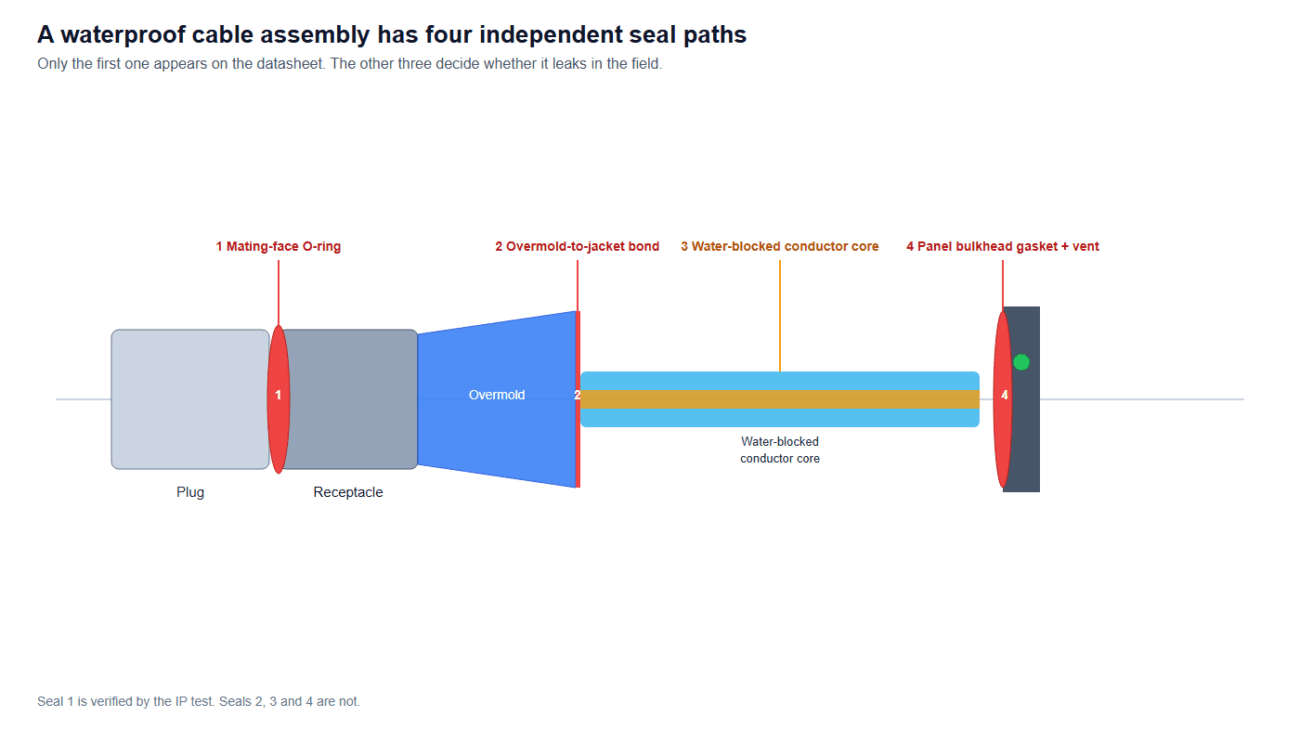
2. The Four Seals in Every Waterproof Cable Assembly
Water does not have to defeat the connector face. There are four independent paths into a terminated assembly, and the assembly is only as good as the weakest one. Only the first appears on a datasheet.
| Seal | What it has to hold | How it fails outdoors | What to write on the drawing |
|---|---|---|---|
| 1. Mating face (O-ring, gasket, interface seal) | Water pressure at the joint between plug and receptacle — and only while mated | Compression set in the O-ring after years of heat; swell or shrinkage from oils and detergents; a coupling nut backed off a quarter turn by vibration; a cracked thread on a stainless nut | Rating in the mated condition, the standard, the O-ring compound, and the coupling torque in N·m |
| 2. Cable-to-connector bond (overmold or gland) | Water travelling along the outside of the jacket and into the back of the connector | Overmold resin that never bonded to the jacket compound; shrink voids; a pull on the cable that opens a channel at the strain relief | Resin matched to the jacket, plus a pull test value and a flex test at the strain relief. See how to specify an overmolded cable assembly |
| 3. Conductor core (the wicking path) | Water travelling inside the cable, between the strands | Capillary action pulling water metres along a stranded conductor, delivering it straight to the back of a sealed connector | Water-blocked or filled construction, tinned strands, sealed single-end terminations — and how the supplier verifies it |
| 4. Panel / enclosure interface (bulkhead, gasket, threads) | Water at the hole the connector passes through | Uneven or painted panel face, a missing gasket, a thread with no sealant, and an enclosure that “breathes” and pulls water past all of it | Panel flatness and finish, gasket material and compression, mounting torque, plus a drain or a pressure-equalising vent. See how to select a panel mount connector |
The practical consequence: buying a connector with a better IP rating improves exactly one of the four paths in a waterproof cable assembly. In the field, seal 3 and seal 4 fail more often than seal 1, and neither is covered by the rating you bought.
Mated is the condition the rating assumes
There is one condition to nail down, and it usually is not. Nearly every water-ingress number you will be quoted is measured on a mated assembly — that is how the immersion tests are defined, and IEC 60529 leaves the test arrangement to the manufacturer’s declaration. Unplug it, and three of the four things doing the sealing stop doing anything. There is no interfacial compression, because nothing is pressing the inserts together. The peripheral seal is not loaded, because the shells are no longer bottomed against each other. And the cavity that the plug clipped shut is open at the front. A mated joint and an unmated receptacle on the same enclosure are not two states of the same product.
Outdoor equipment is full of ports that spend most of their life empty: spares, commissioning connectors, service loops, bays that get populated in year three. IP67 RJ45 panel couplers and IP67 keystone panel frames are the usual answer when a wall opening has to hold either way. If a port will ever sit open to weather, say what happens then: a protective cap, with a note that fitting it is not optional; a receptacle with internal sealing behind the face so the insert holds water with nothing plugged in; or a termination that is potted to a specification and leak-tested, rather than the standard back-potting whose job is to keep wash fluid out of the shell.
Five details that defeat an otherwise good seal
Most of the failure reports we see are not arguments about ratings. They are five small things that nobody wrote down, and all five are cheap to get right.
- Unused cavities. A contact position with no wire in it is still a hole through the same grommet that is sealing every other wire. Every unpopulated position gets a sealing plug. It costs cents, it is skipped constantly, and it is one of the most common single causes of a “failed” connector whose seals were fine.
- Wire size versus seal size. A rear grommet seals by being squeezed around each wire, so a wire thinner than the contact is rated for never gets squeezed enough — and neither does a twisted pair trying to fill a round hole. Build the wire up with a sleeve to reach the correct diameter, or back-pot instead of assuming the grommet is doing something.
- Where the receptacle sits. A receptacle mounted flush leaves a shallow cup with the open side facing up, and cups fill. Given the choice, let it stand slightly proud of the surface, or specify a weld-mount version, so water sheds instead of collecting. This is a geometry decision made in CAD and it is very hard to fix once the panel is cut.
- Dissimilar metals. A stainless coupling nut threaded into an aluminium enclosure, with salt mist or de-icing salt in the environment, is a galvanic cell. The corrosion it produces attacks precisely the joint you were relying on, opening a leak path that did not exist on day one. Match the plating to the panel or isolate the two.
- What the assembler used. O-rings get lubricated before mating and inspected for nicks during it. Jackets get cleaned and abraded before a heat-shrink boot goes on, because most leaks blamed on the boot are really bond failures. And the heat does not stop when the boot has finished shrinking: keep going for roughly another 90 to 150 seconds, depending on boot size, because the adhesive only flows once the shape has settled. Finish with an inspection under axial load.
3. How Waterproofing Is Actually Built
Every one of the four seals above is produced by a process, and the process — not the rating printed on the box afterwards — is what you are actually buying. Six methods cover almost every outdoor waterproof cable assembly, and a single part usually combines two or three of them.
| Method | How the seal is formed | Which seal it serves | What to ask for |
|---|---|---|---|
| Interface seal (O-ring or gasket) | An elastomer is squeezed between two rigid faces. The squeeze comes from the groove depth, not from how hard the coupling is tightened | Seals 1 and 4 | Groove dimensions and compound hardness on the drawing, and the compound named: NBR for oils and fuels, EPDM for weather and water, FKM for heat and chemicals, silicone where the temperature range is extreme. Ask for compression set at your maximum continuous temperature |
| Torqued screw coupling | The thread converts a specified torque into a controlled compressive load on the interface seal, and holds it through vibration | Seal 1, and the retention of the whole joint | The value in N·m, on the drawing and in the installation instruction. An O-ring with no specified clamp load is a guess |
| Overmolding / insert molding | The connector back end, the strain relief and a length of jacket are encapsulated in one shot. The seal is the bond between the molded resin and the cable jacket — not the resin by itself | Seal 2 | Resin matched to the jacket compound, plus evidence of the bond: a pull-test value and a sectioned first article. Where the compounds are not naturally compatible, ask what surface preparation is used. See overmolding injection and how to specify an overmolded cable assembly |
| Potting / encapsulation | A liquid resin displaces the air completely and cures in place — which removes the cavity behind the connector and, with it, the pumping mechanism in section 4 | Seals 2 and 3, on joints that will never be opened | Name the grade. Ordinary back-potting exists to stop wash fluid running up the contacts and is not an IP67 seal in its own right. Ask for the resin family (epoxy, polyurethane or silicone), vacuum degassing, a stated cure schedule, and a sectioned sample showing no voids around the conductor bundle |
| Adhesive-lined heat shrink | The inner wall melts and flows into the gaps as the tube recovers, wetting both the jacket and the connector body | Seal 2, on field terminations, repairs and transitions between jacket diameters | Recovery ratio, adhesive type and the shrink schedule. This is the most operator-dependent method here, so write a visual acceptance criterion |
| Water-blocked core | Filler yarns, swelling tape or powder close the gaps between strands so capillary action has no continuous path | Seal 3 | The construction (yarn, tape or compound) and how it is verified — see section 5 for why this one cannot be assumed |
The two steps where it usually goes wrong
The resin-to-jacket bond. Overmolding fails far more often through adhesion than through the resin itself. A resin that bonds well to PVC can sit on PUR as a skin that peels away in the first winter, and a compound moulded at the wrong melt temperature shrinks off the jacket as it cools. That makes it a tooling and process question as much as a materials one, which is why the mold belongs in the conversation early — see mold making and tooling. The checks are cheap: a pull test to a stated value, and a sectioned first article that somebody actually looks at.
Voids in the potting. Potting only removes the air cavity if it fills it. Entrapped air, incomplete wetting of the strand bundle and shrinkage during cure all leave channels that behave exactly like the leak path they were meant to close. Vacuum degassing, a stated cure schedule and one sectioned sample per build catch nearly all of it.
How it is verified
Two checks cover most of it. In production, a pressure-decay or mass-flow leak test on every part — the limit is a number you write down, because no standard sets one for cordsets (section 7). At qualification, a sectioned first article: cut the termination in half and look at the bond line, the O-ring groove and the fill around the conductor. That one photograph tells you more than any certificate.
None of these methods appears in an IP rating. The rating gives you the result on a new sample on the day of the test. It does not tell you how the seal was made, or whether the bond will still be there in year five. Buying on the rating alone means buying the last thing that was measured rather than the first thing that will fail.
4. Thermal Pumping: The Pressure Nobody Puts on the Drawing
Here is the mechanism that produces the classic “it was fine for a year, then the connector filled with water” failure. Any sealed cavity contains air. When the temperature falls, that air contracts; if there is any leak path at all, the resulting pressure difference draws water in. When the temperature rises again, the air expands — but the water that arrived at the low point does not leave. Night after night, the cavity fills. It is also the easiest failure to design out of a waterproof cable assembly, because it only exists where air is trapped.
The volume drawn in during one cooling cycle follows directly from the ideal gas law, in the form everyone can use:
where Vair is the free air volume in the cavity, ΔT is the temperature drop in kelvin, and Thot is the hot absolute temperature in kelvin. Measured in pressure instead of volume, the same ratio applied to atmospheric pressure gives the driving force that pushes water through any imperfection.
| Temperature swing | Driving pressure | Equivalent water head | Cavity volume drawn per cycle |
|---|---|---|---|
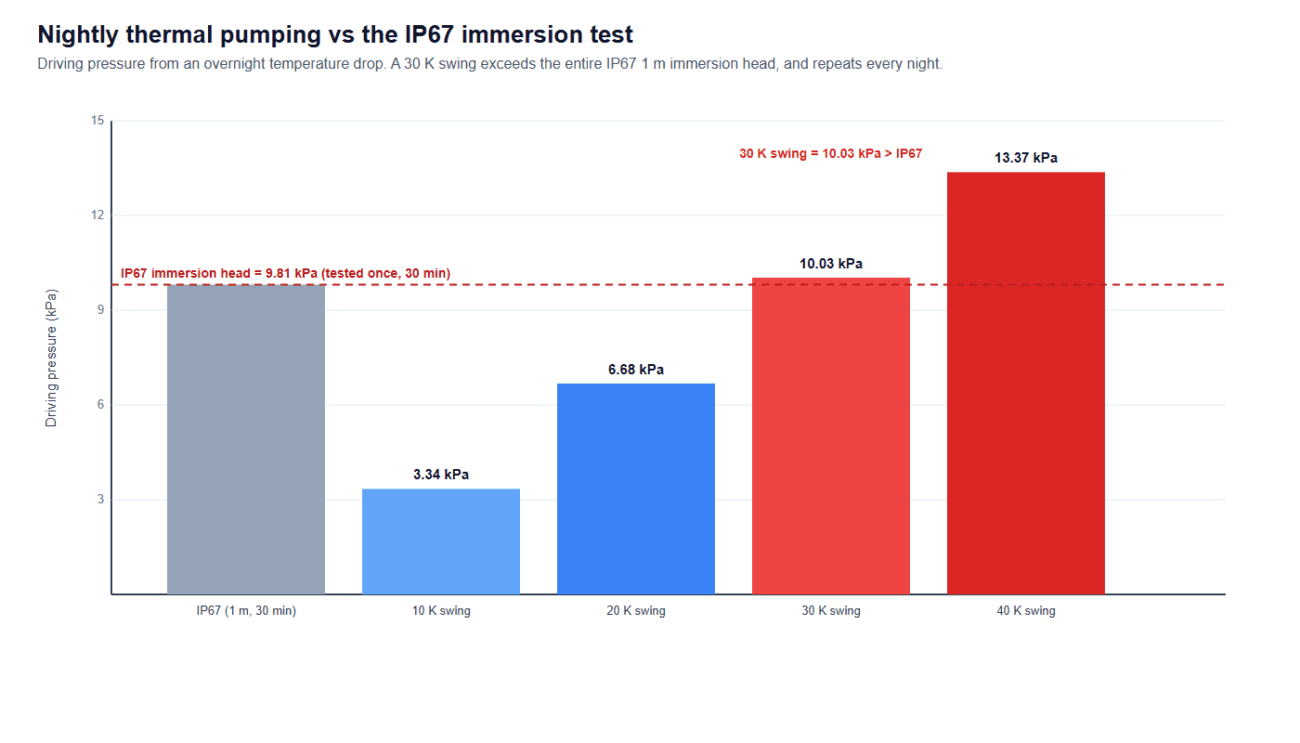
| 30 °C → 20 °C (ΔT = 10 K) | 3.34 kPa | 0.34 m | 3.3 % |
| 30 °C → 10 °C (ΔT = 20 K) | 6.68 kPa | 0.68 m | 6.6 % |
| 30 °C → 0 °C (ΔT = 30 K) | 10.03 kPa | 1.02 m | 9.9 % |
| 30 °C → −10 °C (ΔT = 40 K) | 13.37 kPa | 1.36 m | 13.2 % |
Read the third row again. A clear desert night — 30 °C in the afternoon, freezing before dawn — puts the same pressure across your seal as the IP67 test does with a full metre of water above it. The difference is that IP67 runs once for thirty minutes, and the desert runs it on roughly two hundred nights a year.
Put a number on the cavity. A mated M12 cordset plus the voids behind the overmold holds on the order of 2–5 cm³ of free air; take 3 cm³ as a worked example. At a 30 K swing, the first night draws in 0.30 cm³. Because the air pocket shrinks each time water arrives, the rate decays — but nothing drains it, so the cavity marches towards full:
| Nights | Water accumulated (3 cm³ cavity) | Cavity full |
|---|---|---|
| 1 | 0.30 cm³ | 10 % |
| 5 | 1.22 cm³ | 41 % |
| 10 | 1.94 cm³ | 65 % |
| 20 | 2.63 cm³ | 88 % |
| 30 | 2.87 cm³ | 96 % |
Three weeks of autumn nights is enough to fill most of a connector body, on a part that passes IP67 on the day it is made. Two caveats keep this honest: the draw only happens if a leak path exists (a perfectly sealed part simply goes into vacuum, which is its own problem for the O-ring), and the numbers above are a worst case in which every drop stays. Field behaviour is messier. The conclusion is not the millimetre count — it is that the driving force exists, it is large, and it points inward every single night.
The condensation myth
“It’s just condensation” is the standard explanation, and it does not survive a sanity check. Take the same 3 cm³ cavity, filled with air at 35 °C and 80 % relative humidity, cooled to 15 °C. Saturated vapour density falls from about 39.5 g/m³ to 12.8 g/m³, so the air can release roughly 18.9 g/m³ — which in 3 cm³ is about 0.06 mg of water. One thermal-pumping cycle delivers about 300 mg. The ratio is on the order of 1:5000. Condensation from the air inside a connector is a rounding error; the water is being pumped in from outside.
Four fixes, in order of effectiveness
- Remove the air. A fully potted or encapsulated waterproof cable assembly has no cavity, so there is nothing to pump. This is the most robust answer and the one most often skipped for cost — but only if the cavity really goes. Ordinary back-potting is not specified to fill it completely or to be void-free, so write “fully encapsulated, no residual cavity” and ask for the sectioned sample that shows it.
- Equalise the pressure. An ePTFE vent lets the cavity breathe to atmosphere so no differential ever builds, while holding the water out. Specify it properly: airflow at a stated differential (typically quoted in ml/min/cm² at 70 mbar) and the IP rating it retains. Typical vent product data, for scale, runs from a few hundred to several thousand ml/min/cm² at 70 mbar with IP68 retained at 2 m for 1 h (manufacturer data).
- Give the water somewhere to go. A drain path at the low point, a drip loop below every connector, and an orientation that puts the leak path above the water line instead of below it.
- Slow it down. Sealed single-end construction and a low-permeability jacket reduce how fast vapour gets in. This buys time; it does not remove the mechanism.
This is not speculation. A five-year field study run in Munich from 2002 to 2007 instrumented sealed enclosures with and without pressure-equalising vents; the unvented units developed large internal pressure differentials, failed their seals first, and showed heavy internal condensation, while vented units stayed close to ambient (study summary).
5. Capillary Wicking: The Conductor Is a Pipe
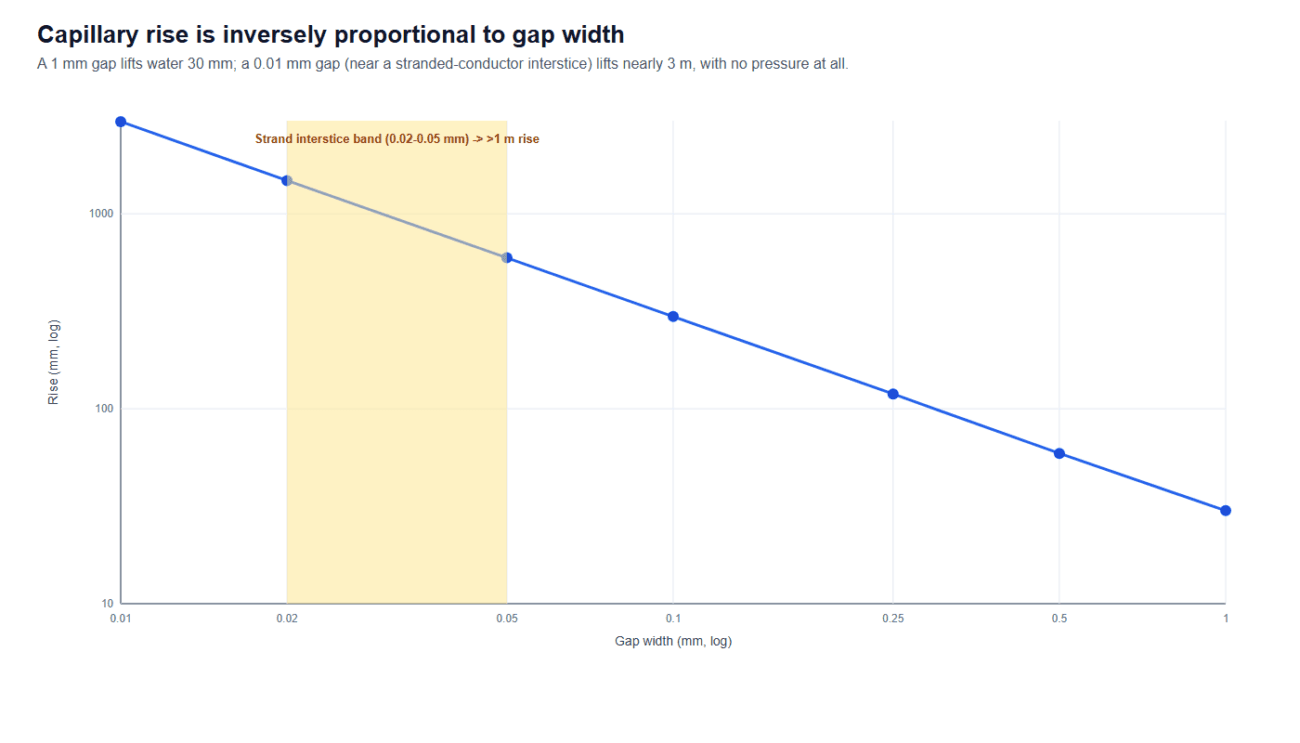
A stranded conductor is a bundle of capillaries, and capillary rise scales inversely with the gap. For clean water at 20 °C against a wettable surface:
| Gap | Capillary rise |
|---|---|
| 1.00 mm | 30 mm |
| 0.50 mm | 59 mm |
| 0.25 mm | 119 mm |
| 0.10 mm | 297 mm |
| 0.05 mm | 594 mm |
| 0.02 mm | 1.48 m |
| 0.01 mm | 2.97 m |
The interstices between the strands of a flexible conductor are on the order of tens of microns, which puts you in the bottom two rows: water can climb a metre or more along the inside of a cable with no pressure at all. Cut one end of a 2 m cable and stand it in a puddle, and the sealed connector at the far end is being watered from the inside. Nothing in the IP code tests this, because the IP test immerses the whole waterproof cable assembly at once — there is no head difference between the two ends.
Optical cable has a codified answer: IEC 60794-1-2 Method F5B puts a 1 m head of water on a sample of up to 3 m for 24 h at (20 ±5) °C and requires no detectable water at the unsealed end. Copper cordsets have no equivalent test that is widely cited, which means longitudinal water blocking is a design choice you have to write down rather than a property you can assume. Ask for one of the following, and ask how it was verified: water-blocking yarn, tape or compound in the core; a filled (bedded) conductor; solid conductor for short fixed runs; or a sealed, potted termination at each end. Tinned strands are cheap insurance against corrosion once the blocking has done its job.
6. Sun, Salt and Freeze: The Outdoor Half of “Outdoor”
An IP rating says nothing about what five years of weather does to the materials doing the sealing. Each mechanism below has a standard and a number; none of them is the IP code.
| Mechanism | Test | What to specify |
|---|---|---|
| UV and sunlight | IEC 60068-2-5 (method Sa; about 1120 W/m², typically 8 h light / 16 h dark) or ISO 4892-2 xenon-arc exposure | Exposure hours and the retained property. Under UL 44 the usual criterion is 720 h with at least 80 % of tensile strength and elongation retained. The familiar “2 % carbon black” exemption is narrower than people think: it applies to specific compound families and carries conditions on particle size and how deep the carbon black is measured — read the clause before relying on it. More on compounds in halogen-free, oil-resistant and UV-stable jackets and PVC vs PUR vs TPE |
| Salt mist | IEC 60068-2-11 test Ka: (5 ±1) % NaCl at 35 ±2 °C, deposition 1.0–2.0 mL per 80 cm² per hour | The standard and the duration — Ka defines the atmosphere, not the hours; 96, 240, 480 and 720 h are all common. “Salt spray tested” without both numbers is not checkable. Also specify the plating: this is where stainless coupling nuts earn their cost |
| Damp heat cycling | IEC 60068-2-30 test Db (24 h cycles at 40 °C or 55 °C at high humidity) | Cycle count and variant. This is the test that finds a bond between overmold and jacket that starts strong and lets go in humidity |
| Temperature change | IEC 60068-2-14 tests Na / Nb / Nc | Rate and cycle count. Fast changes are what drive the pumping in section 4; pair this test with an immersion check afterwards |
| Hydrolysis | No single standard; usually assessed as retention of mechanical properties after damp-heat ageing | For hot, wet climates, polyester-based PUR is the grade most prone to hydrolysis; polyether-based or hydrolysis-stabilised grades are the usual answer. Say which one you are buying |
| Freeze–thaw | Iced conditions are explicitly outside IEC 60529 | Water that has already got in expands on freezing and opens the channel further, so freeze–thaw is an accelerant rather than a root cause. Design the drain and the cavity out |
| Cable gland | EN 62444 (which replaced EN 50262) | Ask for the EN 62444 mark, not “an IP68 gland”. The standard covers cable retention (a defined pull held for 5 min with displacement no more than 3 mm), clamping under pull and torque, impact, sealing to IEC 60529, salt mist and UV — the whole list, not just the water |
7. Test It in Sequence, Not One Factor at a Time
Every IP certificate you have ever been shown was measured on a new, clean, dry sample at room temperature that had never seen the sun. That is not a criticism of the test; it is a warning about what the certificate means. It is also not a secret: qualification for these ratings is normally done on samples selected free of defects, built to the shop’s best procedure, and mated with calibrated tooling and lubricated seals, because that is what reproducible testing requires. The gap between those conditions and year three on a roof is the whole problem. Outdoor life is cumulative, and the failure almost always needs two or three stressors at once: UV cracks the jacket, thermal cycling opens a path at the strain relief, and then the first heavy rain finishes the job. Tested separately, all three pass.
A sequence that actually predicts whether a waterproof cable assembly will still be sealed in year three looks like this:
- Temperature cycling to IEC 60068-2-14 (for example 5 cycles over the specified range).
- Damp heat to IEC 60068-2-30 Db (for example 6 cycles).
- UV exposure to IEC 60068-2-5 Sa or ISO 4892-2, for the agreed hours.
- Salt mist to IEC 60068-2-11 Ka, if the site is coastal or de-iced.
- Then the IPX7 or IPX8 immersion, mated, at the specified torque, at the depth and duration you wrote down.
- Finally insulation resistance and continuity, on every part.
Step 5 after step 3 is the whole point. A seal that survives immersion only before it has been weathered has told you nothing about year three.
For production, add a seal check that does not depend on a water tank. A pressure-decay or mass-flow leak test on 100 % of parts is standard practice in harness shops, and there is no standard that sets the limit for cordsets — so you have to write it: the test pressure, the allowable leak rate (in mbar·L/s or Pa·cm³/s), and the dwell time. Agreeing that number is the single cheapest thing you can do to stop intermittent field failures.
Ten lines for the drawing
- IP rating and standard, and whether it applies mated, unmated, or both.
- For an 8: depth in metres and duration in hours. For a 9: pressure, temperature, nozzle distance and time per angle.
- Coupling torque, in N·m, and the O-ring or gasket compound.
- Free air volume in the termination, or a note that it is fully potted with no cavity.
- Whether a vent is fitted: its airflow at the stated differential, and the IP rating it retains.
- Longitudinal water blocking: yes or no, the construction, and how it is verified.
- Jacket compound plus UV evidence — hours, method, and retained percentage.
- Gland to EN 62444, with the retention value.
- The sequence test list, in order, with cycle counts.
- 100 % electrical test plus the leak-rate limit and test pressure.
If you want the wider context around those lines, our custom cable assembly RFQ guide and the wire harness drawing checklist cover the rest of the documentation, and bend radius, pull force and routing covers the mechanical limits that decide whether the strain relief survives installation.
8. Where Each Waterproof Family Fits
There is no single “waterproof” category, because the answer depends on which of the four seals is under pressure in your application. The families below are the ones our customers actually deploy outdoors; use them as starting points rather than as a shortlist.
Whatever the family, the four seals still apply, and the questions in section 7 still decide whether it lasts.
HKWIRE — build the assembly to the environment, not to the label.
Send us the environment first: temperature range, immersion depth and duration, chemicals, UV exposure, washdown cycle and expected service life. We will come back with the seal design, the compound, the venting or potting approach, and a test sequence with numbers on it — then build to your drawing. Start from a drawing or an RFQ, or browse the custom development process.
Frequently Asked Questions
Is a higher IP rating always better for outdoor use?
Not by itself. The second digit describes one water test on a new sample, and a part marked for high-pressure jetting does not have to meet the immersion test at all. For outdoor work, rating choice is the easy half; the harder half is what happens to the seal after UV, thermal cycling and salt. See IP67 vs IP68 vs IP69K for the rating decision, then specify the sequence in section 7.
Does the IP rating still apply when the connector is unplugged?
Usually not, and this catches teams out. Immersion tests are defined for the configuration the manufacturer declares, which is the mated one. With the plug off there is no compression on the interface seal and no load on the peripheral seal, so whatever protection is left comes from the receptacle’s own internal sealing — if it has any. If a port will sit open to weather, specify that condition: a mandatory protective cap, internal sealing behind the face, or a potted and leak-tested termination. See section 2.
What does “IP68” actually mean without a depth and duration?
Very little. IEC 60529 says the conditions must be agreed between manufacturer and user and must be more severe than the IPX7 test. That makes “IP68” a placeholder until someone writes 2 m for 24 h, or whatever the site actually needs, on the drawing. Always ask for the number.
What is the difference between IP67, IP68 and IP69K for a cable assembly?
IP67 and IP68 are immersion tests from IEC 60529 — IP68 simply adds a maker-specified depth and time on top of IP67. IP69K is a separate high-pressure hot-water jet test from ISO 20653, used for washdown and caustic cleaning. They measure different physical challenges, so a part can pass one and fail another; a washdown connector is not automatically immersion-proof. For the complete comparison with the exact test numbers, see our IP67 vs IP68 vs IP69K guide.
How much water can a temperature change really pull into a connector?
Roughly the cavity volume times the temperature drop over the hot absolute temperature. For a 3 cm³ cavity and a 30 K overnight drop, that is about 0.30 cm³ on the first cycle — around 300 mg, which is roughly five thousand times more than the air inside that cavity could ever condense. The absolute number matters less than the fact that it repeats nightly and does not drain.
Why does a sealed connector fill with water when it never rained hard enough to submerge it?
Because submersion is not required. Capillary action along the strands will lift water more than a metre, and thermal pumping will pull it through a path that would never leak under static pressure. If a cable end sits in a puddle and the far end is sealed, the inside of the cable does the transport.
Do I need a vent, or should I just pot the termination?
Potting is the stronger fix because there is no air left to pump, and it is usually the right answer for a permanently installed joint. A vent is the answer when the enclosure must be opened for service or when a large enclosure would otherwise see a big differential. If you specify a vent, specify two numbers: airflow at a stated differential, and the IP rating it retains.
Which standards should appear on a waterproof cable assembly drawing?
IEC 60529 for the rating, ISO 20653 if high-pressure hot washdown applies, EN 62444 for the gland, IEC 60068-2-14 and -2-30 for cycling and damp heat, IEC 60068-2-5 or ISO 4892-2 for UV, and IEC 60068-2-11 for salt mist with the duration stated. Then add your own leak-rate limit, because no standard sets one for cordsets.
Does a waterproof rating cover the cable jacket as well?
No. The IP code applies to the enclosure or the terminated assembly as tested. The jacket is a material question: UV, hydrolysis, oil and abrasion are handled by the compound and by separate tests. See PVC vs PUR vs TPE for how the compounds compare.
Everything on this page is general guidance for specifying a waterproof cable assembly for outdoor service, with indicative values calculated from published physical constants. Every assembly is built and inspected to your drawing, and the applicable standard always governs. Last updated 16 September 2026.