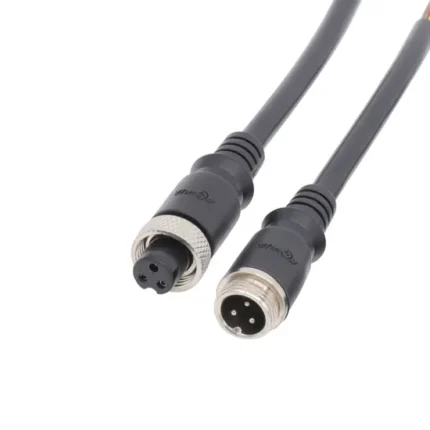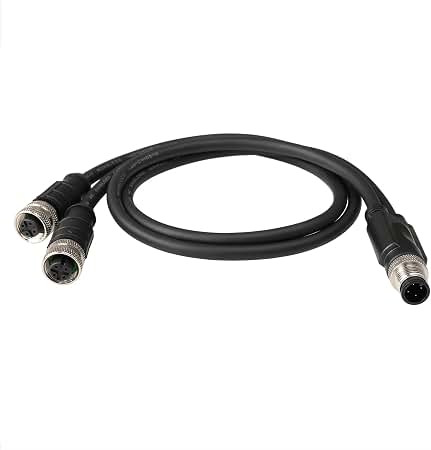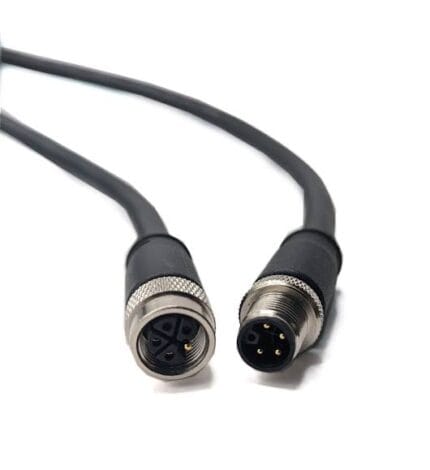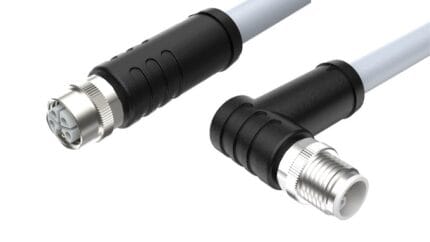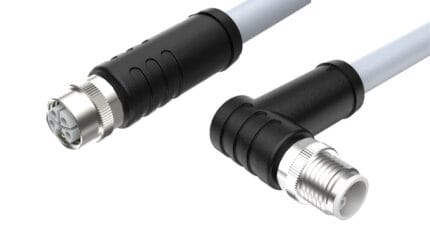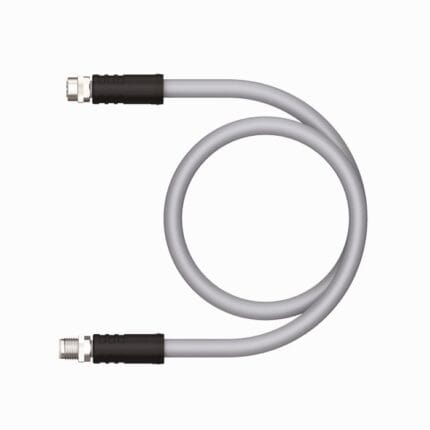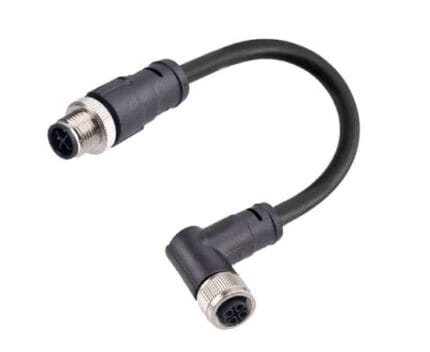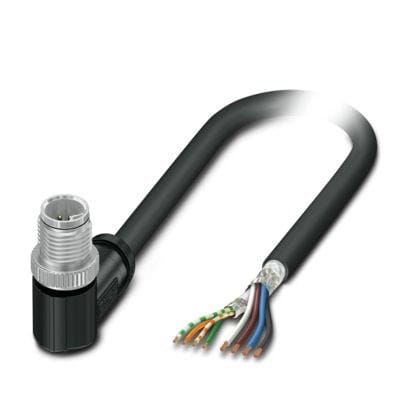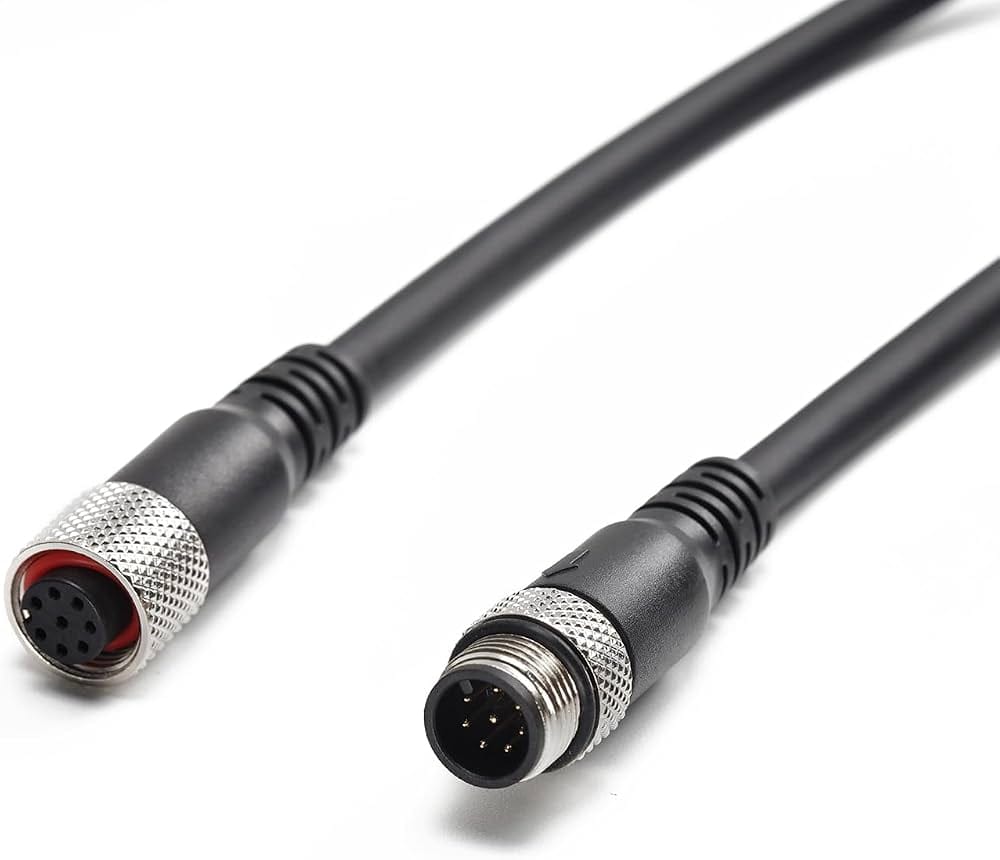
M12 8-Pin A-Coded IP67 Waterproof Male-Female Extension Cable
This M12 8 pin cable carries two complete circuits or full encoder feedback in one IP67 A-coded shell, saving a second run and a second part number. 30 V / 2 A per pin, 8 x 24 AWG, PUR jacket for oil and UV, built to your pinout and length.
Overview
An M12 8 pin cable is the point at which an A-coded stop becomes a small local network. Eight positions will carry two complete three-wire circuits, or an incremental encoder with its complementary outputs and supply, or four balanced pairs worth of signal, in one shell and one routing path. The trade is written into the attributes: two amperes per pin rather than four, because the same contact volume is now shared between eight of them. Specified honestly it saves a second cable run, a second gland and a second part number.
Key Specifications
| Connector | M12 8-pin A-coded male / female |
|---|---|
| Interface standard | IEC 61076-2-101 |
| Ingress rating | IP67 in the mated state |
| Rated voltage | 30 V AC/DC |
| Rated current | 2 A per pin |
| Conductor | 8 x 24 AWG (8 x 0.25 mm2) |
| Jacket | PUR, oil and UV resistant |
| Operating temperature | -25 to +85 °C |
| Mating cycles | >100 |
Where eight positions earn their keep
Ask first whether two circuits genuinely share a route. If they leave in different directions a meter after the connector, eight positions in one shell buys nothing and costs flexibility.
| Configuration | What it carries | Typical device |
|---|---|---|
| Two three-wire sensors | Two supply pairs plus two outputs | Paired proximity switches on one bracket |
| Incremental encoder | Supply, A and B channels, optional zero pulse, sometimes complements | Rotary feedback on small axes |
| Four twisted pairs | Balanced signal pairs for analog or bus duty | Transmitters with several outputs |
| Mixed power and signal | One higher duty supply pair plus signal conductors | Compact instruments with local conditioning |
| Multi-channel I/O island | Several discrete channels grouped at one drop | Remote junction blocks and manifold heads |
Eight positions on an M12 can mean several different connectors depending on the keyway. If you are weighing them up, the coding reference in the download center lists each letter, the pole counts it normally comes in, and what it is used for.
The current rating drops as positions rise
Compare this page with a three-pin cordset and the per-pin figure halves, from 4 A to 2 A. Nothing about the shell changed except how many contacts share the space and how much heat builds up when several conduct at once. That figure is the reason an eight-pin assembly is a signal carrier that also supplies power, never a power feed that happens to carry signals.
| Pin count | Typical per-pin current class | Practical reading |
|---|---|---|
| 3 to 4 positions | 4 A class | Fine for sensor power at modest current |
| 5 positions | 4 A class | Still comfortable for most single-device duty |
| 8 positions | 2 A class | Signal plus light local power only |
| 12 positions | Lower again | High density signal grouping, not distribution |
For actual power, use the connector built for it: an T-coded or L-coded DC power cordset carries multiples of this current with contacts sized for the duty.
Reading eight positions
Do not number them from one to eight clockwise. The face is better understood as groups, because that is how devices assign them, and because the wire color set varies between makers to a degree that catches people out.
| Group | Typical assignment | Confirm before ordering |
|---|---|---|
| Supply pair | Device positive and return | Which two positions the device uses |
| Output pair | Switched outputs, or NO plus NC | Polarity and whether complements are used |
| Second circuit pair | Second device or second channel | Whether the circuits share a return |
| Remaining conductors | Spare, shield land or additional channels | Whether they float or terminate |
Send us the device pinout. Color coding for eight-position assemblies is not consistent enough across manufacturers to guess at, and it costs nothing to build it correctly the first time.
Why this one ships with PUR
Eight conductors make a stiffer, heavier cable that tends to get routed where it will rub, and the applications that need eight positions usually sit outdoors or in machine tool enclosures with coolant in the air. PUR handles the oil, keeps UV from chalking the surface and stays flexible at the cold end where PVC hardens. If your assembly lives in a dry cabinet, PVC is still a legitimate, cheaper choice and we will say so.
Typical applications for this m12 8 pin cable
- Paired proximity switches and limit switches sharing one drop
- Incremental encoders feeding position feedback through one connector
- Outdoor I/O blocks and machine vision junction points needing a UV resistant jacket
- Instruments with several analog outputs on a single route back to the cabinet
- Replacing two cordsets with one where the pair genuinely shares a path
How to specify your build
- Device pinout, including whether the two circuits share a return.
- Ends – male to female, straight or right-angle.
- Length along the route.
- Current per conductor and whether any load has an inrush.
- Jacket – PUR standard here, PVC if the route is dry.
- Quantity, prototype or production.
Workmanship and testing
Workmanship on M12 8-Pin A-Coded IP67 builds follows IPC/WHMA-A-620 Class 3, the line is run under ISO 9001, and the termination range is 32 to 12 AWG. Every M12 unit is checked for continuity and pinout before packing, and seal checking is quoted whenever an ingress rating is on the drawing.
Every production run can ship with RoHS and REACH declarations and the electrical report agreed at quotation; see certifications and material declarations. UL styles and other named approvals are built to drawing: we source to the style you specify and document it, rather than asserting a listing we do not hold. For the sealed version we follow the gasket path and overmold-to-jacket bond practices documented under IP-rated sealing validation. The wider context is covered under our industrial automation work. Tooling is quoted separately, cut in-house rather than brokered out, and owned by you.
Custom builds and ordering
Prototypes are quoted from 1 to 50 pcs and ship within 3 working days. Volume production starts at 500 pcs with a 14 working day lead time after approval, and about 10 working days more when a new tool is needed. Private labeling carries your part number, and material certificates with first-article reports are available on request.
Related M8 and M12 assemblies
- M12 12 Pin Cable, High Density Cordset for Encoders
- M12 8-Pin A-Coded Right-Angle / Straight Extension Cable
- M12 Power T-Code or L-Code DC Power Cable, 63 V DC
- M12 Rail Signal Cable for Door Control and Brake Sensors
- M12 CAN Bus Cable, 5-Pin Shielded Pair
- M8 6-Pin A-Coded Sensor Cable
- M9 Sensor Cordset for Handheld and Medical Instruments
Full range: circular M8 and M12 cable assemblies.
Frequently Asked Questions
Why is the per-pin current only 2 A?
Because eight contacts share the space and the heat that four do. It is the standard class figure for this position count in this shell size, not a limitation of our build.
Can I run two independent sensors through one eight-pin cordset?
Yes, provided they share a route and you tell us whether the two circuits return separately or share a common conductor.
Are the wire colors standard across eight positions?
Not reliably. Makers differ, so we build to the pinout you send rather than to a color chart.
Will it handle an encoder?
Commonly yes, including complementary outputs. Send the encoder interface drawing and we will confirm the assignment.
Is PUR worth the extra cost here?
Usually, because eight-position assemblies tend to live outdoors or in coolant mist. In a dry cabinet PVC is fine and cheaper.
| Connector | M12 8-pin A-Coded Male/Female |
|---|---|
| Standard | IEC 61076-2-101 |
| IP Rating | IP67 |
| Rated Voltage | 30 V AC/DC |
| Rated Current | 2 A per pin |
| Conductor | 8 x 24 AWG (8 x 0.25 mm2) |
| Jacket | PUR (oil/UV resistant) |
| Operating Temperature | -25 to +85 °C |
| Mating Cycles | >100 |