
Silicone Wire Harnesses
A silicone wire harness is a custom cable assembly built from silicone-insulated conductors and matched connectors, engineered for the environments where a conventional PVC, PUR or TPE jacket simply gives up. Standard thermoplastic jackets stiffen, crack and shed plasticizer below roughly −15°C, and they soften, discolor and lose dielectric strength well before +90°C. A silicone wire harness stays supple at −60°C and keeps its rating to +180°C continuous, with high-temperature grades reaching +200°C — which is why it is specified for engine bays, ovens, freezers, rail rolling stock and cleanrooms rather than ordinary office wiring.
The jacket choice is not cosmetic. When a wire bundle has to bend thousands of times in a cold warehouse, sit next to a heater element, or survive a steam autoclave, the polymer around the conductor decides whether the product works on day one or fails in the field. That is the problem a silicone wire harness solves: it keeps the insulation flexible and electrically stable across a temperature window that thermoplastics cannot match, without the brittleness that sends a rigid cable cracking under vibration.
HKWIRE is a custom cable assembly manufacturer and OEM/ODM supplier in Longgang, Shenzhen. Assemblies are cut, stripped, crimped and tested in-house. When you send a drawing or a sample, the silicone wire harness that comes back matches your gauge, length, connector and pinout instead of a catalog page. We build to print, document the bill of materials, and verify every circuit before it leaves the factory. That approach keeps small prototype runs and high-volume OEM production on the same quality system, so a 1 to 50 piece evaluation harness and a 50,000-piece order are made the same way.
It is worth being precise about what silicone is and is not before you commit to a build. Silicone rubber (VMQ) is a thermoset — a cross-linked polymer that cannot be remelted, reground or reshaped like a thermoplastic. That is exactly what gives it the temperature ceiling and the stable flexibility described below, but it also sets the material cost and the manufacturing route apart from PVC, PUR and TPE. A silicone wire harness is therefore a deliberate engineering decision, not a default, and the rest of this page explains exactly when to make it — and when a cheaper thermoplastic is the smarter call.
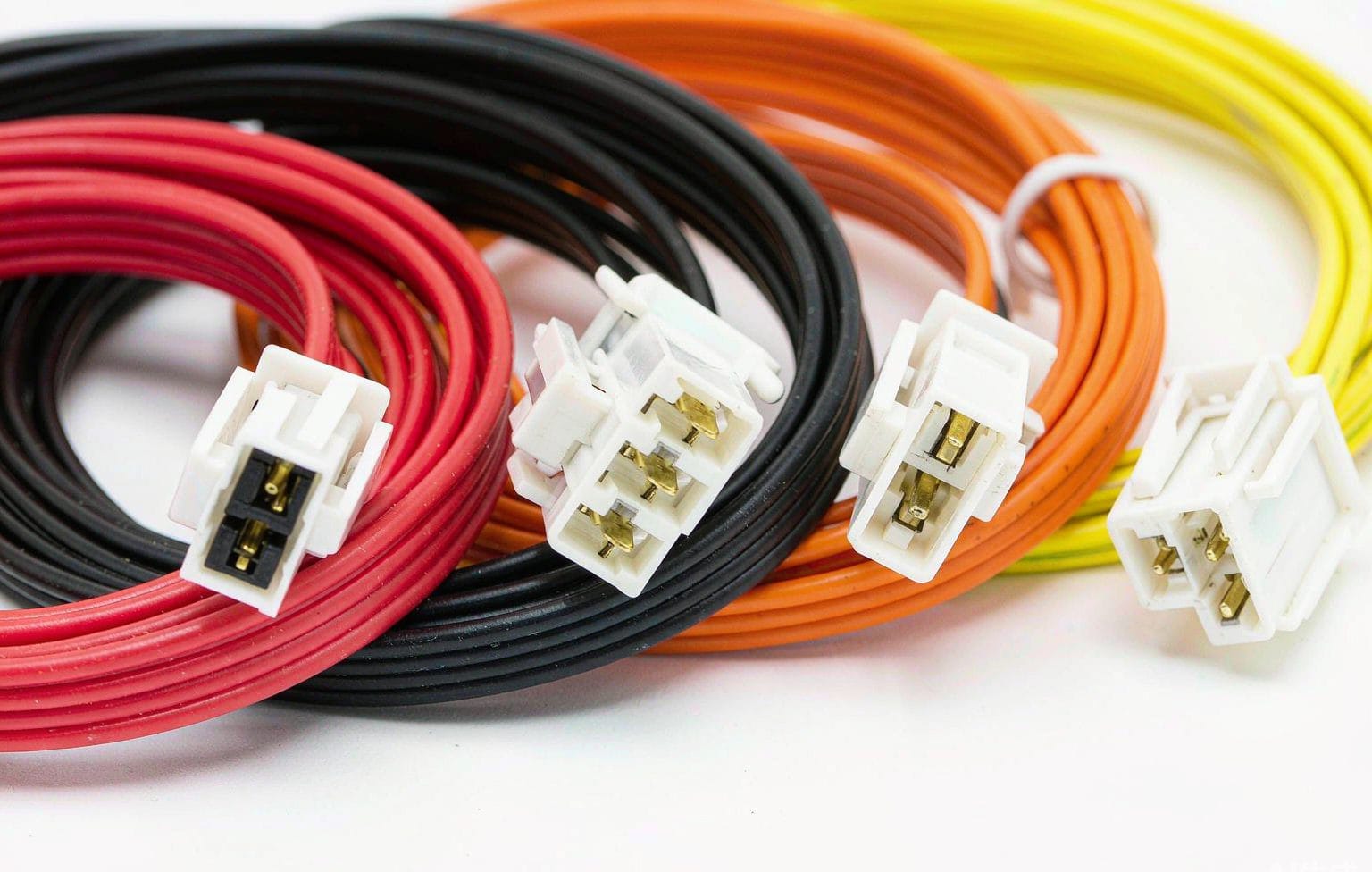
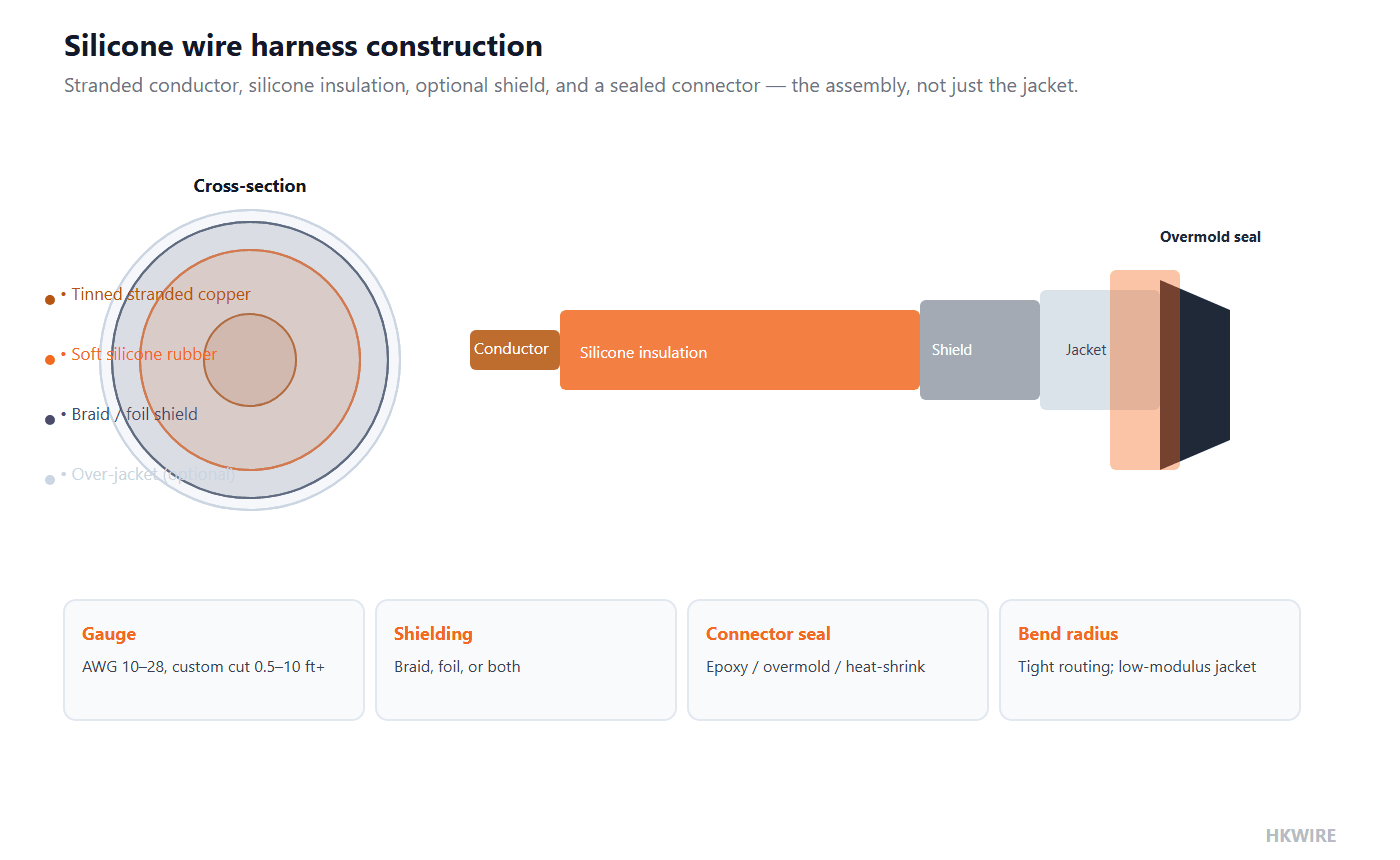
A finished harness is more than insulated wire. It is a bundle of conductors (often tinned, stranded copper for flex life), optional shielding to control electromagnetic noise, connectors crimped to a defined pinout, and some form of strain relief or sealing at the terminations. Each of those elements is a lever we adjust during design review, and the sections below walk through the features, the material trade-offs, the numbers, the specifications and the build process so you can brief us accurately from the first inquiry.
Key Features & Benefits
Every silicone wire harness we build is a balance of temperature performance, flexibility and mechanical protection. The five properties below are the ones buyers ask about most, and each is stated with the honest caveats that protect your design from a field failure. We would rather tell you up front that a different jacket would be cheaper than let a silicone build fail in the field, so the notes below include the limits as plainly as the strengths.
Extreme Temperature Durability
Silicone insulation is rated for continuous service from −60°C to +180°C, with high-temperature compounds reaching +200°C. Beyond the headline number, silicone resists thermal shock — the rapid swing from a cold start to a hot running condition — far better than thermoplastics, which can craze or split at the bond line when heated and cooled repeatedly. It also resists ozone and UV aging, so a harness routed through an engine bay or onto a rooftop combiner keeps its flexibility for years instead of embrittling after one summer. Where a PVC lead would go rigid at −20°C and a PUR lead would approach its +90°C ceiling under hood, silicone stays inside its comfort zone with margin to spare.
Flexible & Abrasion-Resistant Build
The single biggest comfort advantage of silicone is its very low modulus: the jacket stays soft and routable at low temperature, which simplifies installation in tight spaces and reduces strain on terminals during flexing. What we do not claim is that bare silicone is a tough mechanical skin. Standard silicone has poor tear strength and low cut-through resistance, and it can be nicked by sharp edges or abraded by continuous rubbing against a panel. In real builds the jacket is therefore usually braided (aramid or glass) or over-jacketed with a tougher layer for mechanical protection, while keeping the silicone where its temperature and flexibility matter. Specifying the reinforcement up front is how we keep the softness without sacrificing service life, and it is a standard part of our design review rather than an afterthought.
Custom Configuration for Every Project
No two silicone wire harness designs are identical, and the value of custom assembly is that the geometry follows your product instead of a standard part number. We vary wire gauge from 10 AWG down to 28 AWG, set conductor stranding for flex life, choose tinned stranded copper for corrosion resistance, and select shielding (braid, foil or both) for your noise environment. Length is cut to order from 0.5 ft to 10 ft and beyond, and connector bodies from OBD2 J1962 to Molex, JST, TE/Tyco or fully custom are fitted and crimped to your pinout. Branch points, label markers and tie-downs are placed to match your enclosure, so the harness drops in rather than being forced into place during assembly.
Automotive-Grade Reliable Performance
For vehicle and EV auxiliary circuits, an automotive silicone wire harness depends on the connection as much as the insulation. Terminals are precision-crimped with a secure locking structure, giving low and stable contact resistance and reliable signal and power transmission under vibration. Crimp workmanship is inspected to IPC/WHMA-A-620 Class 3 criteria, and each harness passes 100% continuity and pinout testing. The result is a plug-and-play assembly that survives road vibration, under-hood heat and repeated connect-disconnect cycles, rather than a hand-built loom that drifts out of spec between batches. For environments that also need ingress protection at the connector, we can overmold or pot the termination so the joint is part of the harness, not a separate weak point.
Chemical & Weather Resistant
Silicone shrugs off weather, ozone, moisture and many cleaning agents, and it remains flexible in outdoor and washdown conditions where rigid jackets fail. The honest limit of a silicone wire harness is petroleum oil: standard silicone swells in mineral and engine oils, which is a real constraint for some industrial and under-hood applications. Where oil contact is unavoidable we discuss fluorosilicone (FVMQ) or a protected construction, and we can point you to our oil-resistant cable material selection guide for a direct comparison. For chemical resistance outside oil, silicone is one of the most stable insulations available, and its inert surface resists many solvents that attack softer thermoplastics.
Silicone vs PVC, PUR and TPE: when the jacket choice is wrong
The fastest way to waste budget is to pick a jacket for the wrong reason. This jacket is the right call when temperature or flexibility dominates; it is the wrong call when you need oil immersion on a tight budget or maximum cut-through strength per dollar. The table below contrasts the four common jacket families on the properties that actually decide a field failure, so the choice can be made on evidence rather than habit.
| Property | Silicone (VMQ) | PVC | PUR | TPE |
|---|---|---|---|---|
| Material family | Thermoset (cross-linked) | Thermoplastic | Thermoplastic | Thermoplastic |
| Temperature range | −60°C to +180°C (grades to +200°C) | −15°C to +70°/90°C | −40°C to +90°C | −40°C to +105°C |
| Flexibility / modulus | Very low modulus; stays flexible when cold | Stiffens below freezing | Good flexibility; recovers well | Good flexibility |
| Oil resistance | Poor — swells in petroleum oil (FVMQ fixes at high cost) | Poor — plasticizer extraction | Ether PUR good; ester PUR hydrolyzes | Varies by grade |
| Mechanical strength (tear / cut-through) | Poor unless reinforced | Moderate | Very good | Good |
| Recyclability | Cannot be remelted; limited | Recyclable | Recyclable | Recyclable |
The most important row is the first. The assembly is built from a thermoset: the polymer is cross-linked during cure and cannot be remelted, reground or reshaped, unlike the thermoplastics PVC, PUR and TPE. That cross-link is exactly what gives silicone its temperature ceiling and its stable flexibility, but it also sets the manufacturing method — extrude and cure, rather than injection-melt — and limits end-of-life recycling. Choosing this jacket over a thermoplastic is therefore choosing a cured, stable insulation at a higher material and process cost, which only pays back where the temperature or flexibility requirement justifies it.
Two cautions come up constantly in specification reviews. First, standard silicone swells in petroleum-based oil; fluorosilicone (FVMQ) restores oil resistance but at a steep price premium, so it is reserved for the cases that truly need both oil and heat. Second, “silicone-modified” materials such as TPSiV are not silicone — they are TPE blends with a silicone component that improve surface feel and slip but do not reach the −60°C to +180°C ceiling of a true silicone build. If your drawing calls for silicone, confirm the compound is VMQ or FVMQ, not a silicone-touched TPE. For the full material trade-off, see our PVC vs PUR vs TPE cable jacket guide, and for a low-smoke, halogen-free angle our halogen-free cable jacket article.
On cost, the typical ranking from lowest to highest is PVC, TPE, PUR, then silicone, with FVMQ above silicone again. That ordering is why a designer should not default to silicone “just in case”: if the application never leaves −20°C to +90°C and avoids oil, a PUR or TPE jacket delivers most of the flexibility at a fraction of the cost and with better tear strength. Silicone earns its place when the temperature window, the cold-flex requirement, or the ozone and weather exposure pushes past what a thermoplastic can survive.
Real products rarely use one jacket everywhere. A single machine may route a silicone wire harness past a heater while running a PUR or TPE cable through a cool, oily section, and mixing jackets in one build is normal once the temperature map is drawn. The point of the comparison is to put the right material at each point, not to standardize on one polymer for the whole product.
Temperature range and ratings
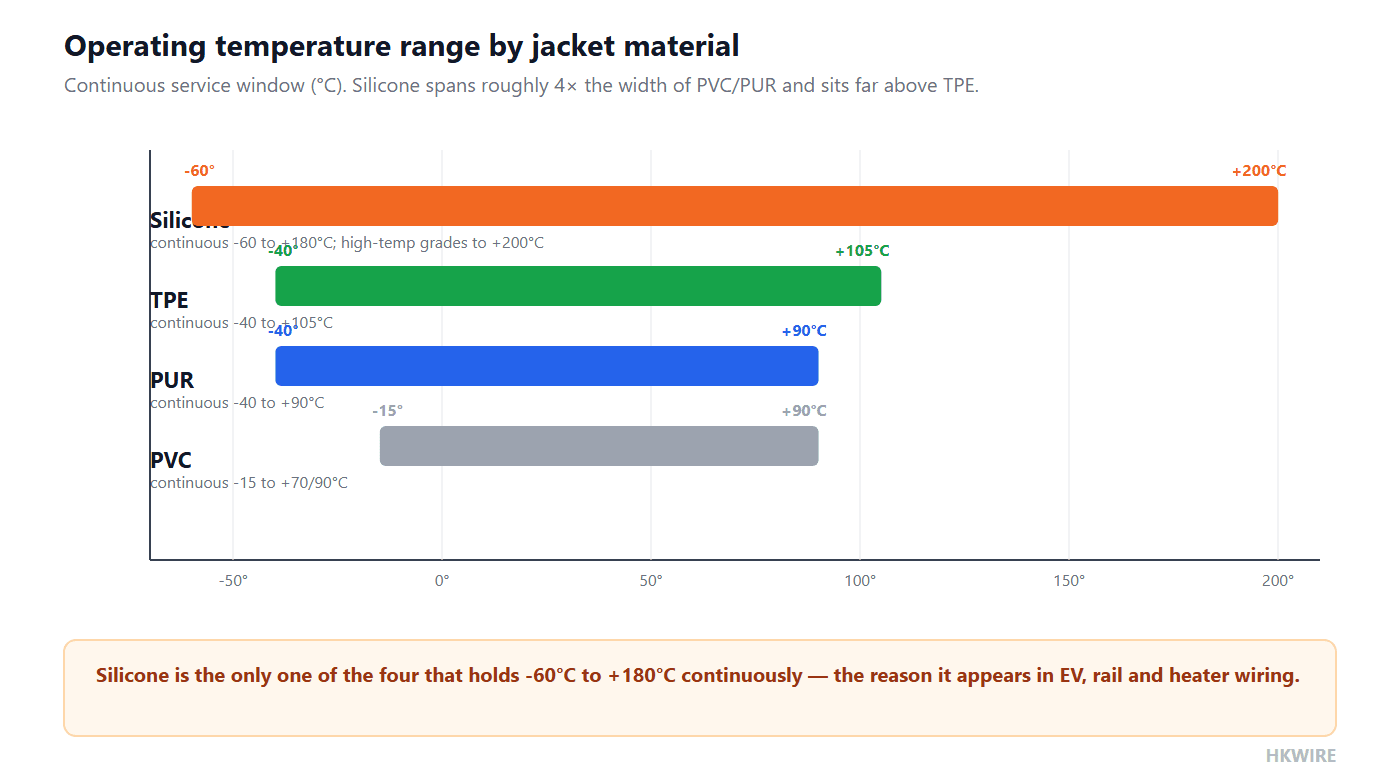
Temperature is where this jacket wins, so it deserves its own numbers. The continuous-service windows below are the figures we quote and build to; they are not marketing ceilings but the stable operating band for each jacket family, measured against the same kind of life-test logic described further down.
| Jacket | Continuous service | Cold bend | Notes |
|---|---|---|---|
| Silicone | −60°C to +180°C | −60°C | High-temp grades to +200°C |
| PVC | −15°C to +70°C | −15°C | Some compounds to +90°C |
| PUR | −40°C to +90°C | −40°C | Ether type better in wet / oil |
| TPE | −40°C to +105°C | −40°C | Widest thermoplastic window here |
Why the rating matters is explained by the IEC 60216 temperature-index concept. A cable material’s rated service life is tied to its temperature index — the temperature at which it retains a defined property, commonly elongation, for a set time — and that life roughly halves for every ~10°C to ~20°C rise above the rating. In plain terms, running a PVC lead at +90°C when it is rated to +70°C can cut its useful life by a large factor, while a silicone wire harness carrying the same load stays comfortably inside its band. Specifying the jacket to the actual worst-case temperature is the difference between a harness that lasts the product’s life and one that becomes the failure point.
Two practical rules follow from that. First, rate the harness against the sustained worst case plus margin, not the occasional peak; a transient spike of a few seconds is very different from a steady-state condition. Second, remember that connectors, crimps and overmolds have their own temperature limits that may be lower than the silicone insulation, so the weakest link in the assembly — not the wire — often sets the real operating ceiling. We flag that limit during design review so the specified numbers hold end to end. As a planning rule, this jacket is the default when the worst case is below −40°C or above +105°C.
In practice we validate the chosen rating against your duty cycle rather than trusting the catalog number: if the harness sees repeated heat-cool loops, we confirm the construction survives thermal cycling, not just a static temperature, before we quote the rating on the drawing.
Silicone vs FEP vs PTFE vs polyimide: choosing the wire insulation
The table above compares jackets — the outer layer that protects the bundle. This one compares the insulation on the individual wire inside it, which is a separate decision. A silicone jacket can sit over PVC-insulated wire, or over PTFE, and the temperature ceiling of the finished assembly is set by whichever layer fails first. Insulation is chosen on temperature, wall thickness and electrical stress; the jacket is chosen on abrasion, oil and handling. They are specified together, but they are not one choice.
| Property | Silicone | FEP | PTFE | Polyimide film |
|---|---|---|---|---|
| Construction | Thermoset rubber, extruded and cured | Fluoropolymer, melt-extruded | Fluoropolymer, paste-extruded and sintered | Polyimide film, tape-wrapped — not extruded |
| Continuous temperature | −60°C to +180°C (grades to +200°C) | +150°C typical for UL1331-class wire | +200°C to +260°C by style | −75°C to +200°C; +300°C for nickel-plated conductors in radiation-resistant builds |
| Typical voltage class | Set by wall thickness and jacket | 600 V (UL1331 class) | 600 V (AS22759/11 and /12 class) | 600 V to 1,000 V by construction |
| Wall thickness | Thickest of the four | Thin | Thin | Thinnest — published commercial walls run 0.10 mm to 0.18 mm |
| Weight at small gauge | Heaviest | Light | Light | Lightest, and the gap widens as the conductor gets smaller |
| Flexibility | Best low-temperature flexibility | Good | Stiff; cold-flows under sustained compression | Good, but a tape wrap can crack at a tight bend radius |
| Abrasion and cut-through | Poor unless reinforced | Good | Good | Good cut-through; a nick propagates easily |
| Radiation and vacuum | Not for ultrahigh vacuum or high dose | Low outgassing | Very low outgassing | The reason to specify it — published ratings span 107 to 109 rad depending on construction |
| Relative cost | Mid | Mid to high | High | Highest |
Three situations push a design off silicone. The first is temperature: above roughly +200°C continuous, silicone has no headroom left and a fluoropolymer or polyimide build is the honest answer. The second is weight on a harness dominated by small-gauge signal wires, because at AWG 30 and below the insulation and plating already carry roughly a third to two fifths of the finished wire mass even with a thin polyimide wall, and more with a thicker one — so wall thickness, not conductor size, is the lever that actually moves the number. The third is the environment itself: ultrahigh vacuum, ionizing radiation, or a low-outgassing requirement that organic rubber compounds simply do not meet.
One caution applies to thin-wall high-voltage builds in particular. A polyimide wall of 0.10 mm to 0.18 mm is mechanically thin, and on published commercial data sheets the resulting working stress lands near 6 kV/mm — a small fraction of the film’s short-time dielectric strength. That gap is the whole point: these designs are not limited by breakdown, they are limited by partial discharge inception, which is governed by layer count, trapped voids and termination quality rather than by anything on the material data sheet. Specify voltage, altitude and duty cycle together, and let the test plan settle it.
In practice most harnesses mix. One build may carry silicone-insulated leads through a heated zone, PTFE-insulated wire where it passes a hot manifold, and a jacket chosen for oil resistance somewhere else entirely — provided the temperature map is drawn first and each section is rated for what it actually sees. HKWIRE supplies standard fluoropolymer-insulated wire styles and builds specialist constructions to your drawing; final limits, sampling and records are agreed in writing before production release and verified on the test bench — continuity, dielectric withstand, insulation resistance and crimp pull, against values we agree with you rather than values we assume.
Specification Highlights
The table below is the starting point we use to scope a build. Every value is adjustable per project; the ranges reflect what we routinely produce rather than a fixed catalog, and they are confirmed against your drawing before any cable is cut.
| Item | Details |
|---|---|
| Insulation Material | Silicone rubber (VMQ); FVMQ on request for oil contact |
| Temperature Range | −60°C ~ +200°C |
| Wire Gauge | 10 AWG ~ 28 AWG (customizable) |
| Conductor | Tinned, stranded copper for flex life and corrosion resistance |
| Shielding | Braid, foil, or both — selected by your EMI environment |
| Jacket Construction | Often braided or over-jacketed for mechanical protection |
| Connector Options | OBD2 J1962, Tyco, Molex, JST, custom terminals |
| Connector Sealing | Epoxy, overmold, or heat-shrink per ingress requirement |
| Length | Custom cut from 0.5 ft to 10 ft+ |
| Minimum Bend Radius | Typically 4×–6× cable OD bare; tighter with reinforced build |
| Compliance | RoHS, REACH, UL available upon request |
Two rows deserve emphasis. First, jacket construction: because bare silicone is soft, a production harness is usually braided or over-jacketed so it can survive handling, routing and vibration without tearing — we decide the reinforcement with you during design review. Second, connector sealing: epoxy potting, overmolding or heat-shrink boots let the same harness meet anything from a dry board connection to a splash-prone interface. For a deeper look at sealing method selection, see our how-to-specify overmolded cable assembly guide.
Gauge and current go together. Within the 10 AWG to 28 AWG range, ampacity falls as the number rises — a 10 AWG conductor carries substantially more current than a 28 AWG one — so the gauge is set by the circuit’s current draw and the allowable temperature rise, not just by the space available. Finer stranding improves flex life for moving applications, while heavier stranding with tinned copper resists corrosion in humid or salty environments. Every silicone wire harness we ship is documented with the chosen gauge, stranding and shielding so the electrical values are traceable to the build record.
Typical Applications
This jacket shows up wherever temperature or flexibility is the binding constraint. The list below is typical, followed by a short note on the design driver for each major use so you can see whether your program fits the same pattern.
These programs share one habit: the temperature or flexibility spec is non-negotiable, so the jacket is chosen first and the connectors, shielding and sealing are engineered around it. If your application is not listed, the same logic applies — send the operating envelope and we will tell you whether silicone is the right call or whether a thermoplastic would do the job for less.
- Automotive ECU programming & OBD2 diagnostic systems
- Under-hood vehicle wiring and engine modification
- Industrial automation machinery and control cabinets
- Medical equipment internal wiring
- New energy vehicle auxiliary circuits
- Outdoor power equipment and aerospace testing
- RC models, drones and high-drain battery packs with JST / XT60 plugs
- Custom PCIE GPU power cables for mini-PC and SFF builds
- Heater, oven and thermal-process leads
- Railway rolling stock and trackside electronics
- Semiconductor cleanroom and low-outgassing instrumentation
EV high-voltage auxiliary circuits
Around a battery pack and power electronics, ambient temperatures swing hard and space is tight. A silicone wire harness for low-voltage auxiliary and signal circuits keeps its flexibility through thermal cycling and resists the ozone and corona near high-voltage busses, complementing the heavier EV main cables rather than replacing them. The soft jacket also eases routing in the cramped cavities of a battery enclosure.
Railway rolling stock
Trains demand low smoke and low toxicity in a fire, and silicone’s clean burn profile helps. Rail EN 45545 smoke and toxicity requirements can be met per project with the right compound and construction; we build to the specified hazard level rather than assuming a standing certificate. The wide temperature band also suits rooftop and underfloor routing where surface temperatures and winter cold both test the jacket.
Medical and food-grade
Biocompatible silicone compounds are available for equipment internal wiring, and silicone tolerates autoclave sterilization cycles that destroy most thermoplastic jackets. For medical or food contact, biocompatible silicone compounds are available; confirm the regulatory pathway with your team — HKWIRE is ISO 9001 certified and builds to your spec. We do not hold medical-device quality certifications, so the compliance evidence is defined by your team and produced within our ISO 9001 system.
Heater and oven leads
This is the classic silicone job: a lead that sits next to a heating element at +150°C to +200°C for years. The jacket here simply outlasts PVC or TPE, which would harden and crack, and it stays flexible enough to route during maintenance. The same logic applies to industrial sealing bars, laminators and food-service heating equipment.
Semiconductor cleanroom
Cleanrooms penalize outgassing and particle shed. Selected silicone compounds offer low outgassing suitable for instrumentation and tooling wiring, and the jacket’s inert surface resists the controlled chemicals used in fab environments. Where the process also exposes the cable to oils or solvents, we review the compound choice before build rather than after a failure.
Looking for a different build? Browse our automotive wire harnesses, custom wire harnesses and M8 and M12 circular cables, or see where these assemblies run in medical devices and automotive and EV programs. Our jacket comparison guide helps if you are still deciding between materials, and our halogen-free jacket article covers low-smoke options. Send a drawing to request a quote.
Built in-house, tested before it ships
Every harness is assembled in our Longgang, Shenzhen facility, where mold making, overmolding and electrical testing share one roof. Crimps are inspected to IPC/WHMA-A-620 Class 3 workmanship criteria under an ISO 9001 certified quality management system, and each unit passes 100% continuity and pinout testing before it is packed. That single-roof model means the silicone wire harness you approve in prototype is the same one that ships at volume, with the same fixtures and the same test records.
Production orders start at 500 pcs; prototype builds run from 1 to 50 pcs. Samples leave in 3 working days and production ships 14 working days after approval. Factory audits — in person or by live video walk-through of the assembly lines and inspection benches — can be arranged in advance, so your quality team can verify the process before commit. Tooling for repeat builds is retained and the bill of materials is documented, which keeps reorder lead times short and consistent.
Documentation is part of the product, not paperwork we add at the end. For each order we retain the approved drawing, the crimp and pull-test records, and the continuity/pinout test results, and we can supply a material declaration for RoHS and REACH on request. That traceability is what lets a prototype become a qualified production part without re-qualification, and it is the reason automotive, medical and industrial customers can audit one process instead of juggling several suppliers across cut, crimp, mold and test.
From the first sample to a stabilized production order, the same process owner watches the build, which is how a 1 to 50 piece prototype build turns into a qualified 500-piece run without the creep in crimp quality that undermines reliability at volume.
Silicone Wire Harness FAQ
What is the MOQ for silicone wire harnesses?
Production orders start at 500 pcs; prototype and small-batch builds start from 1 to 50 pcs. A silicone wire harness evaluation run can therefore begin long before you commit to volume, and the same drawing carries straight into production.
How fast can you deliver?
Samples in 3 working days. Production runs ship 14 working days after approval. Lead time depends on connector sourcing and any overmolding or sealing steps, which we confirm when we quote.
Can you build to our drawing or from a sample?
Yes. Build-to-print is our default. If you only have a physical part, reverse engineering is available — we measure, document and confirm the spec before cutting cable.
Which connectors can you fit?
OBD2 J1962, TE and Tyco, Molex, JST and XT60 as standard, plus customer-specified parts. We can also overmold the connector body for strain relief or sealing on a silicone wire harness.
Can we audit the factory?
Yes. On-site audits or a live video walk-through of the assembly lines and inspection benches can be arranged in advance. We welcome review of the crimp, test and traceability process behind every silicone wire harness.
Do you supply silicone harnesses under our brand?
Yes. We build under your brand as an OEM and ODM manufacturer and supplier, with labeling, packaging and documentation to your specification, assembled in our own factory in Longgang, Shenzhen.
What temperature range do silicone harnesses cover?
−60°C to +200°C, with custom gauge, length and connector selection. Every harness is assembled and continuity tested in our own factory in Longgang, Shenzhen before it ships.
Silicone vs TPE jacket — which should I pick?
Pick silicone when the worst-case temperature is below −40°C or above +105°C, or when you need maximum cold flexibility and ozone resistance. Pick TPE when your window stays within −40°C to +105°C, oil or abrasion resistance matters more than extreme cold, and you want a recyclable thermoplastic at lower cost. Note that TPSiV / silicone-modified TPE is not silicone and does not reach the −60°C to +180°C ceiling; if your drawing specifies silicone, confirm the compound is VMQ or FVMQ. Our jacket comparison guide walks through the trade-offs.
Can a silicone wire harness be oil-resistant?
Standard silicone is not — it swells in petroleum-based oil. The fix is fluorosilicone (FVMQ), which restores oil resistance while keeping the temperature window, but at a meaningful cost premium. If oil immersion is constant, a silicone wire harness may not be the cheapest answer; our oil-resistant material selection guide compares silicone against PUR and other options so you can choose on total cost, not just temperature.
What connectors and sealing options are available?
Connector options include OBD2 J1962, TE/Tyco, Molex, JST, XT60 and fully custom terminals, crimped to your pinout. For sealing we offer epoxy potting, overmolding and heat-shrink boots, chosen by the ingress and strain-relief requirement of the application. See our overmolded assembly specification guide for how to choose between them on a silicone wire harness.
What RoHS, REACH and rail or medical compliance can you provide?
We provide a material declaration per project for RoHS and REACH, and UL rating is available per wire gauge on request. Rail EN 45545 smoke and toxicity can be met per project with the correct compound and construction — we do not claim a standing certificate, so we build to your specified hazard level. For medical or food contact, biocompatible silicone compounds are available; confirm the regulatory pathway with your team. HKWIRE is ISO 9001 certified and builds to your spec; we do not hold medical-device quality certifications, so the regulatory pathway is defined by your team.