
Choosing a cable jacket for an industrial assembly looks like a materials question and is really a documentation question. “PVC or PUR?” is the question everyone asks, and it is the one that leaves the most value on the table. For a rail vehicle, a food plant, an offshore platform or an outdoor solar array, the requirements that decide the outcome are halogen-free, oil-resistant and UV-stable — three properties that are each proven by a named test method with a specimen mass, a temperature and a duration attached to it. This guide gives you the standards to quote, the arithmetic that converts them into a number you can put on a drawing, and a matrix to choose from, so a cable jacket decision is defensible rather than a matter of taste.
One honest note before the detail. HKWIRE does not publish a blanket “certified” claim for every compound. We are certified to ISO 9001, and material declarations are provided per project for RoHS and REACH; for the fire, oil and weathering properties below, we supply the compound data sheet and the test report so you can verify the claim against the standard you actually have to meet. Anything a supplier says about a cable jacket without a method number and a test report is a marketing claim, not an engineering value.
1. What “halogen-free” actually means, and how it is proven
Halogen-free — often labeled LSZH or LSOH, low smoke zero halogen — means the compound contains no fluorine, chlorine, bromine or iodine above the limits set by test. The words alone carry no information. The method carries the information, because each standard fixes a specimen size, a heating profile or a geometry, and the number that comes out means nothing without them.
| Method | What it measures | The conditions written into the method | What it does not give you |
|---|---|---|---|
| IEC 60754-1 | Halogen acid gas evolved from the compound | 750 ± 250 mg specimen, ramped over 40 ± 5 min to 800 ± 10 °C, held 20 ± 1 min under an air sweep, gases absorbed in alkali and back-titrated | No pass or fail value. The standard states that values below 5 mg/g should not be reported, because the precision does not support them |
| IEC 60754-2 | Acidity (pH) and conductivity of the evolved gases | Combustion gases bubbled through water, then pH and conductivity measured | A method only. The pH and conductivity limits come from a product specification |
| IEC 61034-2 | Smoke density | 3 m × 3 m × 3 m chamber (27 m³), 1 m specimen, alcohol fire, lowest light transmittance recorded | The body of the standard sets no pass mark. Annex B suggests a 60 % floor, which is a recommendation, not a requirement |
| IEC 60332-1-2 | Vertical flame spread, one cable | 60 s flame application, extended to 120 s above 25 mm outer diameter; pass means self-extinguishing with damage at least 50 mm below the top clamp | Nothing about what happens when cables are bunched together |
| IEC 60332-3-24 | Vertical flame spread, bunched cables, Category C | 1.5 L of non-metallic material per meter of tray, 20 min flame application, charred height not above 2.5 m | It is one of four categories, and the category is part of the claim |
| UL 1581 VW-1 | Vertical flame test, the North American route | Five applications of 15 s, 75 s in total; afterflame 60 s maximum, kraft indicator flag no more than 25 % charred, cotton below the specimen not ignited | UL 1581 is a test-method reference, not a product standard, so the acceptance criteria travel with the product standard you name |
Method conditions above are the ones written into the standards themselves; the values a compound achieves must come from the maker’s test report.
Two of those methods are the most misquoted, and both keep the caveat in the body of the text: see IEC 60754-1, the halogen acid gas test and IEC 61034-2, the smoke density test.
The bunched-cable categories deserve their own table, because “IEC 60332-3” on a data sheet is only half a claim. The category fixes how much non-metallic material burns per meter, and therefore how severe the test is.
| Category | Non-metallic material per meter of test ladder | Flame application | Char limit |
|---|---|---|---|
| Category A | 7 L/m — the most severe | 40 min | not above 2.5 m |
| Category B | 3.5 L/m | 40 min | not above 2.5 m |
| Category C | 1.5 L/m | 20 min | not above 2.5 m |
| Category D | 0.5 L/m | 20 min | not above 2.5 m |
In a tunnel or a data hall, the category matters more than the phrase itself.
The one equation this article is built on
The halogen content of a compound converts into the mass of acid gas it can release. That conversion is the whole argument for or against a compound, and it takes one line:
m_HX = Σ ( w_i × h_i ) × ( M_HX / M_X )
where w_i is the mass fraction of component i in the compound, h_i is the mass fraction of halogen in that component, and the last term converts halogen mass into hydrogen halide mass. The molar mass ratios are fixed by chemistry, not by any standard: 36.46 / 35.45 = 1.0285 for hydrogen chloride, 80.91 / 79.90 = 1.0126 for hydrogen bromide, and 20.01 / 19.00 = 1.053 for hydrogen fluoride.
The first factor, w_i × h_i, is the one people get wrong. It is not the halogen content of the raw material; it is the halogen content of the finished compound, after the resin has been diluted by filler, plasticizer, stabilizer and colorant. For PVC that dilution is dramatic and it is still nowhere near enough.
Worked example: a 5.5 × 3.0 mm jacket
Take a cable with a 5.5 mm outer diameter over a 3.0 mm core, so the jacket is an annulus. The compound is a general-purpose PVC at 1.42 g/cm³ with the resin at 50 wt% of the compound.
| Step | Expression | Result |
|---|---|---|
| Jacket cross-section | π/4 × (5.5² − 3.0²) = π/4 × 21.25 | 16.69 mm² |
| Volume per meter | 16.69 mm² × 1000 mm | 16.69 cm³ |
| Mass per meter | 16.69 cm³ × 1.42 g/cm³ | 23.70 g/m |
| Chlorine in the vinyl chloride repeat unit | 35.45 / 62.50 | 56.7 wt% |
| Chlorine in the compound | 0.50 × 0.567 | 28.4 wt% |
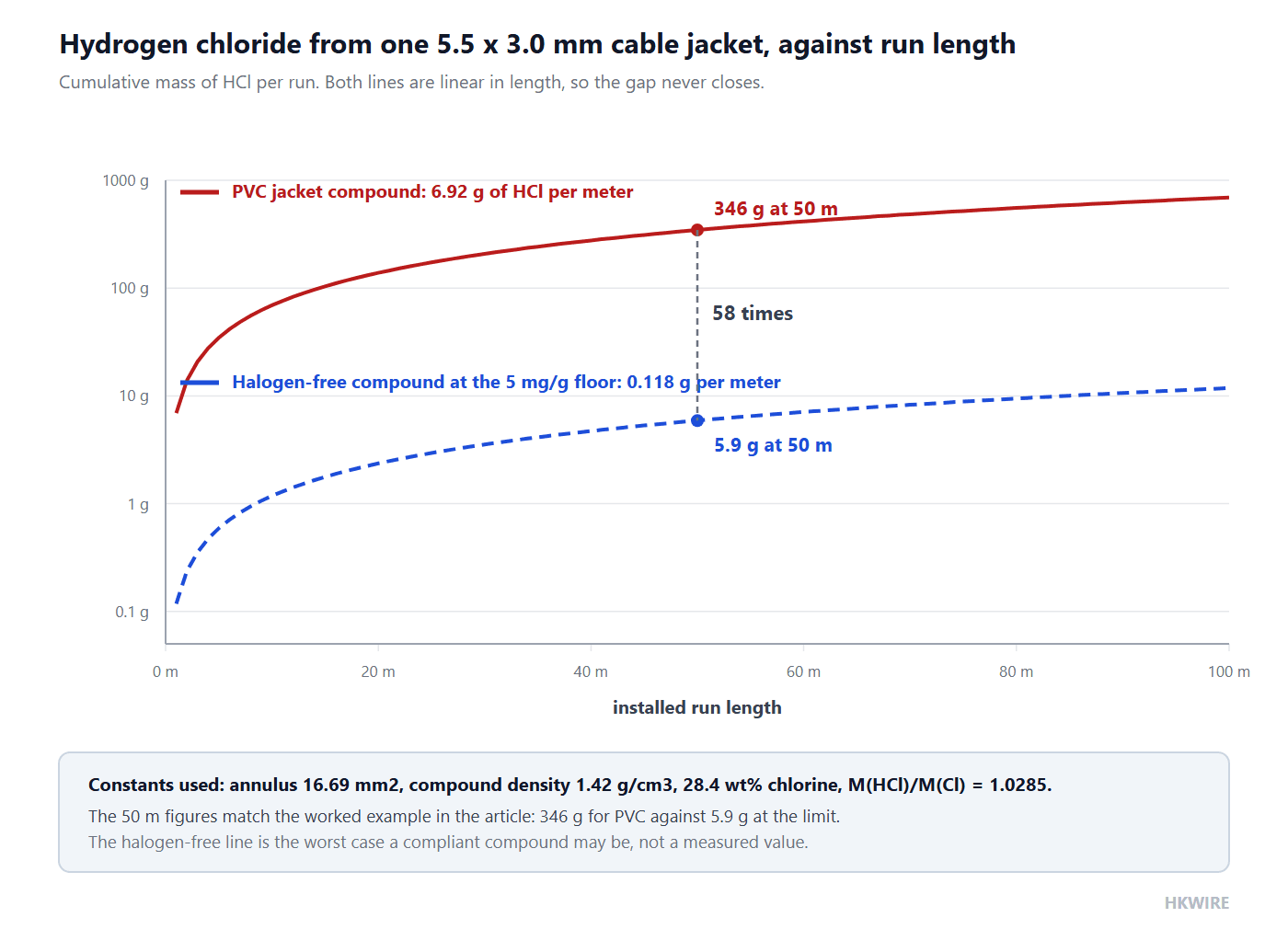
| Hydrogen chloride per meter | 23.70 × 0.284 × 1.0285 | 6.92 g/m |
| Hydrogen chloride over a 50 m run | 6.92 × 50 | 346 g |
The 50 % resin fraction and the 1.42 g/cm³ density are the worked-example inputs; substitute your own compound data and the method is unchanged.
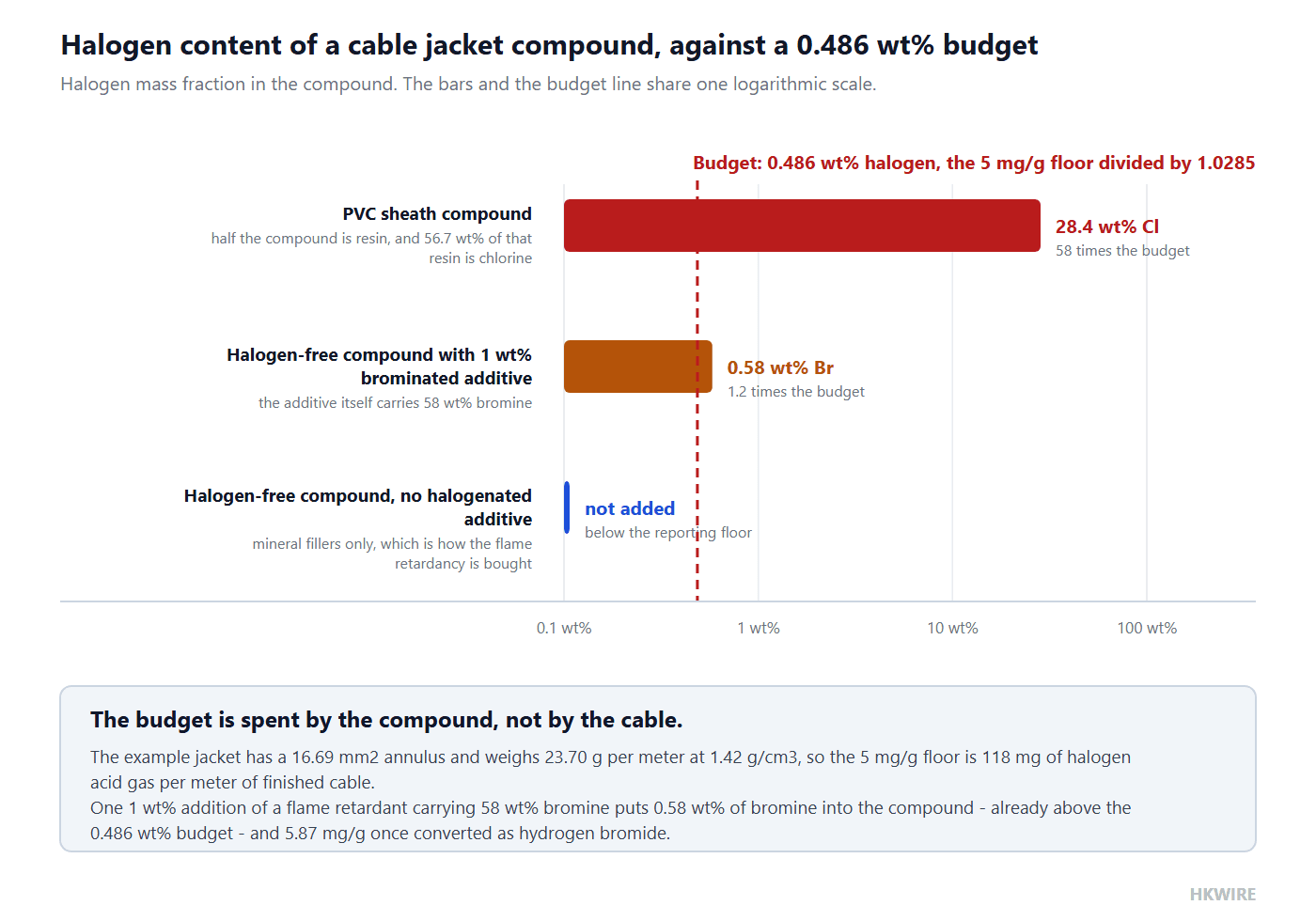
Now put that next to what a halogen-free claim has to deliver. IEC 60754-1 will not support a reported value below 5 mg/g, so 5 mg/g is the practical budget for the whole compound. Applied to this jacket, that is 23.70 g × 5 mg/g = 118 mg of halogen acid gas per meter of finished cable. The PVC sheath produces 6.92 g/m, which is 58 times the budget.
Running the conversion backwards gives the number that is actually useful in a review. To stay under 5 mg/g of HCl the halogen mass fraction in the compound may not exceed 5 / 1.0285 = 4.86 mg/g, which is 0.486 wt%. That is the entire allowance for the compound.
What a single flame retardant addition does to the budget
This is the part that makes the 0.486 wt% figure worth remembering. Suppose the compound is genuinely halogen-free and one additive is chosen badly: a brominated flame retardant, dosed at 1 wt% of the compound, in which the bromine content of the additive itself is 58 wt%.
| Line item | Value | How it was obtained |
|---|---|---|
| Budget available for halogen in the compound | 0.486 wt% | 5 mg/g divided by 1.0285 |
| Bromine added by 1 wt% of an additive carrying 58 wt% Br | 0.58 wt% | 0.01 × 0.58 |
| Same addition expressed as hydrogen bromide | 5.87 mg/g | 5.80 mg/g × 1.0126 |
| Total in the compound | 0.58 wt% against a 0.486 wt% allowance | 1.2 times the budget, and over the 5 mg/g floor |
| PVC sheath compound, for comparison | 28.4 wt% chlorine | 58 times the budget |
2. Oil and chemical resistance: name the oil, not just “oil-resistant”
“Oil-resistant” is not one property. Resistance depends on which oil, at what temperature, for how long, and measured how. The reference oils are standardized so that two laboratories can compare results; the two that matter are defined by ASTM D5964.
| Reference oil | Equivalent designation | Aggressiveness | What it is used for |
|---|---|---|---|
| IRM 902 | ASTM Oil No. 2 | Moderate | The baseline oil-resistance requirement in most cable product standards |
| IRM 903 | ASTM Oil No. 3 | Aggressive | The harder test, used where the compound will see hot lubricating or hydraulic oil |
The oils themselves are defined in ASTM D5964, the practice that fixes the IRM 902 and IRM 903 reference oils. The test condition quoted below is the one published with UL 44 / CSA C22.2 No. 38.
The measurement method for cable materials is IEC 60811-404, which replaced the withdrawn IEC 60811-2-1 clause 10. Note what that sentence does not say: the method standard sets no temperature, no duration and no retention figure. Those come from the product standard. A specification that quotes a method number and stops there has specified nothing.
Where the numbers do exist they are specific, and the two conventions are not interchangeable. One states what must be retained; the other states how much change is permitted.
| Route | Oil | Condition | Criterion |
|---|---|---|---|
| UL 44, clause 5.16.1 | IRM 902 | 96 h at 100 °C | tensile retention and elongation retention each at least 50 % |
| Marine cable specification practice | IRM 902 | 24 h at 100 °C | property change within ± 40 % |
| Marine cable specification practice | IRM 903 | 168 h at 100 °C | property change within ± 30 % |
The last two rows describe the pattern used in marine cable specifications rather than a clause in a method standard; treat them as the industry convention and confirm against your product standard.
The three numbers an oil test reports
A soak test is only interpretable when it reports all three of the following, and most marketing summaries report only the first:
- Tensile strength retention — how much of the compound’s strength survives the soak. This is the number that appears in brochures, because it usually looks good.
- Elongation retention — how much of its flexibility survives. This is the number that predicts field behavior, and it is usually the first one to fall.
- Volume swell — how much oil the compound absorbed. Swell moves dimensions, and in a sealed connector it moves the seal out of its designed compression.
A cable jacket that keeps its tensile strength but loses most of its elongation has not passed; it has become brittle. It will hold together on the bench and crack in service, because service adds bending, vibration and thermal cycling to the chemical attack the test isolated. Ask for elongation retention by name.
3. UV and weathering: black is not a coincidence
Outdoor jackets survive sunlight in one of two ways. Either the compound is loaded with carbon black, which absorbs ultraviolet energy and converts it into heat, or it carries a UV stabilizer package that quenches the degradation chemistry in a light-colored compound. Both routes end in the same place: a weathering test that measures what is left of the mechanical properties.
| Route | Document | Exposure or condition | What it establishes |
|---|---|---|---|
| Sunlight test | UL 1581 / UL 2556 | 720 h of xenon-arc or carbon-arc exposure | tensile and elongation retention of at least 80 %; the Canadian requirement extends the exposure to 1000 h |
| Carbon black exemption | UL 44, clause 5.15.2 | not a test | XL compounds with at least 2.0 % carbon black measured to at least 0.76 mm depth, particle size 35 nm or less, may skip the sunlight test |
| Xenon arc | ISO 4892-2 | cycle set by the product specification | the general accelerated weathering method for plastics |
| Fluorescent UV | ISO 4892-3 | cycle set by the product specification | the second weathering method, harsher in the UV-B range |
| Cable material weathering | IEC 60811-511 | per the product standard | the current home of what used to sit in IEC 60811-4-1, withdrawn in 2004 |
The 720 h exposure and the 80 % retention figure are the ones to write into a specification; both come from UL 1581, the reference standard for electrical wires and cables, which also carries the VW-1 flame test used in section 1.
This is why outdoor-rated industrial cable is usually black: black is a stabilizer package that happens to be free. If you need a light color for identification, specify a UV-stabilized compound and ask for the weathering result in hours and retention. Note also which document you cite: IEC 60811-4-1 was withdrawn in 2004 and its content was reissued across the 60811-5xx series, so a specification citing it is quoting a dead document.
4. Cable jacket compound selection matrix
The matrix below is the one to argue about, because the requirements genuinely conflict. Read the temperature column as a nominal range for the family, not as a property of the abbreviation.
| Compound | Halogen-free | Oil | UV / outdoor | Flex life | Nominal temperature range | Relative cost |
|---|---|---|---|---|---|---|
| PVC | No — contains chlorine | Poor | Fair, in black | Fair | −20 to +105 °C | Low |
| LSZH / LSOH, mineral-filled | Yes | Poor to fair | Fair | Fair | set by the grade, not by the abbreviation | Medium |
| PUR / TPU | Often yes, by grade | Excellent | Good, in black | Excellent | −55 to +80 °C | Medium |
| TPE | Yes in many grades | Good | Good | Good | −50 to +105 °C | Medium |
| XLPE / EPR, thermoset | Yes | Poor | Good | Poor — fixed installation | XLPE −40 to +105 °C; EPDM −55 to +125 °C | Medium |
| FEP / PFA | Yes | Excellent | Excellent | Fair | FEP −80 to +200 °C; PFA −200 to +260 °C | High |
Nominal ranges as quoted by compound suppliers for each family; confirm the rating of the specific grade in its data sheet before it goes on a drawing.
How to read the matrix without over-specifying
Two failure modes are common. The first is specifying the heaviest row for every job: FEP is halogen-free, oil-resistant and UV-stable, and on a fixed indoor run it buys nothing but cost and a stiff cable. The second is specifying a family name and expecting a property — “LSZH” says something about fire and nothing about oil, while “PUR” says a great deal about oil and nothing guaranteed about halogen content unless the grade is declared. Write the environment first and let the cable jacket compound follow.
5. Building the specification
- List the environments, not the material. Is there a fire risk in a confined space? Which oil, at what temperature, for how long? Direct sunlight? Abrasion? Continuous flexing?
- Map each environment to a standard and a condition: fire becomes IEC 60754-1 and IEC 60754-2 with a stated mg/g and pH limit, plus IEC 61034-2 with a stated transmittance floor and IEC 60332-3 with a stated category; oil becomes IEC 60811-404 with IRM 902 or IRM 903, a temperature and a duration; UV becomes ISO 4892-2 or the UL 1581 sunlight test with an hour count.
- State the criterion, not just the method: the retention figure or the permitted change, whichever convention the product standard uses.
- Ask for the test report and the material declaration. HKWIRE returns both with each compound it proposes, so the claim can be checked rather than believed. A report that does not name the specimen mass on a halogen test, or the retention figure on an oil test, does not answer the question.
- Resolve conflicts explicitly. Halogen-free plus oil-resistant is a PUR-based halogen-free grade or a declared TPE grade, written as one requirement.
- Confirm the temperature rating against the hottest point of the route, not the average ambient. The hottest point is usually a termination or a bundle in still air.
- Treat low temperature as its own line item, because it is a separate test on a separate specimen.
Where flex life also matters, pair the cable jacket with fine-stranded Class 5 or Class 6 copper and a molded strain relief. Class 1 and Class 2 conductors are for fixed wiring; the flexible classes are the ones that survive repeated bending, and a jacket compound cannot compensate for the wrong conductor class. Our guide to specifying an overmolded cable assembly covers the cable-to-connector transition.
6. Where the pass/fail numbers come from, and where they do not
Most cable jacket specification mistakes come from confusing a method standard with a product standard. The IEC 60754, IEC 61034 and IEC 60332 series tell you how to run a test and, where the outcome is unambiguous, what that outcome is. They do not tell you how much halogen is acceptable, how much smoke is acceptable, or how acidic the gas may be. Those are product-specification decisions.
The smoke figure is the clearest example. The 60 % that circulates as the “LSZH smoke requirement” comes from Annex B of IEC 61034-2, and Annex B is informative — a recommendation, not a clause you can fail. “Shall pass IEC 61034-2” therefore specifies nothing, whereas “minimum light transmittance 60 % per IEC 61034-2, Annex B” is testable, and a project figure of 70 % is legitimate as long as it is written as a project figure.
| What you want to state | Method standard | The document that actually sets the number | What to request |
|---|---|---|---|
| Halogen-free | IEC 60754-1 | your product specification, using the 5 mg/g reporting floor as the practical basis | a result in mg/g with the specimen mass stated |
| Low acidity of the gas | IEC 60754-2 | your product specification, which must state a pH and a conductivity limit | pH and conductivity values |
| Low smoke | IEC 61034-2 | your product specification; 60 % is Annex B’s suggestion, not the body of the standard | minimum light transmittance |
| Flame spread, single cable | IEC 60332-1-2 | the method itself contains the pass criterion | the report, with the flame time |
| Flame spread, bunched cables | IEC 60332-3 series | the category you name, A, B, C or D | a report that names the category |
| Oil resistance | IEC 60811-404 | the product standard that names the oil, temperature and duration | retention figures, not a phrase |
| UV stability | ISO 4892-2 or ISO 4892-3, or the UL 1581 sunlight test | the product standard that names the hours and the retention | hours and retained percentage |
One column of this table is a method, one is a decision, and the gap between them is where disputed test reports come from.
The low-temperature requirement that hides in the same paragraph
Brittle failure in winter is a different mechanism from the fire, oil and UV properties and needs its own test line. For a jacket up to about 12.5 mm diameter the method is IEC 60811-504, the low-temperature bend test: the specimen is wrapped around a mandrel of four to five times its own diameter, conditioned for at least 16 h, wrapped the required number of turns, allowed to recover for 60 min and then inspected for cracks. Above 12.5 mm, the low-temperature tensile test in IEC 60811-505 takes over. What the method does not give you is the temperature, because IEC 60811-504 has no universal test temperature — that value comes from the product standard and should be chosen against the coldest condition the route will see. “Low-temperature bend tested” with no temperature attached is as empty as “oil-resistant” with no oil.
7. Five things a general guide will not tell you about a cable jacket
- The halogen budget is 0.486 wt%, and one spoonful of the wrong additive spends it. If a supplier calls a compound halogen-free while the additive list contains a brominated flame retardant, the titration result and the marketing name cannot both be right.
- Tensile retention and elongation retention are not the same result. A compound can pass on tensile strength and fail on elongation, and the failure mode is brittleness — a cable jacket that “passed” and then cracked in service.
- Carbon black at 2 % is an exemption from a test, not a requirement. It applies to XL compounds under UL 44 clause 5.15.2; asking a PUR or TPE jacket for it produces a puzzled supplier and no useful information.
- Smoke at 60 % is a recommendation, not a clause. It comes from Annex B of IEC 61034-2, so “shall meet IEC 61034-2” is untestable unless the transmittance floor is written out.
- Do not derate the ampacity twice. If ambient temperature and grouping corrections are already applied, a further reduction for the jacket pushes the design to a larger conductor for no physical reason.
How we help
Tell us the environments and the standards you have to meet, and we propose a jacket compound with the material declaration and the compound data sheet attached so you can verify the claim yourself, then pair it with the right conductor class and termination. See our molded cable assemblies for the standard build, or open a project through custom development if the requirement needs a compound we do not hold.
Frequently asked questions
Is PVC halogen-free?
No. PVC contains chlorine, and that chlorine is what makes it flame-retardant in the first place. In the worked example above the finished compound carries 28.4 wt% chlorine, which is roughly 58 times the 0.486 wt% budget that a 5 mg/g halogen acid gas limit allows.
What does “oil-resistant” actually require?
A named reference oil (IRM 902 or IRM 903 per ASTM D5964), a temperature, a duration and a measured retention figure for both tensile and elongation. UL 44 clause 5.16.1 is a usable pattern: IRM 902, 96 h at 100 °C, both retentions at 50 % or better. “Oil-resistant” alone is not verifiable.
Why is outdoor cable usually black?
Carbon black absorbs ultraviolet energy before it can break polymer bonds, so a black compound reaches a given weathering performance more cheaply than a light color that needs a stabilizer package. The testable requirement is not the color but the exposure hours and the retained properties — 720 h with at least 80 % retention under the UL 1581 sunlight test.
Can one compound be halogen-free and oil-resistant?
Yes, but not with a generic mineral-filled LSZH grade. Halogen-free compounds rely on heavy mineral fillers, which usually work against oil and abrasion resistance. The usual answers are a PUR-based halogen-free compound or a declared TPE grade, with both properties confirmed by test data.
Is a 90 °C rating automatic for LSZH?
No. There is no standard clause that puts every LSZH compound at a 90 °C long-term limit. The temperature rating belongs to the specific grade and has to come from its data sheet, which is why the matrix above quotes no single number for the family.
Which standard gives the smoke density limit?
None of them, in the sense people expect. IEC 61034-2 is the method: a 27 m³ chamber, a 1 m specimen, an alcohol fire and the lowest light transmittance recorded. The 60 % figure people quote is a suggestion in Annex B. If your project needs 70 %, write 70 % as a project requirement.
What should I ask for instead of a “certificate”?
A test report that names the method, the specimen mass or geometry, the conditioning and the measured value, plus the material declaration. A certificate that restates the property in words cannot be checked against anything.
Does the jacket compound affect the current rating?
Not the way it is usually assumed. Ampacity is set by the conductor, the insulation system and the installation conditions. If ambient temperature and grouping corrections have already been applied, a further derating for the jacket compound is double counting and will push you to a conductor larger than the job needs.