
If an industrial cable fails early, the copper is almost never the reason. The jacket is. PVC, PUR and TPE are the three compounds you will be quoted for almost every cordset, and choosing the wrong one turns a cable that should last five years into one that cracks in a single winter, swells in a single coolant splash, or rubs through in a few thousand drag-chain cycles. The three are not interchangeable, and the cost of guessing is a field failure, not a discount.
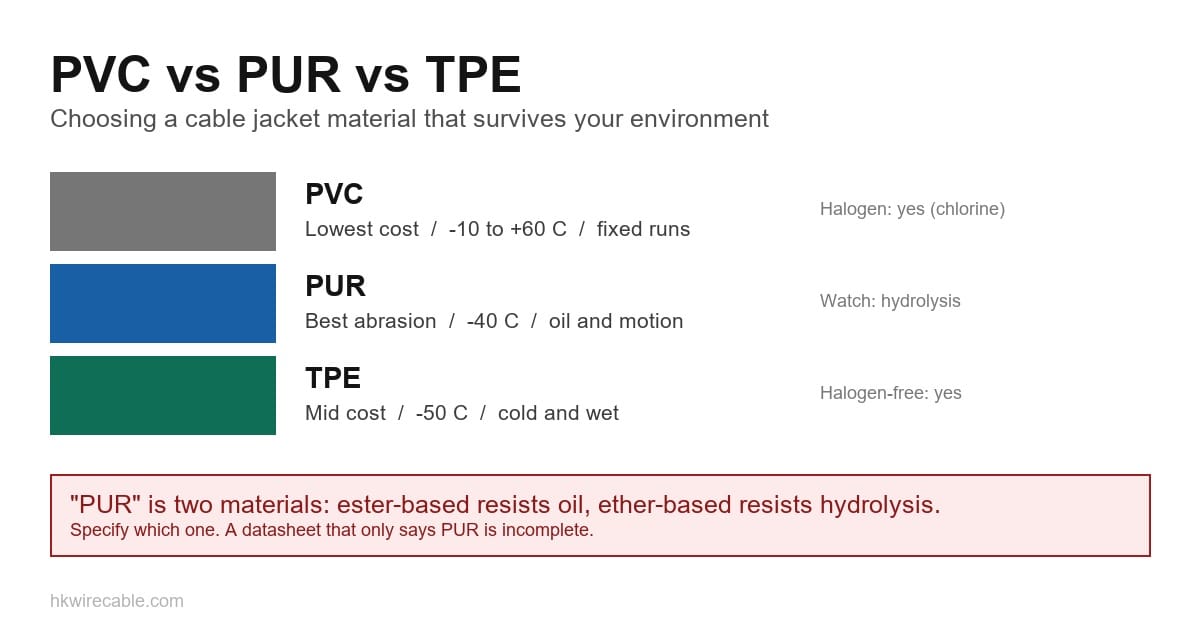
Here is the short answer on the PVC vs PUR vs TPE choice before the detail: use PVC for fixed, indoor, dry, budget-sensitive runs; use PUR when there is oil, abrasion or continuous motion; use TPE when you need cold flexibility and hydrolysis resistance but cannot justify PUR’s price. The interesting part is where that rule breaks, why two cables both labeled “PUR” can behave completely differently in the same machine, and why the jacket you can print a serial number on is not always the jacket you expected.
This guide goes past the one-line comparison. We walk through what each polymer actually is, the ester-vs-ether PUR split that most datasheets hide, how temperature and chemical ratings are really defined, what the abrasion numbers mean, how printable each material is for traceability marking, and how to write a jacket specification a supplier can actually quote instead of a vague “tough cable.” For the 14-post deep-dive version of the related selection topics, see our pieces on halogen-free and oil-resistant jackets and oil-resistant material selection.
PVC vs PUR vs TPE: quick comparison
| Property | PVC | PUR | TPE |
|---|---|---|---|
| Relative material cost | Lowest | Highest | Between the two |
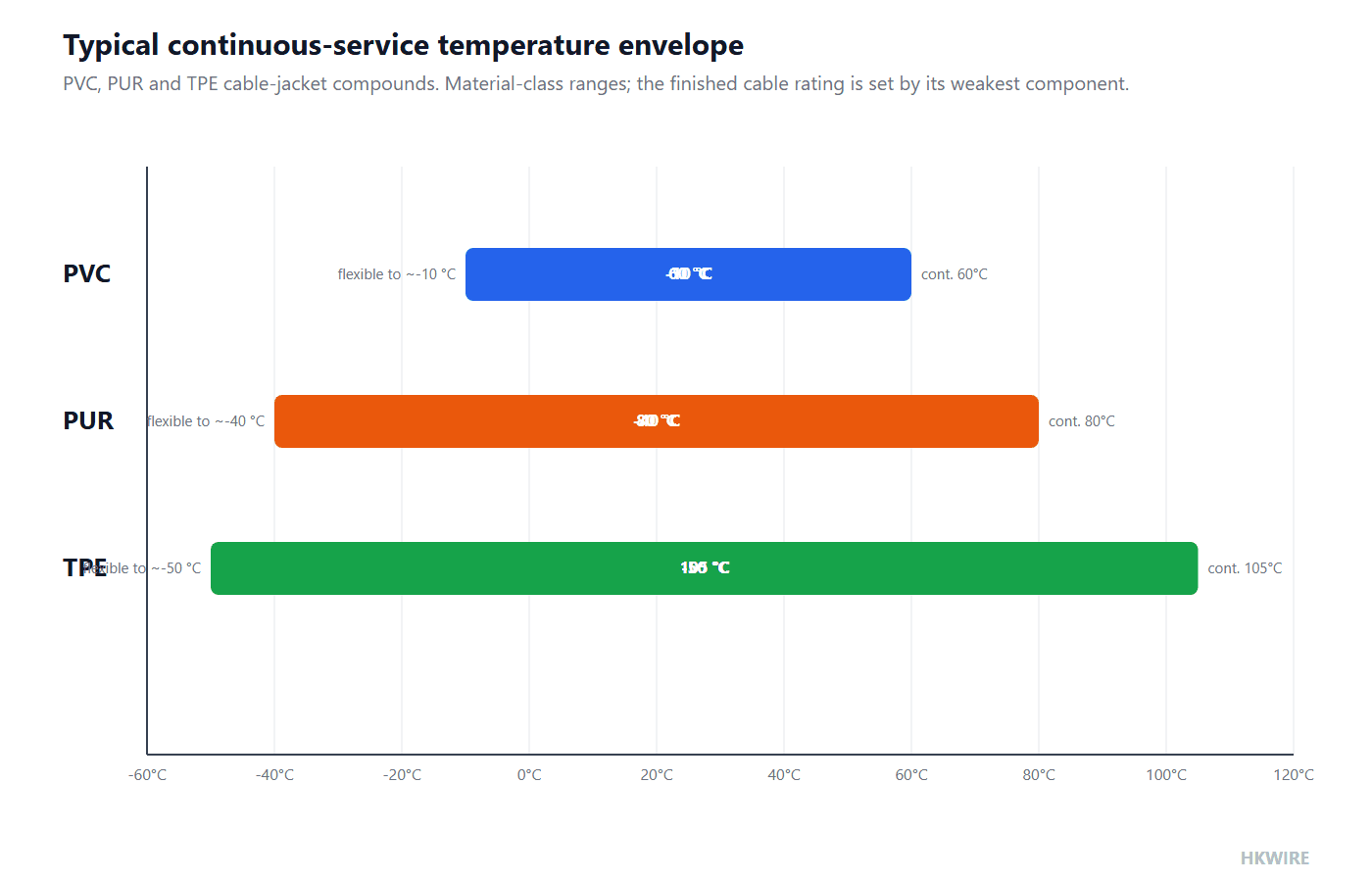
| Typical operating window | -10 to +60 °C (CM grade) | -40 to +80 °C and beyond | -50 to +105 °C class |
| Low-temperature behavior | Stiffens below about -10 °C | Stays flexible to -40 °C | Stays flexible to -50 °C |
| Mineral oil and coolant | Softens and swells | Excellent | Good to excellent |
| Abrasion and cut resistance | Moderate | Best of the three | Good |
| Hydrolysis (hot and humid) | Good | The weak point | Excellent |
| Continuous torsion (±360°) | Not suitable | Best of the three | Adequate single-axis, weaker in torsion |
| Halogen-free versions | No — chlorine-based by chemistry | Yes | Yes |
| Recyclability | Limited | Limited | Easiest of the three |
Those ranges are material-level guidance, not a datasheet promise. The rated temperature on a finished cable depends on insulation, stranding and screening too. As a concrete example from our own catalog, a standard Cat5e UTP patch cord with a PVC CM jacket is rated -10 °C to +60 °C, while the Cat6A S/FTP version with a PUR jacket carries -40 °C to +80 °C. Same category, same connector, completely different envelope — the jacket is doing that work.
Temperature windows at a glance
Before the chemistry, it helps to see the PVC vs PUR vs TPE temperature envelopes side by side. The chart below plots the typical continuous-service temperature range for each compound, with the low-temperature flexibility limit marked on the left end of each bar. These are material-class figures; a finished cable’s rating is set by the weakest component (insulation, screen, adhesive) and the test standard behind the claim.
What each material actually is
PVC (polyvinyl chloride)
In the PVC vs PUR vs TPE set, PVC is the budget default — a thermoplastic built from vinyl chloride monomer. It is cheap, easy to extrude, inherently flame-retardant because of its roughly 50% chlorine content by weight, and available in every color. It is the default for building wiring and general-purpose patching, and it is the right answer far more often than cable marketing would have you believe. The soft, flexible jacket grade is achieved with phthalate or non-phthalate plasticisers that make the compound extrudable and supple; the rigid conduit grade is a different animal and rarely used as a cordset jacket.
Two hard limits come with it. The first is plasticiser migration: the additives that make PVC flexible slowly leave the compound, so the jacket stiffens with age and then cracks. The second is chemistry — when PVC burns it releases hydrogen chloride, which becomes hydrochloric acid on contact with moisture. That is why halogen-free specifications exist, and why the acid-gas test in IEC 60754 and the smoke density test in IEC 61034 are written the way they are. A cable only earns a genuine low-smoke zero-halogen claim by passing them; “PVC but eco” is not a thing.
PUR (polyurethane)
PUR is the workhorse of the PVC vs PUR vs TPE trio: a thermoplastic or thermoset polyurethane elastomer. It is the material you specify when the cable is going to be rubbed, dragged, splashed with cutting fluid or wrapped around a moving axis. It has the highest tear and abrasion resistance of the three, it shrugs off mineral oils, synthetic esters and most coolants, and it stays flexible well below freezing. PUR is not a single chemistry — see the split below — which is why “PUR” on a quote can mean two very different failure modes.
The price — literally and figuratively — is hydrolysis. In hot, humid conditions the polymer chains in some PUR formulations break down, and the jacket loses mechanical strength. This is not a laboratory curiosity: it is the normal failure mode for a PUR cable running through a washdown area or a humid subtropical plant. How badly it affects you depends on which type of PUR you were sold, which brings us to the most important section in this article.
TPE (thermoplastic elastomer)
TPE rounds out the PVC vs PUR vs TPE trio: an umbrella term for a family of materials that behave like rubber but process like thermoplastics — no vulcanisation, so they can be extruded and recycled. For cable jackets the relevant members are TPE-E (thermoplastic copolyester elastomer, often sold as TPC) and TPU (thermoplastic polyurethane). TPE sits between PVC and PUR on most axes: it processes cleanly, recycles more easily, stays flexible at lower temperatures than PVC, and costs less than PUR. It resists hydrolysis where ester-based PUR does not.
Its weak point is mechanical under sustained, multi-axis torsion: it develops cracks sooner than PUR, which is why material-selection charts for six-axis robot wrists usually point at PUR rather than TPE. You will frequently see TPE and TPU quoted on the same datasheet; our M8 3-pin sensor cables list “PVC / TPU” as jacket options for exactly this reason — the TPU variant is the one you want if the cable sees coolant.
The PUR split nobody puts on the datasheet
Here is the part that most PVC vs PUR vs TPE comparisons skip entirely. “PUR” is not one material. It is two, and they fail in opposite environments.
- Ester-based PUR (polyester polyol soft segments). Denser molecular structure, higher surface hardness, better abrasion figures and better resistance to mineral oil, hydraulic fluid and cutting emulsion. It is the correct choice for a dry, oily, high-cycle horizontal drag chain.
- Ether-based PUR (polyether polyol soft segments). The ether linkage is far more stable against water, so this type resists hydrolysis and keeps its elasticity at low temperature. It is the correct choice for wet areas, outdoor humidity, coolant spray and cold storage.
The trade runs both ways: ether types give up some oil and abrasion performance to get that hydrolysis resistance. If your supplier quotes “PUR” without telling you which soft segment they used, you are buying an unknown. For a buyer the rule is simple: in a dry, oily, abrasive, room-temperature drag chain, ester-based PUR wins; anywhere hot, wet or cold-and-wet, ask for ether-based — or step up to TPE-E, which resists hydrolysis by default.
This is not academic for us. The hybrid robot torsion cable we build for six-axis arms specifies polyether polyurethane precisely because it combines continuous torsion duty with coolant exposure — the two conditions that kill an ester-based jacket fastest. Where the requirement is pure high-cycle bending in oil rather than torsion, the M12 drag chain cable uses a high-flex PUR formulation aimed at abrasion instead.
The ISO 4649 abrasion test (DIN abrasion, volume loss in mm³) is the usual way these differences get quantified, and flex life is measured on a reciprocating or rotaryFlex rig to a cycle count at a defined bend radius and load. If a supplier quotes a flex life or an abrasion figure without naming the test standard and the grade, treat it as an opinion rather than a specification.
Where each material earns its keep
Choose PVC when
- The run is fixed. Inside a cabinet, along a cable tray, behind a panel, in a ceiling void.
- The environment is dry, indoors and above freezing.
- Unit cost is the dominant constraint and you are buying by the hundred.
- You need the flame-retardant rating that PVC’s chlorine chemistry gives you for free.
Fixed industrial Ethernet is the classic case in the PVC vs PUR vs TPE lineup. M12 B-coded PROFIBUS cordsets are offered in PUR or PVC, and for a static junction box in a dry plant the PVC build is the sensible buy.
Choose PUR when
- There is motion: drag chains, gantries, robot arms, cobot wrists.
- There is oil or coolant. PVC swells when it meets mineral oil, and a swollen jacket rubs against the carrier wall, which multiplies the wear rate.
- Abrasion is the expected failure mode — metal chips, concrete floors, weld spatter.
- You need low-temperature flexibility down to -40 °C.
Every moving cable we build defaults to PUR in the PVC vs PUR vs TPE ranking for this reason. The Cat6A GigE Vision screw-lock cable uses high-flex PUR with oil and coolant resistance because it lives on a machine-vision rig; the robot teach pendant cable uses PUR because it is coiled and uncoiled all shift; the KUKA motor power cable and FANUC encoder cable both specify drag-chain-rated, oil-resistant PUR.
Choose TPE when
- You need cold flexibility and hydrolysis resistance but PUR is over budget.
- The motion is single-axis bending rather than continuous torsion.
- Halogen-free and recyclability are written into the specification.
- The application touches food, where a halogen-free TPE or PUR jacket is easier to document.
Washdown duty is the clearest example of TPE earning its PVC vs PUR vs TPE slot. Our M12 IP68 / IP69K food-grade cable with a 316L stainless coupling nut is offered with TPE or halogen-free PUR jacket depending on the cleaning chemistry and temperature the line runs at.
Printability and traceability
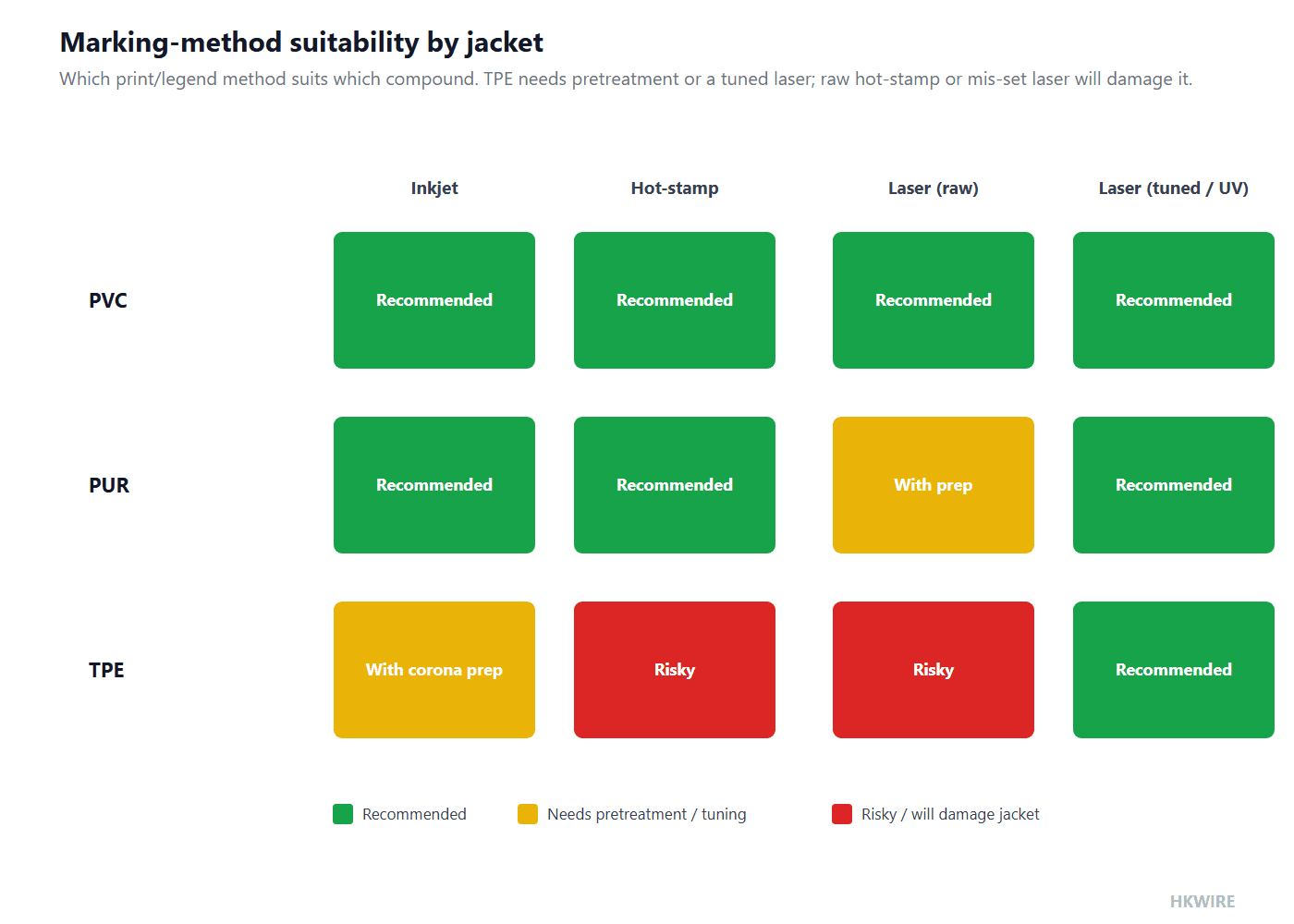
Printability is where PVC vs PUR vs TPE diverge in a way datasheets rarely mention, and it matters the moment a quality auditor asks why the legend on your TPE cordsets rubs off. PVC takes inkjet, hot-stamp and laser marking readily — its surface energy is high enough for standard inks to bite, and its heat-distortion temperature is well above normal marking temperatures. PUR sits in the middle: it prints cleanly with most methods, though low-durometer grades benefit from light surface treatment.
TPE is the awkward one, and the reason is physics rather than a manufacturing shortcut. Its rubber-like surface has very low surface energy, so plain ink has little to grab and tends to flake off under bending, abrasion or skin oils — which is why an untreated TPE jacket can look unmarked in service even after leaving the line printed. Hot-stamping is risky too: TPE’s lower heat-distortion temperature means the pressure and heat that emboss PVC can dent or partially melt a TPE jacket, and a dented jacket is a strain-relief weak point. Laser marking works, but only tuned — a mis-set fiber or CO₂ laser scorches TPE (white burn, fragile edge), whereas a UV or properly parameterized laser leaves a clean mark.
The practical fix is to treat marking as an engineered step, not a default. For TPE specify corona or plasma surface pretreatment ahead of ink, or a laser spec matched to the compound; for PUR a light treatment widens the process window; for PVC standard methods are fine. If you need permanent batch or serial traceability on a TPE run, say so at quote stage — do not discover at incoming inspection that the legend wipes off. None of this rules TPE out; it just moves marking from “it prints” to “it stays printed.” For the connector side of the same problem, see our note on specifying overmolded assemblies, where the overmould material is often the real limit on what you can mark. For a production run, the marking step belongs in the drawing, not the rework bay: specify the method and an acceptance criterion (legible after a defined number of bend cycles, a solvent wipe and a thermal cycle) so the supplier proves it rather than promises it.
The fourth option: fluoropolymers
Sometimes none of the PVC vs PUR vs TPE trio will do. Semiconductor, vacuum and cleanroom environments rule PVC out on outgassing grounds alone, and push the temperature requirement past what PUR or TPE can hold.
For those jobs the jacket becomes FEP, PFA or ETFE. Both our cleanroom robot cable harness for EFEM and vacuum transfer arms and our wafer handling robot harness are built with fluoropolymer jackets and are explicitly PVC-free, because a PVC jacket in an ISO Class 1 zone is a contamination source rather than a cable. Medical and surgical builds go a different way again — the surgical robot harness is normally specified in TPU or silicone for biocompatibility and repeated sterilisation.
The point for a buyer is simply this: if someone offers you a PVC-jacketed cable for a vacuum chamber or an operating room, they have not read the specification.
Silicone: the wide-temperature outlier
One material keeps surfacing in those “none of the three will do” conversations, so it earns its own note: silicone rubber. Unlike PVC, PUR and TPE, silicone is a thermoset — it is cross-linked during curing and cannot be re-melted or reground like a thermoplastic. That single fact is why it belongs here as a special-case jacket, not as a fourth row in the PVC vs PUR vs TPE table.
The headline property is temperature. A silicone jacket holds a continuous service range of roughly −60 °C to +180 °C (some grades to +200 °C), far beyond what PUR or TPE can reach and well past PVC’s limit. That is why silicone appears in heater leads, oven and steriliser wiring, EV high-voltage cabling and railway rolling stock, where the ambient or fault temperature simply exceeds what a thermoplastic jacket survives; on the cold end it stays flexible where PVC would crack. We build these as custom silicone wire harnesses — the jacket is only half the spec, because the stranded construction, shielding and connector sealing decide whether the assembly survives its rated temperature in real service.
Flexibility is the other draw. Silicone has a very low modulus, so it remains supple and resists bend-fatigue better than TPE in tight-radius, low-force service — medical and food-grade harnesses rely on exactly this, plus biocompatibility and repeated autoclave cycles. It is also inherently flame-retardant (no dripping), low-smoke and halogen-free in combustion, with outstanding resistance to ozone, UV and weather ageing.
The trade-offs are mechanical. Silicone’s tear and cut-through strength are poor: a sharp edge or a hard pull will split a bare silicone jacket where PUR would shrug it off, so it is almost always braided, screened or over-jacketed in real builds. Standard silicone also dislikes oil — ordinary silicone rubber swells in petroleum-based fluids, the opposite of PUR; fluorosilicone (FVMQ) restores oil resistance at a steep cost premium. It takes up moisture more readily than the thermoplastics, which lowers volume resistivity in humid service, and the cross-linked structure means off-cuts cannot be reground and reused.
For marking, the printability notes above apply unchanged: low surface energy means untreated ink flakes off and a mis-set laser scorches the surface, so silicone legending needs corona/plasma pretreatment or a tuned UV laser — another reason it is an engineered step, not a default.
One confusion to head off: TPSiV and similar silicone-modified TPEs are thermoplastic and recyclable and borrow some of silicone’s softness, but they are not silicone and do not reach its temperature ceiling. If a spec says “silicone,” confirm whether it means true cross-linked silicone rubber or a silicone-touch TPE, because the temperature and oil ratings are not interchangeable with the PVC vs PUR vs TPE materials you would otherwise quote.
Temperature: what the rating really means
For PVC vs PUR vs TPE, temperature is not one number. “-40 to +80 °C” looks precise, but it bundles at least three different claims, and mixing them up is how cables fail.
- Continuous service temperature. The temperature the jacket can sit at indefinitely and still meet its mechanical and electrical ratings. This is the figure you should design to.
- Peak / short-term temperature. What it survives for minutes or hours (a weld spark, a sterilization cycle). A cable rated 80 °C continuous may tolerate 100 °C for a short excursion, but that is not a duty rating.
- Flexibility limit (cold bend). The temperature below which the jacket stiffens and cracks instead of bending. This is usually far above the lower service-temperature number — PVC that is “rated -10 °C” may already be brittle at -15 °C, while PUR and TPE stay supple tens of degrees lower.
As a practical rule, every 20 °C above the continuous rating roughly halves the service life of an organic jacket polymer, so the continuous figure — not the peak — is what the design should be built around. For a defensible number, look for a temperature index from IEC 60216 (time to a defined property drop at a set temperature) rather than a marketing range. And keep the jacket rating separate from the cable rating: a PUR jacket rated -40 °C does not make a PVC-insulated conductor inside it rated -40 °C. The assembly is only as cold-flexible as its coldest-rated component.
Chemical and oil resistance
| Exposure | PVC | PUR (ester / ether) | TPE (TPE-E / TPU) |
|---|---|---|---|
| Mineral oil & hydraulic fluid | Poor — swells, softens | Excellent / Excellent | Good–Excellent |
| Synthetic ester & cutting emulsion | Poor | Good / Excellent | Good–Excellent |
| Water, humidity, hydrolysis | Good | Ester weak / ether good | Excellent |
| Acids & alkalis (dilute) | Moderate | Good / Good | Good |
| Aliphatic solvents | Poor | Moderate / Moderate | Moderate |
| Ozone & weather | Moderate | Good / Good | Good |
| UV (outdoor, long term) | Moderate (stabilised grades better) | Good | Good (carbon-black grades best) |
The PVC vs PUR vs TPE chemical table below is material-class guidance. Two cautions. First, “PUR resists oil” is only true for the ester type against mineral oil; the ether type trades some oil resistance for hydrolysis resistance, so an ether-PUR in straight mineral oil is weaker than an ester-PUR. Second, TPE-E and TPU are not identical — TPU tracks PUR’s oil behavior more closely, while TPE-E leans toward the hydrolytically stable end. If the fluid is named in your specification, ask for a resistance statement against that exact fluid, not a generic “oil-resistant.” When in doubt, send the supplier the actual fluid data sheet; resistance to “oil” is not one property. Our oil-resistant material selection guide goes deeper on matching fluid to compound, and on why a named fluid beats a generic claim every time.
Abrasion, flex life and the numbers
On abrasion, PVC vs PUR vs TPE sort themselves by ISO 4649 volume loss. “Abrasion-resistant” is not a number until a standard is attached. The two figures that actually mean something:
- ISO 4649 (DIN) abrasion volume loss in mm³: lower is better. PUR typically posts the lowest volume loss of the three; TPE-E sits close behind; plasticised PVC is highest because the soft surface wears fastest. Treat any single number as grade-specific — a 95A PUR and an 85A PUR do not wear the same.
- Flex life in cycles at a defined bend radius, load and temperature on a reciprocating or rotary flex rig. This is the number that predicts drag-chain survival, and it is where ester-vs-ether PUR and TPE-vs-PUR diverge hardest: PUR wins sustained torsion, TPE wins on hydrolysis-prone single-axis bending at lower cost.
The grade matters as much as the material: a 95A PUR and an 85A PUR post different ISO 4649 numbers, and a TPE-E and a TPU are not the same compound despite sharing the TPE label. Do not compare a vendor’s flex-life number to another vendor’s unless the test (radius, load, temperature, conductor) matches. A 10-million-cycle claim at a generous radius in a warm lab is not the same cable as a 10-million-cycle claim at a tight radius in a cooled cell. The drag-chain cable selection guide covers how to read those test conditions.
Flame, smoke and halogen
Flame and halogen is where PVC vs PUR vs TPE pull apart. PVC’s chlorine content makes it self-extinguishing, which is why it dominates building and cabinet wiring — but it also means it is not halogen-free. In a fire, burning PVC releases hydrogen chloride (corrosive, toxic) and dense smoke. Where a specification calls for low smoke zero halogen (LSZH / LS0H), you move to a halogen-free PUR or TPE compound, or a special LSZH thermoplastic, and you give up some of PVC’s cheap, easy flame retardancy in exchange.
Rail (EN 45545), marine and some industrial certifications tie the jacket choice to required smoke and toxicity limits, not just to oil resistance. If the end application is a train, a ship or a public building, the halogen question overrides the cost question — and it usually rules PVC out. Our halogen-free jacket guide lays out which compounds clear those tests.
How to write a jacket specification
The single biggest cause of a wrong PVC vs PUR vs TPE jacket is a vague purchase order. “Tough cable” is not buyable; “PUR, oil-resistant to EN 60811-404, halogen-free, flex-rated to 5M cycles at 5× OD, -25 °C cold bend” is. A usable spec names four things:
- Material and grade. “PUR, ether-based” not just “PUR”; “TPE-E” not just “TPE.”
- The duty numbers. Bend radius, cycle count, load, fluid type and temperature — the conditions the cable actually sees, not the marketing envelope.
- The test standard. ISO 4649 for abrasion, a named flex-life rig, IEC 60216 for temperature, IEC 60754 / 61034 for smoke and halogen.
- The marking requirement. If you need a permanent legend (batch, serial, rating) on a TPE run, state the marking method so the supplier pre-treats or laser-tunes instead of discovering at inspection that the print rubs off.
A good supplier will often specify a cheaper jacket than you assumed, because once the real duty is on the table the application frequently does not need the expensive compound. The spec is what turns a guess into a quote.
Cost, and where mixed installations make sense
On cost, PVC vs PUR vs TPE is rarely a fair fight: on unit price PVC wins outright, and for a 500-piece order of static patch cords that is usually the whole argument. But jacket cost is a small fraction of the cost of a cable failure on a running line, and this is where a purely per-meter comparison misleads.
The pattern we see most often in real B2B orders is a mixed specification: PVC inside the cabinet and in the fixed horizontal run, PUR from the cabinet wall to the machine and anywhere there is motion. You pay PUR prices for perhaps a third of the cable and get almost all of the reliability benefit, because the section that moves is the section that fails. The jacket you over-specify on the fixed run is money you could have spent on the section that actually wears out.
Two practical notes on quoting. First, specify the material and the test standard, not a brand name. Second, state the environment at quote stage. Bend radius, cycle count, fluid type and ambient temperature change the material recommendation, and a supplier who knows the duty will often specify a cheaper jacket than you assumed because the application does not need the expensive one.
Common mistakes
- Assuming PUR is always the upgrade in the PVC vs PUR vs TPE set. In a hot, wet, static installation an ester-based PUR can degrade faster than PVC, at two to three times the material cost.
- Reading “CM” as a universal indoor rating. A CM jacket is general purpose. It is not a riser rating (CMR) and it is not a plenum rating (CMP). Substitution runs one way only — a higher rating may replace a lower one, never the reverse. Check the jacket print legend before it goes into a ceiling void used as a return air path.
- Specifying TPE for a six-axis wrist. TPE handles single-axis bending well and sustained torsion poorly. Robot body and wrist cabling is the exception, not the rule.
- Judging a jacket by how it feels on the day it arrives. Plasticiser migration means PVC feels fine when new and stiffens over years. The datasheet temperature range is the number that matters.
- Forgetting the connector overmould. The jacket is only part of the seal. A PUR cable with a PVC overmould still has a PVC weak point at the strain relief — and, as above, a TPE jacket with an untreated print legend is a traceability gap, not a feature.
- Trusting a flex-life number without the test conditions. Radius, load, temperature and conductor make or break the claim. Match the rig before you compare the cycles.
FAQ
Is PUR always better than PVC?
No. In the PVC vs PUR vs TPE set, PUR wins on abrasion, oil, cut resistance and low-temperature flexibility, and it is the right call wherever there is motion. But it costs more, it is vulnerable to hydrolysis in hot humid conditions, and for a fixed indoor run in a dry plant PVC will outlast the equipment it is wired into. Match the material to the duty, not to the price list.
What is the difference between ester-based and ether-based PUR?
Ester-based PUR has better abrasion and oil resistance and is preferred for dry, oily, high-cycle drag chains. Ether-based PUR resists hydrolysis and stays flexible in the cold, and is the one to specify for wet areas, outdoor humidity, coolant spray and cold storage. If a datasheet says only “PUR”, ask which soft segment it uses — the answer changes the failure mode.
When should I choose TPE?
For the PVC vs PUR vs TPE decision, choose TPE when you need cold flexibility below -40 °C, or hydrolysis resistance, or a halogen-free and more recyclable compound, and the motion is single-axis bending rather than continuous torsion. It typically costs less than PUR. For six-axis robot wrists and sustained ±360° torsion, specify PUR instead. If you need a permanent print legend on TPE, specify the marking method up front.
Can you print a serial number on a TPE jacket?
Yes, with the right process. Bare ink flakes off TPE’s low-surface-energy skin, and raw hot-stamp or a mis-set laser can dent or scorch it. Corona or plasma pretreatment ahead of ink, or a UV / tuned laser, gives a mark that survives service. State the marking requirement at quote stage so it is engineered in rather than discovered missing at inspection.
Is TPE the same as TPU?
No, but they overlap. TPU (thermoplastic polyurethane) is a TPE family and is the TPE grade closest to PUR in oil behavior. TPE-E (thermoplastic copolyester) is the other common cable grade and leans toward hydrolysis stability. On a quote, “TPE” should be read as “which TPE family” before you assume any property.
How do I read a jacket temperature rating?
Separate continuous service temperature, peak temperature and cold-bend (flexibility) limit — they are three different numbers. Design to the continuous figure, and check a temperature index (IEC 60216) rather than a marketing range. Remember the assembly is only as cold-flexible as its coldest-rated component, jacket included.
Last updated: September 2026