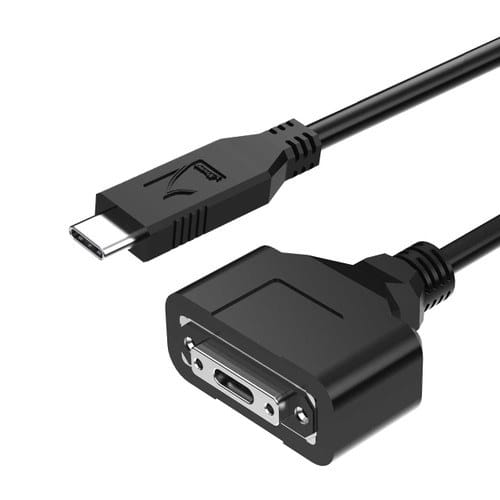
Waterproof USB-C Panel Pigtail, 10 Gbps with Dual Screw Lock
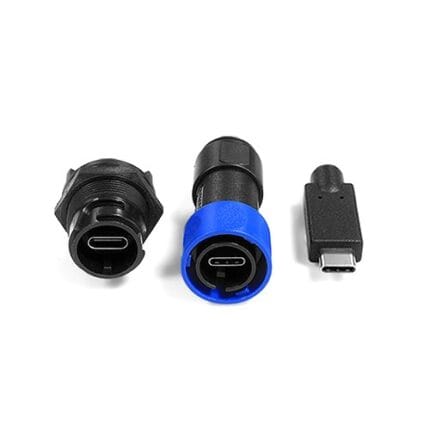
A waterproof USB-C panel pigtail gives an outdoor enclosure a Type-C port that stays put under vibration and stays sealed in the weather. Dual screw lock outside, molded tail inside, Two fixings hold the plug, and the molded tail takes the strain at the housing, not at the contacts.
Last updated: 13 September 2026
Overview
A waterproof USB-C panel pigtail gives a machine enclosure a Type-C port that stays put under vibration and stays sealed in the weather. The outside face is a Type-C receptacle in a threaded housing held by two screws; the inside is a captive cable tail that terminates on the equipment board or on a bulkhead feed. Because the tail is molded into the housing, there is no second connector inside the cabinet to work loose, which is the usual failure mode for a port built from a coupler and a patch lead.
Key Specifications
| Outside interface | USB Type-C receptacle, dual screw lock |
|---|---|
| Inside termination | Molded pigtail, tail length 0.2 / 0.3 / 0.5 / 1 / 2 m (pending confirmation) |
| Data rate | USB 3.2 Gen 2, 10 Gbps (design target, pending supplier datasheet) |
| Power delivery | PD 3.0 up to 100 W; PD 3.1 EPR 240 W optional (pending confirmation) |
| Alternate mode | DisplayPort Alt Mode (design target, pending supplier datasheet) |
| Panel cut-out | 12 mm or M21 x 1.5 threaded body (design target, confirm before cutting) |
| Ingress rating | IP67 / IP68 in mated condition (pending supplier test report) |
| Jacket | TPE, nominal OD 4.8 mm (pending supplier confirmation) |
| Mating cycles | Up to 10000 (pending supplier datasheet and test method) |
| Sealing | O ring plus locknut, screw cap when not in use |
| Strain relief | Molded tail with the bend relief at the housing, potting optional |
| Typical use | Outdoor enclosures, roadside cabinets, machine vision stations, marine panels |
Dual screw lock: retention is a load path problem
A bare Type-C receptacle is retained by friction in the housing and by nothing at all at the plug. On a machine that runs, on a gantry that moves, or on a cart that is wheeled across a floor, the plug rocks, the contacts wear, and the port becomes intermittent. The dual screw lock takes the retention load off the contacts: the plug is held by two fixings on the housing, so the mating force and the vibration load are carried by metal rather than by the spring contacts.
| Failure | Cause | What the dual screw lock changes |
|---|---|---|
| Intermittent link | Plug rocks in the receptacle | Two fixings hold the plug square |
| Worn contacts | Vibration load carried by the spring contacts | Load carried by the housing and panel |
| Cracked panel around the port | Cable load fed into the flange | Cable load fed into the fixings |
| Water in the enclosure | Gasket disturbed by a rocking plug | Gasket stays compressed |
| Lost plugs | Friction-only retention | Positive mechanical retention |
If the port is on a vehicle, a vessel, a moving gantry or an outdoor cabinet that gets leaned on, specify the screw lock and not the snap-in version. It is a small addition to the bill of materials and it removes the most common field fault on the part.
The tail: strain relief, dressing and potting
Outdoor enclosures fail at the back of the port more often than at the front. The tail is molded into the housing so the bend relief starts where the cable leaves the body rather than 10 mm down the cable where the flexing does the damage, and the jacket is TPE so it stays flexible in the cold. What happens after that is down to the installer.
| Detail | Why it matters outdoors | How we build it |
|---|---|---|
| Bend relief at the housing | Flexing at the exit is what breaks conductors | Molded tail, relief starting at the body |
| Tail length | Too short and it is strained; too long and it fouls the door | 0.2 to 2 m, set by the enclosure depth |
| Strain relief clamp | A tail hanging from the port pulls on the seal | Clamp the tail inside the cabinet, close to the port |
| Drip loop | Water runs along the cable into the enclosure | Dress the tail below the port entry where the build allows |
| Potting | Condensation and capillary travel along the strands | Potted version available for unmated or high-humidity exposure |
| Cap when unused | IP67 is a mated-condition rating | Screw cap supplied |
Potting is worth specifying on anything that sees condensation, not just rain. A tail that runs from a cold enclosure into warm humid air will wick water along the strands and deliver it to a board that has never seen a drop of rain. Where that is the risk, ask for the potted version and keep the screw cap on the outside face. The IP code quoted for this class of part is a mated-condition rating, so an open port is an unsealed port however good the gasket is.
Cut-out, O ring and mounting
Comparable parts on the market use either a 12 mm aperture with a small flange or an M21 by 1.5 threaded body. Both are design targets taken from published competitor data; confirm which variant you are buying, and its cut-out diameter, against the supplier drawing before the panel is cut. The O ring and locknut seal the flange against the panel face, and the O ring has to sit on the mating face rather than being pinched by the nut. A twisted or pinched O ring is the single most common reason a correctly specified port still leaks.
Ratings we will not quote without a datasheet
Data rate, power delivery, alternate mode support, ingress rating and mating cycles for this range all come from the published figures of comparable products, and every one of them is a design target until the supplier datasheet for the exact construction is on file. Power delivery in particular depends on the e-marker in the cable and on the source and sink devices, not on the connector alone, so a 100 W figure is a system figure.
Where this waterproof USB-C panel pigtail gets installed
- Outdoor enclosures and roadside equipment cabinets with a service port
- Service and diagnostic ports on electric vehicle maintenance equipment
- Marine instrument panels and helm consoles exposed to spray
- Clinical and laboratory carts, where device-level approval stays with the equipment manufacturer
How to specify your build
- Cut-out – 12 mm flange or M21 by 1.5 threaded, off your enclosure drawing.
- Panel thickness at the mounting point, and what the panel is finished with.
- Tail length and what it terminates on inside the cabinet.
- Power and data – the profile and the rate you actually need.
- Potting – yes or no, and what the condensation risk is.
- Quantity, and whether this is a prototype or a production order.
Workmanship and testing
ISO 9001 governs the line and IPC/WHMA-A-620 Class 3 governs the workmanship. Terminations cover 32 to 12 AWG. No unit is packed before continuity and pinout have been verified, and where an ingress rating is specified we can quote seal checking on the production batch.
Custom builds and ordering
Prototypes are quoted from 5 pcs and ship within 3 working days. Volume production starts at 500 pcs with a 14 working day lead time after approval, and about 10 working days more when a new tool is needed. Private labeling carries your part number, and material certificates with first-article reports are available on request.
Related USB-C and panel hardware
- IP67 Waterproof USB-C Screw Cable, USB 3.2 Gen 2×2 20Gbps, Panel Mount
- USB 3.1 Type-A Male to Type-C Female Screw-Lock Adapter Cable
- Right-Angle USB Type-C Male to Male Screw-Lock Cable
- USB-C Screw Locking Cable, Side or Top 10Gbps 100W / 240W
- USB-C Gen2 Data Cable, 10 Gbps, with 100 W Power Delivery
- Flush Mount USB-C Receptacle, Threaded M21 Body for Dash Panels
Full ranges: panel mount cable and signal and data cables.
Frequently Asked Questions
Why a pigtail instead of a second receptacle inside?
A second receptacle is a second connector to work loose inside a cabinet that vibrates. The molded tail removes that joint and takes the strain at the housing, where the relief is designed for it.
Is the screw lock worth it indoors?
If the machine moves, yes. On a fixed indoor panel friction is usually enough, but on a gantry, a cart or a vehicle the screw lock is the difference between a port that lasts and one that goes intermittent.
What does potting actually protect against?
Condensation and capillary travel along the strands, which is how water reaches a board in an enclosure that has never been rained on. Specify it where the temperature swings across the dew point.
| Outside interface | USB Type-C receptacle, dual screw lock |
|---|---|
| Inside termination | Molded pigtail, tail length 0.2 / 0.3 / 0.5 / 1 / 2 m class |
| Data rate | USB 3.2 Gen 2, 10 Gbps class |
| Power delivery | PD 3.0 up to 100 W; PD 3.1 EPR 240 W optional class |
| Alternate mode | DisplayPort Alt Mode |
| Panel cut-out | 12 mm or M21 x 1.5 threaded body class |
| Ingress rating | IP67 / IP68 in mated condition |
| Jacket | TPE, nominal OD 4.8 mm class |
| Mating cycles | Up to 10000 class |
| Sealing | O ring plus locknut, screw cap when not in use |
| Strain relief | Molded tail with the bend relief at the housing, potting optional |
| Typical use | Outdoor enclosures, roadside cabinets, machine vision stations, marine panels |
Related products
SPE Bulkhead Panel Connector for 10BASE-T1L Field Devices
An SPE bulkhead panel connector brings 10BASE-T1L single pair Ethernet and Power over Data Line into a field device box through one sealed penetration. IEC 63171-6 mating face or M8 coupling, front or rear mounting. The cut-out is smaller and the termination is faster than a four-pair Ethernet entry.