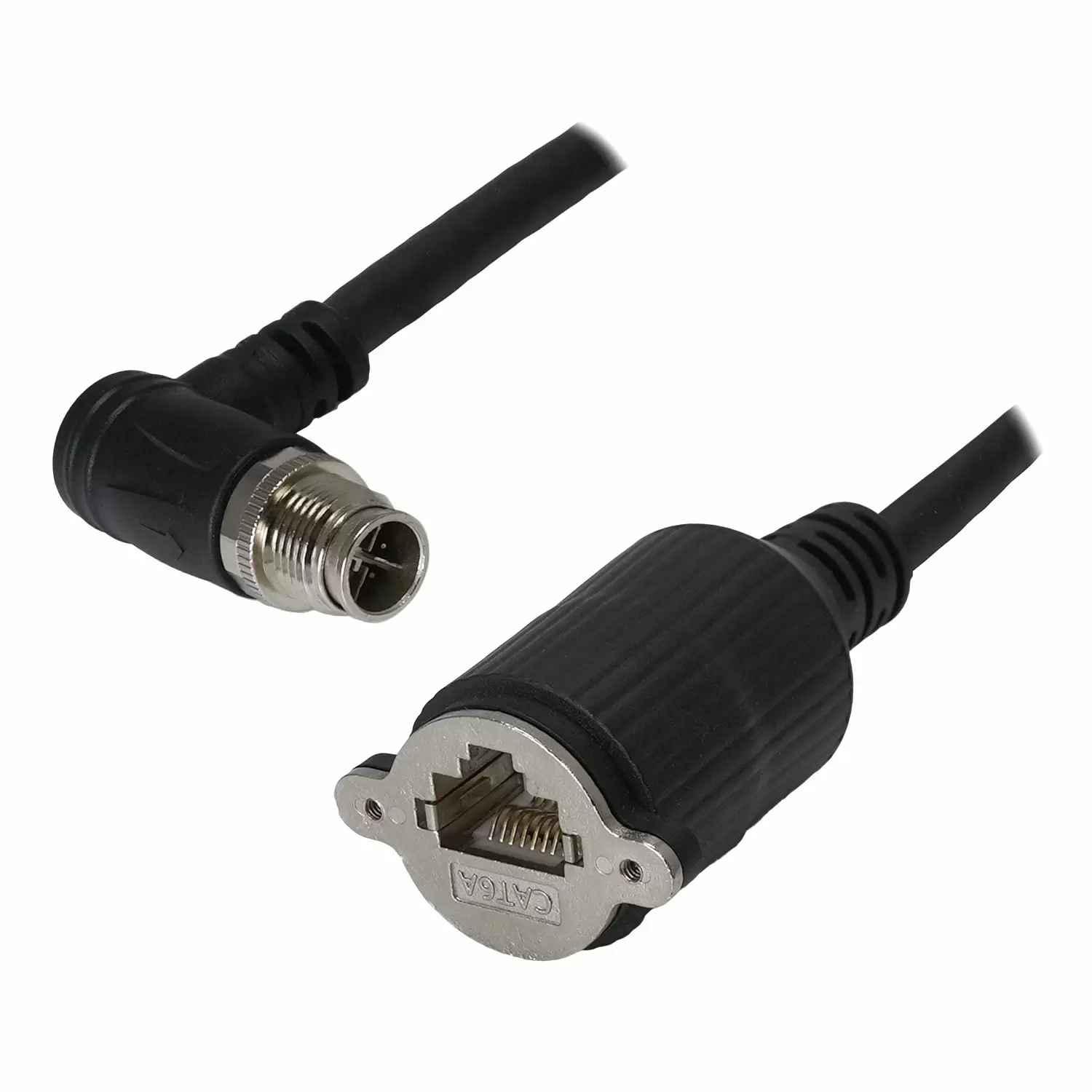
IP69K Screw Lock Cable for RJ45 and M12 Gigabit Vision Links
An IP69K screw lock cable for camera and PLC links on lines that get hosed down with hot water and detergent every shift. Screw-lock RJ45 or M12 8-pin couplings, PUR or stainless braid jacket, sealed at the mated pair, which is the only condition that matters on the line.
Overview
A food line is hosed at short range with hot water and detergent at the end of every shift, then sits wet and cold overnight. Weatherproof hardware is not designed for that cycle. This IP69K screw lock cable is built for the washdown class: sealed screw-lock couplings, a jacket selected against repeated chemical attack, and a strain relief that does not pump water along the core when the jet hits the gland.
Key Specifications
| Cable type | Washdown grade Gigabit Ethernet cordset |
|---|---|
| Connector A | Screw-lock RJ45 or M12 8-pin, threaded coupling |
| Connector B | Screw-lock RJ45 or M12 8-pin, straight or right angle |
| Conductor | AWG26 S/FTP, four individually foiled pairs, pending confirmation |
| Jacket options | Polyurethane, stainless steel braid, 316L stainless shell variant |
| Ingress protection | Washdown class when mated, test report pending |
| Minimum bend radius | 6 x overall diameter, pending confirmation |
| Standard lengths | 3 / 5 / 10 m, other lengths made to order |
| Chemical resistance | Detergents and cleaning agents, material report pending |
| Coupling | Threaded coupling nut, stainless steel variant available |
| Build standard | IPC/WHMA-A-620 Class 3 workmanship, ISO 9001 line |
| Compliance status | Test report and material certificate published when in hand |
What the washdown cycle does to a coupling
The stress is not one thing, it is the repetition of several at once: a hot jet at close range, a chemical film, a thermal swing down to a cold wet night, and the vibration of the machine underneath. Each on its own is survivable. Together they find whichever seal was designed for the weather instead of for the hose.
| Stress on the line | How it kills a cordset | Design response in this build |
|---|---|---|
| High-pressure hot jet | Drives water past a face gasket and into the gland, where it travels along the cores | Threaded coupling that stays compressed, plus a gland molded into the body rather than clamped on |
| Detergent and cleaning agents | Swells or cracks a jacket that was chosen for oil, not for caustic | Polyurethane jacket selected against the agents you actually use; material report on request |
| Thermal cycling | Repeated expansion breaks the bond between the jacket and the overmold | Overmold tooled to the connector so the transition is one body, not two parts |
| Standing fluid | A coupling that sits in a puddle is submerged for far longer than the wash lasts | Routing guidance: keep the drain path clear and take the last meter off the floor |
| Vibration | Backs a bayonet or a latch out until the gasket is no longer compressed | Screw thread tightened to a stated value; the state can be checked by eye at changeover |
| Abrasion against the frame | Wears the jacket through to the braid, then to the pairs | Stainless steel braid option, and a 316L shell variant for the harshest cells |
Material and jacket selection
- Polyurethane for chemical resistance and repeated flexing — the default for food and beverage cells.
- Stainless steel braid over the jacket where the cable crosses a hot or an abrasive surface.
- 316L stainless shell variant where the coupling itself sits in the spray path.
- Fine stranded S/FTP construction so Gigabit link margin survives next to the variable-frequency drives on a filler or a labeling machine.
Naming a jacket is not the same as proving it. Where a food-zone material declaration is required, we supply it with the material certificate once the report is in hand rather than asserting it first.
Why a screw coupling survives and a latch does not
Detergent film, thermal cycling and a daily hose all work on the mating interface. A plastic latch tab embrittles and snaps. A bayonet wiped clean every night wears loose. A screw thread tightened to a stated value keeps the gasket compressed at the same force week after week, and it can be checked by eye at line changeover — which is the part that matters to the person who has to keep the line running.
Two connector families, one sealing principle
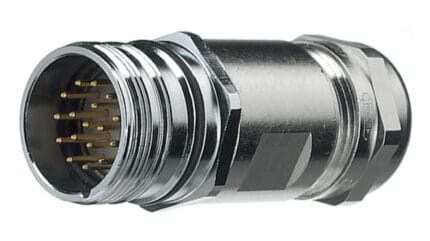
Inspection cameras in primary packaging, dairy, brewing and pharma blister lines usually present either an M12 8-pin socket or a screw-lock RJ45 socket, and we terminate both. The M12 side uses the standard threaded coupling; the RJ45 side uses a metal or molded screw-lock shell that clamps to the mating receptacle so the latch tab no longer carries the retention load. Protection is specified for the mated pair, which is the only condition that matters on the line. Sealed M12 builds in the same duty class are covered by the M12 IP69K washdown cable and the M12 IP68 / IP69K food-grade cable.
Both halves carry the rating together, so a number quoted for the plug alone is not the number the installation gets. Our IP rating reference sets out what each class is tested against and where a jet class and an immersion class part company.
Installation notes
- Respect the minimum bend radius when routing past a conveyor frame.
- Seat the coupling by hand, then torque it; over-tightening flattens the face gasket.
- Route the last meter so the hose jet does not fire straight into the gland.
- Keep the drain path clear so the coupling does not sit in standing fluid.
- Check the coupling visually at changeover, in the same pass as the rest of the line.
Typical applications for this IP69K screw lock cable
- Primary packaging inspection cameras on fillers and labelers
- Dairy and brewery lines washed with caustic at shift change, alongside the Cat6A IP69K washdown patch cord for the M12 X-code side
- Pharma blister and vision checks in classified zones
- CNC coolant zones where the enclosure is washed rather than wiped
- Washdown panels that need sealed connectors elsewhere on the machine, served by the IP67 D-Sub screw cable
Compliance status
The IP code class used here is the one defined in ISO 20653, covering high-pressure and steam-jet cleaning rather than immersion. We treat ingress class, chemical resistance and any food-zone material declaration as pending items and publish them once the test report and the material certificate are in hand, not before. The class your assembly is built and verified to is the one stated on your drawing.
Ordering and lead time
Standard lengths are 3, 5 and 10 m, with other lengths made to order. Tell us the cleaning agents in use, the water temperature and the pressure at the nozzle, and whether the coupling sits in the spray path — those three answers decide the jacket and the shell.
Five pieces is the prototype minimum for IP69K Screw Lock builds, shipping in 3 working days. The production minimum is 500 pcs, delivered 14 working days after approval. Tooling not already held adds around 10 working days. IP69K orders ship as OEM or ODM under your part number and labeling material certificates with first-article reports are available.
Workmanship and testing
IPC/WHMA-A-620 Class 3 is the workmanship bar for IP69K Screw Lock builds, and ISO 9001 is the system behind the line, from 32 to 12 AWG. Every IP69K build gets a continuity and pinout check before it is boxed, and seal checking is quoted whenever an ingress rating is on the drawing.
Material declarations against RoHS and REACH are issued per project, alongside the dimensional and electrical reports agreed at quotation; see certifications, compliance and material declarations. Where your drawing names a UL style or another approval, the build follows your drawing and ships with the supporting document rather than a claim of our own. Sealing follows the insert, gasket and overmold-bond method described under IP67 and IP68 sealing structures, so the rating comes from the joint design rather than from the connector datasheet alone. Related reading: build-to-print cable assemblies. Tooling for this build is cut in our own tool room and belongs to your program, so a repeat run years later starts from the same tool.
Related assemblies
- Cat6A IP69K washdown patch cord
- M12 IP69K washdown cable with stainless steel coupling nut
- Cat6A RJ45 screw-lock GigE Vision cable
- IP67 waterproof M12 molded cable
Full range: screw-lock molded cable.
Frequently Asked Questions
Is IP69K the same as IP67?
No. IP67 under IEC 60529 covers immersion. IP69K under ISO 20653 covers high-pressure and steam-jet cleaning, which is a different and usually harsher test.
Can you supply a food-zone material declaration?
Yes, with the material certificate. We publish it when the report is in hand rather than asserting it first.
Why stainless rather than plated brass?
In the spray path a plated coupling eventually loses its finish to detergent and abrasion. A 316L shell is offered for exactly those cells.
Do I need to torque the coupling?
Yes. Hand-seat it, then tighten to the stated value. Over-tightening flattens the face gasket, which is as bad as leaving it loose.
What is the minimum order?
Prototypes are quoted from 1 to 50 pcs, built and shipped within 3 working days. Production is quoted from 500 pcs with 14 working days after you sign off the sample.
| Cable type | Washdown grade Gigabit Ethernet cordset |
|---|---|
| Connector A | Screw-lock RJ45 or M12 8-pin, threaded coupling |
| Connector B | Screw-lock RJ45 or M12 8-pin, straight or right angle |
| Conductor | AWG26 S/FTP, four individually foiled pairs class |
| Jacket options | Polyurethane, stainless steel braid, 316L stainless shell variant |
| Ingress protection | Washdown class when mated |
| Minimum bend radius | 6 x overall diameter class |
| Standard lengths | 3 / 5 / 10 m, other lengths made to order |
| Chemical resistance | Detergents and cleaning agents |
| Coupling | Threaded coupling nut, stainless steel variant available |
| Build standard | IPC/WHMA-A-620 Class 3 workmanship, ISO 9001 line |
| Compliance status | Test report and material certificate published when in hand |