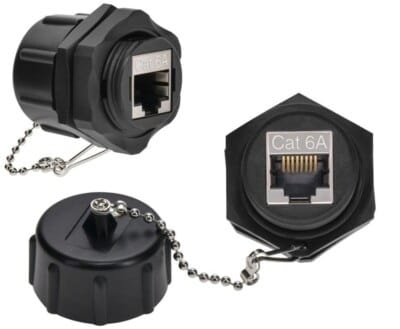
IP67 RJ45 Panel Coupler, Cat6A Shielded Bulkhead Feedthrough
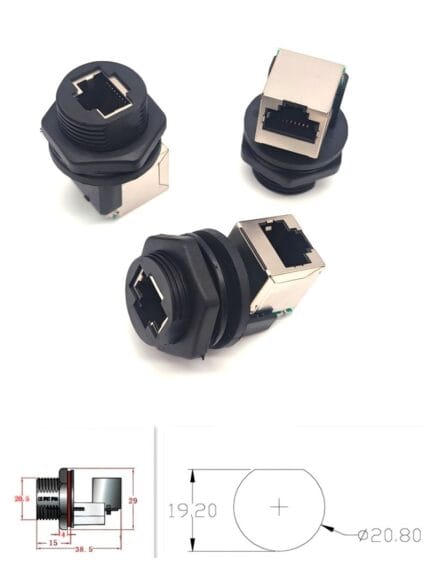
An IP67 RJ45 panel coupler turns an enclosure wall into a sealed patch point: two 8P8C jacks sit back to back in a metal shell that clamps through the panel. Pick the cut-out, the gasket side and the mounting direction and we build the bulkhead to your drawing.
Last updated: 13 September 2026
Overview
An IP67 RJ45 panel coupler moves the patch point off the DIN rail and onto the enclosure wall. Two 8P8C jacks sit back to back inside a metal shell that clamps through the panel, so a technician plugs a standard patch lead outside and a machine-side lead inside without opening the cabinet. That is a different build from a cable gland plus a loose inline coupler floating in the enclosure: the gland version is harder to strain-relieve, and once the gland has been pulled it cannot be resealed without cutting the cable back. We build the bulkhead body to the cut-out, the panel thickness and the mounting direction on your drawing.
Key Specifications
| Connector interface | RJ45 8P8C, female to female bulkhead |
|---|---|
| Category rating | Cat6A STP (design target, pending channel test) |
| Shell | Metal, shielded, continuity across the panel |
| Panel cut-out | Round, approximately 20 to 22 mm (design target, confirm before cutting) |
| Mounting | Front or rear mount, locknut fixing, keystone frame version available |
| Contact material | Gold-plated phosphor bronze (pending supplier confirmation) |
| Ingress rating | IP67 in mated condition (pending test report) |
| Current rating | 1.5 A per contact (pending supplier datasheet) |
| Temperature range | -40 to +105 C (pending supplier datasheet) |
| Accessory | Tethered dust cap; potted version for unmated exposure |
| Interface standard | RJ45 per IEC 60603-7 |
| Rear side option | Second jack, or molded pigtail in place of the rear receptacle |
Panel cut-out and bolt pitch: confirm these before you drill
Cut-out is the one dimension you cannot recover. Once a hole is punched in a molded enclosure or a finished stainless door, the only fixes are a step plate or a new door. The figures below are the values you will commonly see quoted in the trade for each cut-out family; they are typical values, not a standard and not a promise about our part. Confirm the exact aperture, the bolt pitch and the panel thickness window against the supplier drawing before you cut anything.
| Cut-out family | Commonly quoted values | Best for | Confirm before cutting |
|---|---|---|---|
| Round, plain bore | 20 to 22 mm class for an RJ45 bulkhead | Sheet metal cabinets and molded enclosures | Exact diameter, wall thickness, nut torque |
| Round, threaded body | M16 x 1.5, M20 x 1.5 or PG9 to PG16 depending on shell | Thin panels where the thread carries the clamp load | Thread callout, panel thickness window |
| D-shape flange | The D-series / XLR-type family, commonly around 24 mm across the flats | Racks and patch panels that already carry XLR or other D-shape devices | Flange drawing, screw pitch, orientation |
| Square / keystone aperture | The keystone module opening used by wall plates and frames | Panels that should accept any standard keystone module | Frame drawing, module brand fit |
Bulkhead coupler or a waterproof plug straight into the box?
This is the decision buyers actually face. It is not about which part is better, it is about what happens at the panel the fiftieth time the port is used.
| Option | How it is built | Where it wins | Where it loses |
|---|---|---|---|
| Sealed bulkhead coupler | Two jacks in a clamped metal shell, standard patch leads both sides | Service ports used often; spares are standard patch cords | Two extra mating faces in the channel; needs a cut-out |
| IP67 overmolded plug into a receptacle | A molded cordset plugs into a panel receptacle, no rear jack | Washdown and outdoor gear where the cable is fixed | A damaged cord means replacing a molded assembly, not a patch lead |
| Cable gland plus inline coupler | Loose coupler inside the box, cable through a gland | One-off builds, no panel tooling | No strain relief at the wall, cannot be resealed after a pull |
| Molded pigtail through the wall | Receptacle outside, captive tail inside, gland sealing the cable | Cabinets where the internal run is fixed and short | Tail length has to be right at order time |
Shield continuity across the panel
The shell is metal and the insert is shielded, so the drain path continues across the bulkhead instead of stopping at the panel. That only works if the shell actually contacts the panel: on painted, powder-coated or anodized surfaces, either mask a small area under the flange before finishing or specify a conductive gasket. A shielded coupler floating on a coat of paint is an unshielded coupler with a nicer datasheet. On the mating side, the 8P8C modular connector interface is defined in IEC 60603-7, and the plug shell should meet the receptacle shell on both sides for the shield to do anything useful.
Where this IP67 RJ45 panel coupler gets installed
- Control cabinets and outdoor enclosures that need a sealed Ethernet entry point
- Self-service kiosks and ticketing machines with an external service port
- EV charge points and dispensers where the service laptop plugs in outside
- Machine HMI panels washed down between production runs
- Temporary event and broadcast boxes that are rigged and struck repeatedly
- Rooftop and roadside telecoms cabinets, alongside our IP68 Deck Feedthrough Cable with RJ45 Pass-Through
What we treat as a target rather than a claim
Contacts are gold-plated phosphor bronze on comparable parts. Current rating, temperature range and the ingress rating quoted for this range come from the published data of comparable products, not from a verified datasheet of ours, and we hold every one of them as pending confirmation until the supplier document is on file. The ingress figure applies to the mated condition: an open jack with the cap off is not a sealed connector. Where a port has to survive unmated exposure, ask for the potted version and keep the tethered cap on it.
How to specify your build
- Cut-out and bolt pitch – off your panel drawing, or off the existing hardware.
- Panel thickness at the mounting point, and what the panel is made of.
- Mounting direction – front or rear, and which side the gasket has to sit on.
- Rear side – second jack or a molded pigtail, and the tail length.
- Cable category and shielding for the leads that will plug into it.
- Cap and potting – tethered cap, potted body, or both.
- Quantity, and whether this is a prototype or a production order.
Workmanship and testing
The line works to IPC/WHMA-A-620 Class 3 under ISO 9001, terminating 32 to 12 AWG. Every unit gets a continuity and pinout test before it is packed. Seal checking on the production batch is available when an ingress rating is in the specification.
Custom builds and ordering
A first build of 5 pcs ships in 3 working days. Repeat production starts at 500 pcs and ships 14 working days after approval, plus roughly 10 working days if a new overmold tool is required. Your part number and labeling go on OEM and ODM orders, with material certificates and first-article reports on request.
Related panel and Ethernet hardware
- Control Cabinet Service Interface with RJ45 and USB-C Front Plate
- Cat6 RJ45 Panel-Mount Extension Cable with Thread-locking
- IP67 RJ45 Screw-Lock Bulkhead Cable with Threaded Coupling
- IP67 RJ45 Patch Cable, Dual-Use Waterproof Shielded Ethernet Jumper
- Cat6A IP67 Industrial Pigtail, S/FTP RJ45 with Dust Cap
Full ranges: panel mount cable, Ethernet patch cords and signal and data cables.
Frequently Asked Questions
Does the coupler need a shielded patch lead on both sides?
For a Cat6A channel, yes. The shell only continues the drain path if both plugs have metal shells that meet the receptacle. An unshielded lead on one side leaves the shield open at that end.
Can I mount it from the rear?
Yes. Front mounting keeps the nut and the gasket on the accessible side; rear mounting is used where the flange would foul a door or where the assembly has to go in from inside. Tell us which and the gasket ships on the correct face.
What happens if the cap is left off?
The port is not sealed. IP67 for this class of part is quoted for the mated condition, or capped, so a spare port with the cap missing is an open port. Fit the cap or specify the potted version.
Is the cut-out the same as a keystone opening?
No. A keystone frame takes a module aperture; this coupler takes a round bore. If your panel is already prepared for keystone, take the frame version instead and push in the module you already stock.
| Connector interface | RJ45 8P8C, female to female bulkhead |
|---|---|
| Category rating | Cat6A STP class |
| Shell | Metal, shielded, continuity across the panel |
| Panel cut-out | Round, approximately 20 to 22 mm class |
| Mounting | Front or rear mount, locknut fixing, keystone frame version available |
| Contact material | Gold-plated phosphor bronze |
| Ingress rating | IP67 in mated condition |
| Current rating | 1.5 A per contact |
| Temperature range | -40 to +105 C class |
| Accessory | Tethered dust cap; potted version for unmated exposure |
| Interface standard | RJ45 per IEC 60603-7 |
| Rear side option | Second jack, or molded pigtail in place of the rear receptacle |
Related products
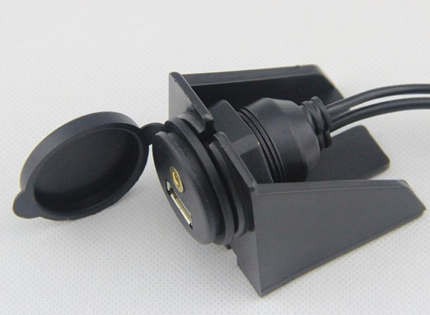
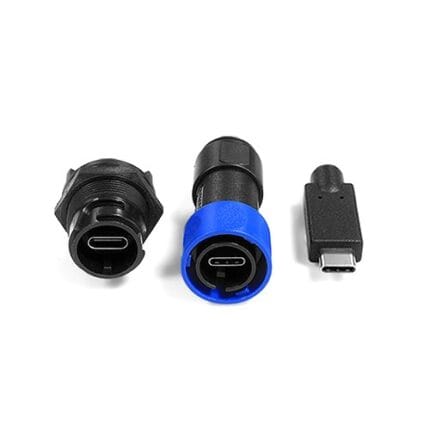
SPE Bulkhead Panel Connector for 10BASE-T1L Field Devices
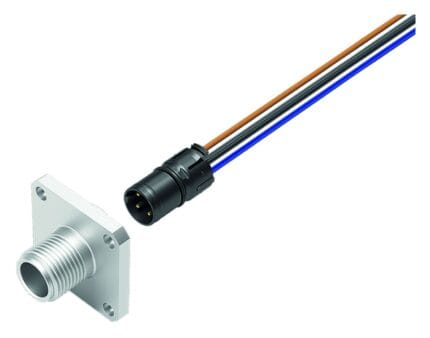
An SPE bulkhead panel connector brings 10BASE-T1L single pair Ethernet and Power over Data Line into a field device box through one sealed penetration. IEC 63171-6 mating face or M8 coupling, front or rear mounting. The cut-out is smaller and the termination is faster than a four-pair Ethernet entry.