IP65 Waterproof DC 5521 Extension Cable
An ip65 5521 cable carries DC power from an indoor supply out to garden and landscape fixtures through sealed 5.5 x 2.1 mm connectors. Threaded collars with O-rings keep water out of the joints.
Overview
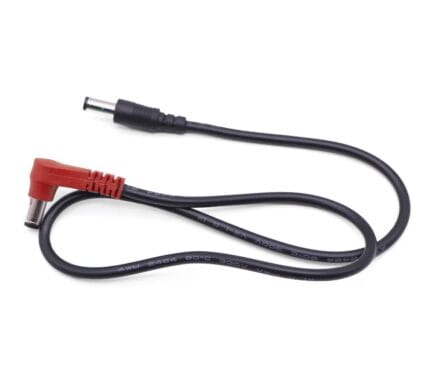
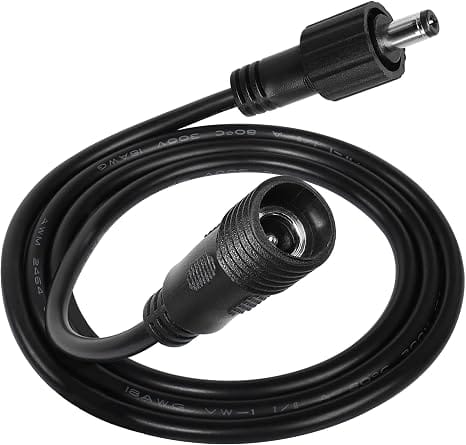
An ip65 5521 cable is the link between a supply that lives indoors and a fixture that does not. Both ends carry 5.5 x 2.1 mm coaxial connectors inside threaded sealing collars with internal O-rings, so a run that crosses a wall, a soffit or a garden bed does not put an unsealed barrel joint in the wet. The collars are hand-tightened and need no tools, which matters when the joint is behind a planter or under a deck board. Jacket is UV-stable black PVC with the 2464 VW-1 80 C marking printed along the length, and the build length is cut to your run.
Key Specifications
| Connector A | DC 5.5 x 2.1 mm male plug (IP65 sealed) |
|---|---|
| Connector B | DC 5.5 x 2.1 mm female socket (IP65 sealed) |
| Ingress Protection | IP65 |
| Cable Length | Custom |
| Jacket | Black PVC, UV-stable |
| Cable Marking | 2464 VW-1 80 C printed on the jacket |
| Sealing Method | Threaded collar with internal O-ring, hand-tightened |
| Polarity | Center positive (standard) |
| Application | Outdoor landscape lighting, garden path lights, signage |
What the IP65 rating actually covers
Ingress protection ratings are written as two digits and buyers routinely read only the first. The first digit is the solid-particle score, the second is the water score, and the water score is the one that decides where the cable may be installed. The ratings below are the standard definitions from IEC 60529; they describe the test the enclosure is built to, not a guarantee about a particular installation.
| Rating | Water test it is defined against | Suitable for | Not suitable for |
|---|---|---|---|
| IP65 | Low-pressure water jet from any direction | Rain, splash, wash-down of a sheltered fixture | Immersion, or a joint that sits in standing water |
| IP66 | Strong water jet from any direction | Exposed runs hit by driven rain or hose-down | Immersion |
| IP67 | Temporary immersion to a stated depth and time | Joints in a flood-prone bed or a shallow pool surround | Permanent submersion |
| IP68 | Continuous immersion under conditions set by the maker | Pond lighting and permanently submerged runs | Nothing it is not specified for |
Read the table as a routing instruction. A joint under a deck edge that only ever sees splash is fine at IP65. A joint in the bottom of a planter that holds water after rain is an immersion application and should be specified IP67 or IP68. Where the route is uncertain, go up a class: the cable costs marginally more than the callout does.
Splash and immersion are two rows of the same table, and the planter example above is the one that catches people out. The IP rating reference gives the conditions behind each row, including the limits of a jet class.
Why the sealed joint is still the weak point
Sealed connectors fail at the seal, not in the contact. Four mechanisms account for most of the returns we see on outdoor DC work.
- Collar left hand-tight rather than seated. A collar that is snug but not bottomed out leaves the O-ring short of its compression window, and the joint passes a visual check while wicking water along the cable.
- O-ring rolled or pinched during assembly. This is a build-quality issue and it is why we seal-check the batch where an ingress rating is specified.
- Water tracking along the conductor. If the far end of the run is an unsealed fixture, water can enter there and travel inside the jacket. Sealing both ends only helps if the fixture end is sealed too.
- UV and thermal cycling on the collar thread. Plastic collars lose preload over years outdoors; a collar that is accessible should be re-checked at service intervals.
Installing the joint with a drip loop below the connection point costs nothing and removes the first two failure modes from most jobs.
Length, conductor and voltage drop on long garden runs
Landscape work is where DC runs get long, and long low-voltage runs are where the job quietly fails. A 12 V fixture at the end of a long cable sees whatever is left after the drop, and the symptom is not a dead lamp but a dim one, or a color shift on an addressable strip. Two rules settle it: measure the voltage at the fixture with the load running, and if the drop is more than the fixture tolerates, increase conductor cross-section rather than raising the supply voltage, which the load was not built for.
| Run length | What to check | Typical decision |
|---|---|---|
| Up to a few meters | Supply rating against total fixture draw | Standard build, no special sizing |
| Medium runs across a garden | Voltage at the far fixture under load | Step up conductor size if the measured drop is outside the fixture tolerance |
| Long runs to a distant zone | Whether one home run or several shorter ones is cheaper in copper | Split the zone and feed it separately, or move the supply closer |
Conductor size is stated per your drawing. Give us the run length and the measured or nameplate current and we will quote the conductor that holds your drop inside the window you specify.
Where this ip65 5521 cable gets installed
- Garden path, deck and step lighting fed from a supply mounted in a garage or utility room
- Outdoor CCTV where the camera lead has to cross an exposed wall
- Illuminated signage and lettering with a driver mounted indoors
- Temporary event and seasonal lighting that gets struck and re-rigged each year
- Gate and perimeter lighting, alongside our IP67 Waterproof DC Extension Cable for joints that sit lower
- Solar-fed garden circuits paired with our DC7909 Solar Extension Cable
How to specify the build
- Length of the run, measured along the route it will actually take.
- Worst-case exposure at the joint: splash, driven rain, or standing water.
- Total current of everything downstream of the joint.
- Conductor size, or the voltage drop you can accept at the far end.
- Polarity and whether the fixture end is sealed as well.
- Jacket preference if the run is in direct sun for years.
Workmanship and testing
For IP65 Waterproof DC 5521 builds the line runs to IPC/WHMA-A-620 Class 3 under ISO 9001, terminating 32 to 12 AWG. Every IP65 build gets a continuity and pinout check before it is boxed, and seal checking is quoted whenever an ingress rating is on the drawing.
Every production run can ship with RoHS and REACH declarations and the electrical report agreed at quotation; see certifications and material declarations. UL styles and other named approvals are built to drawing: we source to the style you specify and document it, rather than asserting a listing we do not hold. The ingress rating is built into the joint, following the sealing structures set out in IP67 and IP68 sealing structures and validated against IEC 60529 before release. The wider context is covered under our marine and outdoor work. Tooling is quoted separately, cut in-house rather than brokered out, and owned by you.
Custom builds and ordering
IP65 Waterproof DC 5521 prototype lots start from 1 to 50 pcs and ship in 3 working days; production requires 500 pcs and runs 14 working days after sample approval. Tooling not already held adds around 10 working days. Your part number and labeling go on OEM and ODM IP65 shipments, and material certificates and first-article reports can be supplied.
What is listed here for IP65 Waterproof DC 5521 builds is the industry-standard definition, not a measurement we took on a finished part. What your assembly is built and verified to is what your drawing states, confirmed against the supplier datasheet before a quote goes out.
Related outdoor and DC power builds
- IP67 DC to USB-C Cable, 5.5×2.1mm Barrel Power
- Threaded Locking DC Pigtail 5.5×2.1mm
- 14 AWG DC Barrel Pigtail Cable 5.5×2.1mm to Bare Wire
- Starlink Mini DC Extension Cable – DC 5.5×2.1mm
- Solar MC4 Adapter Cable to XT60, Anderson, DC7909
- 12V/24V Cigarette Lighter Power Cable
Full range: DC plug power cable.
Frequently Asked Questions
Can the joint be buried?
The connector is rated against water jets and dust, not against permanent burial. Buried joints need a gel-filled or resin-sealed enclosure; the cable can be direct-burial rated while the connector still sits in an accessible box.
Is IP65 enough for a deck that gets hosed down?
A hose is a jet, so yes for the splash case. If the joint sits where water pools after hosing, specify IP67 so the immersion case is covered.
Do the collars need tools?
No. They are designed to be seated by hand. Snug is not seated, though: tighten until the collar bottoms and the O-ring is compressed.
Can I get this with a right-angle connector on one end?
Yes. Where the joint is behind a fixture or against a wall, a right-angle sealed connector removes the bend radius from the depth budget. Say which end and which exit direction.
| Connector A | DC 5.5 x 2.1 mm male plug (IP65 sealed) |
|---|---|
| Connector B | DC 5.5 x 2.1 mm female socket (IP65 sealed) |
| Ingress Protection | IP65 |
| Cable Length | Custom |
| Jacket | Black PVC, UV-stable |
| Application | Outdoor landscape lighting, garden path lights, signage |
| Cable Marking | 2464 VW-1 80 C printed on the jacket |
| Sealing Method | Threaded collar with internal O-ring, hand-tightened |
| Polarity | Center positive (standard) |
Related products
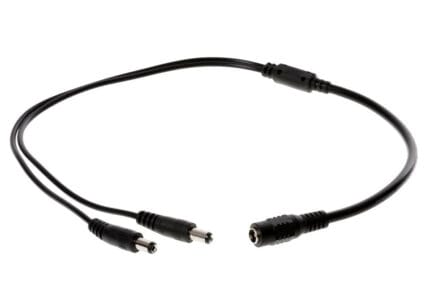
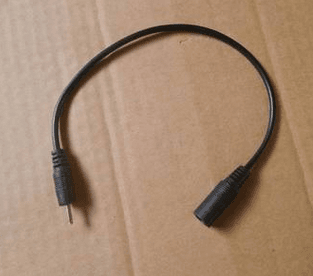
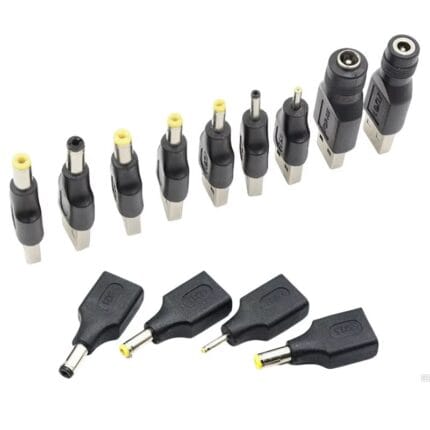
DC Barrel Adapter Kit – 5521 / 5525 / 4017 / 3513 / 1.35mm / 2.5mm, 6-Piece
A dc barrel adapter kit covering 5.5x2.1, 5.5x2.5, 4.0x1.7, 3.5x1.35 and 2.5 mm in six molded female-to-male adapters, so one supply covers a mixed estate. Center positive throughout, with nickel-plated brass contacts. Measure the socket pin with a caliper before ordering: the outer shell is identical across three of these five sizes. Bagged with a size card, or boxed with a printed insert.