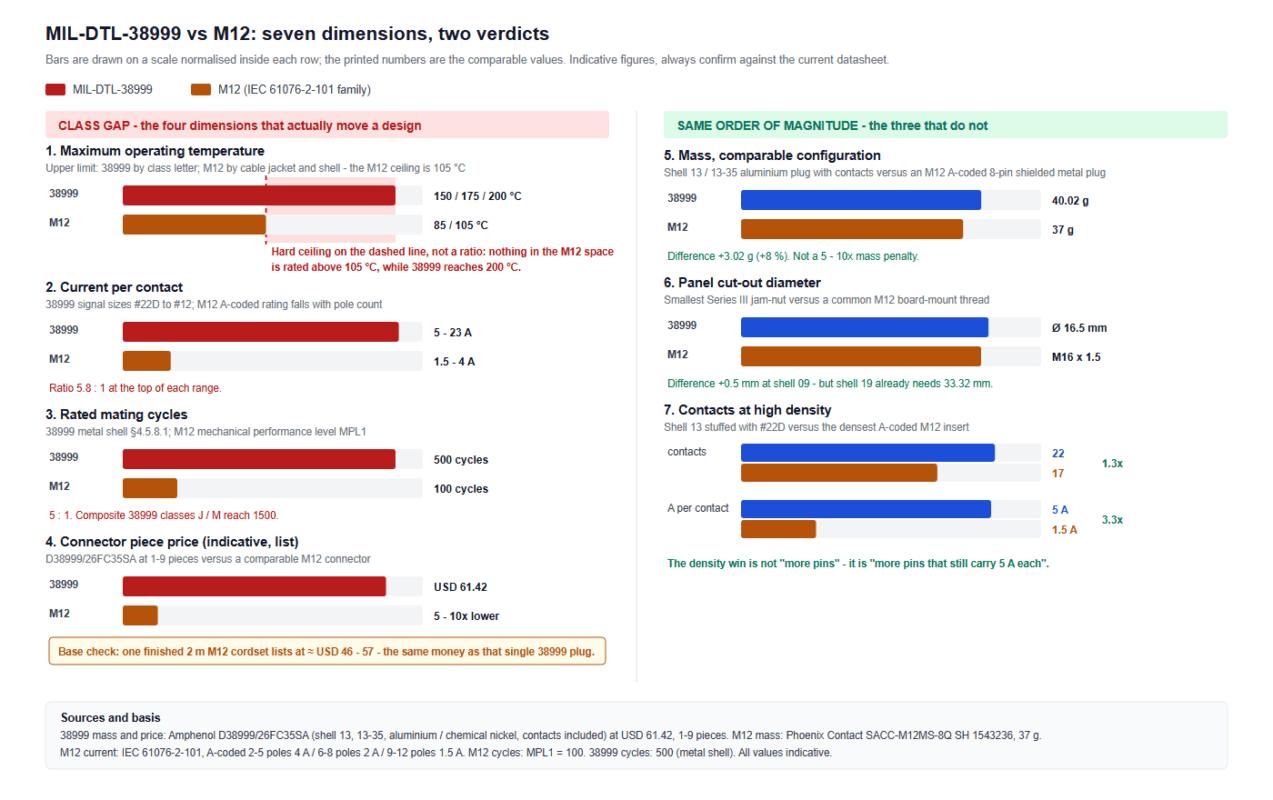

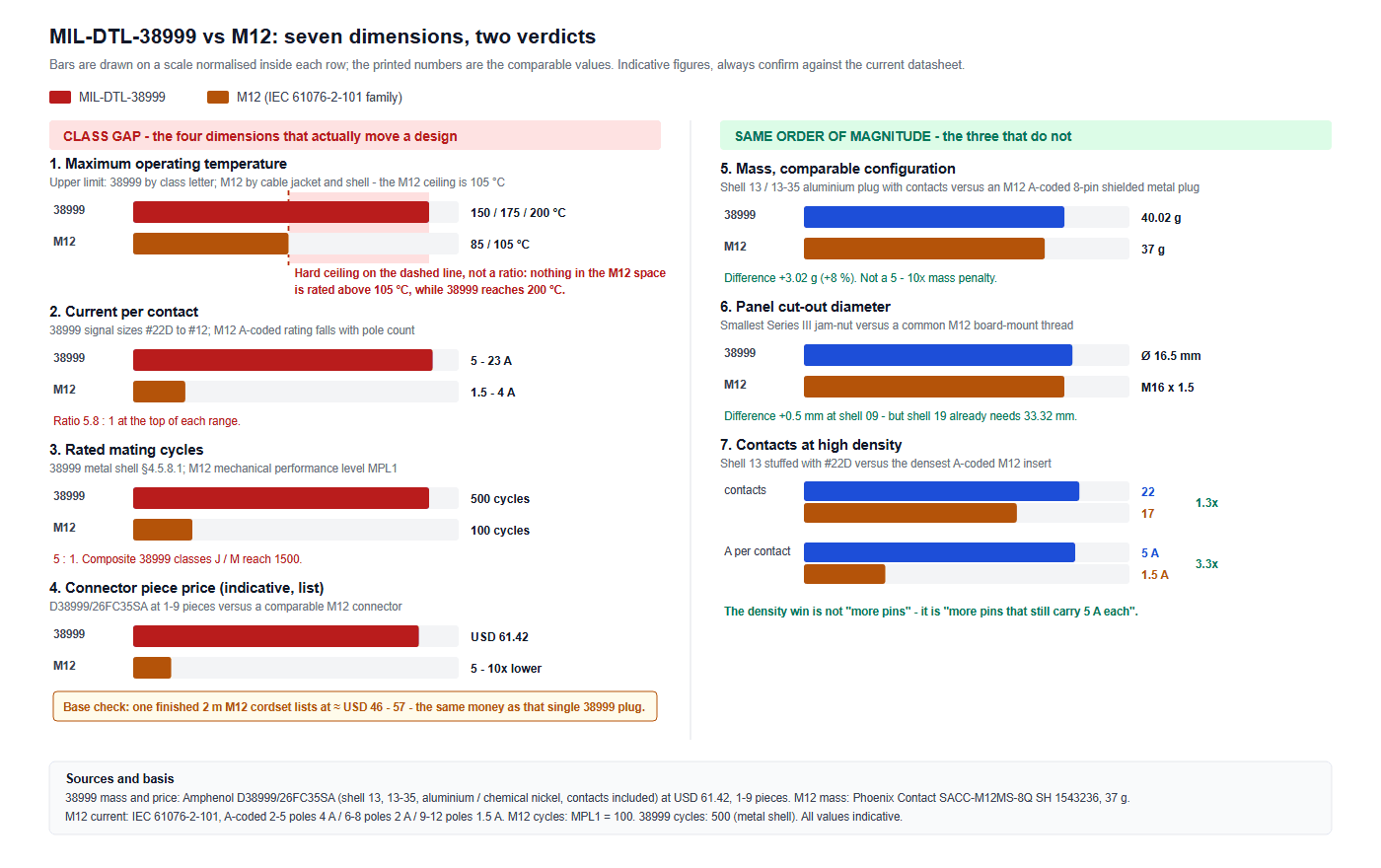
MIL-DTL-38999 vs M12 is usually presented as a one-sided fight in which the military part wins every row. That framing collapses once you check the seven dimensions a buyer actually cares about. Only four are separated by a class: temperature ceiling, current per contact, mating cycles and piece price. An Amphenol D38999/26FC35SA plug — shell 13, 13-35 arrangement, aluminum with chemical nickel plating, contacts included — weighs 40.02 g; a Phoenix Contact SACC-M12MS-8Q SH (M12 A-coded, 8-pin, shielded, metal knurled plug) weighs 37 g. Panel cut-out is not one either: the smallest Series III jam-nut needs a 16.5 mm hole against the 16 mm of a common M12 board-mount thread. What follows separates the four dimensions where MIL-DTL-38999 vs M12 is a genuine class gap from the three where it is not, then turns the difference into a budget you can check against your own bill of materials.
1. What Each Specification Actually Governs
The current revision is MIL-DTL-38999N plus Amendment 1, dated 2023-09-14; revision N was published 2023-02-10 at 158 pages and replaced MIL-C-38999. Four shell styles are defined: Series I bayonet, Series II low-profile bayonet, Series III triple-start stub-ACME thread, and Series IV breech-lock with a 90° quarter-turn. Series III shells run 9 to 25, lettered A to J, with threads from M12×1 to M37×1, and arrangements per MIL-STD-1560 reach roughly 128 contacts.
The M12 side is governed by IEC 61076-2-101, whose fourth edition arrived in 2024; its European adoption, EN IEC 61076-2-101:2025, was published on 2025-01-09, superseding the 2012 third edition. The 2024 revision dropped P-coding and the glass-to-metal sealed variants and added the NF type, and clause 3.5 points safety at IEC 61984. X, T, L, K and S codings, plus the 12–16 A power M12 variants, sit outside it in IEC 61076-2-111, -109 and -113; in North America, harness approval runs through UL 2238 or CSA C22.2 No.182.3.
One warning. MIL-DTL-38999 does not state a current rating in its body text; contact ratings belong to SAE-AS39029, and the document quotes only test currents: 17 A at #12, 10 A at #16, 5 A at #20 and 3 A at #22D. In any MIL-DTL-38999 vs M12 comparison, a current figure that does not name its source is a vendor nominal value.
2. Seven Dimensions: MIL-DTL-38999 vs M12 Compared
Put the two families on the same grid and the pattern is not “military wins everything”. It is four class gaps and three dimensions where the two parts are neighbours, and Table 1 holds the whole argument.
| Dimension | MIL-DTL-38999 | M12 | Gap |
|---|---|---|---|
| Maximum operating temperature | 150 / 175 / 200 °C by class letter (A, U, D / B, W, Z, T, V, J, AB / C to Y); −65 °C lower limit throughout. | No single standard value: Phoenix SACC −40 to +85 °C, Turck PVC cordset and Molex 1200790164 to 105 °C. | Class gap |
| Current per contact | Vendor nominal 5 A (#22D), 7.5 A (#20), 13 A (#16), 23 A (#12), 45 / 80 A (#8). The standard quotes test currents only. | A-coded 4 A at 2–5 poles, 2 A at 6–8 poles, 1.5 A at 9–12 poles; B-coded 5-pole 4 A; D-coded 4-pole 4 A. | Class gap |
| Rated mating cycles | 500 for the metal shell (clause 4.5.8.1, up to 300 cycles per hour); 250 for Series II spring-finger; 1500 for composite shells, classes J and M. | Levels MPL1 = 100, MPL2 = 50, MPL3 = 20. Mainstream vendors simply print “≥100”. | Class gap |
| Connector piece price | USD 61.42 at 1–9 pieces for a D38999/26FC35SA with contacts; USD 76.54 for a D38999/26FD19PN. | Indicative 5–10× lower than an equivalent military connector, but base-sensitive. See Table 3. | Class gap, base-sensitive |
| Mass, comparable configuration | 40.02 g for a shell 13, 13-35 arrangement in aluminum with chemical nickel plating, contacts included. | 37 g for an M12 A-coded 8-pin shielded metal knurled plug. | Same order |
| Panel cut-out diameter | Jam-nut cut-out ±0.15 mm: 16.5 (09), 19.07 (11), 23.82 (13), 26.97 (15), 30.15 (17), 33.32 (19), 36.50 (21), 39.67 (23), 42.85 mm (25). | M16×1.5 is the common board-mount thread, i.e. a 16 mm hole. | Same order at shell 09 |
| Contact density | Shell 13 takes 22 #22D contacts, each still rated 5 A nominal. | A-coded reaches 17 poles, but 13–17 poles drop to 30 V and 1.5 A. | Same order on count |
The three green rows are the most exaggerated online. Mass is the clearest: 40.02 g against 37 g is an 8 % difference, not a five- to ten-fold penalty, measured on comparable parts and documented in the PEI-Genesis listing for the D38999/26FC35SA. Panel cut-out behaves the same way low down; a shell 19 needing 33.32 mm is where it becomes a real constraint. Density is subtlest: the military insert wins not by having more contacts than an M12, but because those contacts still carry 5 A each while a 13-pin M12 has dropped to 1.5 A.
3. Current Ratings: Where the Numbers Really Come From
Current is the dimension most often misquoted. For the military part the number is not in the specification body at all: it comes from SAE-AS39029, while MIL-DTL-38999 supplies test currents used to qualify the contact system. For M12 it is in the standard but is not a constant, because IEC 61076-2-101 rates A-coded connectors by pole count, so “M12 is 4 A” holds only for low pole counts.
| Interface | Contact or coding | Test current in the standard | Vendor nominal current | Rated voltage |
|---|---|---|---|---|
| 38999 | #22D | 3 A | 5 A | DWV 1300 V (service M) to 2300 V (service II), AC rms at sea level |
| 38999 | #20 | 5 A | 7.5 A | as above |
| 38999 | #16 | 10 A | 13 A | as above |
| 38999 | #12 | 17 A | 23 A | as above |
| 38999 | #8 | not stated | 45 A / 80 A | as above |
| M12 | A-coded, 2–5 poles | not applicable | 4 A | 250 V |
| M12 | A-coded, 6–8 poles | not applicable | 2 A | 30 V |
| M12 | A-coded, 9–12 poles | not applicable | 1.5 A | 30 V |
| M12 | B-coded, 5 poles | not applicable | 4 A | 60 V |
| M12 | D-coded, 4 poles | not applicable | 4 A | 250 V |
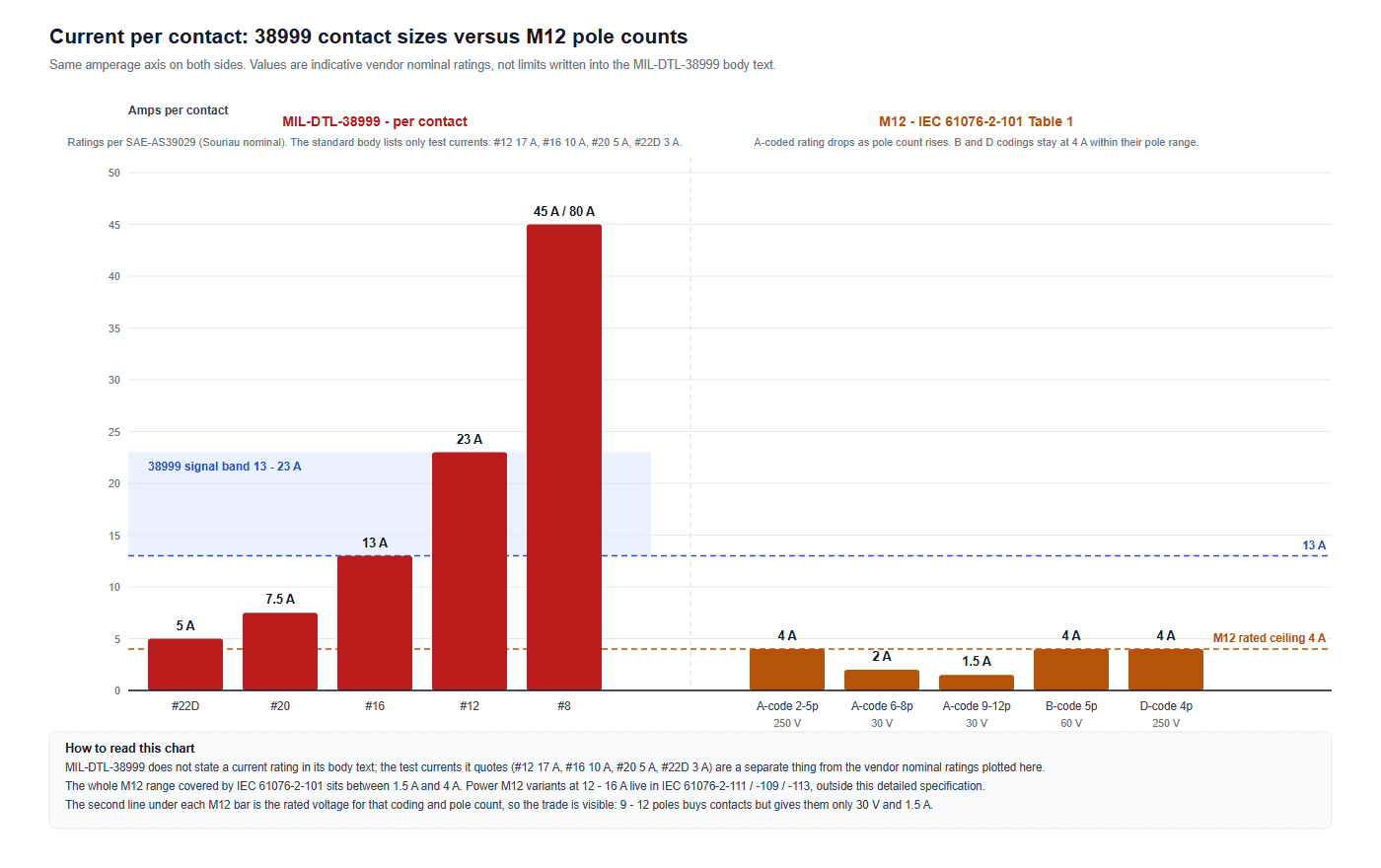
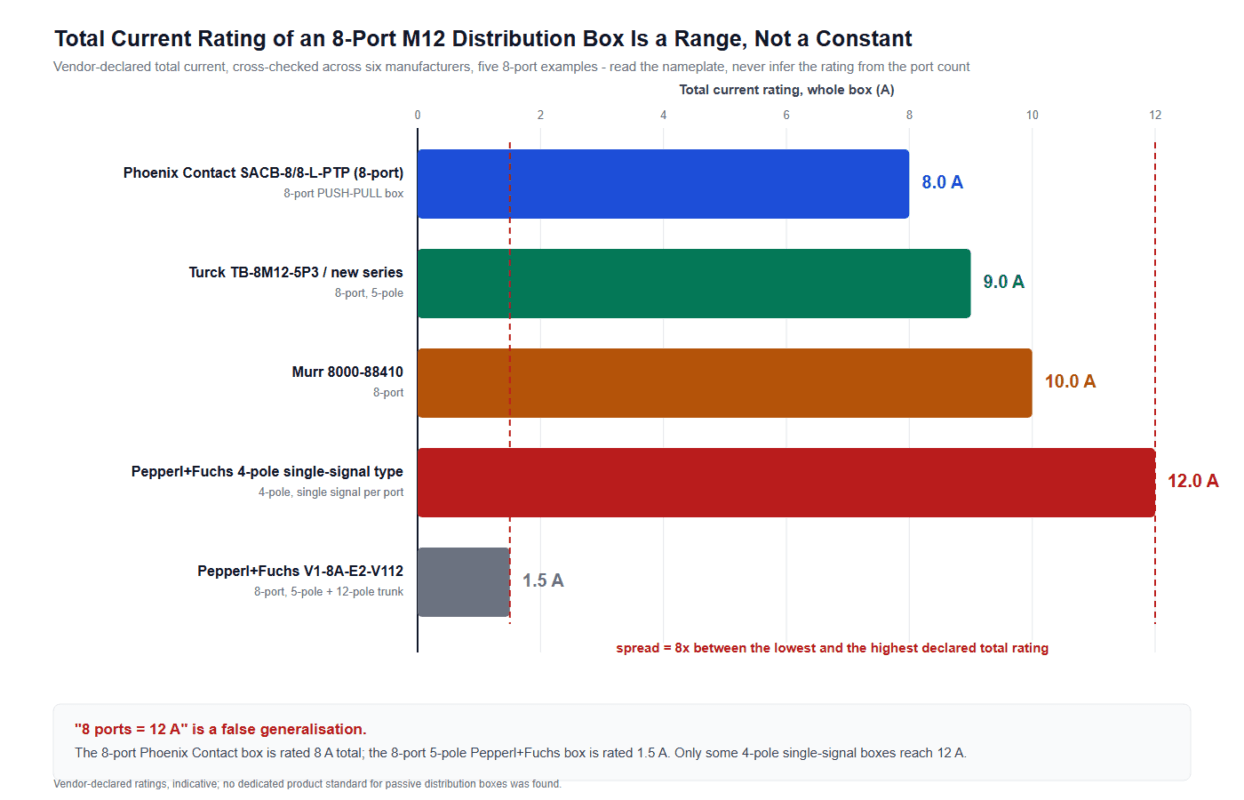
Figure 2 makes one trade visible that a plain reading hides. Going from 4 poles to 12 on an A-coded M12 does not just add wires; it drops the current from 4 A to 1.5 A and the voltage from 250 V to 30 V, because the contacts get smaller. A designer who needs twelve signals and 3 A on each has already left IEC 61076-2-101. That is the honest form of the gap: not that M12 is weak, but that the specification stops at 4 A while the pole count you need may push you below it. Inside the M12 world, the coding guide is the fastest way to see which limit applies to the letter you picked.
4. MIL-DTL-38999 vs M12: What the 10x Actually Buys
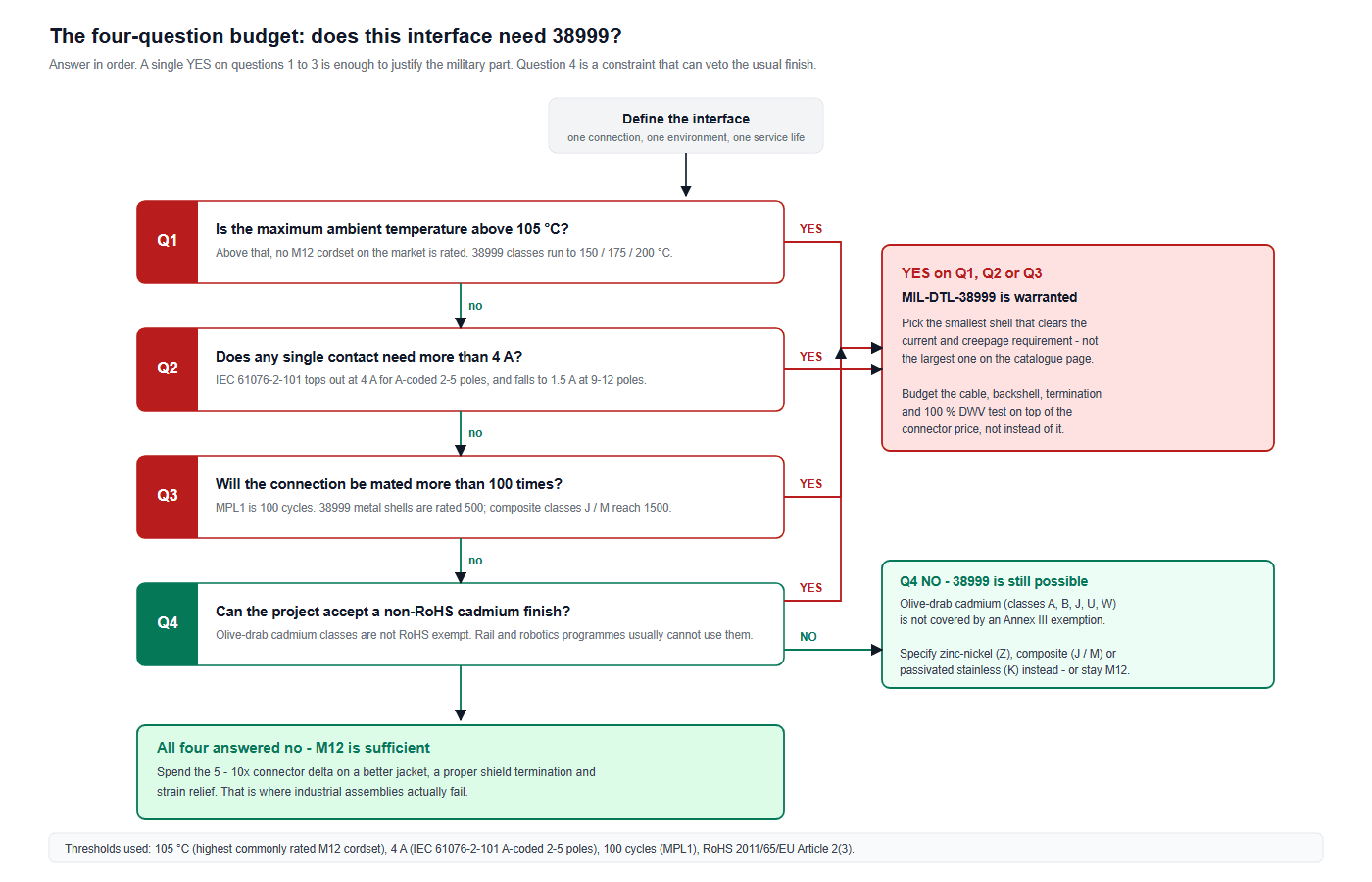
Here is what general comparison articles skip. The 5–10× price difference is real, but it does not buy across-the-board superiority. It buys four things, each testable with a yes-or-no question.
Question 1: is the maximum ambient temperature above 105 °C?
If it is, the M12 conversation is over. There is no unified M12 temperature rating: the limit depends on jacket and shell, and the practical ceiling sits at 85 °C for a Phoenix SACC and 105 °C for a Turck PVC cordset or a Molex 1200790164. The military side starts at 150 °C (classes A, U, D), moves to 175 °C (B, W, Z, T, V, J, AB) and reaches 200 °C (C to Y), with a −65 °C lower limit throughout. This is the strongest gap because it is a hard ceiling, not a ratio: 95 °C of margin cannot be bought in the M12 ecosystem.
Question 2: does any single contact need more than 4 A?
Within IEC 61076-2-101, 4 A is the top of the range, and only for A-coded 2–5 pole, B-coded 5-pole and D-coded 4-pole parts. A single #12 contact in a 38999 is nominally rated 23 A; a #8 reaches 45 A or 80 A. That is the widest gap — about 5.8× at the top of each range, and over 10× from a 1.5 A, 9–12 pole M12. The constraint runs one way: you cannot get 6 A through a 13-pin M12, and the alternatives — paralleled contacts, or an IEC 61076-2-111 power variant — change the interface, not just the part number.
Question 3: will the connection be mated more than 100 times?
This one deserves arithmetic rather than opinion. IEC 61076-2-101:2024 defines mechanical performance levels MPL1 = 100, MPL2 = 50 and MPL3 = 20 cycles, and mainstream manufacturers publish “≥100”, not 500; the Turck B2301 M12 datasheet is representative. The military metal shell is rated 500 cycles under clause 4.5.8.1 at up to 300 cycles per hour, Series II spring-finger inserts 250, and composite shells in classes J and M 1500.
To compare those fairly, convert them into a cost per rated mating cycle:
C = P / Nwhere C is the cost per rated mating cycle in USD, P is the price of the unit you actually purchase, and N is its rated number of mating cycles.
- MIL-DTL-38999 plug:
C = 61.42 / 500 = USD 0.123per rated mating cycle. - M12 2 m finished cordset:
C = 51 / 100 = USD 0.51per rated mating cycle. - Ratio: 0.51 / 0.123 = 4.1×, i.e. the M12 unit costs about four times more per rated mating cycle.
- Composite 38999 shell (class J or M):
C = 61.42 / 1500 = USD 0.041, a further 3× better. - Series II spring-finger insert:
C = 61.42 / 250 = USD 0.246, narrowing the gap to about 2×.
That inverts the usual intuition, so the caveat matters as much as the number. P is not the same kind of thing on both sides: a bare plug with contacts on the left, a finished two-meter cordset including cable, overmolding and test on the right. Comparing purchase price against purchase price therefore flatters the military part. The point is not that M12 is expensive; it is that a 100-cycle connector and a 500-cycle connector are not interchangeable line items in a maintenance budget. If your answer to Question 3 is yes, price the replacement cordsets, not just the first one.
Question 4: can the project accept a non-RoHS cadmium finish?
This is a constraint rather than a capability, and it catches people out. Olive-drab cadmium platings — classes A, B, J, U and W — are not covered by an Annex III exemption under RoHS 2011/65/EU, which instead excludes whole military platforms under Article 2(3) as weapons, ammunition and war material for specifically military purposes. A rail vehicle or a collaborative robot cannot borrow that exclusion. Distributors list an olive-drab cadmium part such as the D38999/26WF11SN as not RoHS compliant, while Amphenol Socapex marks only the zinc-nickel, composite and stainless finishes as conforming to 2011/65/EU and 2015/863. The military route stays open if your answer is no, but only in zinc-nickel (class Z), composite (classes J and M) or passivated stainless (class K).
5. The Base Trap in Every MIL-DTL-38999 vs M12 Price Comparison
“38999 costs five to ten times more” is repeated everywhere, and it is almost always a comparison of two different things. The number is defensible when both sides are a bare connector, and misleading once one side is a component and the other a finished assembly. Table 3 shows one transaction on three bases.
| Basis of comparison | MIL-DTL-38999 | M12 | Ratio |
|---|---|---|---|
| One bare connector, list price | USD 61.42 for a D38999/26FC35SA with contacts, 1–9 pieces | Indicative 5–10× lower for an equivalent M12 connector | 5–10× |
| One finished 2 m assembly | USD 122.84 in connectors alone (two plugs at 61.42), before cable, backshells, termination labor and 100 % dielectric withstand and insulation-resistance testing | USD 46–57 for a Molex 1200790164: A-coded, 4-pin, 2 m, IP67 / IP69K, complete | 2.4× and up |
| Per rated mating cycle | USD 0.123 (61.42 / 500) | USD 0.51 (51 / 100) | 0.24×, i.e. M12 roughly 4× higher |
The middle row is the one to remember. A single 38999 plug costs about the same as an entire two-meter finished M12 cordset, roughly USD 46 to 57 at prevailing exchange rates. Count both ends, the cable, the overmolding and the test, and the finished military assembly is closer to two and a half times the M12 one, before custom tooling on either side. Anyone quoting a single multiplier without stating the base is telling you nothing useful. The same discipline applies to molded versus field-wired M12 cordsets — see how to specify an overmolded cable assembly.
6. Environment, Sealing and Mating Hardware
Three specifications in this MIL-DTL-38999 vs M12 comparison are widely misread, and they matter most when a design is evaluated at the end of a project.
Vibration and shock. Series III parts are described in vendor-summarised material, for example the Connector Supplier technical archive on MIL-DTL-38999, as tested to sinusoidal vibration from 10 to 2000 Hz, with the 140–2000 Hz segment at 60 g for 36 hours under clause 4.5.23.2.1, random vibration at roughly 41.7 to 49.5 g rms, and shock at 300 g for 3 ms half-sine under clause 4.5.24. Treat those as vendor summaries rather than a direct quotation, and note that 60 g is well below the 100 g figure that circulates informally. M12 has no equivalent single number, which is why much of the range is sold as a continuous-flex variant.
Salt spray. Tested to EIA-364-26, chemical nickel plating (class F) survives 48 hours; olive-drab cadmium (W), black zinc-nickel (Z) and passivated stainless (K) reach 500 hours; naval bronze 1000 hours; composite shells 2000 hours. M12 connectors are qualified by IP rating instead, so if the assembly lives near a dock or roadside, raise it with the supplier rather than assuming.
Sealing and IP codes. M12 sealing is defined through IEC 60529, and this is where datasheets get loose with terminology. IP69K does not exist in IEC 60529 at all: it originated in DIN 40050-9, withdrawn in 2012, and the current equivalent is IP6K9K under ISO 20653, while IEC 60529:2013 Amd.2 expresses the same washdown test as IPX9 or IP69 without the K. If washdown is driving the decision, the IP67 versus IP68 versus IP69K breakdown is the place to check what each grade tests.
Mating hardware. Series III coupling torque rises with shell size, from 0.9 N·m to mate a shell 9 up to 4.6 N·m for a shell 25, with uncoupling around 0.2 to 0.6 N·m, per the Amphenol Series III characteristics table; jam-nut tightening runs from 4 N·m at shell 9 to 14 N·m at shell 25, ±0.5 N·m. M12 is an order of magnitude lighter: 0.4 N·m on a Phoenix plastic or IDC knurled nut, 0.8 to 1 N·m on a Turck metal shell. Made by hand in a confined space, that is a usability fact — see connector locking mechanisms.
7. Where HKWIRE Fits
Most projects that arrive with a military connector already specified do not need one, and the four questions above usually sort that out. When the answer is M12, we build the finished assembly rather than a catalog part: M8 and M12 cordsets, overmolded cable assemblies and custom wire harnesses to drawing, with jacket, shield termination and strain relief matched to the environment rather than picked from stock lengths. When the answer really is a military interface, we would rather say so at quotation than sell you an M12 that fails in service. A drawing carrying ambient temperature, current per contact, mating cycles, IP requirement and a 0.5–5 m cable length is enough to quote.
8. FAQ
Is MIL-DTL-38999 RoHS exempt?
No, and this is the most common misreading. Cadmium-plated classes such as A, B, J, U and W are not covered by an Annex III exemption. RoHS 2011/65/EU excludes complete military platforms under Article 2(3), as weapons, ammunition and war material for specifically military purposes, and civilian programs cannot borrow that. A D38999/26WF11SN in olive-drab cadmium is therefore listed as not RoHS compliant.
Does an M12 connector really only last 100 mating cycles?
IEC 61076-2-101:2024 defines levels of MPL1 = 100, MPL2 = 50 and MPL3 = 20 cycles, and mainstream manufacturers publish “≥100” across their standard range. It is not a durability limit for the parts; it is the point beyond which the standard no longer guarantees sealing and contact performance. If the application mates daily, price spare cordsets early.
Can I push 16 A through an M12 connection?
Not through anything covered by IEC 61076-2-101, which stops at 4 A for A-coded 2–5 pole, B-coded 5-pole and D-coded 4-pole parts, and drops to 2 A or 1.5 A as pole count rises. The 12–16 A power variants belong to IEC 61076-2-111, a different interface with different keying. If the circuit needs 16 A, use a separate power connector or a military-style insert.
Is a 38999 connector much heavier than an M12?
No. On comparable parts the difference is small: 40.02 g for an Amphenol D38999/26FC35SA (shell 13, 13-35 arrangement, aluminum with chemical nickel plating, contacts included) against 37 g for a Phoenix Contact SACC-M12MS-8Q SH 8-pin shielded metal plug. That is about 8 %. The penalty grows with shell size, but low in the Series III range the families are neighbours.
What is the operating temperature of an M12 cordset?
There is no unified value, because the limit comes from the cable jacket and the shell, not the interface. Phoenix SACC is rated −40 to +85 °C and a Turck PVC cordset −40 to +105 °C. Read the datasheet for the exact cordset: the highest figure in the mainstream M12 range is around 105 °C, against 150 to 200 °C for 38999.
Does MIL-DTL-38999 specify how much current a contact can carry?
Not in the body text. Contact ratings are defined by SAE-AS39029, and MIL-DTL-38999 itself quotes only test currents: 17 A at #12, 10 A at #16, 5 A at #20 and 3 A at #22D. Vendor nominal ratings are higher — 23 A at #12, 45 or 80 A at #8 — but they are the manufacturer’s number, not the specification’s, so in any MIL-DTL-38999 vs M12 comparison the current figure must be confirmed against the datasheet.
HKWIRE — M8 / M12 cordsets, overmolded assemblies and custom harnessesSend us the ambient temperature, the current per contact and the expected mating cycles. In a MIL-DTL-38999 vs M12 decision, we will tell you whether the interface you specified is the right one before we quote it.
All figures are indicative and drawn from published standards, vendor catalogs and distributor listings at the time of writing. Values vary by class, shell size, coding, pole count and cable construction, and rated numbers for current, temperature and mating cycles are always superseded by the datasheet for the exact part number you buy.