IP68 Industrial Data Cable for Serial, USB and Ethernet Ports
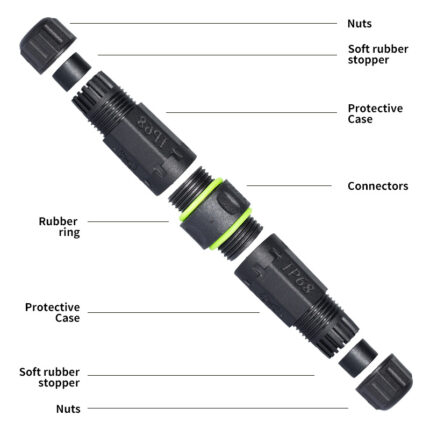
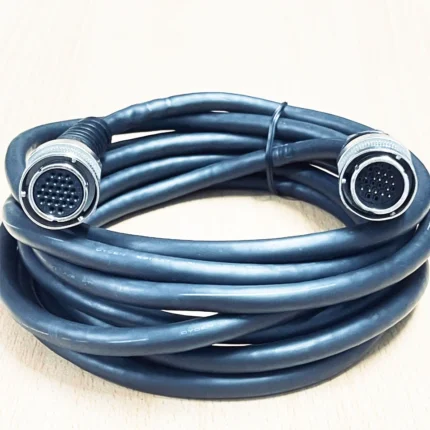
An IP68 industrial data cable that carries serial, USB and Ethernet in one sealed lead, with a gasketed panel feedthrough and a dust cap for the state the port is in most of the time.
Last updated: 13 September 2026
Overview
Sealing one interface is straightforward. Sealing three different ones on the same panel is where it gets hard, because a DB9, a USB-C and an RJ45 do not present the same face to a gasket. An IP68 industrial data cable for a mixed service panel has to solve each interface on its own terms and still leave the technician one coupling action to learn. We build the feedthrough, the sealed lead and the dust caps as one set, and we treat the unmated state as the normal state, since that is how a service port spends most of its life.
What we build, interface by interface
Each port type has its own sealing problem, and mixing them is what makes this range more than a set of molded leads.
| Interface | Why it is awkward to seal | How we handle it |
|---|---|---|
| DB9 serial | A large flat face with nine contacts and two screw locks, and every one of those is a leak path | Gasketed D-shell with sealed screw posts, or the same signals on a circular shell where the panel is already drilled for one |
| USB-A | A thin rectangular shell that goes out of shape when it is tightened down | Sealed body molded behind a gasketed face, or replaced by a circular shell on the panel side |
| USB-C | A very small shell with almost no face area for a gasket, and the plug itself does not seal | Metal circular shell with a threaded coupling, an O-ring at the panel, and a tethered cap for the rest of the time |
| RJ45 | The largest face of the three, and a latch that does not compress a gasket evenly | Shielded bulkhead coupler with a screw or bayonet ring, and a gasket compressed to a set thickness |
| Mixed plate | Three cut-outs at three different compression heights | One plate with matched compression, or separate sealed inserts in a standard frame |
Keeping the sealing approach consistent across the plate is worth more than optimizing one port. A technician who learns one coupling action does it correctly every time.
Where a sealed assembly actually leaks
| Seal point | What goes wrong | What we do about it |
|---|---|---|
| Panel to gasket | Uneven compression on a thin or slightly curved panel | We ask for wall thickness and flatness, and add a back plate or insert where the panel is too thin to compress evenly |
| Shell to face | Water tracks along the thread or the latch rather than through it | An O-ring or face gasket on the mated pair, not only on the panel side |
| Cable exit | Water wicks along the conductors and into the equipment | Overmolded strain relief that grips the jacket, plus a sealed entry at the equipment end |
| The unmated port | A cap that is rated for storage and used outdoors for a year | A tethered dust cap built for the same conditions as the shell it closes |
| Between circuits | One leak wets all three interfaces | Separate sealed inserts instead of one shared cavity behind the plate |
What IP67 and IP68 cover
The rating is defined by the IP code in IEC 60529. The first digit covers solid ingress and 6 means dust-tight. The second covers liquid: 7 is temporary immersion under stated conditions, 8 is continuous immersion under conditions agreed between the maker and the user. Neither digit says anything about a high-pressure jet, which is a different test in a different standard. Two practical points follow from that. A rating applies to a mated pair, so an open port with its cap off is not rated at anything. And the rating depends on gasket compression in the specific shell on the specific panel, which is why we hold it as a target until the production sealing parts have been tested, then build and verify to the value stated on your drawing.
Planning one panel for three interfaces
Start from the panel, not from the cable. What is the wall thickness, what cut-out can you make, and what does the equipment side terminate into? Then choose the interface, the lead length and the jacket. If the plate carries a mixed set, decide early whether you want one plate with three inserts or three separate feedthroughs, because that choice fixes the cut-out drawing. Where the lead sits outside in sun, or where it gets hosed down, say so at the start: it decides the jacket compound and the shell plating.
What we need from you
- Interfaces — DB9, USB-A, USB-C, RJ45, or a mix, and the gender on the panel face.
- Panel details — wall thickness, material, existing cut-out or the drawing for the new one, and the space behind it.
- Rating target — IP67 or IP68, and whether the port is immersed, hosed, or just outdoors.
- Equipment-side termination — flying leads, a second connector, or a pigtail, and how long.
- Cable length and jacket — PUR or TPU, and what it will see: oil, sunlight, flexing, cold.
- Cap and lanyard — whether the dust cap needs to be tethered, and to what.
- Quantity, and whether you need prototypes to fit-check the panel first.
How the build runs
- Panel review — we check wall thickness, cut-out and compression before anything is tooled.
- Material and tooling — shell, gasket compound and mold tooling booked against your part number.
- Prototype — from 5 pcs, shipped in 3 working days, so you can fit the plate before committing.
- Seal verification — quoted per order, on the production sealing parts.
- Production — 14 working days from approval, on four lines at our Longgang, Shenzhen factory.
Tooling and lead time
We hold about 100 sets of mold tooling in house. A standard sealed body costs no tooling time; a new overmold or a new plate insert adds roughly 10 working days. Prototypes start from 5 pcs and ship in 3 working days. Production orders start at MOQ 500 pcs and ship 14 working days after approval. Annual capacity across four lines is about one million pieces. Factory audits and video line tours can be arranged.
Inspection and testing
Assembly and inspection follow IPC/WHMA-A-620 Class 3 workmanship criteria under our ISO 9001 quality management system, with 100% continuity and pinout testing on every unit — which on a mixed lead means every conductor in the serial, USB and Ethernet circuits, not a sample. Seal testing on the production batch, pull testing and first-article reports are quoted per order. Operating temperature and immersion figures quoted for this class of assembly are the values we are given to build to; the figures your assembly is built and verified to are the ones stated on your drawing.
Typical applications for this IP68 industrial data cable
- Outdoor enclosures and traffic cabinets that still need a legacy serial port for instrumentation
- AGV and mobile machine bodies, where the service port is on the outside of the shell
- Food and beverage lines hosed down at shift change — the same problem our M12 IP68 / IP69K food grade cable solves on the sensor side
- Marine decks and through-hull feedthroughs, alongside our IP68 deck feedthrough cable
- Control cabinets with a combined service plate — see the control cabinet service interface
- Field instrumentation where one lead has to carry both the serial link and the laptop connection
Related sealed assemblies
- Waterproof USB-C bulkhead cable for panel mount enclosures
- Waterproof USB-C panel pigtail with dual screw lock
- IP67 RJ45 panel coupler, Cat6A shielded feedthrough
- IP67 keystone panel frame for field-replaceable modules
- IP67 D-sub screw cable for outdoor panels
- IP67 RJ45 screw-lock bulkhead cable with dust cap
- D-type USB panel feedthrough and dual port USB panel
- Custom shielded Ethernet data cable for the equipment-side run
Full ranges: panel mount cable and signal and data cables.
Frequently Asked Questions
Is the port sealed when nothing is plugged in?
Only with the dust cap fitted and secured. The rating applies to a mated pair, so a cap that is left hanging is an open port. We supply tethered caps built for the same conditions as the shell.
Can all three interfaces go on one plate?
Yes. The important detail is gasket compression: each insert has to compress by the same amount, or one of the three will seal and the others will not. Send the panel thickness and we will design the plate to it.
Does IP68 mean it can be pressure washed?
No. IP68 covers immersion under agreed conditions, not a high-pressure jet. If the equipment gets washed down, tell us and we will quote to the washdown requirement instead.
Can you put a circular shell on the panel and a standard plug inside?
Often yes, and it is usually the cheapest way to seal an awkward interface. The panel sees a circular cut-out and an O-ring; the equipment side keeps the connector it already has.
What is the minimum order?
Prototypes start from 5 pcs and ship in 3 working days. Production runs start at 500 pcs and ship 14 working days after approval. New tooling adds about 10 working days.
| Product type | Sealed industrial data cable |
|---|---|
| Interfaces | DB9 serial, USB-A, USB-C, RJ45 |
| Ingress protection | IP67 / IP68 when mated, with dust cap |
| Shell options | M12 or other circular patterns |
| Jacket material | PUR or TPU |
| Temperature range | Stated per order, verified on the production build |
| Standard lengths | 0.5 m to 10 m; longer to order |
| Sealing points | Panel gasket, shell face and cable exit, detailed per build |
| Testing | 100% continuity and pinout; seal check quoted on request |