
Test lab · Verification planning
Test Lab
Verification planning for custom cable assemblies, with test scope aligned to the approved circuit, geometry and application requirements.
Test the risks that matter to the assembly
The required verification depends on the circuit, connector, overmold and operating environment.
Test method and report format should be defined during quotation. That is the only point at which defining them is free.
- Electrical
- Continuity, pinout and project-defined circuit checks against the approved definition.
- Dimensional and visual
- Critical lengths, branches, molding geometry, identification and workmanship review.
- Project-specific validation
- Mechanical or environmental requirements assessed against the requested method and available capability.
How we state capability
This page does not claim a universal equipment list. Specific instruments, standards, sample size and report availability are confirmed for each project — and confirmed at quotation rather than at final inspection.
That is not a hedge. Publishing a generic equipment list is how suppliers end up promising a test they have to subcontract. We would rather name the scope and then meet it.
Where to go next
Every electrical and mechanical test we run, with the method and what it actually proves.
Read more
02The facility and inspection areaHow the inspection area fits into the production flow, and capacity figures.
Read more
03Documentation and complianceWhich reports and declarations we provide, including RoHS, REACH and first article format.
Read more
Every unit, versus on request
Test scope is easier to agree when it is split in two: what runs on every single assembly, and what runs when the project calls for it.
On 100% of production assemblies
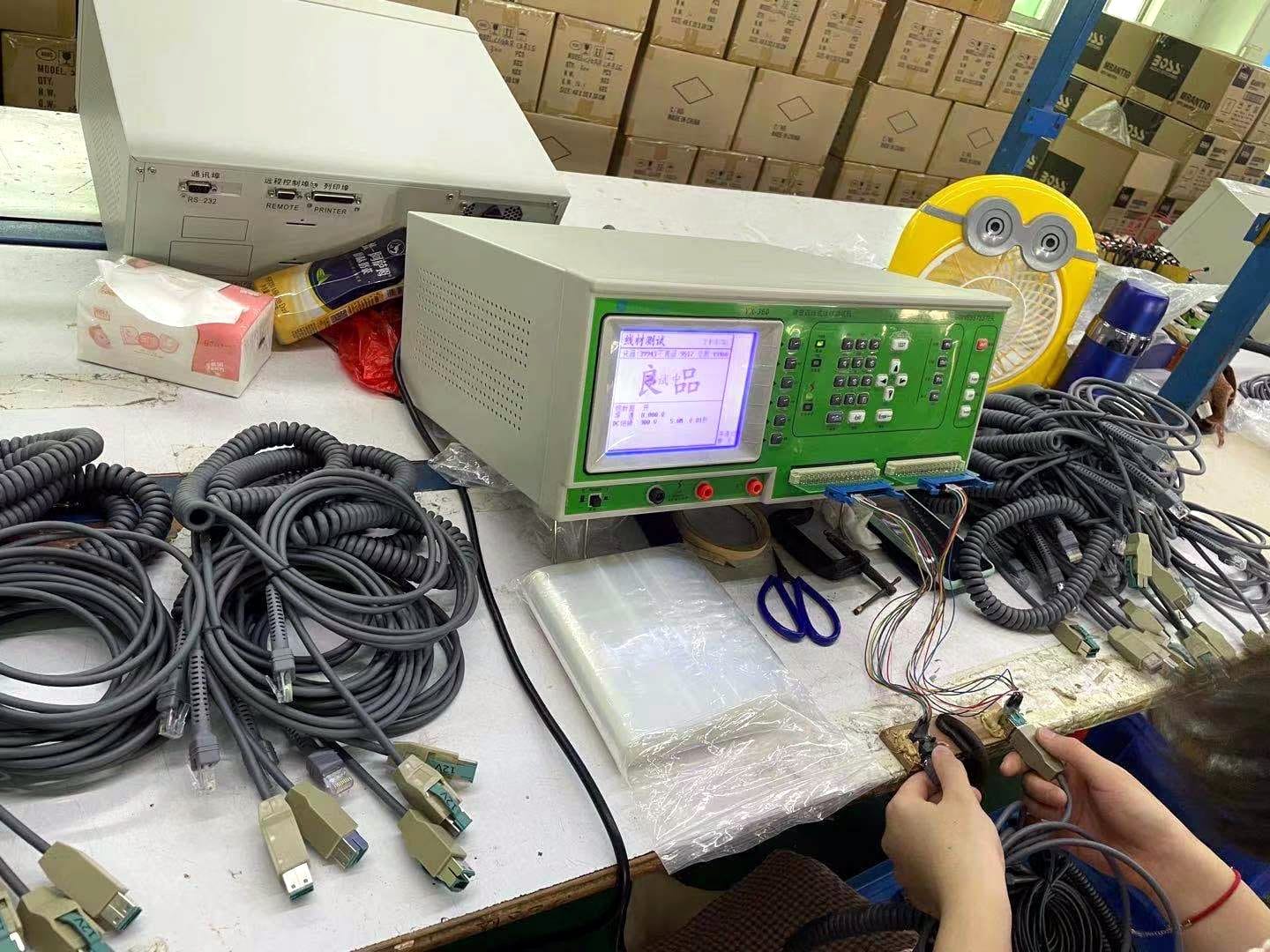
- Continuity — checked against the approved netlist, not sampled.
- Pinout — verified end to end, including shielding and drain termination.
Defined per project
- Insulation resistance / hipot — voltage, dwell and threshold set by your standard.
- Crimp pull force — minimum value and sampling frequency.
- Dimensional and visual — critical lengths, molding geometry, identification, workmanship.
- Mechanical or environmental — flex, pull, salt spray, thermal cycling, assessed against the requested method.
The line between the two is not about cost. Continuity and pinout catch the failures that actually reach a customer, and they are cheap enough to run on everything. The published test matrix lists every test with the method and what it proves; the quality assurance page explains where those checks sit in the build.
Test scope FAQ
Do you test 100% of units or take a sample?
Continuity and pinout run on 100% of production assemblies. Everything else — pull force, dimensional, visual, environmental — runs 100% or to a sampling plan depending on what the volume and the risk justify. The same scope is agreed for first article and build-to-print work before anything is quoted.
Can you test to our standard rather than yours?
Yes. Send the standard, the limits and the sample size. If you do not have them, we will propose a scope based on the application — but that proposal is a starting point for your approval, not a substitute for it.
What documents come with a shipment?
Whatever the project defines: inspection records, first article report to your format or ours, material certificates, RoHS and REACH statements, and a certificate of conformance.
What if we need a test you do not run in-house?
We will say so at quotation rather than subcontract it silently. That is why this page does not publish a generic equipment list — naming the scope and then meeting it beats promising a test that has to be sent out.
Define the evidence your approval process needs.
Send the standard, the limits and the sample size. If you do not have them, we will propose a scope based on the application.