
A drone cable supplier is not a general wire shop that happens to sell silicone wire. The difference is three disciplines most harness shops never have to learn: gram accounting, because a multicopter pays for every gram in flight time; vibration endurance, because the airframe never stops shaking; and EMI control, because the motor controllers sit centimeters from the video and GPS wiring. Get any one wrong and the machine flies worse, draws more current, or drops out of the sky.
This article is the engineering checklist for choosing — or briefing — a drone cable supplier, with the numbers you can verify before you send a drawing.
What separates a drone cable supplier from a general wire shop
The catalog answer is “anyone can crimp a JST connector.” The difference shows up in three places you cannot see in a photograph. First, a competent drone cable supplier records the mass of every assembly, because a “weight budget” that is not measured per serial number is a wish. Second, it builds the flex section with fine stranding and a controlled bend radius, because the vibration failure is a fatigue failure, not a pull-out. Third, it treats the harness as part of the EMC system, because the shield on an FPV run is useless unless its drain is terminated the way the airframe actually flies it.
Our lightweight UAV wire harness line is built this way — to a mass budget, with the finished weight of each assembly recorded against its serial number — and the two examples below show the same discipline applied to a power lead and a camera breakout.
Where the grams actually go
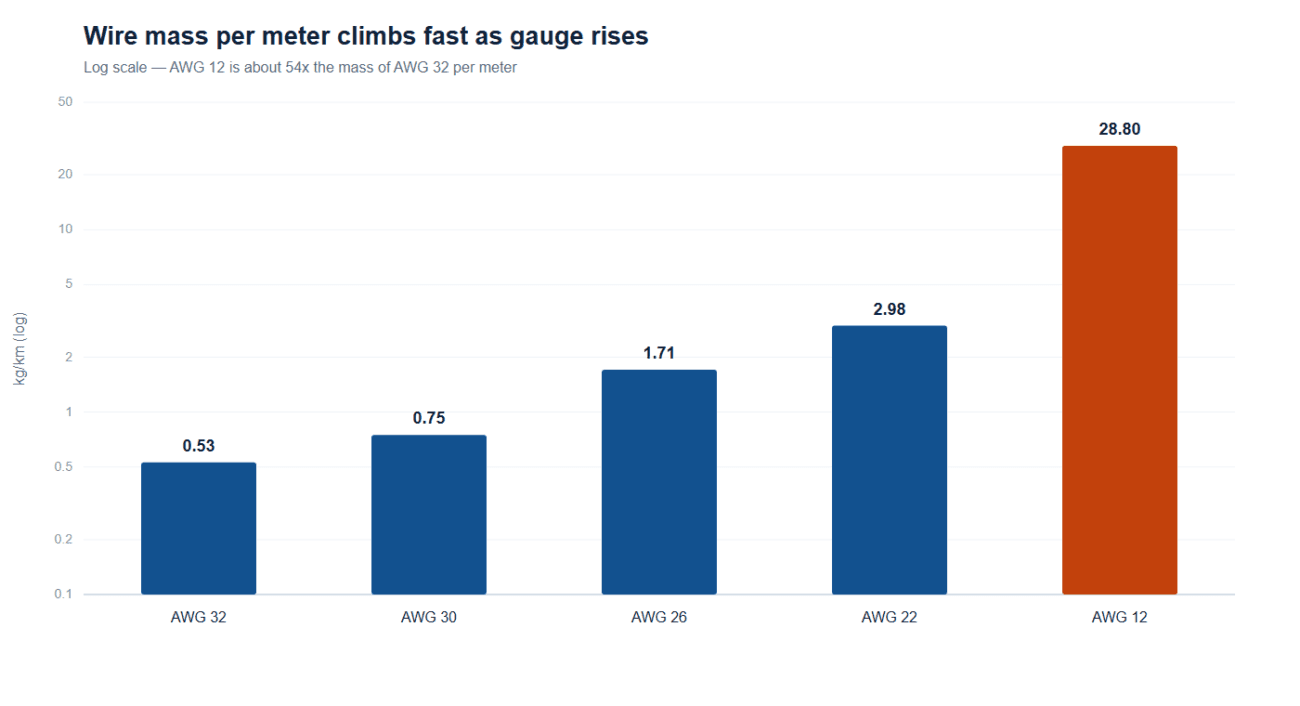
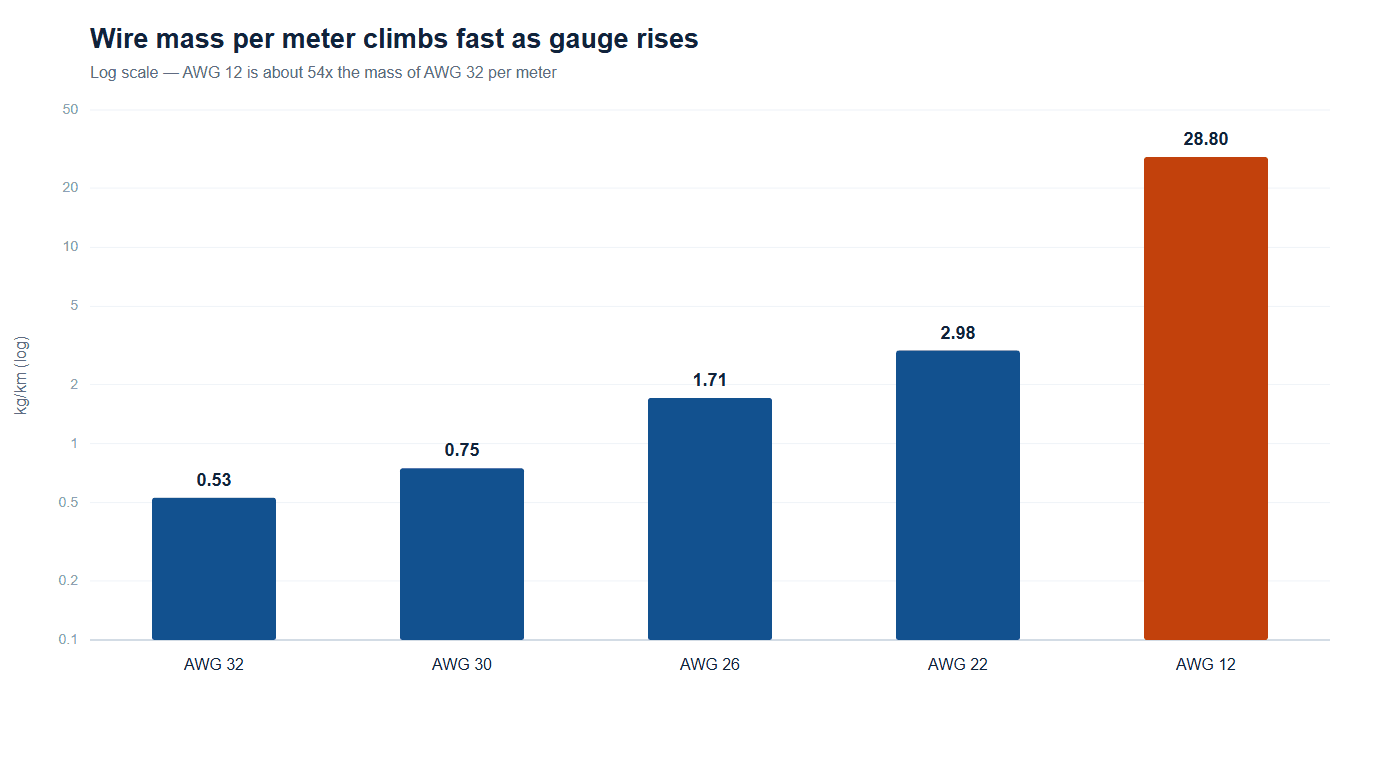
The first surprise in a weight review is that the conductor is not the only thing you are carrying. Reversing a public polyimide wire datasheet by cross-section and copper density gives the insulation (plus plating) as a share of total wire mass: roughly 41 percent at AWG 32, 34 percent at AWG 30, 22 percent at AWG 26, 15 percent at AWG 22 and 6 percent at AWG 12. The finer the wire, the larger the share of its mass that is insulation, not copper.
| AWG | Mass per km (max) | Insulation + plating share |
|---|---|---|
| 32 | 0.53 kg/km | ≈ 41% |
| 30 | 0.75 kg/km | ≈ 34% |
| 26 | 1.71 kg/km | ≈ 22% |
| 22 | 2.98 kg/km | ≈ 15% |
| 12 | 28.8 kg/km | ≈ 6% |
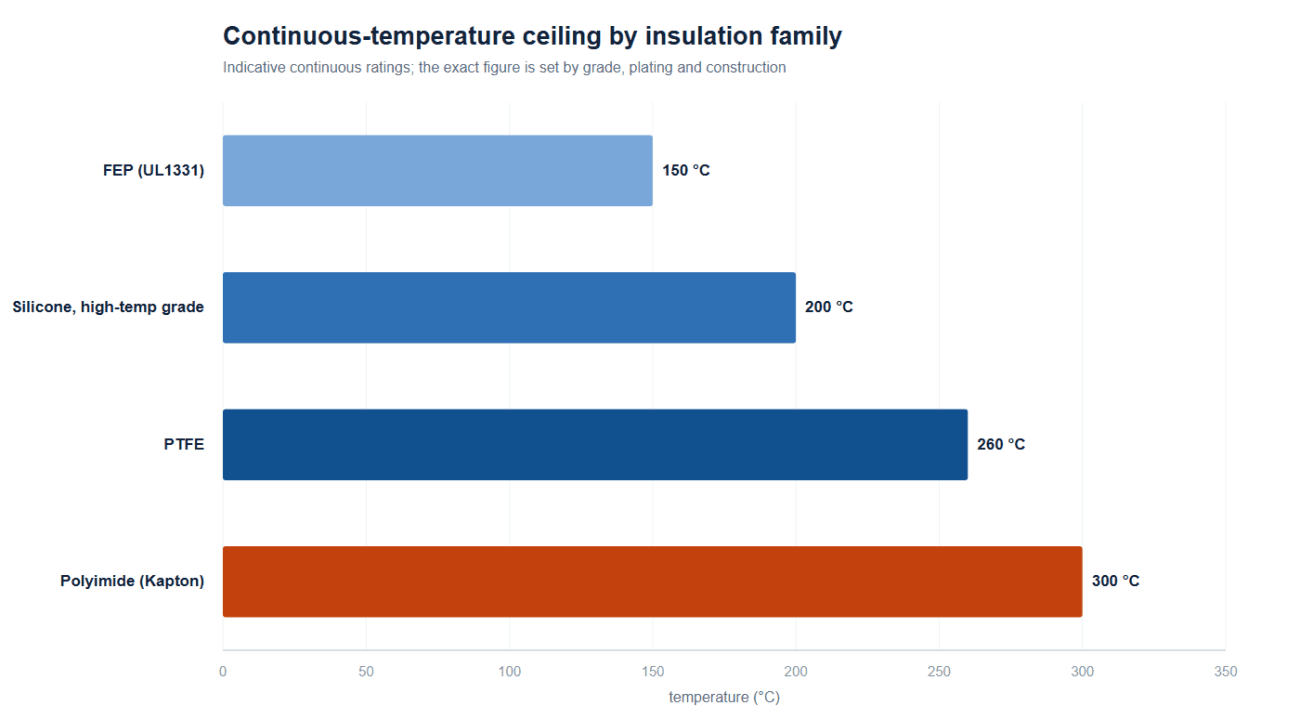
Why this matters for a drone is arithmetic. A multicopter harness is mostly signal wire — camera video, UART, I²C, GPS, compass, receiver — and only a handful of power conductors. A dozen 28–30 AWG signal runs, each with insulation that is a third of its own mass, add up faster than the two 14 AWG battery leads do. So the biggest gram-saving lever on a drone is not “drop a gauge size”; it is thinning the insulation wall on the many fine conductors — which is exactly where thin-wall materials such as polyimide and ETFE earn their keep. Our comparison of Kapton, PTFE, FEP and silicone insulation walks through that trade-off in full; for the extruded end of the range see the silicone wire harness page and our UL1331 FEP wire.
A related lever that most checklists skip: standardize the connector count. Every extra connector is a mating pair, a strain-relief, and a few grams. Two harnesses that carry identical signals can differ by 15–20 percent in mass purely through connector and branch-count choices, before a single conductor changes.
Vibration kills the termination, not the wire
Ask any drone cable supplier what actually fails in the field and the answer is rarely “the copper broke mid-span.” It is the termination: a strand fracturing right where the wire leaves the crimp or the solder joint, where the harness passes through a frame hole, or where it flexes against a standoff. The physics is one bending-strain relationship, applied to the strand, not the cable:
ε = d / (2R)
where ε is the peak fiber strain, d the diameter of the individual strand (or conductor) being bent, and R the bend radius. The point that gets lost is that d is the strand diameter, not the cable outer diameter. A fine-strand conductor bends each thin strand through a much gentler curve than a solid conductor of the same total cross-section, so the peak strain on each copper fiber is far lower. Run the numbers: a 0.15 mm strand bent around a 5 mm radius sees ε = 0.15 / (2 × 5) ≈ 1.5 percent. A solid conductor of the same cross-section (about 0.5 mm) sees 0.5 / (2 × 5) ≈ 5 percent — over three times the strain, at the same bend. Fatigue life falls off a cliff with strain, which is why flexible harnesses are specified with fine stranding and why the flex and drag-chain construction is a different animal from a fixed panel run.
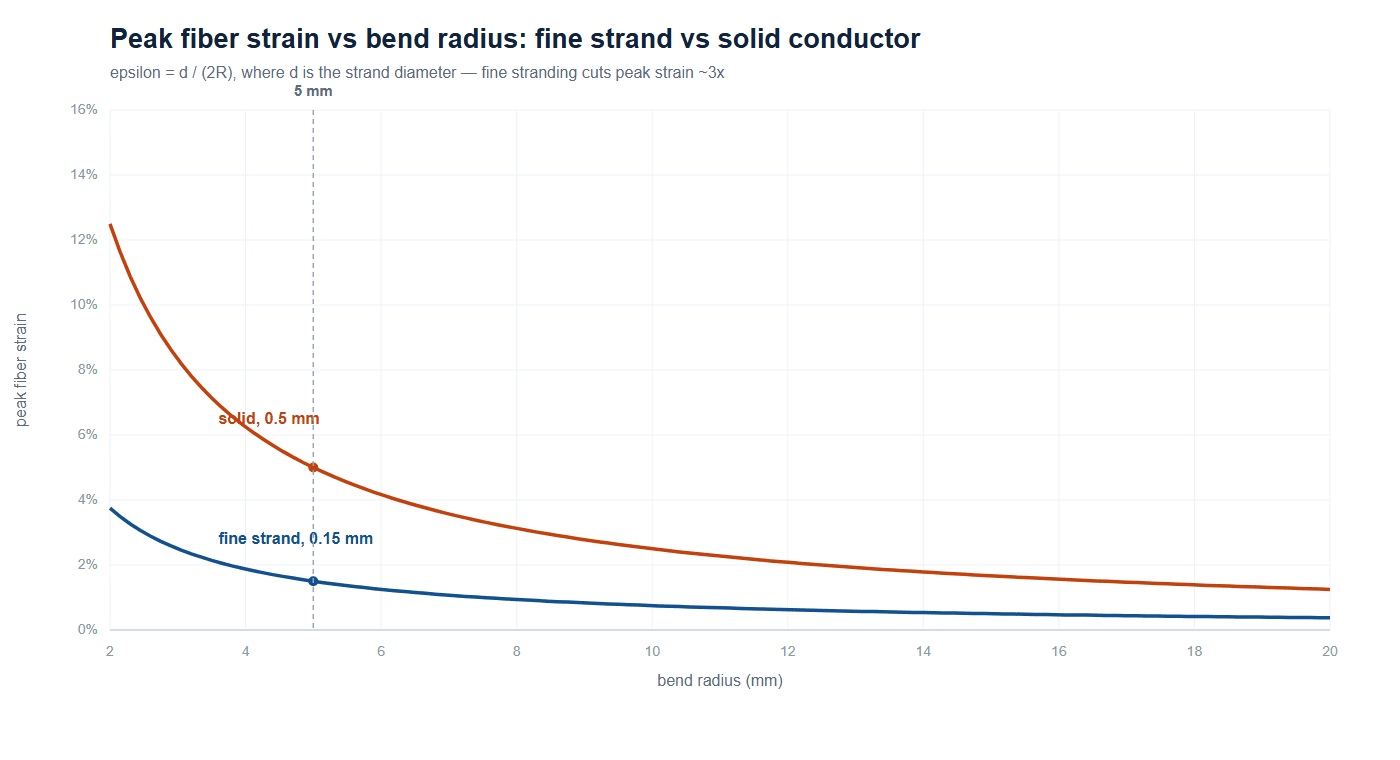
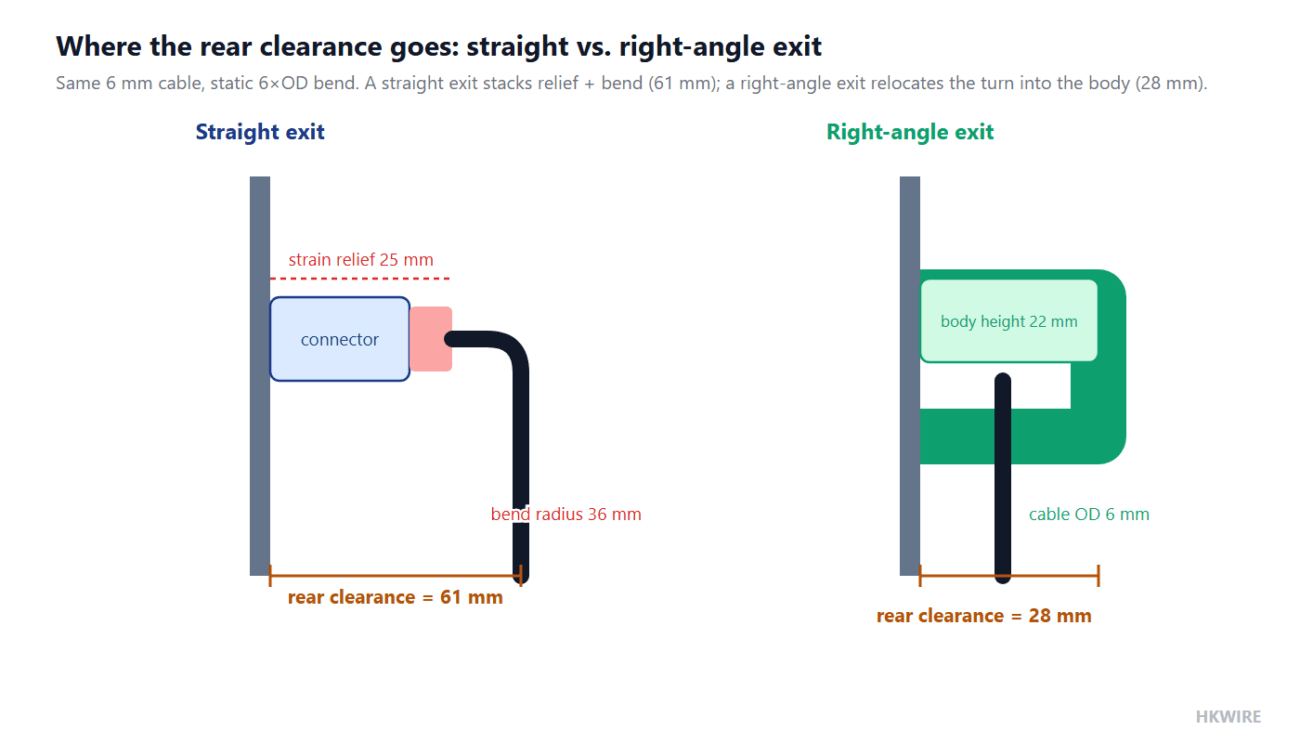
Two practical rules fall out of it. First, never put the bend right at the crimp — the crimp is a strain concentrator, so the free bend should start a few strand-diameters away. Second, specify the flex cycle count and the bend radius together: a harness that survives 5,000 cycles at a 10 × OD radius tells you nothing about 500,000 cycles at 4 × OD on a gimbal that never stops rotating.
EMI: the ESC noise path runs through your harness
The third discipline is the one most likely to be invisible until the machine is in the air. Motor controllers switch at tens of kilohertz with hard edges; the noise couples onto the video, GPS and receiver wiring, and the harness is the antenna that carries it. A shielded cable that is terminated wrong is worse than an unshielded one, because it collects the noise and then has nowhere clean to dump it.
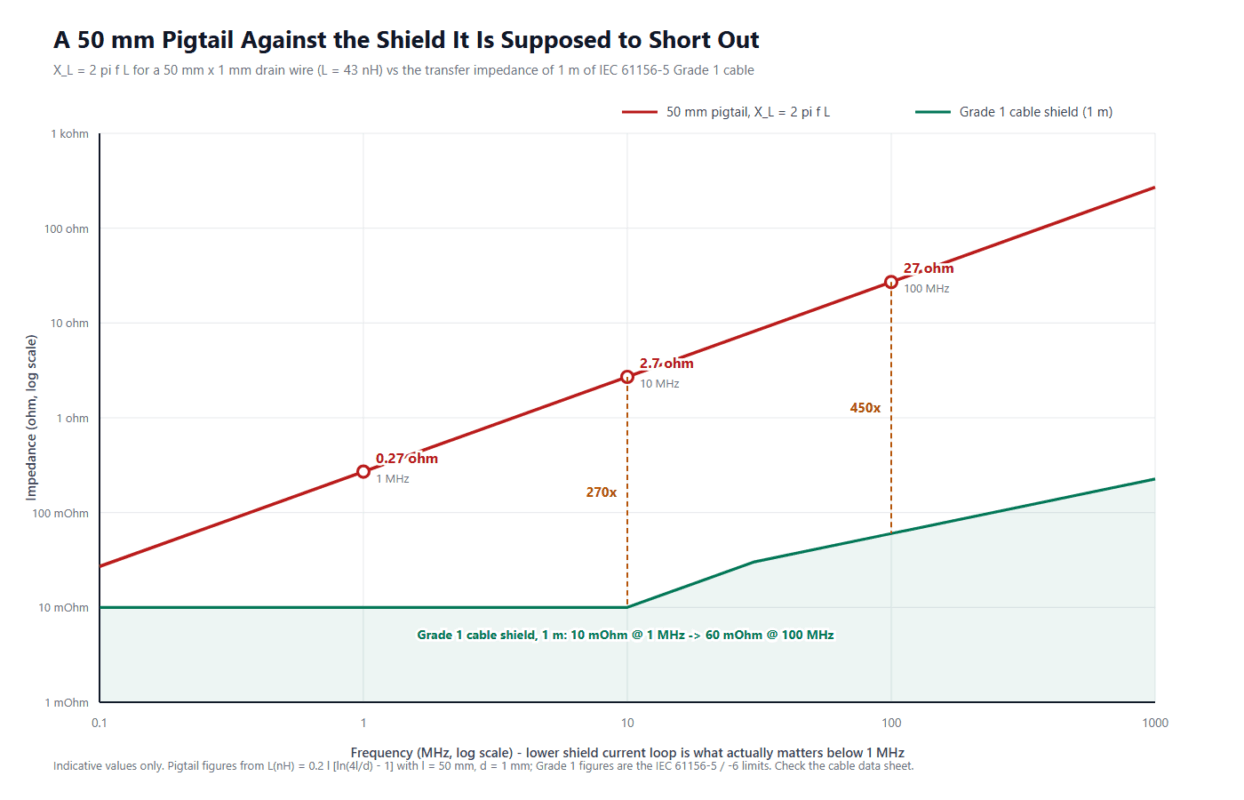
The shield only works when it is bonded and drained: the braid connects to the connector shell or a dedicated drain pin, and that drain lands at the same reference the signal returns through, terminated at one end (or both, per the airframe’s ground scheme) rather than left floating. On an FPV run, the failure mode is not a lost command — it is a video feed full of diagonal bands that only appear at throttle. The cheapest fix is almost never a thicker shield; it is a correct drain termination and a bit of physical separation between the power pair and the video pair.
Specifying a UAV harness: what to put on the drawing
A drawing that arrives with only “length and connector” forces the supplier to guess at the three disciplines above. A drawing that specifies the following gets a correct assembly the first time:
- Mass budget — target grams per assembly, and whether the finished weight is recorded per serial number.
- Conductor construction — gauge, stranding class (fine vs solid), and plating; stranding class is defined in IEC 60228.
- Flex section — the radius, the cycle count, and where the bend sits relative to each termination.
- Shielding and drain — coverage, and exactly where each drain is bonded and terminated.
- Connector map — family, gender, pitch and keying for every end, not just “JST.”
- Environment — temperature range, and any moisture exposure — stated as a real IP rating rather than “waterproof.”
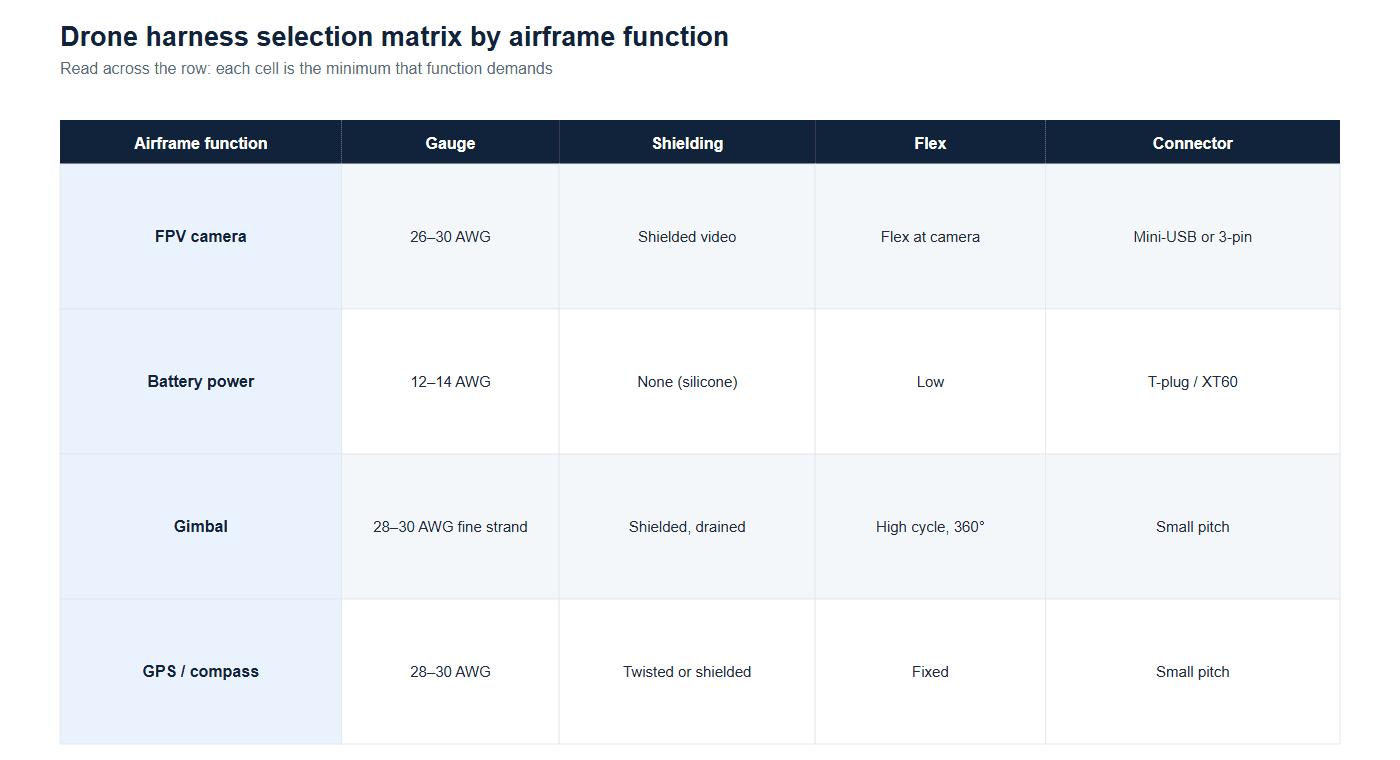
HKWIRE builds both ends of a typical airframe. The drone battery power harness carries the high-current run in 12 AWG silicone with T-plug connectors, and the FPV drone video cable breaks a right-angle mini-USB camera port out to 3-pin leads for the VTX — each cut and terminated to your drawing, with continuity, pinout and crimp-pull checks run on every piece, and limits agreed in writing before production release through our test and validation process.
What wire gauge should a drone use?
It splits by duty. Power runs are sized by current and voltage drop, not by the drone’s marketing: a 12 AWG silicone lead suits the battery-to-ESC path, while signal runs stay in the 26–30 AWG range where the insulation, not the copper, dominates the mass. The drawing should carry gauge, stranding class and plating, and the current should be checked against the actual duty, not a headline figure.
Why does the insulation share of wire mass go up as the wire gets thinner?
Because the copper cross-section falls faster than the wall thickness does. A fine signal wire carries a thin conductor inside a wall that cannot shrink below a practical minimum, so at AWG 32–30 the insulation and plating are a third to two-fifths of the wire’s weight — which is why thin-wall insulation is the real weight lever on a signal-heavy harness.
What causes a drone wiring harness to fail from vibration?
Fatigue at the termination, where the bend concentrates at the crimp or passes through the frame. The peak strain on each copper strand is what matters, and fine stranding keeps that strain roughly a third of a solid conductor’s at the same bend radius. A correct drawing specifies the flex radius, the cycle count and where the bend sits relative to each termination.
Does a drone cable supplier need to do anything special about EMI?
Yes — it has to treat the harness as part of the airframe’s ground and shield scheme, not as a passive loom. A shielded video or GPS run works only if the braid is bonded and its drain terminated at the right reference; otherwise the shield collects ESC noise and the feed shows throttle-linked interference. Physical separation between power and signal runs is the cheapest mitigation.
Frequently asked questions
How much mass can a UAV harness realistically save?
Start with the connector map. Two harnesses carrying identical signals can differ by 15–20 percent in mass purely through connector and branch-count choices, before a single conductor changes. After that, thinning the insulation wall on the many fine signal runs pays more than dropping a gauge size, because insulation is already about a third of a 30 AWG wire’s weight.
Do I need fine-strand conductors everywhere in a drone harness?
Only where the harness actually moves. Fine stranding keeps peak strand strain at roughly a third of a solid conductor’s at the same bend radius, which is what keeps a gimbal or camera loom alive. Where a run is clamped and static, standard stranding is fine and costs less. Say which sections move on the drawing.
Can you work from an existing harness instead of a drawing?
Yes. Send an airframe loom or a photographed installation and we measure it, map the pinout and return a drawing for approval before anything is built. That is how most prototype UAV programs start, and it usually surfaces revision drift at the same time — connector counts that grew over several board spins, for example.
Do you record harness mass per serial number?
Yes, when the drawing asks for it. Per-serial mass records let you see whether a production batch has drifted and give you a real baseline to hold future revisions against. Ask for it alongside any flex limits, so both are agreed before production release rather than after.
What is the minimum order quantity for a custom drone harness?
Prototypes and engineering samples run from 1 to 50 pcs and ship in 3 working days; production starts at 500 pcs per part number, 14 working days after first article approval. A harness normally needs no new mold, so the first small batch carries no tooling charge — where an overmold is required we quote it as a separate line item.
Need a drone harness built to a mass budget, not a catalog guess?
HKWIRE builds lightweight UAV harnesses — power leads, camera breakouts and full airframe looms — to your drawing, with per-serial mass records, fine-strand flex sections and shield drains terminated the way your airframe actually flies. Send the drawing and the mass budget and we will quote a tested assembly.