IP67 Keystone Panel Frame for Field-Replaceable RJ45 Modules
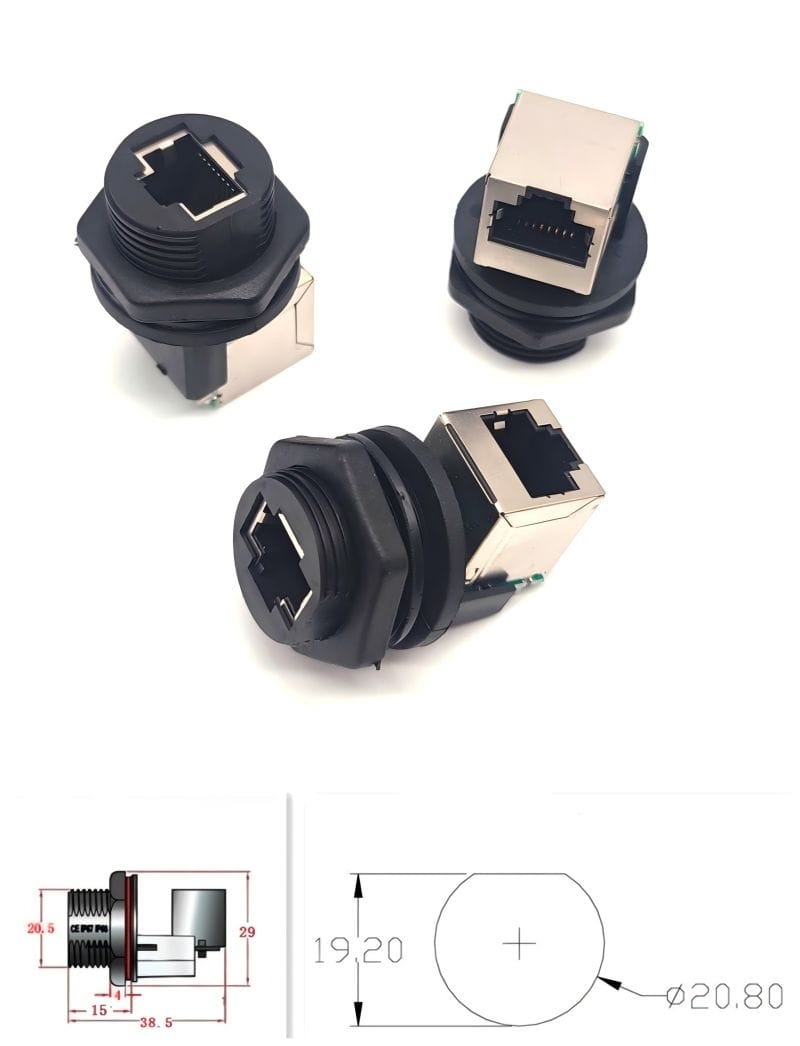
An IP67 keystone panel frame is a sealed housing with a round cut-out and a locknut that takes any standard keystone module. A damaged jack or a move from Cat6 to Cat6A is a module swap at the panel, not a new cable.
Last updated: 13 September 2026
Overview
An IP67 keystone panel frame is the answer when the jack itself should stay a commodity part. The frame is a sealed housing with a round cut-out, a threaded body and a locknut; the installer pushes in whichever keystone module the project already uses, and the frame provides the gasket, the strain relief and the environmental seal. If a port is damaged, or a machine is re-specified from Cat6 to Cat6A, the module is swapped at the panel instead of the whole bulkhead being replaced.
That is the whole argument for a frame over a molded coupler, and it is also why the frame asks more of the assembly step.
Key Specifications
| Product type | Sealed keystone frame for field-replaceable modules |
|---|---|
| Accepts | Standard keystone modules, Cat5e / Cat6 / Cat6A, shielded or unshielded |
| Cut-out shape | Round (diameter set by the frame drawing, pending supplier confirmation) |
| Panel thickness range | Pending supplier drawing |
| Fixing | Threaded body with locknut |
| Sealing | Flange gasket plus rear cable entry seal sized to cable diameter |
| Ingress rating | IP67 (pending supplier test report) |
| Accessory | Blanking cover for unpopulated positions |
| Module fit | Retention geometry must be sample-tested against the buyers own module brand |
| Compliance files | RoHS and REACH declarations pending supplier confirmation |
| Rear cable range | Set by the sealing insert; confirm the cable diameter before ordering |
| Typical use | OEM machines, outdoor enclosures, food lines, kiosks built in several configurations |
Field-replaceable versus one-piece: what a service call costs
The three options below all get an RJ45 port onto a sealed panel. They differ in what happens the first time something goes wrong, and that is where the money is.
| Keystone frame plus module | One-piece bulkhead coupler | Molded pigtail through the wall | |
|---|---|---|---|
| What fails | The module, usually | The whole coupler | The whole assembly |
| Repair | Swap the module at the panel | Replace the coupler, re-terminate both leads | Replace the assembly and re-route the cable |
| Spares held | One module type covers several machines | One coupler per configuration | One assembly per length and configuration |
| Category upgrade | Push in a Cat6A module | New coupler | New assembly |
| Sealing joints | Flange, rear entry, module interface | Flange and rear entry | Flange only |
| Assembly care needed | Highest – three surfaces to get right | Medium | Lowest |
| Best for | Fleets and machines built in several variants | One configuration, high volume | Fixed internal run, no rear access needed |
The honest counter-argument: a frame has one more sealing interface than a one-piece coupler, because the module has to seal in the frame as well as the frame sealing in the panel. On a machine that is hosed down daily and never re-configured, the one-piece coupler is the simpler sealed part. On anything built in more than one configuration, or shipped to a site where a technician cannot re-terminate a lead, the frame wins.
How the seal is made: three surfaces
The gasket between the frame flange and the panel face keeps water out of the cut-out. The thread and locknut hold the clamping force, so the torque applied at the nut matters more than the torque on the screws. The rear cable entry has its own sealing insert sized to the cable diameter, and a cable outside that range defeats the seal no matter how tight the gland is screwed.
A blanking cover is offered for positions that are fitted but not yet populated, which is common on machines shipped with options installed later. Fit the cover rather than leaving the aperture open: an unpopulated frame is not a sealed frame, and an open frame is where the water goes when someone washes the machine.
Module compatibility: test it on a sample
The frame is intended for standard keystone modules in Cat5e, Cat6 and Cat6A, including shielded modules where the drain path has to continue through the frame and onto the panel. The module itself is the commodity registered jack format your site already terminates, which is the point. Compatibility with the modules you already stock is the one thing worth testing before a production order, because keystone retention geometry varies more between module brands than buyers expect. A module that clips in loosely will work on the bench and fall out in a vibrating cabinet. Send us the module part number and we will confirm the fit, or send us a module and we will test it.
Where this IP67 keystone panel frame is used
- OEM machines that want one sealed aperture across several product variants
- Outdoor enclosures where the port has to be serviced without replacing the housing
- Food and beverage lines where a damaged jack is cheaper to swap than a bulkhead
- Kiosks and terminals built in several network configurations
- Machines shipped with options installed later, paired with our Cat6A Shielded Patch Cord – S/FTP 26AWG, 500 MHz, 10G
- Control cabinets that carry both copper and fiber through the same panel family
What we still have to confirm
- Cut-out diameter – set by the frame drawing, not yet released.
- Panel thickness range – confirm before the panel is tooled.
- Rear seal cable diameter range – give us the cable you intend to use.
- Gasket material – and what it will be exposed to.
- Temperature range – pending the supplier datasheet.
- Module retention fit – against the brand you actually stock.
The published data for comparable frames gives an IP67 rating and a round cut-out, but no diameter, panel thickness range or temperature range. We are not going to put a number on those without a drawing. Ask for the frame drawing before the panel is tooled and we will confirm all six together, with the supplier datasheet for the rating that applies to the configuration you order.
Workmanship and testing
Cable assemblies here are built to IPC/WHMA-A-620 Class 3 workmanship inside an ISO 9001 system, across a 32 to 12 AWG range. Continuity and pinout are verified on every unit before packing. Seal checking on the batch can be quoted when an ingress rating is specified.
Custom builds and ordering
Smallest quoted lot is 5 pcs, out in 3 working days. Production orders start at 500 pcs and ship 14 working days after sample approval; a new overmold body adds about 10 working days. OEM and ODM builds ship under your part number, and we can provide material certificates and first-article reports.
Related panel and patching hardware
- IP67 RJ45 Panel Coupler, Cat6A Shielded Bulkhead Feedthrough
- Control Cabinet Service Interface with RJ45 and USB-C Front Plate
- Cat6 RJ45 Panel-Mount Extension Cable with Thread-locking
- Cat6 S/FTP Shielded RJ45 Patch Cord (Foiled + Braid, Snagless Boot)
- IP67 RJ45 Screw-Lock Bulkhead Cable with Threaded Coupling
- Cat6A IP67 Industrial Pigtail, S/FTP RJ45 with Dust Cap
Full ranges: panel mount cable and Ethernet patch cords.
Frequently Asked Questions
Will my existing keystone modules fit?
Probably, but keystone retention geometry varies more between brands than buyers expect. Send us the module part number, or a sample, and we will confirm the fit before a production order.
Is a frame as sealed as a one-piece coupler?
It has one more interface to seal, because the module seals in the frame as well as the frame sealing in the panel. Fitted correctly the assembly targets IP67; fitted badly it leaks at the module.
Can I leave a position empty?
Only with the blanking cover fitted. An open frame is not a sealed frame, and that is exactly where washdown water goes.
What cable diameter does the rear seal take?
It is sized to a range, and a cable outside that range defeats the seal regardless of how tight the gland is. Give us the cable and we will confirm the insert.
| Product type | Sealed keystone frame for field-replaceable modules |
|---|---|
| Accepts | Standard keystone modules, Cat5e / Cat6 / Cat6A, shielded or unshielded |
| Cut-out shape | Stated per your drawing |
| Panel thickness range | Stated per your drawing |
| Fixing | Threaded body with locknut |
| Sealing | Flange gasket plus rear cable entry seal sized to cable diameter |
| Ingress rating | Stated per your drawing |
| Accessory | Blanking cover for unpopulated positions |
| Module fit | Retention geometry must be sample-tested against the buyers own module brand |
| Compliance files | RoHS and REACH |
| Rear cable range | Set by the sealing insert; confirm the cable diameter before ordering |
| Typical use | OEM machines, outdoor enclosures, food lines, kiosks built in several configurations |
Related products
SPE Bulkhead Panel Connector for 10BASE-T1L Field Devices
An SPE bulkhead panel connector brings 10BASE-T1L single pair Ethernet and Power over Data Line into a field device box through one sealed penetration. IEC 63171-6 mating face or M8 coupling, front or rear mounting. The cut-out is smaller and the termination is faster than a four-pair Ethernet entry.