
The IP67 vs IP69K question comes up the moment a machine has to be cleaned, and it is usually answered the wrong way — by treating the ratings as rungs on one ladder and buying the highest number. They are not rungs. Two describe water sitting still against a seal; one describes hot water hitting a seal at pressure. The choice is about your cleaning and exposure regime, not about how cautious you feel.
This guide gives each rating a number you can put on a drawing. It works through IEC 60529 test parameters, converts them into pressures with the hydrostatic relation P = ρ·g·h, and shows why an IP69K washdown is around two orders of magnitude harder on the seal than an IPX6 hose jet. HKWIRE builds sealed molded assemblies; the standards below are the ones those drawings should quote.
What do the two digits actually test?
An IP rating is two independent numbers sharing a single test report. The first digit covers solids and dust; the second covers liquids. The scale is defined in IEC 60529, Degrees of protection provided by enclosures (IP Code), and the marking means nothing without the two digits being tested separately. A 6 on the first digit means dust-tight under the defined dust test. A 7 means the enclosure survives temporary immersion under stated conditions, and an 8 means continuous immersion under conditions the manufacturer states. Then there is 9K, which is not a step past 8 at all: it describes protection against high-pressure, high-temperature water jets, run on completely different equipment.
The first digit: dust and solids
The dust test is a chamber test, not a splash test. Dry talcum powder passing a 0.075 mm sieve is kept airborne at about 2 kg per cubic meter of chamber volume, and the run lasts up to eight hours. For IP6X the enclosure is also put under a vacuum of up to 20 mbar below ambient, which mimics how a real enclosure breathes as it heats and cools. IP5X allows some dust in if it cannot affect operation; IP6X allows none to be observed inside.
| Dust parameter | Value in IEC 60529 | On the floor |
|---|---|---|
| Test dust | Dry talcum powder, all below 0.075 mm | Finer than most process dust |
| Concentration | About 2 kg/m³, kept suspended | A heavy, continuous dust cloud |
| Duration | Up to 8 hours, set by airflow | A full shift of worst-case exposure |
| Vacuum for IP6X | Up to 20 mbar below ambient | Pulls dust through any leak path |
| IP5X / IP6X | Limited ingress / no dust observed | Dust-protected / dust-tight |
Chamber conditions as written into the IEC 60529 dust test; the pass-or-fail value is the inspection result, not a number in the method.
The second digit: a different rig for every number
Water separates the ratings, because each second digit is a different machine. The lower digits use drip boxes and oscillating spray, the middle digits aim a nozzle at the part, the immersion digits use a tank, and 9K uses a heated high-pressure nozzle on a turntable. The table below collects the parameters that matter.
| Second digit | Setup | Flow or depth | Distance or angle | Duration |
|---|---|---|---|---|
| IPX5 jet | 6.3 mm nozzle | 12.5 ± 0.625 L/min, about 30 kPa | 2.5–3 m | 1 min/m², minimum 3 min |
| IPX6 powerful jet | 12.5 mm nozzle | 100 ± 5 L/min, about 100 kPa = 1 bar | 2.5–3 m | 1 min/m², minimum 3 min |
| IPX7 immersion | Still-water tank | Lowest point 1 m below the surface, highest at least 150 mm below | Static | 30 min |
| IPX8 immersion | Still, or pressurized | Deeper than IPX7, set by the manufacturer | Static | Set by the manufacturer |
| IPX9K hot jet | Close-range nozzle, turntable | 14–16 L/min at 80–100 bar | 100–150 mm at 0/30/60/90° | 30 s each, 2 min total |
Second-digit parameters, IEC 60529 for IPX5–IPX8 and the IPX9 water test; the 9K label and its parameters come from DIN 40050-9, now ISO 20653 for road vehicles, and IEC 60529 added an equivalent high-pressure jet test as IPX9.
What does IP67 actually buy you on a plant floor?
IP67 is the sensible default for industrial wiring: dust-tight, and it survives brief immersion. That covers most machines: rain during loading, a puddle at the frame base, coolant splash, and a gentle hose-down at end of shift. For the majority of sensor and Ethernet runs it is the correct answer, and specifying more buys nothing measurable.
The immersion half has a number attached, and the number is small. IPX7 puts the lowest point of the enclosure exactly one meter under the surface for thirty minutes, so the seal sees:
P = ρ·g·h = 1000 × 9.81 × 1.0 = 9,810 Pa = 9.81 kPa ≈ 0.098 bar ≈ 1.4 psi
That is roughly one tenth of atmospheric pressure, held for half an hour. A correctly sized static O-ring handles it comfortably, which is why so many industrial cordsets carry IP67 without any exotic sealing hardware.
IP67 does not include a jet test
The two digits are chosen independently, so IP67 means the part passed IP6X (dust-tight) and IPX7 (immersion). It does not mean it passed IPX5 or IPX6, the directional water-jet tests. A part can be perfectly dust-tight and survive a one-meter dunk and still leak under a pressure nozzle, because a jet loads the seal with dynamic pressure and impact force that still water never applies. For the IP67 vs IP69K decision, note that both start with a dust-tight 6, so dust is never the deciding digit — the water digit is.
The part most data sheets omit. IP68 does not automatically include IPX6, and IP69K does not include IPX7 or IPX8. Each second digit is a separate test, and a part is only rated for the digits that appear in its report. When a drawing says “must survive washdown and occasional flooding,” the honest answer is a dual rating stated in full, not a single higher-looking number.
Assembly-level, the everyday form of this is a molded IP67 M12 cordset feeding a sealed enclosure, specified with the strain relief and seal check described in our guide to how to specify an overmolded cable assembly.
Where IP68 stops being useful
IP68 answers a question most factories never ask: will this part survive sitting under water continuously, at a depth and for a duration the manufacturer defines. It suits a submerged pump, a below-grade junction box, or a flooded pit sensor. The catch is that depth and duration are set by whoever publishes the rating, not fixed by the classification; the only rule is that IPX8 must be more severe than IPX7. Convert your real depth into a pressure and write it on the drawing:
| Depth h (m) | P = ρ·g·h | In bar | Typical framing |
|---|---|---|---|
| 1.0 | 9.81 kPa | 0.098 bar | IPX7, the fixed 1 m test |
| 2.0 | 19.6 kPa | 0.196 bar | A common IPX8 rating point |
| 3.0 | 29.4 kPa | 0.294 bar | Deep end of typical IPX8 claims |
| 5.0 | 49.1 kPa | 0.491 bar | Below-grade pits and sumps |
| 10.0 | 98.1 kPa | 0.981 bar | Nearly one atmosphere of static head |
Computed from P = ρ·g·h with ρ = 1000 kg/m³ and g = 9.81 m/s². Depths are illustrative project depths, not values written into IEC 60529.
There is a second trap that costs buyers money every week. A part marked IP68 is not automatically compliant with IP67, because the second digit 8 is assessed against the manufacturer’s stated condition rather than the IPX7 test; unless the data sheet lists both marks you have only been told about one. If the part has to survive both a dunk and a long soak, ask for both ratings in writing. Even at ten meters the seal sees under one bar, so IP68 is about material compatibility and time, not extreme pressure.
When is IP69K the only rating that answers the question?
IP69K was written for washdown. The test is close-range, high-pressure, high-temperature spray from four fixed angles, and it exists because that is what food and beverage plants, and any machine with a documented clean-in-place cycle, actually do to their equipment. If the cleaning procedure on your line has a pressure, a temperature and a nozzle distance printed on it, that procedure is pointing at IP69K.
| IPX9K parameter | Value | Why it matters |
|---|---|---|
| Nozzle pressure | 80–100 bar (8–10 MPa) | Impact force, not just wetting; can shear a soft seal |
| Water temperature | 80 °C ± 5 °C | Thermal shock on the seal and the overmold bond |
| Flow rate | 14–16 L/min | Keeps the jet coherent at close range |
| Nozzle distance | 100–150 mm | Close enough that pressure is the load, not flow |
| Angles | 0°, 30°, 60°, 90° | Every face is hit, including the underside |
| Duration | 30 s at each angle, 2 min total | Long enough to drive water past a splash-only seal |
IPX9K test parameters; the 9K designation and this test come from DIN 40050-9, superseded by ISO 20653:2013 for road vehicles, with an equivalent high-pressure jet test added to IEC 60529 as IPX9.
It is also the most overspecified rating on the market: a dry-warehouse cabinet does not need a jet rating, and paying for the hardware and jacket chemistry to get one wastes money on a test nobody runs. Where the regime really is washdown, the coupling choice matters: a screw or bayonet coupling that stays torqued beats a friction fit when the jet works the joint loose, as covered in the guide to connector locking mechanism selection. This is the crux of the IP67 vs IP69K comparison: the load case, not the number.
Immersion, jets and steam are three different failure modes
The ratings split along the failure mode, not a severity scale. Still water loads the seal with steady pressure and asks a material to stay compatible for hours. A jet adds impact and asks a structure to resist being pushed apart. Steam adds heat on top of both and asks the assembly to survive thermal cycling. The IP67 vs IP69K split is a split between static and dynamic load.
| Exposure | What it loads | Rating that speaks to it | What still has to be stated |
|---|---|---|---|
| Rain, splash, end-of-shift hose-down | Water running over and around the seal | IP67 | Mated state only; torque |
| Standing or continuous water | Hydrostatic pressure over hours | IP68 | Depth, duration, chemistry |
| High-pressure hot washdown | Jet impact plus heat plus detergent | IP69K | Pressure, temperature, nozzle distance |
| Condensation inside a sealed box | Humid air breathing in and out | None of them | Vent or breather, and potting |
| Steam cleaning | Heat and pressure together | IP69K, then verify separately | Confirm against your actual cycle |
The last two rows are where waterproof assemblies fail without leaking. A sealed enclosure that breathes humid air collects condensate inside it, and no rating on the connector prevents that; the answer is a vent, a breather or a potted joint. Steam is harder still, combining heat, pressure and detergent, so a rating proven on ambient tap water tells only part of the story. Verify against the real cycle and chemistry.
What no IP rating covers at all
- Chemistry. Cutting oil, coolant, caustic cleaner and solvent attack the jacket and the gasket. The digits are about water and dust, not chemical compatibility, so the seal material is chosen against the media list — the logic set out in oil resistant cable material selection.
- UV and weathering. Sunlight degrades jackets and plastic nuts. Outdoor runs need a UV-stable compound, a material decision that sits beside the ingress rating rather than inside it, as covered in the guide to halogen-free, oil-resistant and UV-stable cable jackets.
- Thermal cycling. Hot wash then cold rinse works the seal mechanically, because metal, elastomer and plastic expand at different rates. Ask for a cycle count, not a rating.
- Flexing and drag chain. A moving cable flexes at the strain relief, which is a construction question, not a sealing one.
- The unmated state. Every rating applies mated and correctly torqued; an open port needs a dust cap or it is the leak path.
The pattern is the same in all five: the IP number describes a water and dust test on a complete, mated, static assembly, and everything about materials and motion has to be specified separately.
The seal is a system, not a connector specification
An assembly is sealed in four places: the face gasket between the halves, the coupling nut and its thread, the cable-to-overmold interface, and the panel interface if there is a bulkhead. A connector’s published rating normally covers the first two in isolation; the last two are where an assembly either holds or weeps.
Cable outer diameter is the usual culprit. An overmold seals against a stated OD range, so a jacket outside that range is compromised before the part leaves the box. Torque is the second: an under-tightened nut weeps, an over-tightened one deforms the gasket or cracks the body. Put the torque figure on the drawing so the part is built and verified to it. The joint design behind each of these is the subject of overmolded cable assembly specification. The seal is a system, not a spec on the connector body.
Where the cable side is replaced more often than the machine side, split them: a panel coupler or bulkhead lead on the enclosure wall, with the cordset as the wear part.
How washdown really kills a cable
Rarely by flooding it. The three mechanisms in returned parts are thermal shock, chemistry and wicking. Thermal shock works the seal and the overmold bond as materials expand at different rates, and after enough cycles the bond line opens. Chemistry hardens or swells the jacket — a compound happy in coolant can go brittle under a caustic cleaner. Wicking is the slow one: water that enters the braid at one end travels inside the cable and appears at a connector a meter away.
All three are answered at the material and construction level, which is why a washdown assembly is specified as a jacket compound plus an overmold geometry rather than a rating alone. The chemistry half is a materials question in its own right, covered in depth in our oil resistant cable material selection guide; the point is that the seal material and jacket compound must be chosen against the media list, which the IP digits do not do for you.
How to write the rating on your drawing
A bare rating is not a specification, because it leaves out every condition the test attached to it. The lines below turn a marketing claim into something a supplier can build and inspect — the same discipline that applies from an M12 cordset to a DIN 43650 valve connector on a solenoid.
| State this | Why it matters |
|---|---|
| The rating and the standard it is tested to | “IP67” on its own leaves the test method open |
| Mated or unmated, and the torque | Ratings apply in the mated state |
| Depth and duration for any 8 | The classification does not fix them |
| Pressure, temperature, nozzle distance for 9K | The jet test has parameters, and they belong in the drawing |
| The chemical list | Detergents and oils are not in the rating |
| Cycle count for washdown | Seals wear; one test is not a service life |
| Whether the batch needs seal checking | Turns a claim into an inspection record |
Seven lines, and the conversation with your supplier stops being about adjectives. A worked example shows how little it takes. Instead of writing “IP69K,” write: Sealed to IP67 (IEC 60529) and IP69K (ISO 20653), tested mated at 1.2 N·m, washdown 80 °C / 100 bar / 150 mm, cable OD 6.0–6.4 mm, seal check each batch. Every clause is a number a supplier can hold an inspector to, and every clause closes one of the failure paths the rating alone leaves open.
How we build and verify a sealed assembly
A rating on a drawing is only as good as the process behind it. Four assembly lines at our Longgang facility in Shenzhen build close to a million pieces a year to IPC/WHMA-A-620 Class 3 inside an ISO 9001 system, with material declarations per project for RoHS and REACH. We terminate 32 through 12 AWG, and every unit passes continuity and pinout verification; where the drawing calls for a seal, batch seal checking is added, as a pressure-decay or controlled immersion and dye check per the rating. Prototypes ship in three working days; series start at MOQ 500 pcs, fourteen working days after sample approval.
Which rating your assembly carries is a function of the connector bodies, the overmold geometry and the cable you specify — we build and verify to what your drawing states, not a generic number. When the drawing asks for IP69K and an immersion rating together, the two tests are run separately, because passing one never implies the other.
Pressure math: what IP67 vs IP69K means in bar
Everything above comes back to one relation. For still water, the pressure a seal feels depends only on depth:
P = ρ · g · h
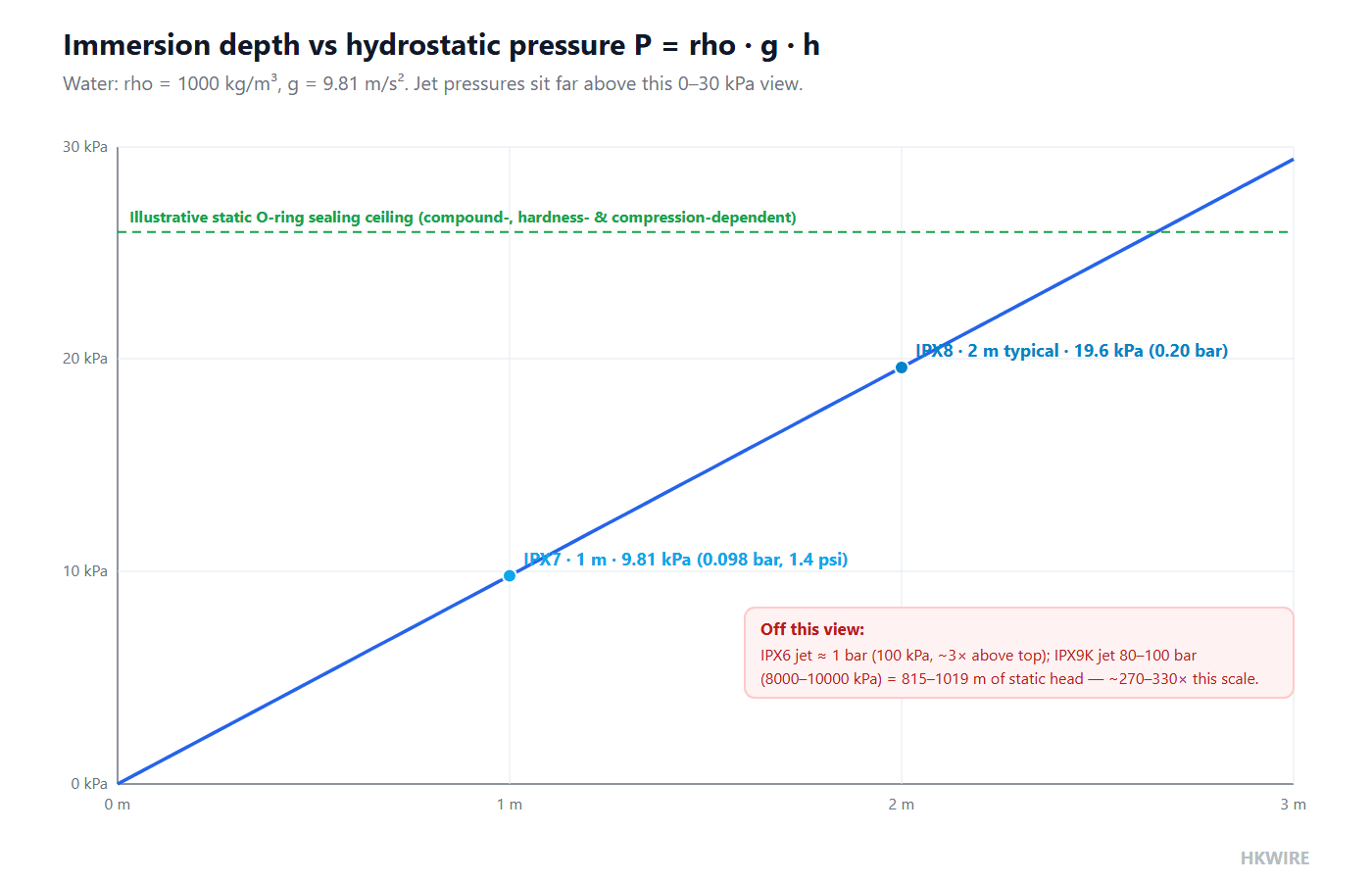
where density is 1000 kg/m³, g is 9.81 m/s², and h is the depth below the surface in meters. At h = 1 m, P = 9.81 kPa, or about 0.1 bar, or about 1.4 psi. Double the depth and the pressure doubles, because density and gravity are constant. That is the entire stress a part sees while it is under water, and it is why shallow immersion is easy to seal.
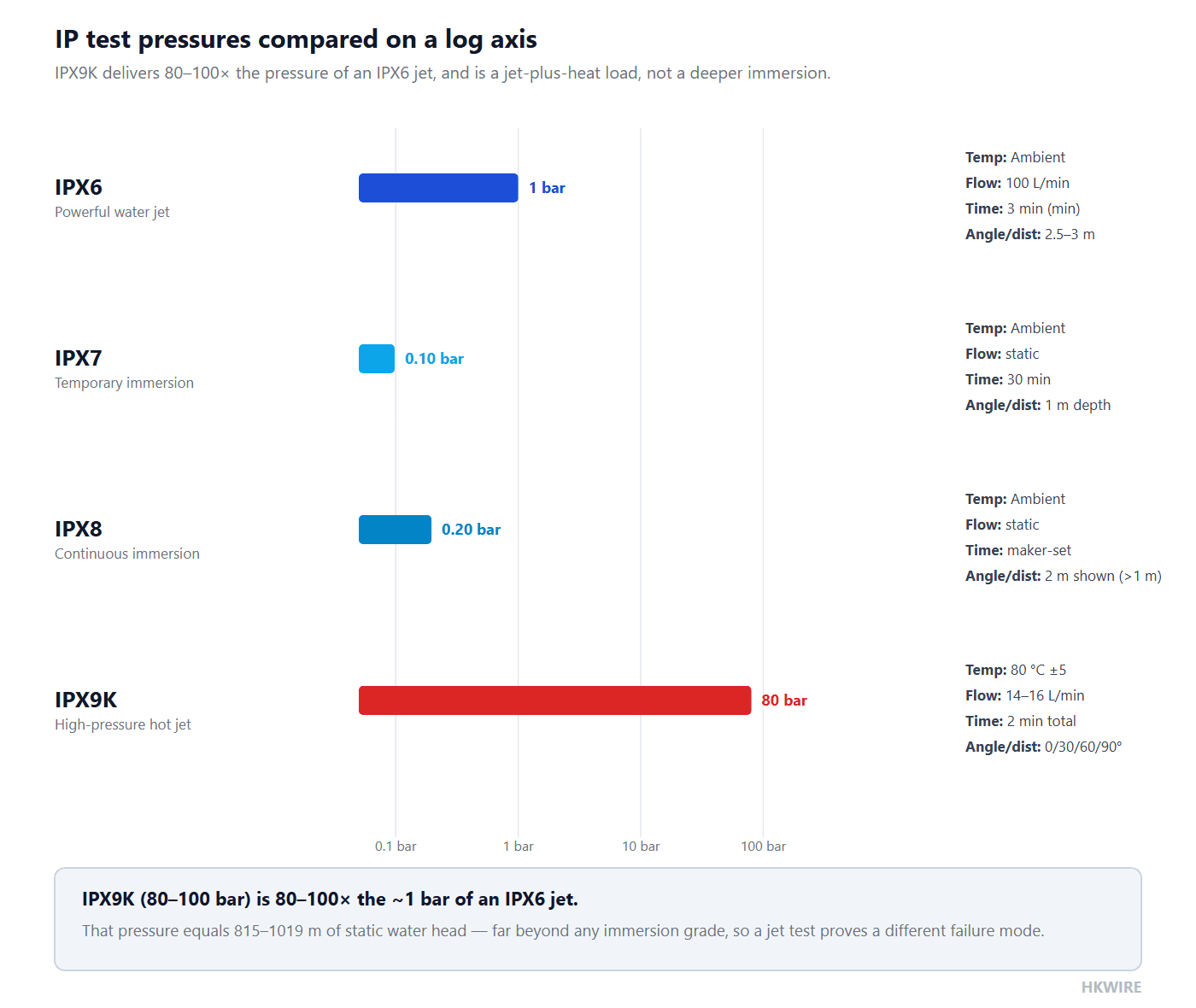
The jet ratings are a different order of magnitude, and putting them on the same scale is the exercise most comparisons skip. An IPX6 jet, 100 L/min through a 12.5 mm nozzle, corresponds to roughly 1 bar at the surface; an IPX9K jet is delivered at 80 to 100 bar. The ratio is therefore:
P(IPX9K) / P(IPX6) ≈ 80 / 1 to 100 / 1 = 80× to 100×
A useful way to see how far past immersion that is: rearrange the same hydrostatic relation to find the depth of still water that would produce the jet pressure, h = P / (ρ·g). For 80 bar that is 8,000,000 / (1000 × 9.81) ≈ 815 m, and for 100 bar it is about 1,019 m. No immersion rating is stated in hundreds of meters, so the IP67 vs IP69K gap is not a matter of degree — it is a change of load type, from gentle static pressure to hot, fast, impact load.
The one thing a calculator will not tell you. Turning the digits into pressures shows that IP68 and IP69K are not on one scale at all. A ten-meter IP68 soak is under one bar of gentle, static load; an IP69K wash is 80 to 100 bar of hot, moving, impact load, around two orders of magnitude higher. That is why IP69K is not “a better IP68”: the failure it prevents is the jet shearing or working the seal loose, not water soaking slowly past a material. It is also why shallow immersion can be sealed by an O-ring alone, while a high-pressure jet needs a harder, more chemically resistant elastomer and a gland designed to stop the seal extruding.
From the digits to a seal decision
An O-ring seals because it is squeezed: at its installed compression the rubber pushes back with a contact pressure that simply has to exceed the pressure of the medium trying to get past it. For immersion the medium pressure is tiny — 0.2 bar at two meters — so almost any correctly sized O-ring in a clean groove develops far more contact pressure than it needs. Under an 80 to 100 bar jet the same logic reverses: the medium pressure is now large and dynamic, so the seal must be stiffer and better supported, shifting toward higher hardness, a hot-water- and detergent-compatible compound, and a groove with a back-up ring so the rubber cannot extrude. The exact contact pressure depends on compound, hardness and compression, and the seal maker publishes it; treat any single bar figure as vendor data, not a constant.
Seal material and temperature
IP69K puts 80 °C water on the seal, and a washdown cycle often runs a cold rinse straight after, so the elastomer choice is as much about temperature as water. The four common families behave very differently; the ranges below are continuous-service figures from seal makers’ data sheets, and they move with the specific grade, so confirm against the data sheet rather than the family name.
| Seal material | Typical continuous range | Reads well against | Caveat |
|---|---|---|---|
| Silicone (VMQ) | About −60 to +200 °C | Wide temperature, low-temperature flexibility, static seals | Lower mechanical strength; not first choice in oils or abrasion |
| FKM (fluorocarbon) | About −20 to +200 °C | Hot oils, fuels, many chemicals, high temperature | High-grade compound; not the best choice for hot water or steam |
| EPDM | About −50 to +150 °C | Hot water, steam, weather, ozone, many detergents | Poor in mineral oils and fuels |
| NBR (nitrile) | About −40 to +120 °C | Mineral oils, greases, general industrial sealing | Limited heat and ozone resistance |
Continuous-service ranges as published in seal makers’ material data sheets; values vary by compound grade and by whether the seal is static or dynamic, so treat these as selection guidance and confirm against the specific data sheet. Temperature-based selection guidance is available from seal material temperature-selection data.
Two rules follow. First, a washdown seal is usually a hot-water seal, and hot water narrows the field to EPDM or silicone rather than FKM, a common and expensive mix-up. Second, temperature and pressure interact: a compound chosen only for top temperature can still fail if the jet also asks it to hold 100 bar, because the same heat that softens it lowers the contact pressure it can sustain. Specify the medium, temperature and pressure together, and let the seal maker confirm the compound.
How we help
Tell us the exposure, and HKWIRE will build and verify the assembly to it. Send the cleaning regime — pressure, temperature, nozzle distance and chemistry — plus the depth and duration of any standing water, the cable OD you need, and the connector interface on the machine. We will come back with a sealed construction, the rating it can honestly carry, and the inspection record that proves it, whether that is a molded IP67 cordset or a dual-rated IP68 and IP69K washdown assembly.
Start a custom cable assembly project or talk to our engineering team.
Frequently asked questions
Is IP69K better than IP68?
No. They test different things and neither implies the other. IP68 is continuous immersion at a manufacturer-stated depth and duration, so the seal sees under about one bar even at ten meters. IP69K is a close-range 80 to 100 bar jet of 80 °C water, around eighty to a hundred times that pressure plus heat and impact. A part can pass one and fail the other, which is the whole point of the IP67 vs IP69K comparison.
Does IP67 include protection against a pressure washer?
Not by itself. IP67 means the part passed the dust test (IP6X) and the temporary-immersion test (IPX7, one meter for thirty minutes, about 9.8 kPa). The water-jet tests are the separate IPX5 and IPX6 digits, so a dust-tight part can survive a dunk and still leak under a pressure nozzle. If your cleaning procedure has a pressure and a nozzle distance, specify the jet rating as well.
What does IP68 mean if the depth is not fixed?
IEC 60529 defines IPX8 as continuous immersion under manufacturer-stated conditions, with the only rule that they are more severe than IPX7. That is why “IP68” alone is incomplete: read it as a pair, such as “IP68, 2 m, 24 h.” Two parts marked IP68 can be rated for very different depths, so take the stated depth and duration from the data sheet.
Why is dust protection the same for IP67, IP68 and IP69K?
All three begin with a first digit of 6, the dust-tight level and the highest in the standard. The dust test is identical: dry talcum powder below 0.075 mm, about 2 kg/m³ of chamber volume, up to eight hours, with a 20 mbar vacuum for IP6X and no dust permitted inside. They differ only in the water digit, so dust never separates them.
Can I seal a high-pressure jet with an ordinary O-ring?
Not with an ordinary one. For shallow immersion the O-ring’s compressed contact pressure exceeds the 0.2 bar of a two-meter soak, so a standard O-ring is enough. Under an 80 to 100 bar jet that reverses: the heat reaching the seal reduces the contact pressure the rubber can hold, so the design needs higher hardness, a hot-water-compatible compound, and a gland with a back-up ring. The exact contact pressure depends on compound, hardness and compression, from the seal maker’s data sheet.
What does an IP rating not cover?
Chemistry, UV and weathering, thermal cycling, flexing and drag-chain motion, and the unmated state. The digits describe a water and dust test on a complete, mated, static assembly. Detergents and oils attack the jacket and gasket, sunlight degrades plastics, and a moving cable flexes at the strain relief regardless of rating. Each must be specified separately, usually by the jacket compound and overmold geometry.
What should I put on the drawing instead of just “IP67”?
State the rating and standard, the mated state and torque, the depth and duration for any 8, the pressure, temperature and nozzle distance for 9K, the chemical list, the washdown cycle count, and whether each batch needs a seal check. That turns a claim into numbers a supplier can build and an inspector can verify, closing the failure paths the bare rating leaves open.
Everything on this page is general guidance for the IP67 vs IP69K choice and the ratings around it. Each assembly is built and inspected to your drawing. Last updated 15 September 2026.