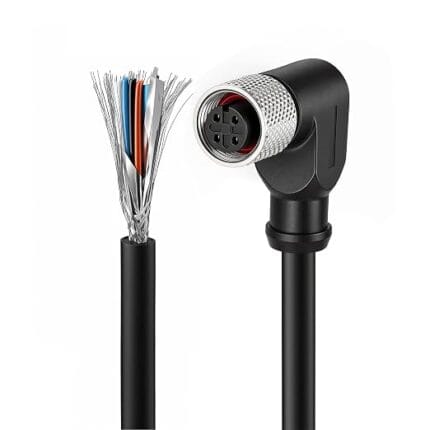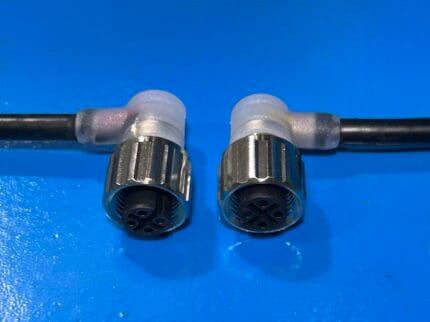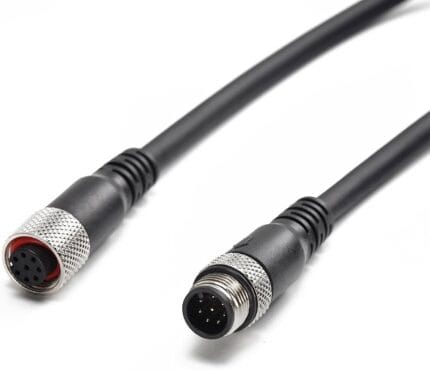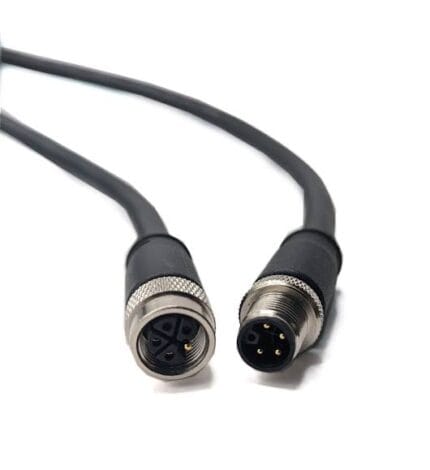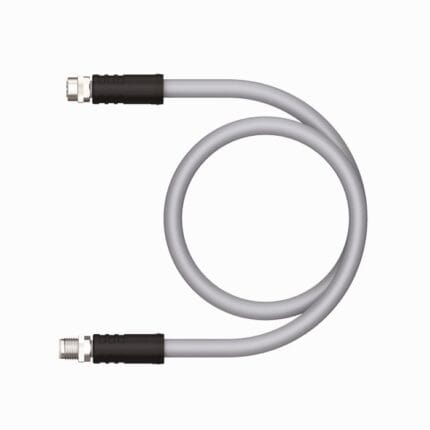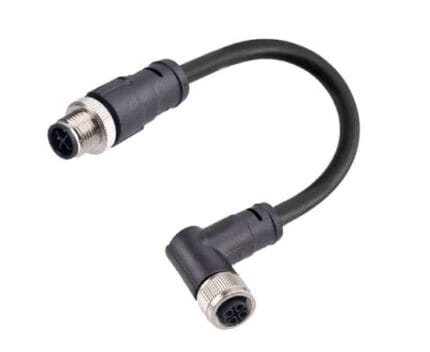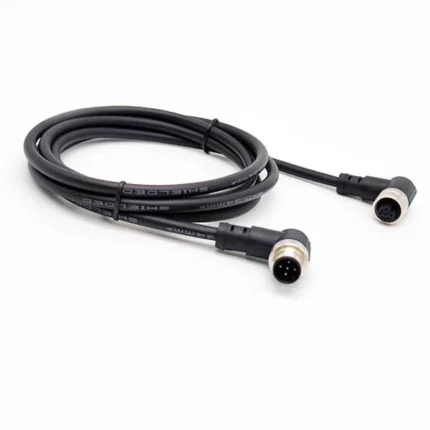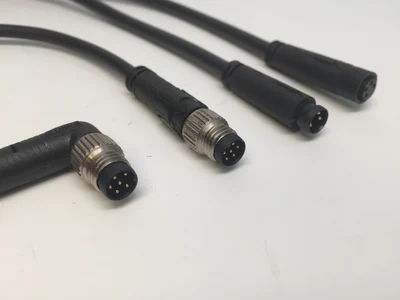
M8 3-Pin A-Coded Circular Connector Sensor / Actuator Cable
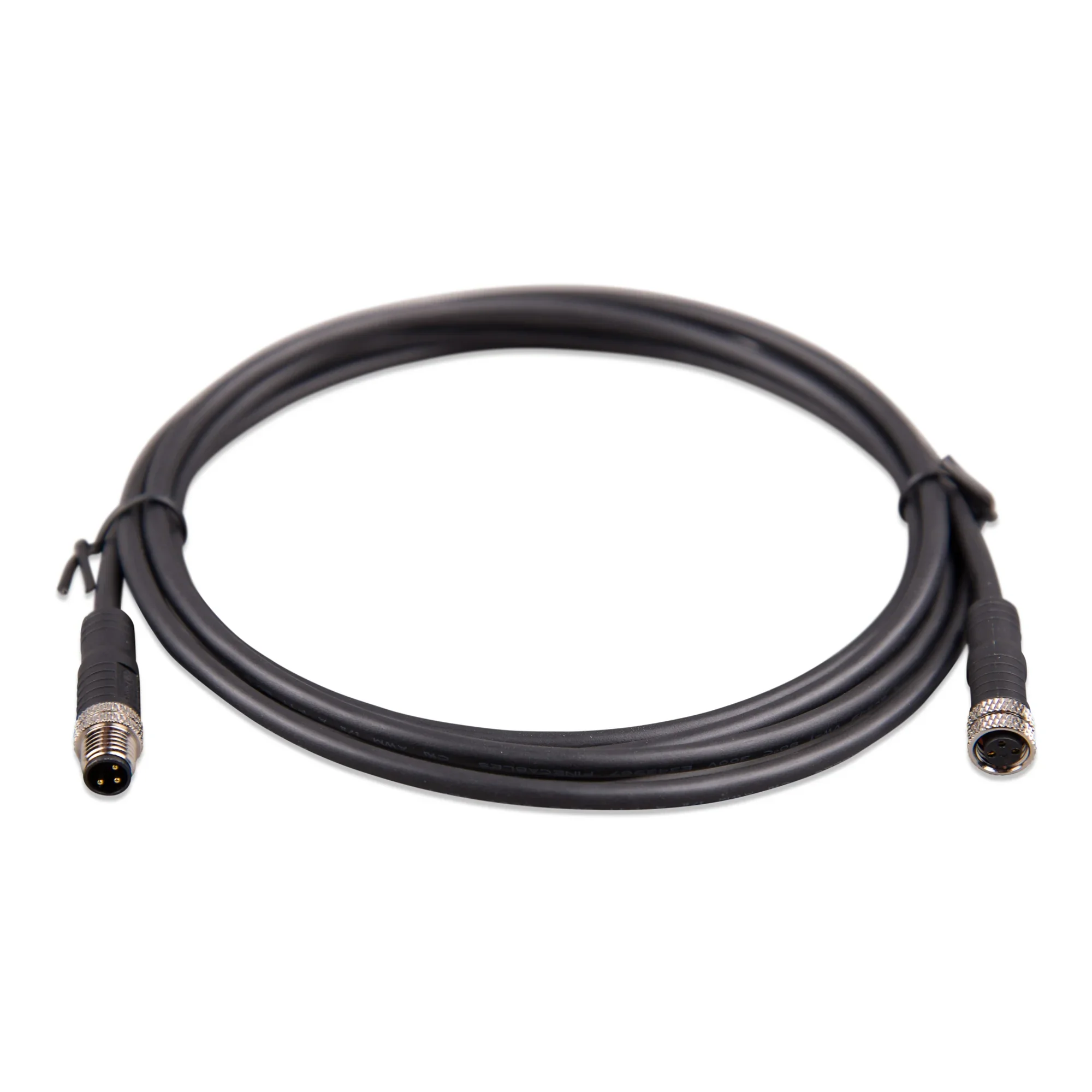
This M8 actuator cable drops the standard sensor interface to an 8 mm thread for compact photo sensors, small transmitters and robot wrists where there is no room for an M12 coupling nut. IEC 61076-2-104, IP67, 60 V / 3 A, 3 x 24 AWG, straight or right-angle, built to your drawing.
Overview
An M8 actuator cable is what you specify when the sensor fits but the connector does not. The 8 mm thread exists because a lot of modern sensing hardware is simply too small for a 12 mm shell plus the bend radius its jacket needs, and on a moving axis every millimeter of protrusion eventually collides with something. You give up current-carrying ability and a little robustness for the space, and this build is made to the pinout, jacket and length on your drawing so the compromise stays a deliberate one rather than an accident.
Key Specifications
| Connector | M8 3-pin A-coded male / female |
|---|---|
| Interface standard | IEC 61076-2-104 |
| Ingress rating | IP67 in the mated state |
| Rated voltage | 60 V AC/DC |
| Rated current | 3 A per pin |
| Conductor | 3 x 24 AWG (3 x 0.25 mm2) |
| Jacket | PVC or TPU |
| Operating temperature | -25 to +85 °C |
| Mating cycles | >100 |
Why M8 and not M12
The saving is not only the coupling nut. A smaller thread drags a smaller strain relief, a slimmer jacket, a tighter bend radius and a lighter assembly behind it, which matters on the end of a robot wrist or inside a compact vision head where every gram has to be accelerated twice per move. Many good layouts run M12 through the fixed part of the run and drop to M8 only at the device, and we build that transition as one assembly so there is no second sealing point and no second part number.
| Factor | M8 | M12 |
|---|---|---|
| Coupling thread | M8 x 1 | M12 x 1 |
| Shell volume | Roughly one third across the nut | Reference size |
| Current per contact | 3 A class | 4 A class |
| Typical device | Compact photo sensors, small flow and pressure heads | General proximity switches, valve connectors |
| Bend radius burden | Low | Higher, and often underestimated |
| Handling robustness | Small threads strip more easily | Tolerant of rough handling |
Shell size and coding are separate choices, and the coding family is the larger of the two. The download center carries a two-page coding reference covering every letter from A to Y, with the pole counts and the jobs each is normally specified for.
The M8 position menu
Three positions is the default for a simple sensor. Everything above it is there because a device needed another conductor, and each step costs you contact area and, with it, current.
| Positions | Carries | Where it shows up |
|---|---|---|
| 3 | Supply pair plus one output | The majority of small inductive and optical sensors |
| 4 | Power pair plus two signals | Devices with complementary outputs or an extra control line |
| 5 | Five signal or mixed conductors | Small encoders, bridges that double as USB diagnostic ports |
| 6 | Three pairs | Analog devices and compact transducers needing balanced lines |
Reading the face
M8 A-coded 3-position shares its wire colors with its larger sibling so a technician who knows one knows the other: brown for supply positive, blue for the return, and black for the switched output. The numbering again comes from the four-position layout, so pin 2 is absent rather than renumbered.
Send us your wire set if the device does not follow the convention. It costs nothing to build it the way you need and a great deal to discover it in the field.
Three amperes is not four
Contact area drives the current rating, and an 8 mm shell has less of it to spend. In practice this means an M8 drop is a signal link that also carries power, not a power feed that happens to carry a signal. If you are feeding anything with an inrush, such as a small solenoid or a lamp, check the peak rather than the steady figure and tell us before the build. Where the load genuinely wants more than this family delivers, we will say so and point you at a M12 power cordset instead.
Where an M8 drop gets damaged
The failure is almost always mechanical, and it happens during installation rather than in service. A small hex invites a large spanner, and a thin-walled coupling nut deforms long before anything visibly cracks, after which the seal lands unevenly and IP67 quietly becomes IP54. Hand-tight plus a small fraction with the correct size spanner is enough. The second cause is unsupported weight: because M8 hardware usually sits at the end of a small cantilevered device, the cable tends to hang directly off the connector body. Clamp it.
What the rating actually tests
The second digit is the one that matters here and it is narrower than most people assume: the IP code second number 7 describes immersion in still water at an agreed depth for an agreed time, which is not the same duty as a directional spray or a steam cleaning cycle. Where a drop lives in a wash area, say so at the quote stage and we will build with the right seal material and the right nut, and we will tell you when the honest answer is a stainless IP69K assembly rather than the smallest connector that physically fits.
Typical applications for this M8 actuator cable
- Compact photoelectric and inductive sensors mounted in machine frames with minimal clearance
- Robot wrist and tool changer drops where mass and bend radius set the budget
- Flow, pressure and level transmitters with an integrated M8 port
- Small valve manifolds and pilot heads with a compact four-pin port
- Replacing a failed device lead without disturbing the cabinet side of the run
How to specify your build
- Ends – M8 male, female, straight or right-angle on each side.
- Length, following the routed path.
- Jacket – PVC indoors, TPU or PUR where coolant, oil or UV is present.
- Fixed or moving service, and the bend radius you are routing to.
- Wire set, if it departs from the standard colors.
- Quantity and target ship date.
Workmanship and testing
Terminations on M8 3-Pin A-Coded Circular builds run from 32 to 12 AWG, and the work is held to IPC/WHMA-A-620 Class 3 inside an ISO 9001 system. Every M8 unit is checked for continuity and pinout before packing, and seal checking is quoted whenever an ingress rating is on the drawing.
Material declarations against RoHS and REACH are issued per project, alongside the dimensional and electrical reports agreed at quotation; see certifications, compliance and material declarations. Where your drawing names a UL style or another approval, the build follows your drawing and ships with the supporting document rather than a claim of our own. Flex life is a construction decision made before tooling, following the conductor and jacket approach set out under continuous-flex design and testing. More background: our industrial automation work. Tooling for this build is cut in our own tool room and belongs to your program, so a repeat run years later starts from the same tool.
Custom builds and ordering
M8 3-Pin A-Coded Circular prototypes start from 1 to 50 pcs and ship in 3 working days. Series supply starts at 500 pcs and takes 14 working days after approval. Tooling not already held adds around 10 working days. M8 builds ship under your part number and labeling for OEM and ODM orders, and material certificates with first-article reports are available.
Related M8 and M12 assemblies
- M8 6-Pin A-Coded Sensor Cable
- M8 6-Pin A-Coded Right-Angle Sensor Cable
- M8 / M12 5-Pin Right-Angle PUR Sensor Cable
- M8 D-Coded Ethernet Cable, 4-Pin 100 Mbit Cordset
- M12 3-Pin A-Coded Sensor / Actuator Extension Cable
- Single Pair Ethernet Cable in M8 and M12 Shells
- M5 3-Pin Sensor Cordset for Micro Sensors
Full range: circular M8 and M12 cable assemblies.
Frequently Asked Questions
Is M8 a straight swap for M12?
No. The thread, contact size and current rating all change, and the shell will not mate. M8 is used where the space does not exist for M12, or where the device simply has an M8 port.
How much current can each pin carry?
Treat 3 A pin as the class figure for this connector size and derate with temperature and simultaneous load. The value your assembly is verified to is the one on your drawing.
Do you build M8 on one end and M12 on the other?
Yes, and it is a common build. Give us the length from the M8 device to the M12 junction point and we will quote it as one assembly.
Will the small hex survive hand tightening?
Yes, if it is hand tight plus a small fraction with the correct spanner. Most damage comes from using a tool that is too large and deforming the nut.
What happens if I need IP69K in this size?
Tell us at the quote stage. For genuine washdown duty the honest answer is often a stainless assembly rather than the smallest connector that fits.
| Connector | M8 3-Pin A-Coded Male/Female |
|---|---|
| Standard | IEC 61076-2-104 |
| IP Rating | IP67 |
| Rated Voltage | 60 V AC/DC |
| Rated Current | 3 A per pin |
| Conductor | 3 x 24 AWG (3 x 0.25 mm2) |
| Jacket | PVC / TPU |
| Operating Temperature | -25 to +85 °C |
| Mating Cycles | >100 |