
An oil resistant cable is usually specified with a single test condition printed on the data sheet: “IRM 902, 96 h, 100 °C.” That line looks like a material property, but it is actually a promise about time. If the jacket survives 96 hours in hot reference oil, how many years does that buy you in service? The answer is not written on the data sheet, and it is exactly where most selection guides stop. This article works the number out: the Arrhenius acceleration factor, applied to the oil-aging test, converts a 96 hour laboratory run into a service lifetime you can quote and defend. It also corrects the most common shortcut — the “10 °C halves life” rule — which is an approximation, not a law, and which leads engineers to the wrong number for oil-resistant jacket compounds.
HKWIRE supplies this material analysis on a compound-by-compound basis. We are certified to ISO 9001, and material declarations are provided per project for RoHS and REACH; the thermal-aging and oil-resistance numbers below come from the standard and the maker’s data sheet, not from a marketing claim. Every value in this guide is either a number written into a standard or a number computed from those standard numbers using one equation.
1. What an oil resistant cable aging test actually measures
When you qualify an oil resistant cable, oil resistance and thermal endurance look like two separate lines on a data sheet, but in a real jacket they act at the same time and on the same polymer. The test that matters — the one this article is built around — is an oil-plus-heat combined aging test: a specimen is soaked in hot reference oil for a fixed duration, then its mechanical properties are measured against the original. The retained properties are the pass mark.
The North American route is UL 44, the standard for thermoset-insulated wires and cables, published together with CSA C22.2 No. 38 (a marked copy of the current revision text is available here). Its oil-resistance clause is the one engineers actually quote when they specify an oil resistant cable:
| Standard / clause | Conditions written in | Pass mark | What it is |
|---|---|---|---|
| UL 44 §5.16.1 (PR I) | IRM 902 oil, 96 h at 100 °C | Tensile and elongation retention of at least 50 % | The main oil-resistance test, oil plus heat combined |
| UL 44 §5.16.2 (PR II) | 75 °C for 60 days | Retention of at least 65 % | A longer, lower-temperature oil-aging route |
| IEC 60811-404 | Method only; temperature and time are set by the product standard | No pass mark of its own | The IEC method standard for oil resistance |
| ASTM D5964 | Defines the reference oils IRM 901 / 902 / 903 | No pass mark | Standardizes the oils, not the result |
| ASTM D471 §11 / ISO 1817 | Volume change after immersion | No pass mark | The swell method, ΔV % |
The 96 h at 100 °C figure and the 50 % retention mark come from the UL 44 revision text; IEC 60811-404 and ASTM D471 are method standards whose limits travel with the product specification.
Read the pass mark carefully before you compare one oil resistant cable with another. The test says “at least 50 % retained.” It does not say “unchanged.” A jacket that loses 49 % of its tensile strength has failed; a jacket that loses 20 % has passed with margin. The retained percentage is the single number that decides whether the cable can be sold for an oil-wetted environment, and it is the anchor for the lifetime math that follows.
2. The Arrhenius factor: how a test becomes a lifetime
Thermal aging is a chemical reaction — oxidation, cross-linking, chain scission — and chemical reactions accelerate with temperature in a predictable way. The model that links a short hot test to a long cool service life is the Arrhenius equation, and the version engineers use for acceleration is a ratio of two rates:
AF = exp[(Ea/R) × (1/T_use − 1/T_test)]
Here Ea is the activation energy of the aging reaction in J/mol, R is the gas constant 8.314 J/(mol·K), and the two temperatures are in kelvin. T_test is the hot test temperature, T_use is the cooler service temperature. The acceleration factor AF is how many times faster the cable ages at the test temperature than in service. The standard source for treating thermal endurance this way is IEC 60216 (part 8 covers the analysis of thermal-endurance test data), which assumes that the logarithm of time to failure is approximately linear in the reciprocal temperature 1/T. This is the equation behind every oil resistant cable lifetime claim worth trusting.
Two things make this equation powerful and two things make it dangerous. It is powerful because every input is a number you can look up or set: the test temperature is on the data sheet, the service temperature is on the drawing, and the activation energy is published for the jacket compound family. It is dangerous because the result is exponentially sensitive to Ea and to temperature — a small error in either blows the answer out. That is the whole point of this article: use the right Ea, and state your temperature assumptions out loud.
2.1 The activation energy is the part most people guess
For the elastomers and plastics used in an oil resistant cable jacket, the apparent activation energy is not one number. Published values for EPR, cross-linked polyethylene and PVC-compound families sit in a wide band. The literature values this article uses are:
| Material family | Apparent activation energy Ea | Source type |
|---|---|---|
| EPR / PR / PVC / CSM compounds | 68–133 kJ/mol | Literature range |
| XLPE | about 103 kJ/mol | Literature value |
| XLEPR | about 102 kJ/mol | Literature value |
These are apparent activation energies from the thermal-endurance literature; a specific compound must use the value on the maker’s data sheet or test report.
For the worked example below I use Ea = 100 kJ/mol, a round value sitting squarely inside the 68–133 kJ/mol band and close to the XLPE and XLEPR values. If your jacket is a specific compound, replace 100 with the maker’s number and re-run the same arithmetic — the method does not change, only the constant does. The laboratory protocol itself follows the IEC 60216 thermal-endurance method cited above.
3. The UL 44 oil test, translated to service hours
Now the calculation that turns the oil resistant cable test line “96 h at 100 °C” into a lifetime. Take the UL 44 §5.16.1 condition as the test point, and a 40 °C jacket surface temperature as a realistic service point for an oil-wetted industrial cable. The inputs, in the order the equation wants them:
| Quantity | Symbol | Value | Unit |
|---|---|---|---|
| Activation energy | Ea | 100,000 | J/mol |
| Gas constant | R | 8.314 | J/(mol·K) |
| Service temperature | T_use | 40 °C = 313.15 | K |
| Test temperature | T_test | 100 °C = 373.15 | K |
| Reciprocal of service temperature | 1/T_use | 0.003193 | K−¹ |
| Reciprocal of test temperature | 1/T_test | 0.002680 | K−¹ |
| Difference | 1/T_use − 1/T_test | 0.000513 | K−¹ |
| Ratio | Ea / R | 12,028 | K |
| Exponent | (Ea/R)(1/T_use − 1/T_test) | 6.17 | — |
| Acceleration factor | AF | 478 | — |
| Test duration | t_test | 96 | h |
| Equivalent service life | t_use = AF × 96 h | 45,900 | h |
Step by step. First compute the reciprocal temperatures and their difference: 1/313.15 = 0.003193, 1/373.15 = 0.002680, so the difference is 0.000513 K−¹. Next compute Ea/R = 100000 / 8.314 = 12,028 K. Multiply: 12,028 × 0.000513 = 6.17. Raise e to that power: AF = e^6.17 = 478.
That single number is the whole message. At 100 °C the jacket ages 478 times faster than at 40 °C. So the 96 hour oil test is equivalent to 96 × 478 = 45,888 hours at 40 °C. Round it to 45,900 hours, divide by 24 and by 365, and you get about 5.2 years.
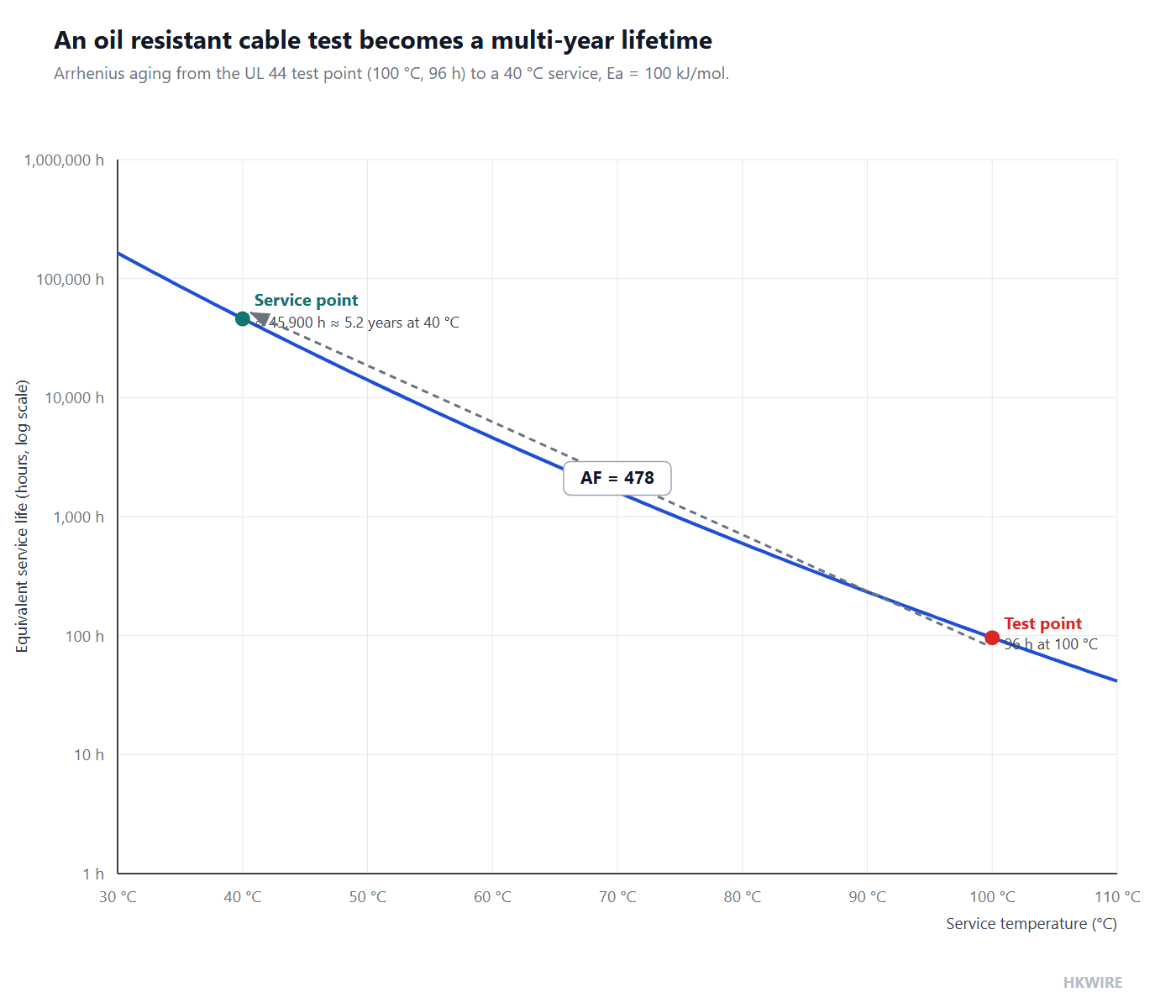
This is the number most selection guides never give you. They repeat “96 h at 100 °C” as if it were the answer, when it is only the input. The answer — 5.2 years of equivalent aging at 40 °C — is what a design engineer can actually put into a service-interval or replacement decision.
4. Why “10 °C halves life” is an approximation, not a law
Every cable selector has heard the rule: raise the temperature 10 °C and the life halves. It is one of the oldest shortcuts in electrical engineering, and for an oil resistant cable it is only sometimes right. Understanding exactly when it is right is the deepest part of this article.
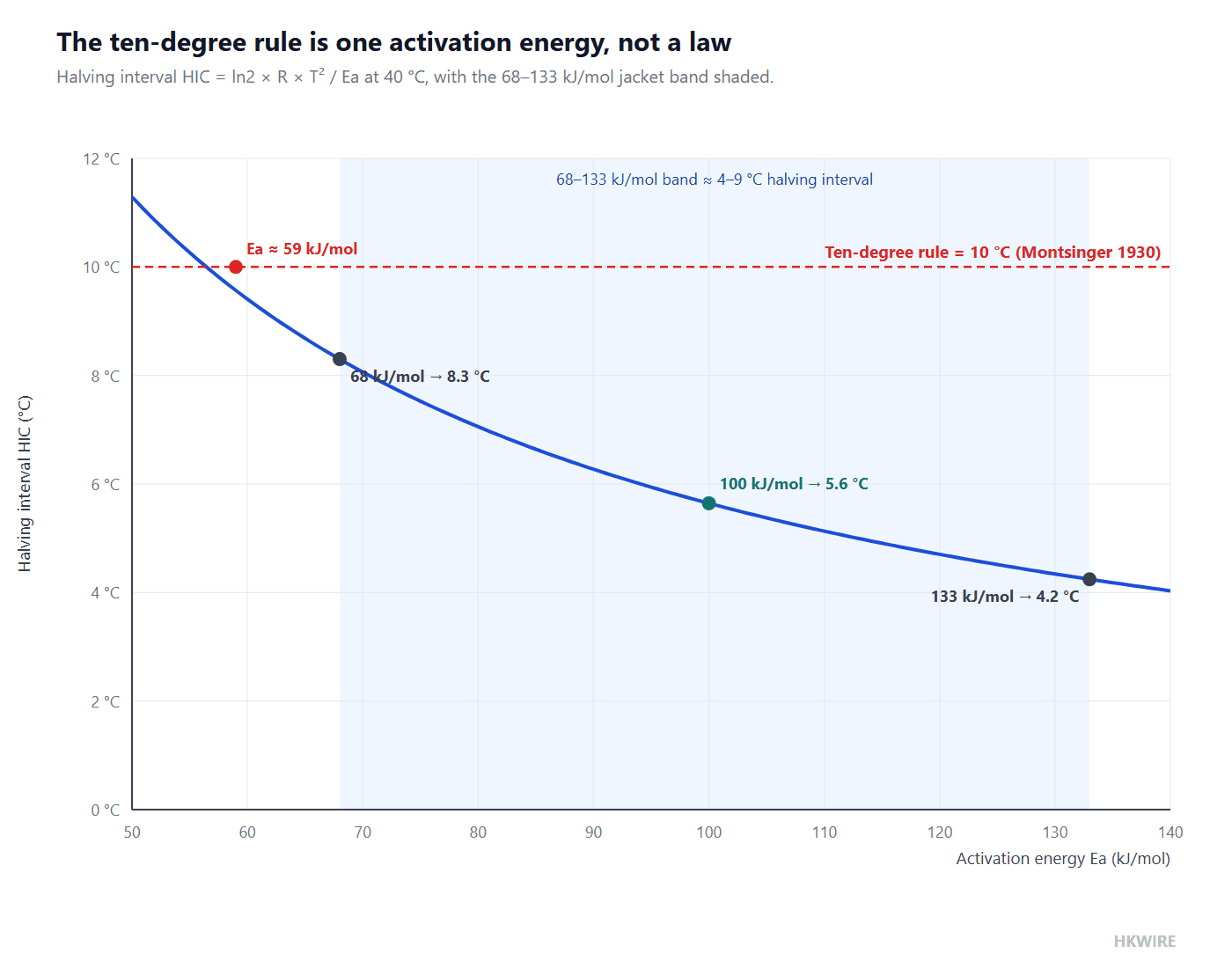
The rule has a name and a date. It is the Montsinger ten-degree rule, published in 1930 from insulation measurements that actually showed a halving roughly every 8 °C, later rounded up to 10 °C for convenience. In 1948, Dakin showed that the rule is just a special case of Arrhenius aging with a particular activation energy. It is not a law of materials; it is a law of one specific activation energy.
Here is the connection. If life really halved for every 10 °C rise, then at AF = 2 the temperature step would be ΔT = 10 °C. Solve the halving condition for the activation energy at a reference temperature near 320 K (about 47 °C, typical of the operating range where the original rule was fitted):
Ea = ln2 × R × T² / ΔT = 0.693 × 8.314 × 320² / 10 ≈ 59 kJ/mol
So the ten-degree rule is the Arrhenius equation with Ea ≈ 59 kJ/mol baked in. The moment you know that, the rule stops being a general truth and becomes a specific, checkable claim. And the check fails for most oil-resistant jacket compounds, because their activation energies are higher.
Go the other way. Ask: for a given activation energy, what temperature rise actually halves the life? The halving interval is:
HIC = ln2 × R × T² / Ea
At the same 40 °C service temperature (T = 313 K), the halving interval for Ea = 100 kJ/mol is HIC = 0.693 × 8.314 × 313² / 100000 ≈ 5.6 °C. A higher activation energy means a smaller temperature step to halve the life — the material is more, not less, sensitive to temperature. That is the counter-intuitive part everyone gets backwards: “10 °C halves life” is the optimistic end of the range for a high-Ea jacket.
| Activation energy Ea (kJ/mol) | Halving interval HIC at 40 °C (°C) | Meaning |
|---|---|---|
| 59 | about 9.6 (rounds to the 10 of the ten-degree rule) | Montsinger’s historical anchor |
| 68 | 8.3 | Low end of the EPR / PR / PVC / CSM band |
| 100 | 5.6 | The worked example in this article |
| 103 / 102 | 5.5 | XLPE / XLEPR literature values |
| 133 | 4.2 | High end of the band |
Halving intervals computed from HIC = ln2 × R × T² / Ea with T = 313 K and R = 8.314 J/(mol·K).
Across the 68–133 kJ/mol band that covers real oil-resistant compounds, the halving interval sits between roughly 4 °C and 9 °C, not a fixed 10 °C. That is the correction this article exists to make: when someone tells you a jacket “follows the 10 °C rule,” they are really telling you its activation energy is about 59 kJ/mol — which is lower than the published band for most oil-resistant materials, and therefore the rule understates how much a hot spot shortens the jacket’s life.
5. Oil severity: IRM 901, 902 and 903 are not interchangeable
Saying an oil resistant cable is “oil resistant” without naming the oil is like saying a part is “temperature resistant” without naming the temperature. The reference oils are standardized by ASTM D5964, and they are ranked by their aniline point — a lower aniline point means the oil is a more aggressive swelling agent for the jacket polymer.
| Reference oil | Aniline point | Relative severity | Where it appears |
|---|---|---|---|
| IRM 901 | 124 °C | Least severe | Mild oil exposure |
| IRM 902 | 93 °C | Middle | UL 44 §5.16.1 (PR I) |
| IRM 903 | 70 °C | Most severe | Harsher oil exposure |
Severity order IRM 903 > IRM 902 > IRM 901 follows the aniline point: the lower the aniline point, the more aggressive the oil.
The order matters because the UL 44 PR I test uses IRM 902, the middle oil. A jacket that passes in IRM 902 has not been tested in IRM 903, and a data sheet that just says “oil resistant” with no oil named is a claim you cannot audit. When you write a specification, name the oil: “oil resistance per UL 44 §5.16.1, IRM 902” is a defensible requirement; “oil resistant” is not.
6. Swelling versus retained properties: two different failure signals
Oil attacks the jacket of an oil resistant cable in two distinct ways, and they are measured by two distinct numbers that selection guides frequently blur together.
The first is volume swell. Oil absorbs into the polymer and it expands. The standard method is ASTM D471 §11 (ISO 1817 is the equivalent), which reports the percentage volume change:
ΔV % = (V_after − V_before) / V_before × 100
As a worked example: a specimen measured 1.00 cm³ before immersion and 1.10 cm³ after, giving ΔV = (1.10 − 1.00) / 1.00 × 100 = 10 %. The typical magnitudes for mineral oil at 70 °C are a maker-data matter, but the published order of magnitude is: polyurethane jackets swell only 3–15 %, while PVC compounds swell 20–40 %. Treat those as maker-data ranges — always confirm against the specific data sheet.
| Jacket material | Volume swell ΔV % in mineral oil, 70 °C | Reading |
|---|---|---|
| PUR | 3–15 % | Low swell, dimensionally stable |
| PVC | 20–40 % | High swell, softens and grows |
Swell figures are maker-data ranges for mineral oil at 70 °C, not standard pass marks; confirm against the compound data sheet.
The second, and the more important for service life, is retained properties. The UL 44 pass mark is not about swell at all — it is about tensile strength and elongation retained after aging. These are two different things, and a compound can look good on one and bad on the other. A jacket that swells only a little but loses 60 % of its elongation has become brittle and will crack in flexing, even though the volume-change number looks fine. The retained-elongation figure is the direct proxy for remaining service life; the swell figure is a dimension and compatibility check. Keep them separate when you write the specification.
7. Two temperature indexes: IEC 60216 TI and UL 746B RTI
Once you are doing the thermal endurance side of an oil resistant cable properly, you will meet two “temperature index” numbers that sound like the same thing and are not.
- IEC 60216 defines a temperature index (TI) as the temperature at which the material reaches its end point — for example, tensile strength reduced to 50 % — after 20,000 hours. The halving interval (HIC) is the companion quantity: the temperature rise that halves the life.
- UL 746B defines the relative thermal index (RTI) differently. It does not predict an absolute lifetime; it compares the candidate material against a reference material of known performance in the same oven, and reports the temperature at which the property falls to 50 % of initial, split into three dimensions — electrical, mechanical-with-impact, and mechanical-without-impact.
Do not mix them. A TI of 105 °C is a 20,000-hour end-point temperature; an RTI of 105 °C is a comparative 50 %-retention temperature. They come from different tests, use different end points, and are not interchangeable on a drawing. When the standard you must meet is a UL one, quote RTI; when it is an IEC one, quote TI. The activation-energy and Arrhenius logic in this article belongs to the IEC 60216 line of reasoning, where the logarithm of life is treated as linear in 1/T.
8. How the oil-and-heat number fits the rest of the jacket story
This article deliberately covers one deep corner — oil-plus-heat aging and its conversion to lifetime — and leaves the rest of the jacket decision to its companion pieces. If you are specifying an oil resistant cable and also need the halogen-free and UV-stable properties of the same jacket, the place to go is our guide on halogen-free, oil-resistant and UV-stable cable jackets, which covers the fire, smoke and weathering standards that this article does not touch. And if the jacket is headed into a vehicle, the wire and harness context — ISO 6722 temperature classes and gauge selection — lives in our automotive wire harness selection guide, with the cable families themselves in the automotive cable and wire harness category. The division of labor keeps each article honest: this one owns the aging math, the others own the materials and the standards they each need.
How we help
HKWIRE turns the standards into a number you can put on a drawing. Tell us the service temperature, the oil your oil resistant cable will see, and the standard you must meet, and we supply the jacket compound data sheet, the oil-resistance test report and the activation energy so the lifetime math above is run on your material, not on a textbook constant. We are certified to ISO 9001, and material declarations are provided per project for RoHS and REACH. Start a custom cable development or contact us with the oil and temperature on the drawing.
Frequently asked questions
What does the UL 44 96 h at 100 degree C oil test actually prove?
It proves the jacket retains at least 50 % of its tensile strength and elongation after 96 hours in IRM 902 oil at 100 °C (UL 44 §5.16.1). By itself it is a pass mark, not a lifetime. The lifetime comes from applying the Arrhenius factor to that test condition, which is the calculation in section 3 of this article.
How many years does a 96 h oil test represent at 40 degree C?
With an activation energy of 100 kJ/mol, the acceleration factor between 100 °C and 40 °C is 478, so 96 hours maps to about 45,900 hours, or roughly 5.2 years of equivalent thermal-plus-oil aging for that oil resistant cable. This is an equivalent-aging figure tied to a specific activation energy, not a calendar guarantee.
Is the “10 degree C halves life” rule accurate?
Only as a special case. It is the Montsinger ten-degree rule, equivalent to Arrhenius aging with an activation energy of about 59 kJ/mol. For oil-resistant jacket compounds with activation energies of 68–133 kJ/mol, the true halving interval is smaller — roughly 4–9 °C — so the rule understates temperature sensitivity.
Which reference oil should I specify?
Name the oil, not just “oil resistant.” The severity order is IRM 903 > IRM 902 > IRM 901, following the aniline point (70, 93 and 124 °C respectively). UL 44 §5.16.1 uses IRM 902, the middle oil; if your oil resistant cable faces a harsher fluid, specify a test against IRM 903.
Is volume swell the same as oil resistance?
No. Swell (ΔV %, ASTM D471 §11) measures how much the jacket grows, while retained tensile and elongation measure how much mechanical strength survives. A jacket can swell little yet lose most of its elongation and turn brittle; the retained properties are the service-life proxy, so keep the two numbers separate.
What is the difference between IEC 60216 TI and UL 746B RTI?
IEC 60216 TI is the temperature at which a material reaches its end point, such as 50 % tensile retained, after 20,000 hours. UL 746B RTI is a comparative temperature against a reference material, at 50 % retention, split into electrical, impact and non-impact dimensions. They use different tests and end points and are not interchangeable.
Where do I get the activation energy for my jacket compound?
From the compound maker’s thermal-endurance data or test report. The literature band for EPR, PR, PVC and CSM compounds is 68–133 kJ/mol, with XLPE about 103 and XLEPR about 102 kJ/mol. Do not guess; the Arrhenius result is exponentially sensitive to this one input.