
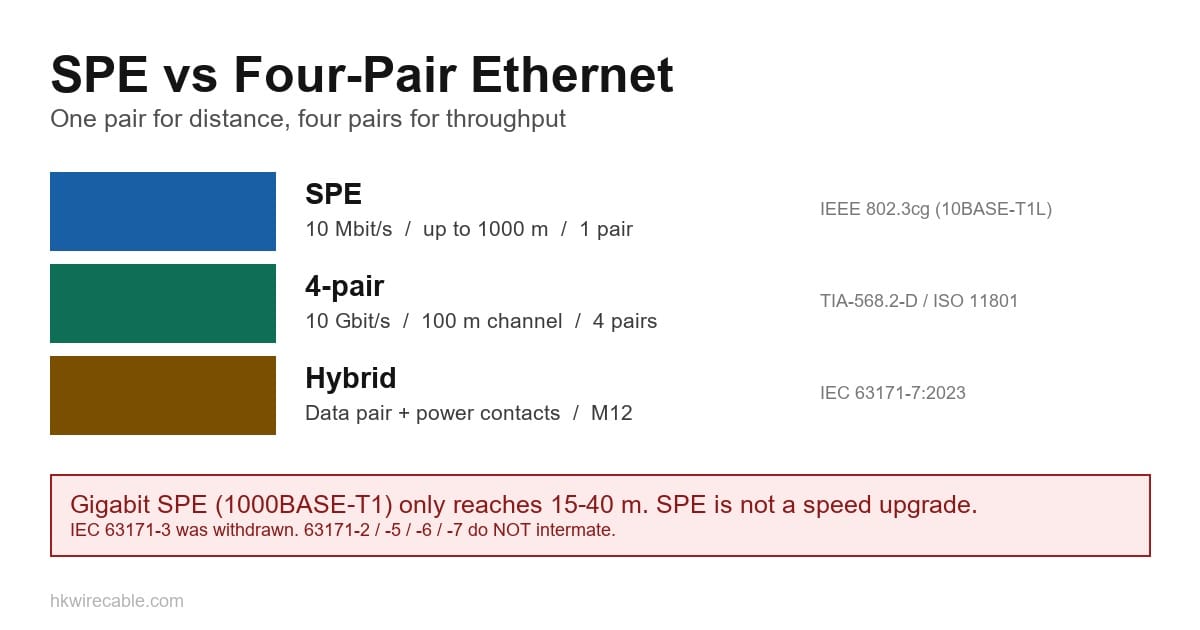
Single Pair Ethernet is not a faster version of the Ethernet you already run. That is the single most common misunderstanding, and it leads people to specify SPE for jobs it cannot do. SPE runs slower than the four-pair cabling in your cabinet — what it buys you is distance, weight and a dramatically simpler cable.
The short version: choose SPE when the device is far away, simple, and low-bandwidth — a sensor, a valve island, a field instrument, a building automation node. Choose four-pair Ethernet when the device needs real throughput — a vision camera, an AGV, a panel PC, anything moving video or large data sets. The crossover point is about 10 Mbit/s and about 100 meters, and the rest of this article explains why those numbers land where they do.
Quick comparison
| Attribute | Single Pair Ethernet | Four-pair Ethernet (Cat5e / Cat6A) |
|---|---|---|
| Conductors carrying data | 1 pair (2 wires) | 4 pairs (8 wires) |
| Headline reach | Up to 1000 m at 10 Mbit/s | 100 m channel (TIA limit) |
| Top speed over that reach | 10 Mbit/s at 1000 m | 10 Gbit/s at 100 m (Cat6A) |
| Gigabit over SPE | Only over very short runs — 15 to 40 m class | Standard to 100 m |
| Power delivery | PoDL, class-based, up to about 52 W at the PD | PoE / PoE+ / 4PPoE up to 90 W |
| Connector families | IEC 63171 series (several, not intermateable) | 8P8C (RJ45) and M12 X-coded |
| Cable weight and diameter | Roughly a third less copper, markedly thinner | Four pairs plus shielding where specified |
| Spare pairs for troubleshooting | None | Two unused pairs on 1000BASE-T |
| Maturity of the installed base | Early, still consolidating | Decades of structured cabling practice |
What single pair Ethernet is
SPE is a family of IEEE physical layer standards that carry full-duplex Ethernet over one balanced twisted pair instead of two or four. The variant that matters for industrial work is 10BASE-T1L, defined in IEEE 802.3cg, published in November 2019. It delivers 10 Mbit/s full duplex over a point-to-point link up to 1000 meters.
Read that combination again, because the trade is the whole point. You are exchanging bandwidth for reach. Ten megabits is slow by office standards and utterly useless for a machine vision camera — but it is sixty thousand times faster than the 4–20 mA current loop or HART link that SPE is designed to replace, and it reaches ten times further than a standard Ethernet channel is allowed to.
The other two variants you will see quoted are 100BASE-T1 (IEEE 802.3bw) and 1000BASE-T1 (IEEE 802.3bp), both from automotive. Their reach is 15 meters, or 40 meters for some 1000BASE-T1 implementations. If a datasheet claims gigabit over single pair without stating the distance, it is talking about a car, not a factory.
What four-pair Ethernet is
Four-pair twisted-pair cabling is what TIA-568 and ISO/IEC 11801 were written around. Cat5e, Cat6, Cat6A and Cat8 all use four pairs; the categories differ in bandwidth, shielding and how far they can carry a given data rate.
The architecture is mature, the test equipment is everywhere, and the 100-meter channel limit — 90 meters permanent link plus 10 meters of patch — is baked into the standards. The ANSI/TIA-568.2-D document defines Cat5e, Cat6, Cat6A and Cat8. Notably it does not define Cat7, which is an ISO/IEC 11801 Class F specification instead.
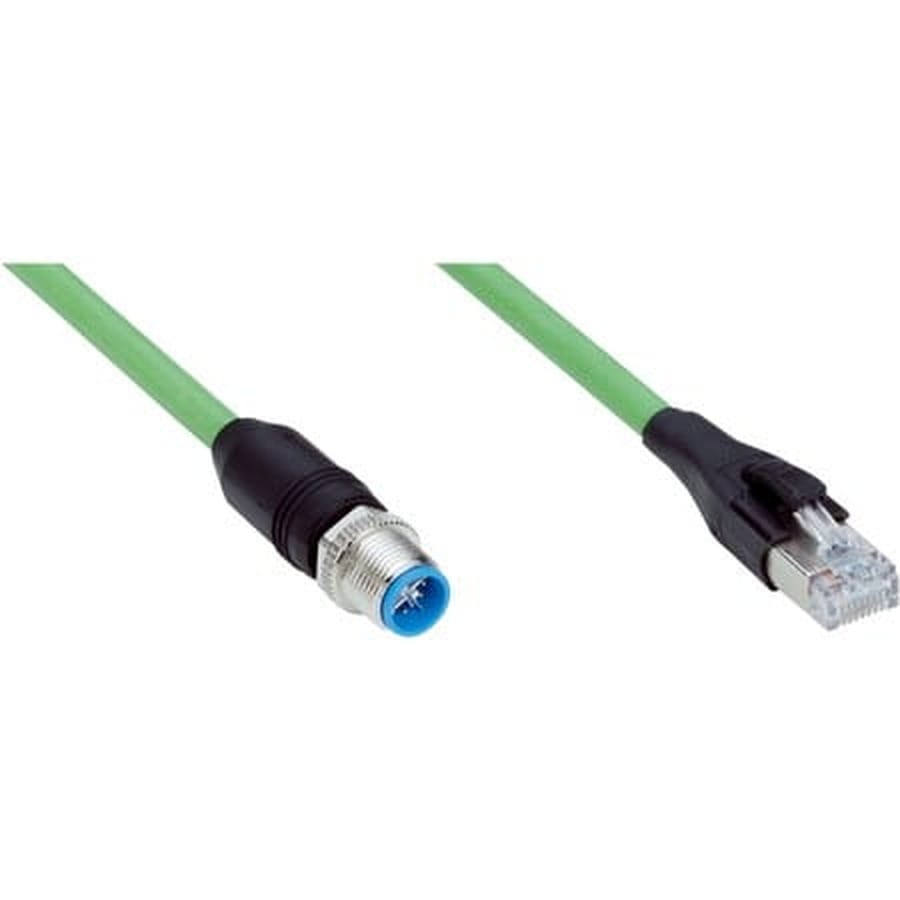
Where industrial Ethernet needs a sealed connector rather than an RJ45 latch, the four-pair world answers with M12. The M12 X-coded Cat6A cable carries 10 Gbit/s in an IP67 shell, which is precisely the job SPE cannot do.
Key differences that actually change the design
1. Distance
SPE wins by an order of magnitude. A 1000-meter 10BASE-T1L segment replaces what would otherwise be a fiber run or a fieldbus trunk with gateways. For a process plant, a water treatment site, a long conveyor or a building automation backbone, this is the entire business case. Our 10BASE-T1L patch cord and sealed screw-lock version are both built for that reach class.
2. Throughput
Four-pair wins, and not narrowly. Cat6A carries 10 Gbit/s over 100 meters. SPE carries 10 Mbit/s over 1000 meters. These are not competing specifications so much as different jobs, and any comparison that presents SPE as an upgrade path for the LAN is either mistaken or selling something.
3. Power over the same pair
Both sides deliver power with the data, but the mechanisms are not interchangeable. Four-pair uses PoE under IEEE 802.3af/at/bt. SPE uses PoDL under IEEE 802.3bu, extended by 802.3cg. The 802.3cg power classes run from Class 10 to Class 15, with the top class specified at up to 52 W available at the powered device. That is real power — enough for a field instrument, a valve manifold or a compact sensor hub — but it is a different negotiation and a different voltage envelope from PoE, and it will not power a PoE camera through an adapter.
Where more power is genuinely needed, the hybrid route exists. The SPE M12 hybrid cable to IEC 63171-7 puts dedicated power contacts alongside the data pair — 2 × 8 A at up to 63 V DC — which is a different proposition from squeezing power through the data pair.
4. Connectors: the part that catches people out
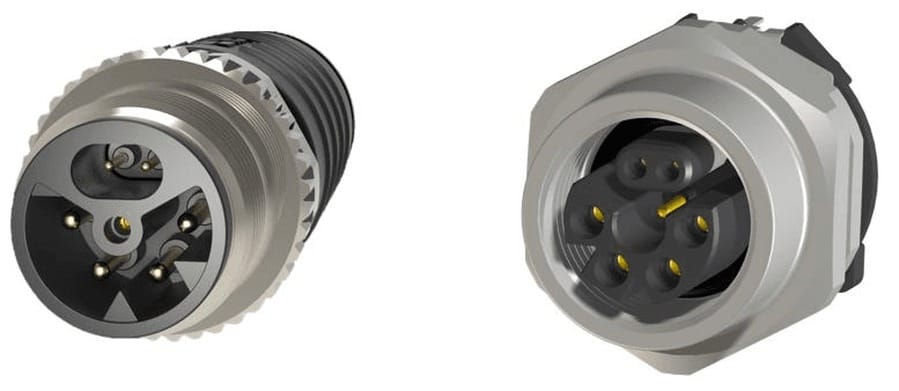
This is where SPE projects go wrong, and it is the section most comparison articles skip. There is no single SPE connector. The IEC 63171 series defines several mating faces, and they do not mate with each other:
- IEC 63171-2 — compact IP20 design, widely pushed for building automation.
- IEC 63171-5 — IP67-rated M8 and M12 shells based on the 63171-2 mating face, aimed at factory floor.
- IEC 63171-6 — the T1 Industrial family, published January 2020, covering everything from IP20 through IP65/67. This was the world’s first published SPE connector standard.
- IEC 63171-7 — the M12 hybrid interface, and the one currently converging as the harmonised mating face for IP20, M8, M12 and M12 hybrid. It uses roughly two thirds of the PCB area of an RJ45.
Two practical warnings. First, IEC 63171-3 was withdrawn — if a supplier offers it, they are selling an obsolete interface. Second, if you are specifying today, IEC 63171-7 Edition 2 is the safer direction of travel: it is the mating face that PROFINET system guidelines have adopted and that multiple connector makers have committed to. Our M12 hybrid SPE cable is built to IEC 63171-7:2023, and the SPE bulkhead panel connector is offered with either an IEC 63171-6 mating face or an M8 threaded coupling depending on the panel design.
The corollary for buyers: state the mating face standard and edition on the purchase order. “SPE connector” is not a specification.
5. Cable and installation
SPE cable is thinner and lighter, which matters in conduit and on moving assemblies. The cable standards live in the IEC 61156 series — 61156-11 and -12 cover SPE data cable up to 600 MHz for fixed and flexible installation respectively.
The retrofit case is where SPE gets genuinely interesting. Existing single-pair fieldbus cable can often carry 10BASE-T1L, which means a plant can move to Ethernet without pulling a single new meter. Two conditions apply: the run has to be measured for insertion loss and return loss, and any open branch lines or stubs from the old bus topology must be removed or terminated, because unterminated stubs cause reflections that will wreck the link.
Choose SPE when
- The device is more than 100 meters from the switch.
- Bandwidth need is modest — sensor readings, status, setpoints, diagnostics.
- You are replacing 4–20 mA, HART, or a legacy fieldbus and want to delete the gateway.
- Weight, space or conduit fill is constrained.
- You need power and data to a remote, simple device over one pair.
The canonical applications are valve islands and actuators with feedback, which is exactly what the M12 hybrid SPE cable is built for, and distributed sensing, where the M8 and M12 shell SPE cable gives you a sealed IP67 interface on a two-conductor run. Even something as unglamorous as an M8 leak detection pigtail in a coolant distribution cabinet is a candidate — long thin runs to monitoring inputs are SPE territory.
Choose four-pair Ethernet when
- You need more than 10 Mbit/s — cameras, AGVs, panel PCs, high-density I/O.
- The run is under 100 meters anyway, in which case SPE buys you nothing.
- You want the installed base, the test gear and every electrician’s existing knowledge.
- You want spare pairs available for diagnostics or a future upgrade.
- You need PoE to a standard device.
Machine vision is the clearest case. A GigE Vision camera on a Cat6A screw-lock cable needs 10 Gbit/s; SPE cannot serve it at any distance. Industrial PROFINET over M12 D-coded stays four-pair as well — the M12 D-code PROFINET cordset is a 100 Mbit/s Cat5e SF/UTP build, and for higher throughput the M12 Y-coded hybrid carries four data conductors plus four power conductors in one connector.
Cost and the mixed deployment reality
Almost nobody rips out working four-pair infrastructure to install SPE, and almost nobody should. The economic case for SPE is at the edge — the last few hundred meters to devices that today are served by an analogue loop, a fieldbus trunk, or a fiber drop with a media converter at each end.
That last comparison is where the money is. A fiber run to a remote instrument needs a converter at both ends, a local power supply at the device, and someone to commission it. A 10BASE-T1L segment needs one cable and no local power. Delete the converters and the power drops, and the saving is not in the cable price, it is in the installation and commissioning.
The realistic pattern for the next several years is therefore mixed: four-pair Cat6A inside the cabinet and across the machine, SPE from the cabinet out to the field devices. That is why the SPE bulkhead connector exists — it is the transition point where the two worlds meet in the panel wall.
Common mistakes
- Specifying SPE expecting a speed upgrade. 10BASE-T1L is 10 Mbit/s. If the device needs gigabit, you need four pairs, or fiber.
- Assuming all SPE connectors mate. They do not. IEC 63171-2, -5, -6 and -7 are distinct interfaces; IEC 63171-3 was withdrawn.
- Treating PoDL as PoE. Different standard, different voltage envelope, different negotiation. A PoE device will not run off a PoDL PSE.
- Reusing legacy cable without checking it. Measure insertion loss and return loss, and remove open stubs. Old bus topologies have branch lines that SPE cannot tolerate.
- Forgetting there is no redundancy. A four-pair cable has spare pairs you can press into service in an emergency. SPE has one pair, and if it fails the link is down.
- Assuming 1000 m is unconditional. It is a reach class that depends on conductor gauge, cable quality and the connector interfaces at each end.
FAQ
Is single pair Ethernet faster than normal Ethernet?
No, it is slower but longer. 10BASE-T1L carries 10 Mbit/s up to 1000 meters, while Cat6A carries 10 Gbit/s up to 100 meters. The gigabit SPE variants — 1000BASE-T1 — are automotive standards with a reach of 15 to 40 meters. SPE replaces analogue loops and fieldbus trunks over distance; it does not replace the LAN.
Can SPE replace my existing Cat6A cabling?
Not for anything that needs bandwidth. SPE makes sense at the edge, for remote low-data-rate devices beyond the 100-meter Ethernet channel limit. Inside the cabinet and across the machine, four-pair Cat6A remains the right choice, and most real installations will run both — four-pair to the machine, SPE out to the field devices.
Which SPE connector should I specify?
State the IEC 63171 part and edition on the order. IEC 63171-6 (T1 Industrial) is the established IP20 to IP67 family, IEC 63171-5 covers sealed M8 and M12 shells, and IEC 63171-7 Edition 2 is the harmonised mating face covering IP20, M8, M12 and M12 hybrid that the industry is converging on. Avoid IEC 63171-3, which has been withdrawn.
Last updated: September 2026