M12 B-Coded PROFIBUS Cable, 5-Pin Fieldbus Cordset
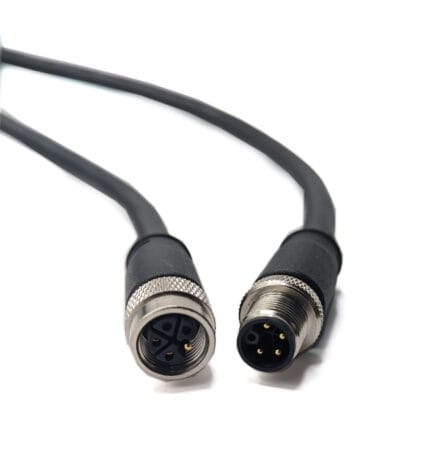
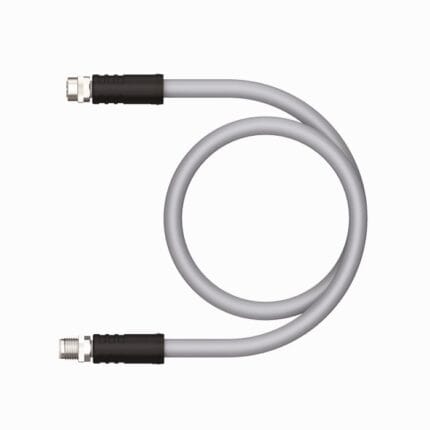
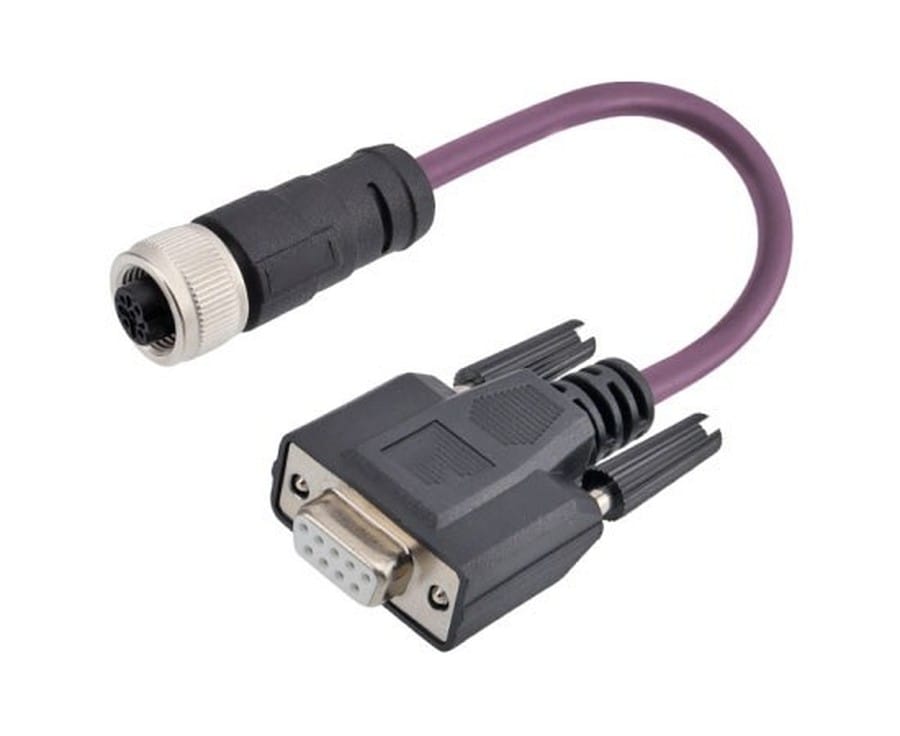
An M12 B-coded PROFIBUS cable with the keyway reversed relative to A-code, so a sensor lead cannot be pushed into a bus port. Five-pin shielded pair, braid bonded to the coupling nut, for bus-in, bus-out or spur drops on existing DP segments.
Overview
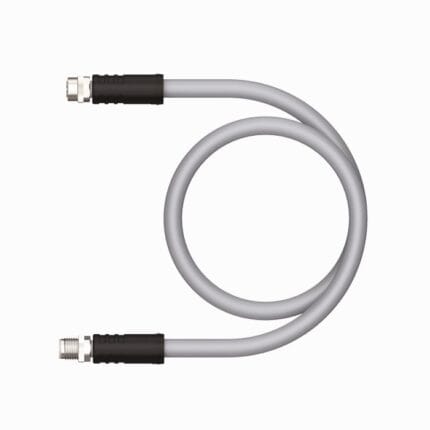
An M12 B-coded PROFIBUS cable is a five-pin fieldbus cordset with its keyway deliberately reversed relative to A-code. It exists to make a bus port physically unable to accept a sensor lead. PROFINET gets the attention today, but the installed base of PROFIBUS DP is still enormous – drives, remote I/O racks, weigh scales and valve islands on factory floors that stop the machine when one drop fails. This is the replacement part those machines need.
Key Specifications
| Coding | B-code, fieldbus (IEC 61076-2-101) |
|---|---|
| Connector A | M12 B-coded 5-pin, straight or right-angle |
| Connector B | M12 B-coded 5-pin, or open leads for field termination |
| Signal conductors | One shielded signal pair, controlled lay |
| Class ratings | 60 V / 4 A class – confirm per build |
| Jacket | PUR for oil and coolant, PVC for dry indoor runs |
| Shielding | Braid bonded to the coupling nut |
| Ingress rating | IP67 / IP68 when mated – confirm per build |
What happens if the wrong cable goes in the port
The classic commissioning mistake is plugging a 24 V sensor cordset into a bus terminal. With B-coded ports it cannot happen mechanically: the keyway is reversed, so the plug will not seat. Where it does happen on older installations – through an adapter, a mismatched receptacle, or a field-fitted connector on a bare cable – the result is a whole segment taken offline by one lead, and a fault that presents as every node on that segment failing at once. That single mechanical detail is the reason the coding exists.
The second failure we see is subtler: the plug seats, the link comes up, and the segment is unstable under load. That is almost always the screen rather than the protocol.
B-code 5-pin PROFIBUS pinout reference
The assignment below follows the convention used on most PROFIBUS M12 drops. Colors are the part that varies between makers, so treat the pin functions as the contract.
| Pin | Signal | Typical color | Note |
|---|---|---|---|
| 1 | VP – bus supply | Brown | Only present where the drop powers the node |
| 2 | RxD/TxD-N, the A line | Green | Negative side of the differential pair |
| 3 | DGND – data ground | Yellow | Reference for VP |
| 4 | RxD/TxD-P, the B line | Red | Positive side of the differential pair |
| 5 | Shield / screen | Bare | Bonded to the coupling nut at both ends |
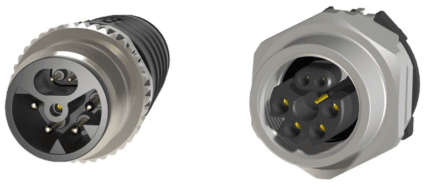
B-coding is what keeps a PROFIBUS drop out of an A-coded sensor port, and it is the reason the two cannot be swapped on site. The full family, A through Y, is set out in the two-page coding reference in the download center.
Where B-code sits in the M12 coding family
B-code is the fieldbus entry in a family where every code shares the same 12 mm thread and differs only by keyway. The table below is the whole map, from the sensor codes through to the hybrid arrangements.
| Code | Positions | Carries | Typical use |
|---|---|---|---|
| A | 3 / 4 / 5 / 8 / 12 | DC sensor supply and signals, IO-Link | Proximity switches, photoelectric sensors, valve plugs |
| B | 5 | PROFIBUS-DP fieldbus | Legacy drives, remote I/O racks, weigh scales |
| C | 3 to 6 | AC power, dual keyway, extended earth | AC sensors, solenoid coils, legacy actuator blocks |
| D | 4 | 100 Mbit/s Ethernet over two pairs | PROFINET, EtherNet/IP, EtherCAT device drops |
| K | 4 + PE | Three-phase AC power | Motor feeds, power distribution blocks |
| L | 4 + PE | DC power | IO-Link power, AGV and drive supplies |
| M | 5 + PE | Three-phase motor plus brake pair | Servo and geared motors with holding brake |
| P | 4 + PE | Data pairs plus 24 V DC supply | Single-cable EtherCAT and remote I/O blocks |
| S | 3 + PE | Single-phase AC power | Field I/O blocks, cabinet heaters, pumps, fans |
| T | 4 | DC power, two circuits | Low-voltage DC distribution |
| X | 8 | Up to 10 Gbit/s Ethernet over four pairs | Machine vision, M12 to RJ45 10G links |
| Y | 6 + PE / 8 | Hybrid power plus Fast Ethernet | Valve islands, hybrid power and data drops |
A, B, C and D are defined in IEC 61076-2-101, X in IEC 61076-2-109 and the power codings in IEC 61076-2-111. Y is a de-facto hybrid arrangement rather than an IEC-defined code. The 60 V / 4 A class figures above are the industry-standard values quoted for the B-coded interface; the values your assembly is built and verified to are the ones stated on your drawing.
Reading the segment before you order
PROFIBUS is a two-wire RS-485 bus, so the questions that decide the build are not the same as for a point-to-point drop. Tell us whether the port is bus-in, bus-out or a spur, whether the node draws supply from the same cordset, and where the segment terminates. A terminating resistor built into the last drop is more reliable than one added on site.
| Segment condition | What it drives |
|---|---|
| Bus-in / bus-out through a node | Two connectors on the device, one cordset in and one out |
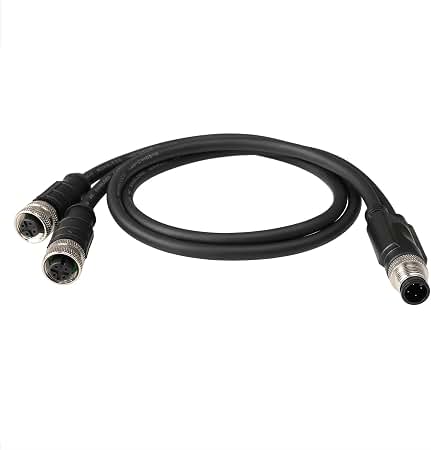
| Single spur off a trunk | One cordset, flying leads or a tee at the trunk |
| Node powered from the cordset | Auxiliary cores alongside the signal pair |
| End of segment | Termination built into the last drop |
Construction we build to
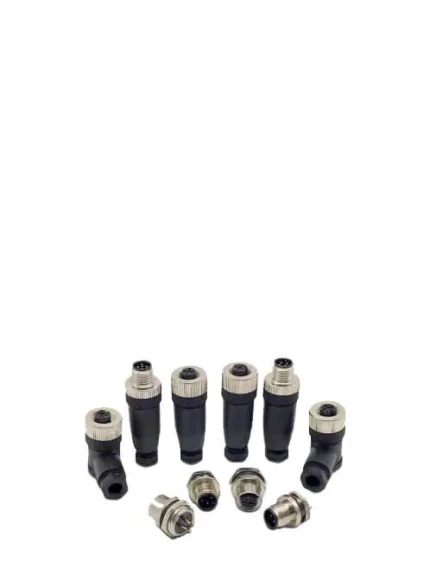
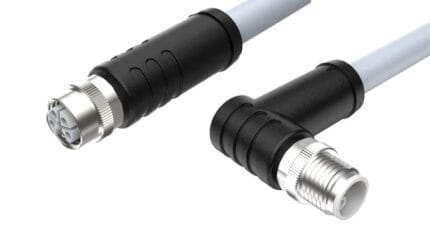
Both ends can be straight or right-angle, male or female, or one end can be left open for field termination. The shield is bonded to the metal coupling nut so the drain path continues through the connector instead of stopping at the gland, and the strain relief is molded onto the cable rather than clamped, which is what keeps the shield contact stable under vibration. Where the cable is dragged over a machine frame, ask for the high-flex PUR version with finer stranding – the conductor construction matters more than the jacket in continuous-motion applications.
PROFIBUS runs over RS-485 at the physical layer, which is why the pair geometry and the screen matter more than the connector does. We hold the pair at a controlled lay and land the braid at both ends.
Typical applications for this M12 B-coded PROFIBUS cable
- Drive networks on legacy production lines
- Remote I/O racks and distributed peripherals
- Weigh scales, dosing and batching equipment
- Valve islands still talking DP rather than PROFINET
- Replacement drops on machines where the original cordset is obsolete
- Mixed installations alongside our M12 D-code PROFINET industrial Ethernet cable
What we need from you
- Pinout, or a photo of the existing connector face
- Node type, and whether the port is bus-in, bus-out or a spur
- Length, and whether the run is fixed or moving
- Jacket preference and any oil, UV or coolant exposure
- Whether you need a matching terminating resistor
Workmanship and testing
IPC/WHMA-A-620 Class 3 is the workmanship bar for M12 B-Coded PROFIBUS builds, and ISO 9001 is the system behind the line, from 32 to 12 AWG. No M12 assembly is boxed before 100% continuity and pinout are confirmed, and seal checking is quoted whenever an ingress rating is on the drawing.
Custom builds and ordering
Five pieces is the prototype minimum for M12 B-Coded PROFIBUS builds, shipping in 3 working days. The production minimum is 500 pcs, delivered 14 working days after approval. Tooling not already held adds around 10 working days. M12 orders ship as OEM or ODM under your part number and labeling material certificates with first-article reports are available.
Related fieldbus and M12 assemblies
- M12 D-code PROFINET industrial Ethernet cable
- M12 CAN bus cable for CANopen and DeviceNet
- M12 A-coded straight or right-angle extension cable
- M12 12-pin bulkhead cable with flying leads
- M12 rail Ethernet cable for rolling stock
- M12 IP69K washdown cable with stainless steel coupling nut
Full range: Circular M8 and M12 cable assemblies.
Frequently Asked Questions
Can I use an A-coded cable on a PROFIBUS port?
No, and it should not be possible – the keyway is reversed precisely to stop it. If you have a mixed panel, keep the bus outlets B-coded and the sensor outlets A-coded.
Why does my segment fail when the drives start?
Usually screen continuity rather than a protocol fault. Check that the braid is bonded to the coupling nut at both ends and that the pair is twisted up to the contact.
Do you supply terminating resistors?
We can build the termination into the last drop when you give us the segment layout, which is more reliable than a resistor fitted on site.
Is PROFIBUS still worth maintaining?
For an installed machine, yes – a replacement cordset costs a fraction of a network migration. For a new design, PROFINET on D-code is the usual direction.
| Connector A | M12 B-coded 5-pin, straight or right-angle |
|---|---|
| Connector B | M12 B-coded 5-pin, or open leads for field termination |
| Coding | B-code, fieldbus (IEC 61076-2-101) |
| Jacket | PUR for oil and coolant, PVC for dry indoor runs |
| Ingress rating | IP67 / IP68 when mated – confirm per build |
| Shielding | Braid bonded to the coupling nut |
| Signal conductors | One shielded signal pair, controlled lay |
| Class ratings | 60 V / 4 A class – confirm per build |