
Cat5e, Cat6 and Cat6A patch cords sit within a few dollars of each other, look identical on a bench, and are sold in the same colors. That is exactly why the choice so often gets made badly. This guide sets out what each category is actually guaranteed to do, where the megahertz figure on the label stops carrying any meaning, and why Cat7 and Cat8 are usually the wrong purchase despite sitting higher up the chart.
The short answer
If you are specifying a new installation and the runs stay inside 100 m, buy Cat6A. If you are feeding 1 Gbit/s devices on a tight budget in a benign office, Cat5e still works. Cat6 is the awkward middle: it is fine for gigabit, and it is not a 10 Gbit/s cable beyond roughly half a channel length, which surprises people who bought it for exactly that.
| What you are doing | Buy this | Why |
|---|---|---|
| Gigabit to desktops, phones, printers | Cat5e UTP | Rated to 100 MHz, 1 Gbit/s to the full 100 m channel. Cheapest per drop. |
| Gigabit in plenums or risers | Cat6 CMP plenum | NFPA 262 / FT6 flame rating is the requirement, not the bandwidth. |
| Anything new, or anything that must outlive one refresh | Cat6A S/FTP | 10 Gbit/s to the full 100 m, 500 MHz, and the only category with real thermal headroom for PoE. |
| 10 Gbit/s in a factory, on a machine, or outdoors | Cat6A PUR industrial | Oil, coolant and UV resistant jacket, and it survives movement. |
| Top-of-rack to server at 25 or 40 Gbit/s | Cat8 | The only copper that reaches 25/40GBASE-T — but the channel stops at 30 m. |
What each category is guaranteed to deliver
These are the numbers the standards actually define, not the numbers on the cable jacket.
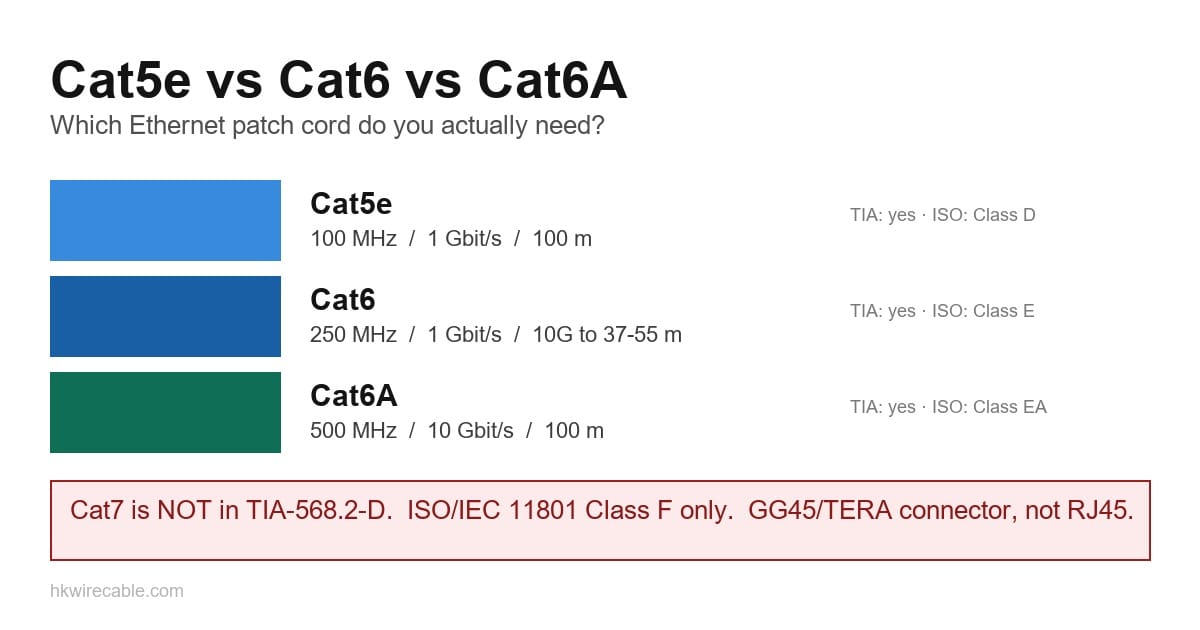
| Category | Bandwidth | ISO/IEC class | In ANSI/TIA-568.2-D? | 10GBASE-T reach | Connector |
|---|---|---|---|---|---|
| Cat5e | 100 MHz | Class D | Yes | Not rated for it | RJ45 (8P8C) |
| Cat6 | 250 MHz | Class E | Yes | 37–55 m | RJ45 (8P8C) |
| Cat6A | 500 MHz | Class EA | Yes | 100 m | RJ45 (8P8C) |
| Cat7 | 600 MHz | Class F | No | 100 m (ISO only) | GG45 or TERA |
| Cat8 | 2000 MHz | Class I / II | Yes | 100 m (irrelevant at this price) | Screened RJ45 |
The categories recognized in North America are defined in ANSI/TIA-568.2-D, and that document defines Category 5e, Category 6, Category 6A and Category 8. It does not define a Category 7. That single fact drives most of the confusion below.
The 10 Gbit/s distance nobody reads
Cat6 is routinely sold as a 10 Gbit/s cable. It is, over a short channel. IEEE 802.3an set two reach objectives for 10GBASE-T over Category 6: 55 m on a clean channel with low alien crosstalk, and a more conservative 37 m in open-office environments where bundled cables raise interference. If your horizontal run is 60 m, Cat6 will not reliably give you 10 Gbit/s, and no amount of better patch cords at the ends will fix that.
Cat6A has no such caveat. Full 100 m channel, 90 m permanent link plus patch cords, 10 Gbit/s, no alien crosstalk asterisk. This is the single most common reason a “Cat6 was cheaper” decision turns into a re-cable two years later.
The megahertz trap: rated versus required
Here is something worth knowing before you compare two quotes. A Category 5e cord has to meet 100 MHz. Plenty of the Cat5e cords on the market — including several we sell, such as the Cat5e UTP LSZH — are printed and tested at 350 MHz. A Category 6 cord has to meet 250 MHz; the Cat6 S/FTP shielded cords we carry are characterised to 550 MHz.
That headroom is real and it is useful — it is margin against installation damage, ageing and marginal terminations. But it is not a standard. When an integrator certifies your channel, they test against the category limit, not the marketing number. A 350 MHz Cat5e cord is still certified as Cat5e. So use the extra bandwidth as a quality signal between two otherwise similar products, and never as a substitute for specifying the right category.
Cat6A is the exception in the other direction: 500 MHz is the actual requirement. There is no gap between what is printed and what is tested, which is one more reason it is the sane default.
Where Cat5e still makes sense
Cat5e carries 1000BASE-T to the full 100 m channel and it is the cheapest thing you can legitimately install. For desk phones, printers, badge readers, and anything else that will never see more than a gigabit, spending more buys you nothing today.
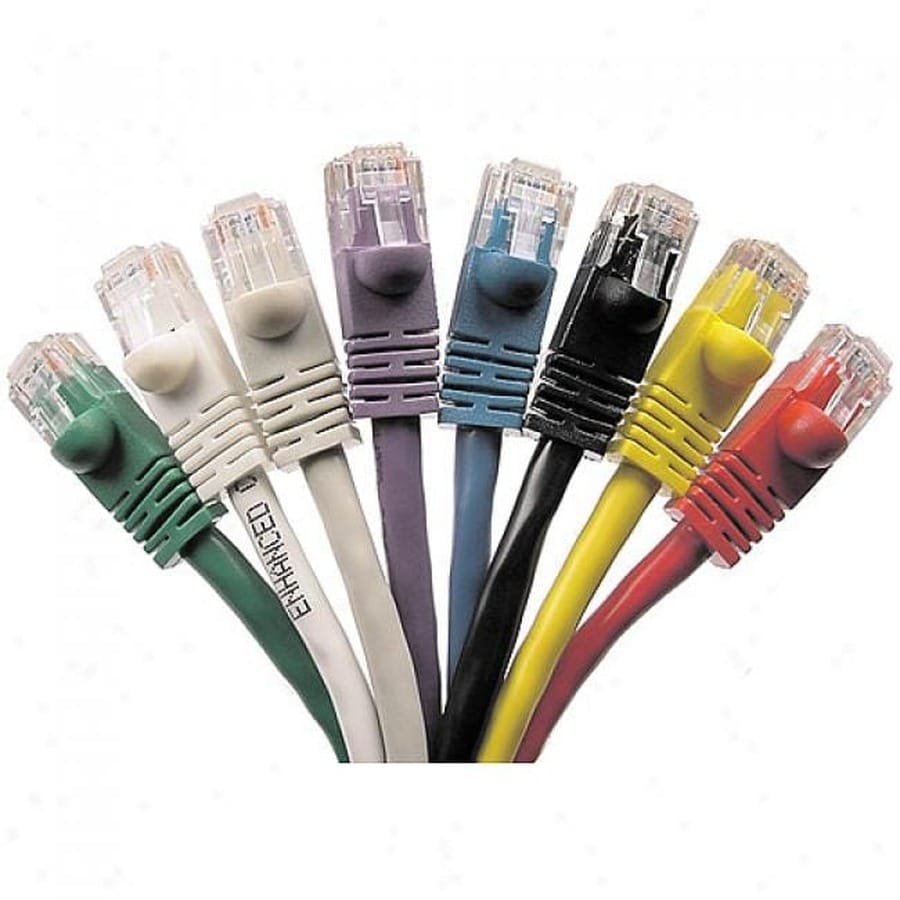
It also has a couple of genuinely useful specialities. The Cat5e FTP outdoor direct-burial cord uses a 24 AWG solid conductor in a UV-resistant LLDPE jacket and reaches IP67 when the shrouds are fitted — for a run across a yard to a gate camera, the environment kills the cable long before the bandwidth does. And for touring and stage work, the etherCON ruggedised Cat5e solves a problem no category number addresses: a plastic RJ45 latch does not survive being coiled and uncoiled every night.
Cat6: the middle ground with a caveat
Cat6 is a perfectly good gigabit cable and a compromised 10 gigabit one. Buy it for gigabit with margin, and if there is any chance you will want 10 Gbit/s on that run later, the price difference to Cat6A is almost always smaller than the cost of pulling cable twice.
It also covers requirements that have nothing to do with speed. The CMP plenum-rated Cat6 exists because air-handling spaces need an NFPA 262 flame rating, and the IP67 S/FTP Cat6 exists because a washdown area needs a sealed connector, not more bandwidth.
Why Cat6A should be your default
Beyond the 100 m 10 Gbit/s reach, Cat6A has two advantages that matter more in practice than the headline number.
Thermal headroom for PoE. Power over Ethernet heats a bundle from the inside. Modern access points, PTZ cameras and LED fixtures draw from IEEE 802.3bt at up to 90 W across four pairs, and a cabinet full of cables carrying that current gets warm. Cat6A conductors are larger and the category is specified with that in mind.
It is the category the industrial ecosystem builds around. Every M12 X-coded connector, every sealed RJ45 system and every drag-chain rated cable we carry is engineered to Class EA. If you need a sealed connection, a locking connection, or a cable that moves, you end up in Cat6A territory by default.
Why we do not lead with Cat7
This is the part most comparison articles get wrong, and it is worth being blunt about it because it costs buyers real money.
ANSI/TIA-568.2-D does not recognize Category 7. The TIA sequence runs Category 5e, 6, 6A, and then jumps straight to Category 8. Category 7 exists only in ISO/IEC 11801 as Class F, at 600 MHz.
That would be a footnote if not for the connector. Class F was written for GG45 or TERA connectors (IEC 61076-3-104), not RJ45. The reason is physical: Class F requires each of the four pairs to be individually shielded all the way through the connector, and the contacts in a standard 8P8C RJ45 sit too close together to isolate four shielded pairs from each other.
So what is the “Cat7 patch cord” sold in retail and distributor channels? Shielded S/FTP cable terminated with RJ45 plugs. The moment you crimp an RJ45 onto it, the connector becomes the bottleneck and the channel performs to roughly Cat6A limits — while you paid for S/FTP and 600 MHz cable. There is no TIA test profile for Category 7, which means a North American integrator certifying to TIA-568 cannot produce a compliant Cat7 channel certification, because that standard does not exist in their framework.
We do sell a Cat7 S/FTP cord, specified with GG45 / TERA connectors per IEC 61076-3-104, and it is the right product if you are maintaining a genuine Class F installation — these exist in parts of Europe and in some broadcast and medical imaging environments. If you are putting it into an RJ45 ecosystem, buy Cat6A instead and spend the difference on better shielding or a better jacket. Honest answer, even though it costs us the higher-margin sale.
Why Cat8 is a data center part
Cat8 is real, it is TIA-recognized under ANSI/TIA-568-C.2-1, and it is the only copper category that reaches 25GBASE-T and 40GBASE-T. It is also limited to a 30 m channel — typically read as a 24 m permanent link plus two 3 m patch cords. That is a top-of-rack switch to a server in the same cabinet. It is not horizontal cabling, it is not industrial cabling, and the 2000 MHz figure is meaningless if your run is 40 m.
Our Cat8 cord is built as 4-pair S/FTP in 22 AWG with a screened RJ45 plug, offered in 1 to 5 m lengths, which is exactly the use case: short 25G and 40G links in edge and AI clusters. Outside that, Cat6A is the better buy.
Category choice in harsh environments
This is where category comparison articles usually stop, and it is where most industrial purchases are actually decided. Once the cable leaves a climate-controlled room, the environment dictates the specification and the category becomes secondary.
Washdown, food and beverage
IP69K means surviving high-pressure, high-temperature spray, and it is defined in ISO 20653 rather than IEC 60529. A Cat6A IP69K washdown patch pairs an M12 X-coded wet end with a shielded RJ45 dry end, in a halogen-free PUR jacket that tolerates caustic foam and Ecolab-type detergents. A 316L stainless steel braid is available where the cable will be dragged across stainless decks.
Rail and rolling stock
Fire performance dominates: EN 45545-2 requirement set R15 at HL1–HL3, with smoke density and toxicity tested to IEC 61034 and EN 50305. The Cat6A railway patch cord is built to those standards with a halogen-free LSZH jacket in RAL 6018, and is available with M12 X-coded ends.
Direct burial and outdoor runs
Water ingress along the core, not bandwidth, is what ends outdoor runs. Gel-filled cores with UV-stable LLDPE jackets handle it: the Cat6A outdoor direct-burial cord reaches IP68 with the shroud fitted, and there is a matching IP68 coupler for field extension.
Moving cable: drag chain and robotics
Standard PVC patch cords crack in a cable carrier. High-flex PUR with oil and coolant resistance is the specification that matters, as in the Cat6A PUR high-flex patch and the drag-chain rated GigE Vision screw-lock cable.
Vibration and repeated mating
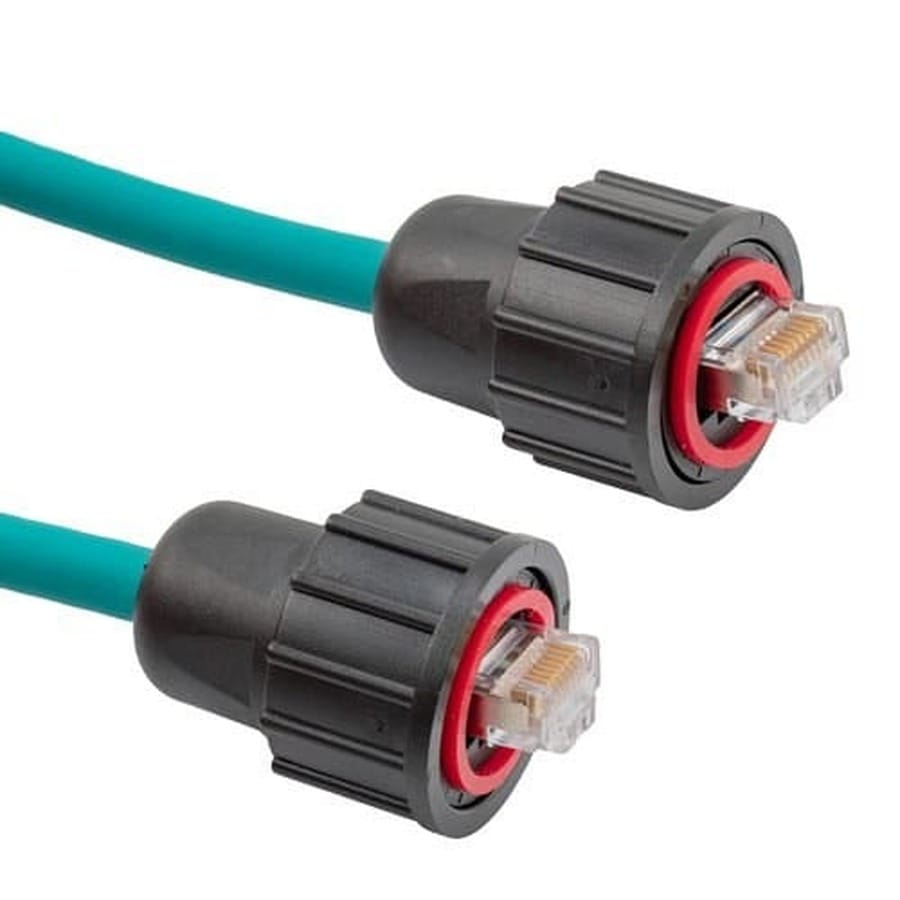
A standard RJ45 per IEC 60603-7 is rated for about 750 mating cycles. Where a connection gets made and broken constantly, or vibration can walk a latch out, the locking mechanism matters more than the category. Options in Cat6A include metal-shell locking patches rated to 1000 cycles, M12 X-coded connectors per IEC 61076-2-109 such as the M12 X-coded to RJ45 and the push-pull X-code variant, and ix Industrial, which is rated to a 5000-cycle class and takes roughly 70 percent less panel area than RJ45.
PoE and the thin-cable trade-off
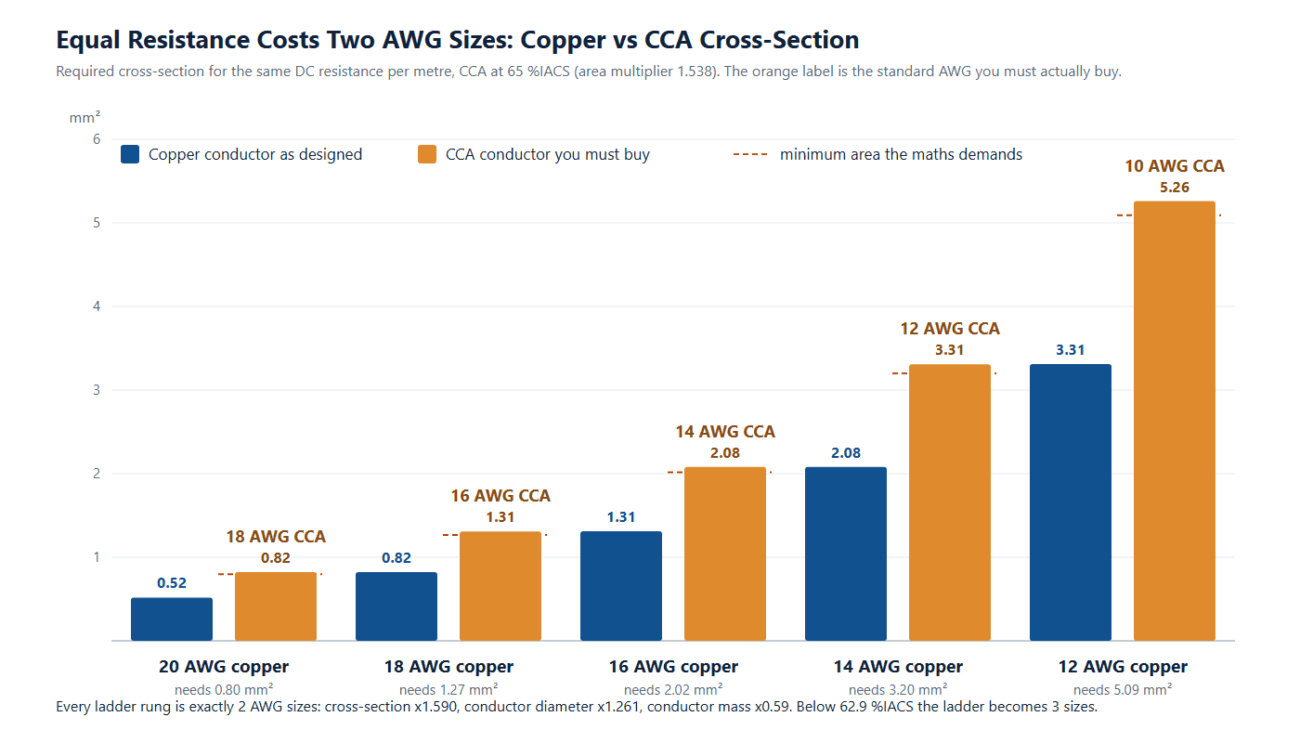
Slim patch cords exist because a full-size Cat6A cord is thick, stiff, and fills a cabinet faster than you expect. A 28 AWG slim cord such as our Cat6A slim patch drops the outside diameter to roughly 4.5 mm and makes high-density patching manageable.
The trade-off is resistance, and resistance is heat. In a densely packed bundle carrying 802.3bt loads, thin conductors run hotter and the bundle as a whole needs derating. Our guidance: use slim cords for short patch-field runs where airflow is reasonable, and switch to standard 26 AWG or 23 AWG construction for long runs, dense bundles, or anything drawing PoE++ continuously. If you are filling a cabinet with 90 W devices, the standard Cat6A S/FTP is the safer call.
Decision checklist
- Will this run ever need 10 Gbit/s? If yes, or if you cannot rule it out, buy Cat6A. Cat6 will only give you 37–55 m.
- Is the run longer than 30 m and needing more than 10 Gbit/s? Then copper is the wrong answer — go fiber.
- Does the environment have a requirement written into a code? Plenum, riser, rail fire performance, washdown rating — these override the category decision entirely.
- Does the cable move, or the connector get re-mated often? Specify jacket and locking before you specify category.
- Is someone quoting Cat7 into an RJ45 system? Ask what standard they will certify the channel against. There is no TIA Category 7 test profile.
Common mistakes
- Reading the printed MHz as the category. A 350 MHz Cat5e cord is certified as Cat5e. Buy category, treat headroom as a quality signal.
- Assuming Cat6 does 10 Gbit/s at 100 m. It does not; it is 37–55 m depending on the environment.
- Mixing categories and expecting the best one to win. A channel performs to its weakest component. A Cat6A cord into a Cat5e jack gives you a Cat5e channel.
- Specifying Cat8 for horizontal cabling. The 30 m channel limit makes it a data center part.
- Shielded cable with unshielded termination. S/FTP only helps if the screen is bonded at both ends through a shielded connector and a properly grounded jack.
Frequently asked questions
Is Cat6A worth the extra cost over Cat6?
For new installations, yes. The material premium is small compared with the cost of re-cabling, and Cat6A removes the 37–55 m restriction on 10GBASE-T, adds thermal headroom for PoE, and is the category the sealed and locking connector ecosystem is built around.
Can I use a Cat6A patch cord with Cat5e or Cat6 structured cabling?
Physically yes, and it is common in patch fields. The channel will perform to the lowest category in the path, so a Cat6A cord in a Cat5e link gives you Cat5e performance. The reason to do it anyway is durability: a better-built cord survives more re-patching.
Why is there no Category 7 in the TIA standard?
TIA moved from Category 6A straight to Category 8, skipping 7. Category 7 exists as ISO/IEC 11801 Class F and requires GG45 or TERA connectors, which are not compatible with the installed base of RJ45 hardware. Terminating Class F cable with RJ45 plugs caps the channel at roughly Cat6A performance.
How long can a Cat6A channel be?
100 m total channel: 90 m permanent link plus up to 10 m of patch cords across both ends. That holds at 10 Gbit/s with no derating.
Do I need shielded cable?
In offices with normal EMC, UTP is fine and easier to terminate. Specify S/FTP where there are variable-frequency drives, welders, large motors, or where the cable runs alongside power. Remember that shielding only works if it is bonded continuously and grounded properly.