
Quick Comparison: RJ45 vs M12 X-Coded
If your Ethernet link lives inside a cabinet, an office, or a patch panel, use RJ45. If it runs on a machine, a robot joint, an AGV, or anything that gets washed down, use M12 X-coded. Bandwidth is not the deciding factor — both carry 10GBASE-T over Category 6A. What actually separates them is how the connector stays locked, how it seals, and how the cable shield is terminated where it meets the connector shell.
| Factor | RJ45 | M12 X-Coded |
|---|---|---|
| Locking | Plastic latch; thumbscrew variants use 4-40 UNC hardware | M12 threaded coupling nut; some builds offer push-pull |
| Ingress rating | IP20 as standard; IP67 only when mated into a sealed system | IP67 in the mated condition |
| Positions | 8 (8P8C) | 8, X-coded keyway prevents mis-mating with A/B/D coded |
| Category support | Cat5e through Cat6A; Cat8 on some builds | Cat6A / Class EA, four pairs |
| Mating cycles | 750 minimum on IEC 60603-7 series connectors | Designed for repeated field mating; confirm against the connector datasheet |
| Shield path | Depends on plug and cord construction | 360° screen terminated to the metal coupling shell |
| Panel footprint | Baseline | Larger than RJ45; ix Industrial is roughly 70% smaller if density is the constraint |
| Governing standard | IEC 60603-7 series | IEC 61076-2-109 |
What Each Connector Is
RJ45
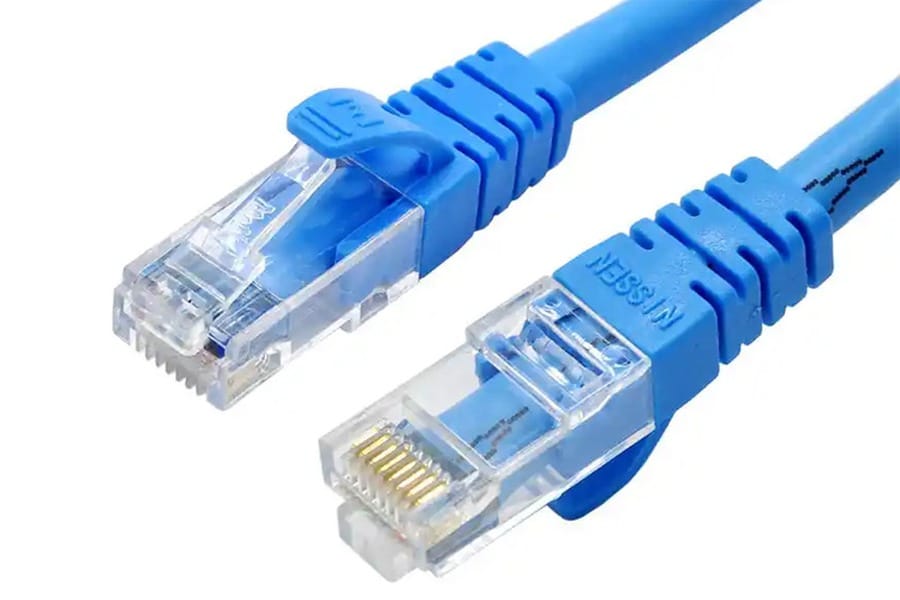
The 8P8C modular plug is the default Ethernet interface everywhere except the factory floor. It is defined by the IEC 60603-7 series, it is cheap, it is available in every length and color, and every switch, camera and PLC with an Ethernet port accepts it. The retention mechanism is a moulded plastic latch that clicks into a jack. That latch is also its weak point: it snaps, it wears, and in a vibrating enclosure it can walk out far enough to drop the link intermittently rather than cleanly.
When you need more retention, the common fix is a thumbscrew variant. A Cat6A RJ45 screw-lock patch cable replaces the latch with twin 4-40 UNC thumbscrews that thread into mating jacks or panel receptacles, and it still supports IEEE 802.3af, 802.3at and 802.3bt PoE across all four pairs.
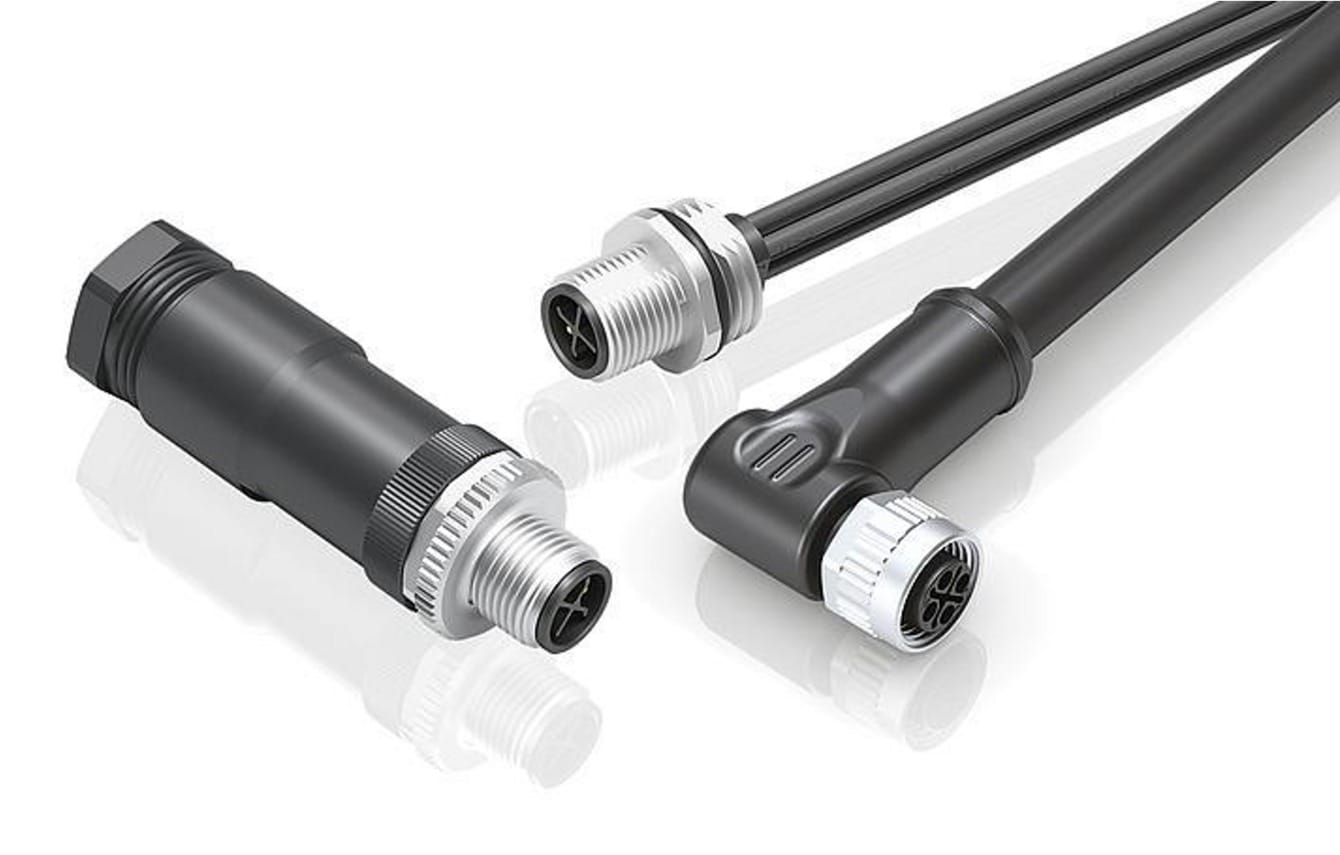
M12 X-Coded
M12 is a circular connector family built for industry. The letter code is a mechanical keyway that stops you mating the wrong insert — X-coded is the code reserved for Ethernet, and it will not physically accept an A-coded sensor plug or a D-coded PROFINET plug. The X-coded insert carries eight contacts arranged as four pairs, which is what allows it to reach Category 6A rather than the 100 Mbit/s ceiling of 4-pin D-coded.
The coupling is a threaded metal nut. Tightened by hand or with a torque tool, it does not rely on a spring tab, and the metal shell gives the cable shield a continuous 360° termination instead of a drain wire pigtail. Our Cat6A M12 X-coded patch cord is typical: 8-pin X-coded M12 on one end, shielded RJ45 on the other, halogen-free PUR jacket.
Key Differences That Decide the Job
1. Locking under vibration
This is the single most common reason an RJ45 link fails on equipment. A plastic latch holds a plug against the spring force of the jack contacts and nothing else. On a gantry, a press, or an AGV that brakes hard all day, that is not enough. Intermittent link-drop is worse than a clean failure because it looks like a software fault, a bad IP configuration, or a flaky camera.
A thumbscrew RJ45 solves most of this at low cost, and it is often the right answer when the equipment already has RJ45 jacks. The Cat6A RJ45 Screw-Lock GigE Vision Cable pairs a thumbscrew end with a standard latched end, which is exactly the configuration you want when the camera end moves and the switch end does not.
2. Ingress protection — and the half-rated trap
M12 X-coded is IP67 in the mated condition. That is a property of the connector system, not of the cable. The mistake buyers make is assuming an “IP67 cable” is sealed at both ends.
A hybrid M12-to-RJ45 cord is IP67 on the M12 side and IP20 on the RJ45 side. Read the fine print on our own listing: IP67 mated on the M12 side, IP20 on the RJ45 side. If you plug that RJ45 end into an unsealed jack inside a washdown area, the whole run is IP20 at its weakest point.
To seal the RJ45 side you need a sealed system, not just a booted plug. Two options: an IP67 RJ45 patch cable with a dual-use shroud that mates to both standard jacks and sealed IP67 receptacles, or a Cat6A IP67 industrial pigtail with a threaded sealing coupler and tethered dust cap. Both still support IEEE 802.3bt PoE++ device feeds.
3. Shield termination
Industrial Ethernet runs next to servo drives, weld controllers and VFDs. What matters is not whether the cable is shielded — a Cat6A shielded patch cord uses pair foil plus an overall braid — but whether that shield stays continuous through the connector.
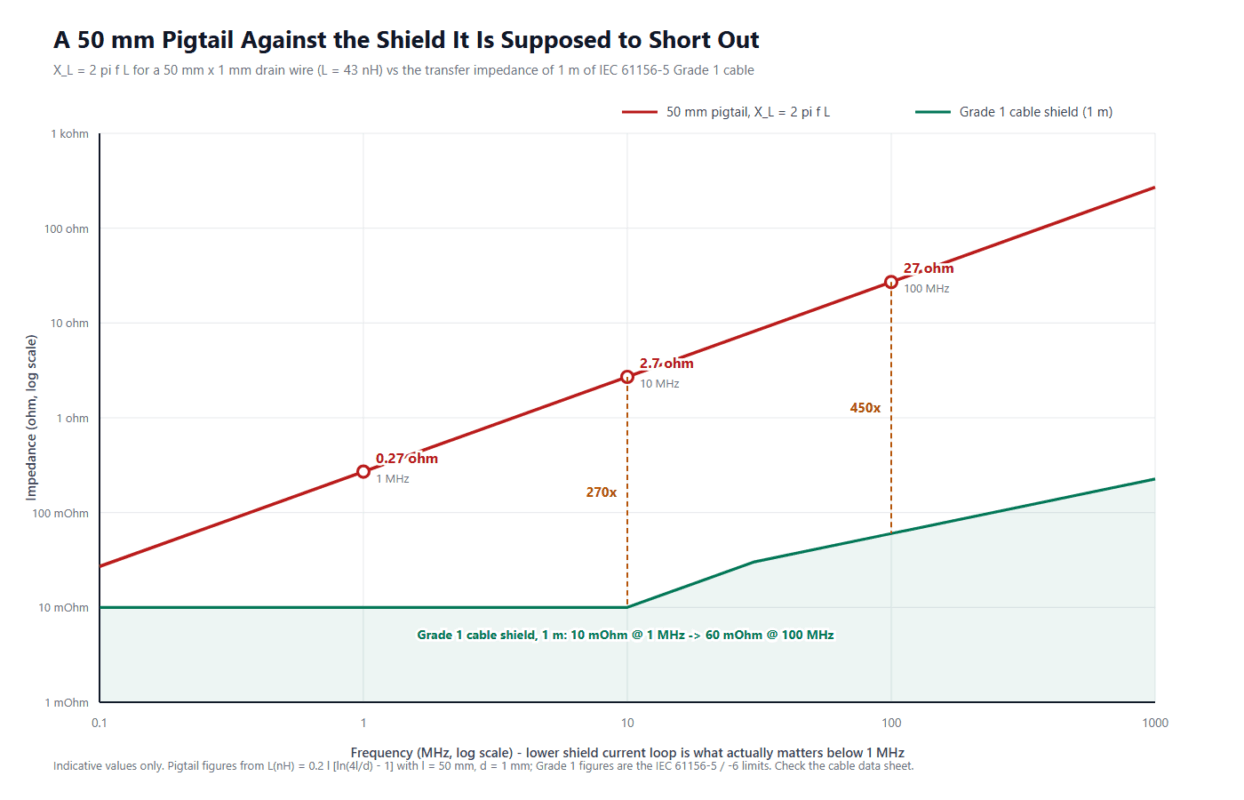
On a well-built M12 cord, the braid is terminated 360° against the metal coupling nut, so the shield continues into the device chassis. On an RJ45 plug the shield usually ends at the plug shell, and the quality of that connection varies a lot between manufacturers. If you are running GigE Vision or any trigger-sensitive application, this is worth checking on the datasheet rather than assuming.
4. Panel density
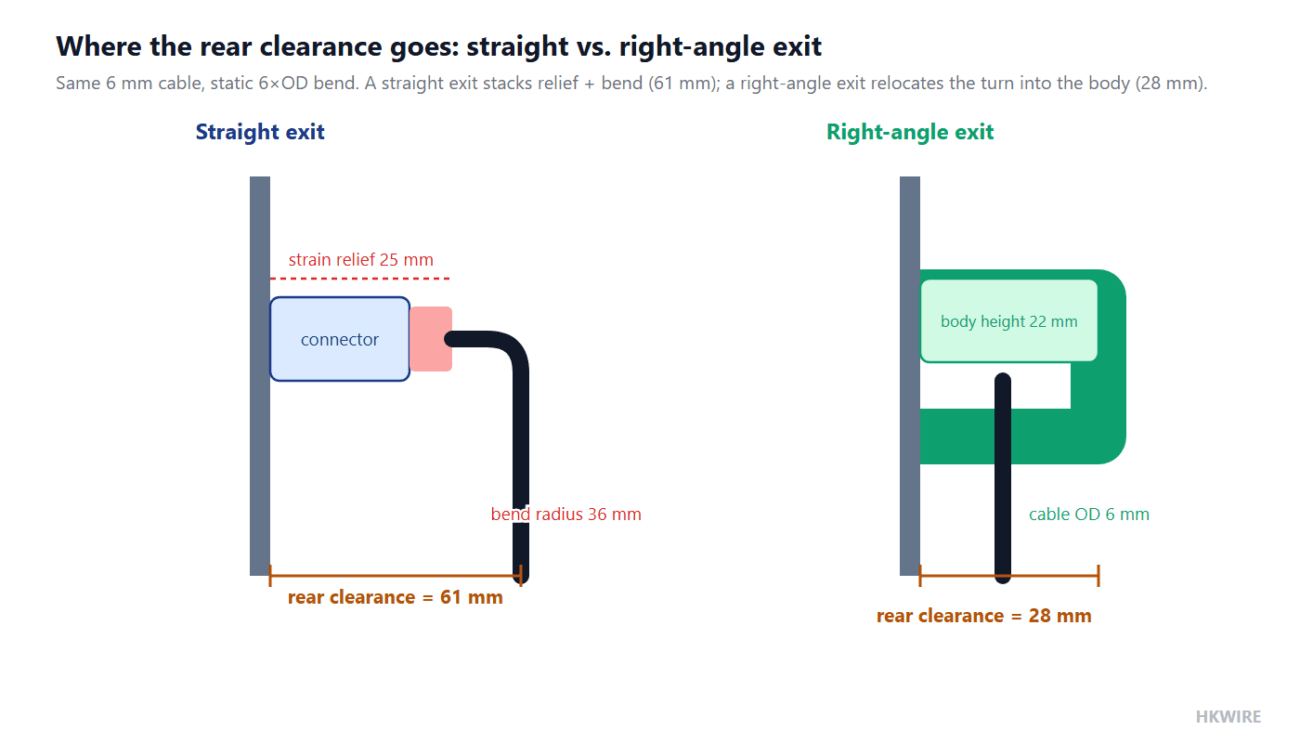
M12 is bulkier than RJ45. If you are putting eight camera ports on one machine faceplate, M12 X-coded couplings take real estate and finger clearance for the nut. Where density is the binding constraint, ix Industrial is the smaller alternative — it is roughly 70% smaller in faceplate area than RJ45 while still carrying Cat6A, with 360° shielding through the shell. Our ix Industrial Cat6A patch cord covers ix-to-RJ45 and ix-to-ix.
5. Service life and who touches it
Standard IEC 60603-7 series RJ45 hardware is rated for a 750-cycle minimum. That is fine for patching and for equipment that gets reconfigured a few times a year. It is not fine for a fixture that gets unplugged every shift.
Where the connector is handled constantly, the cycle rating matters more than the IP rating. ix Industrial is quoted around 5000 cycles; our Cat6A rugged locking patch cord uses a metal shell with a 1000-cycle minimum and is built for stage and AVoIP use where it is patched nightly.
Choose RJ45 If…
- The link stays inside a cabinet, a control room, or an office
- You are patching into existing RJ45 infrastructure and cannot change the panel
- Cost per link matters and the environment is benign
- You need long standard lengths — RJ45 patching is stocked up to 75 m in rugged builds
- The port is touched a few times a year, not a few times a shift
If you want RJ45 but need it to stay put, add retention rather than changing connector families. A thumbscrew build is usually enough.
Choose M12 X-Coded If…
- The connector sits on moving equipment: robot joints, AGVs, gantries, drag chains
- The area gets washed down, or sees coolant, oil or dust
- You need Cat6A and 10GBASE-T on the machine, not just 100 Mbit/s PROFINET
- Shield continuity into the chassis matters for your noise environment
- You want the keyway to make mis-mating physically impossible for maintenance staff
Our M12 X-coded range covers the three wiring patterns that come up most: M12 X-code to M12 X-code for a fully sealed machine run, M12 X-code to screw-lock RJ45 for a machine-to-cabinet transition, and M12 X-coded Cat6A to RJ45 where push-pull locking and 0.5–20 m lengths suit machine vision.
Cost, Availability and Mixed Installations
RJ45 patching is a commodity. Standard lengths are stocked, priced per piece, and ship quickly. If a cord is damaged you swap it from a drawer. That availability is worth a lot, and it is the reason RJ45 remains the right answer for every link that does not need sealing.
M12 X-coded assemblies are built to order. You specify connector A, connector B, jacket compound and length, which means a longer lead time and a higher unit cost. What you are buying for that money is a keyed, sealed, shield-continuous assembly that will not vibrate loose — and, just as importantly, one that a maintenance technician cannot plug into the wrong port.
In practice most machines end up using both, and that is not a compromise. The usual pattern is M12 X-coded at the device, a bulkhead or panel feedthrough at the cabinet wall, and standard RJ45 patching inside the cabinet where the environment is clean. You pay for sealed hardware only where sealing is needed, and you keep commodity patching where it is not. If you are crossing a cabinet wall, an IP67 RJ45 panel coupler does that job without forcing the whole run to be M12.
The practical advice: standardise on M12 X-coded for anything on the machine side, and standardise on RJ45 for everything behind the cabinet door. Do not mix them arbitrarily on the same run — every transition is a place where the shield path or the IP rating can quietly break.
Common Mistakes
- Assuming the IP rating covers the whole run. A hybrid cord is only as sealed as its weakest end. Check both.
- Specifying M12 where D-coded would do. If the link is 100 Mbit/s PROFINET, D-coded 4-pin is cheaper and smaller. X-coded only pays off when you need four pairs and Cat6A.
- Ignoring the mating half. Buying an M12 cord and then discovering the device has no M12 receptacle. Confirm the device side before ordering.
- Over-specifying on the cabinet side. Inside a clean cabinet, a standard Cat6A S/FTP patch cord is correct and costs less. Save the M12 for the machine.
- Forgetting PoE. If you are powering devices over the link, confirm the connector and cable support 802.3bt across four pairs — not all industrial cords do.
Frequently Asked Questions
Can M12 X-coded carry 10GBASE-T?
Yes, provided the whole channel is Category 6A. X-coded M12 carries all four pairs and is built to Class EA performance; our M12 X-coded cords are specified as Cat6A S/FTP with 10GBASE-T capability over standard Cat6A channel limits.
Is an M12 X-coded to RJ45 cord waterproof at both ends?
No. The M12 end is IP67 when mated; the RJ45 end is IP20 unless it is plugged into a sealed receptacle or a sealed coupler. For a fully sealed path, use M12 on both ends, or terminate the RJ45 side into an IP67 sealing coupler.
Do I need shielded cable for industrial Ethernet?
On the machine side, almost always. Servo drives and VFDs generate the kind of noise that unshielded pairs will pick up. Use S/FTP construction and make sure the shield is terminated 360° at the connector rather than left as a pigtail.
Specifying Your Next Build
Start from the environment, not the connector. If the link is clean, dry and static, RJ45 wins on cost and availability. If it moves, gets washed, or sits next to a drive, M12 X-coded is the safer specification — and if density is your constraint, look at ix Industrial before you commit to either.
If you are unsure, send us the device-side connector, the environment, and the link length; we will tell you which of the three makes sense rather than selling you the most expensive one.
Last updated: September 2026