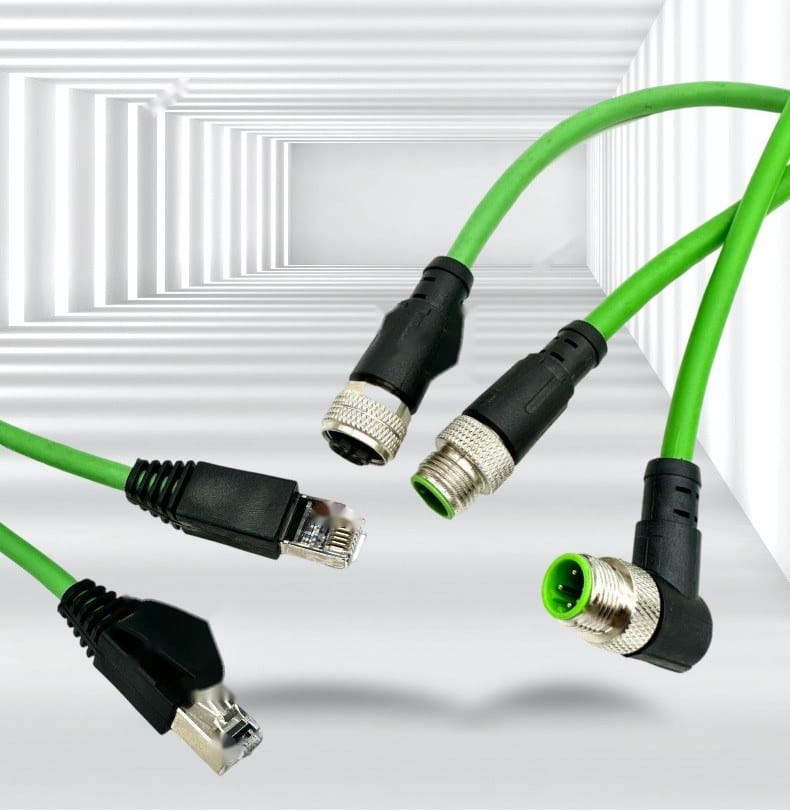
M12 D-Code to RJ45 Screw-Lock Cable
This m12 d-code rj45 cable joins a screw-locking D-coded M12 male to a standard RJ45 plug over four shielded pairs, bridging sealed field wiring and ordinary cabinet Ethernet in one PROFINET-ready cordset.
Overview
This m12 d-code rj45 cable joins a screw-locking D-coded M12 male to a standard RJ45 plug over four shielded pairs, bridging sealed field wiring and ordinary cabinet Ethernet in one PROFINET-ready cordset.
The D-coded 4-position layout carries one 100 Mbit/s industrial Ethernet channel, the speed class PROFINET RT networks run on, and the threaded M12 coupling nut is the screw-lock element that keeps the field end seated where vibration or accidental pulls would work a latch-free connection loose. On the other end the RJ45 plug lands in any standard switch or media converter port.
Key Specifications
The table below lists the configuration shown in the product photo.
Why D-Code for Industrial Ethernet
D-coding is the four-contact Ethernet member of the M12 family, standardised in IEC 61076-2-101 and built around two shielded pairs carrying one 100 Mbit/s channel. It exists because factory Ethernet does not live in the environment office cabling was designed for. An RJ45 port uses a plastic latch that wears, releases under vibration, and leaves the contacts open to dust; a threaded M12 pair screws down, seals at the mating face, and stays together.
The electrical result is the same link. The difference is everything about how that link behaves after eighteen months on a machine that shakes, gets hosed down and has its connectors pulled by people in a hurry.
Straight or Right-Angle at the M12 End
Both styles exist in this family and the choice is made by clearance, not preference. A straight exit needs room in front of the port equal to the connector body plus the cable’s minimum bend radius. On the front of a control cabinet that space usually exists; behind a camera on a bracket, or at a device mounted flat against a frame member, it generally does not.
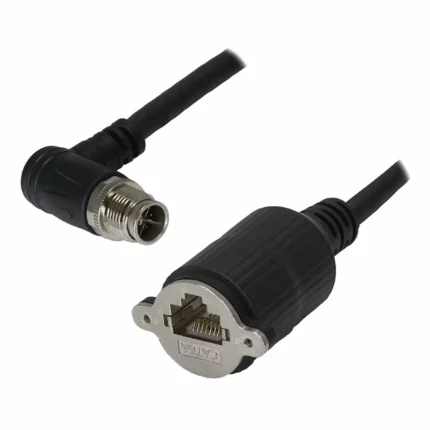
A right-angle body puts the turn inside the molded shell so the cable can run flat along the mounting face, which drops the installed depth dramatically. The trade-off is that the exit direction is fixed at molding time, so it has to be specified up front rather than adjusted on site. Tell us which way the run needs to leave and we will build it that way.
Construction and Materials
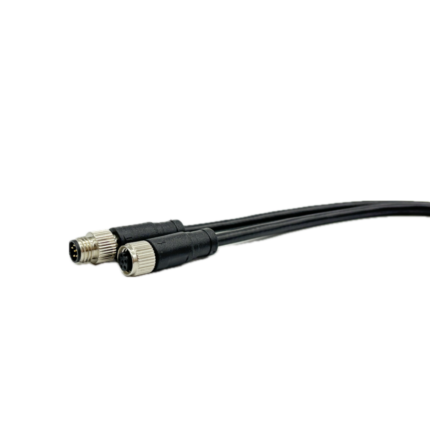
The green circular jacket carries four twisted, individually color-coded pairs with an overall screen, the wiring class D-coded Ethernet expects. Both ends are overmolded with strain relief, and the M12 coupling nut is knurled metal so it can be tightened reliably in a packed cabinet. Straight M12 service ends and a right-angle male option in the same green jacket are shown in the family photo.
All four pairs are individually screened and color-coded to the D-code pin map, and the pair lay is held through the overmold so the twist is not opened at the termination. Preserving lay length right up to the contact is what keeps the channel within its crosstalk budget — untwisting even a short section to make soldering easier degrades exactly the pairs that carry the data.
The coupling nut seats on the M12 thread rather than on the molding, so repeated tightening loads metal instead of the overmolded body.
Shielding: One End or Both
Screened Ethernet cable is standard in industrial installations, and the question that follows is where to land the screen. The answer depends on your installation and should follow whatever your network owner specifies, because practices differ.
The failure mode to avoid is a screen connected at both ends where the two grounds sit at different potentials. The screen then carries current it was never meant to carry, and instead of protecting the pairs it couples noise into them. Keep the drain short where it terminates, use a screen that lands on the connector shell cleanly, and do not improvise.
Typical Applications
Run it from a cabinet switch RJ45 port out to IP-rated cameras, wireless access points, remote I/O blocks and operator terminals whose Ethernet port is an M12 D-coded receptacle. It is the standard drop cable for PROFINET devices installed outside the control cabinet in washdown or dusty zones.
IP-rated machine vision cameras are the most common endpoint, partly because camera makers standardised on the D-coded port early and partly because cameras almost always sit outside the cabinet.
Remote I/O blocks distributed along a machine are the second group. Running one sealed drop to each block replaces a field junction box, glands and terminal strip.
Operator terminals, weigh scales, barcode readers and wireless access points in food and beverage plants round out the list — anywhere the equipment is cleaned with a hose.
Wiring and Pinout Notes
The D-code pin map assigns the two pairs to fixed positions, so a cordset built to it is, in effect, a straight-through cable with a circular connector substituted for one plug. That makes it protocol-agnostic within the 100 Mbit/s class: PROFINET, EtherNet/IP and ordinary TCP/IP traffic all run over it.
Where installations get into trouble is gender rather than wiring. D-coded ports are produced in both male and female variants and the cordset has to complement the device. Check the device datasheet, or send us a photograph of the port, before ordering.
Compatibility and Fitment
The keyway follows IEC 61076-2-101 D-coding and the wiring supports 100BASE-TX class links, so the cordset works with standard industrial Ethernet protocols at 100 Mbit/s. It will not mate with X-coded eight-position ports, which serve the gigabit and ten-gigabit classes.
Where the whole run lives inside one cabinet and nothing is exposed to washdown, a screened RJ45 patch lead is usually the simpler and cheaper answer than a sealed cordset.
Installation Notes
Tighten the coupling nut by hand to a firm seat. Using pliers to crush it further deforms the sealing face rather than improving retention.
Do not let the cable’s weight hang off the field connector, particularly in vertical drops where sustained tension will eventually show up as an intermittent link.
Label both ends. In a cell with several identical cordsets, labelling is the difference between a two-minute swap and an afternoon of tracing.
Custom Builds and Ordering
Length, exit direction on the M12 end and labeling are configurable. Share your device schedule and we will quote the cordset mix, including straight and right-angle M12 service ends from the same product family. Prototype and sample lots run from 1 to 50 pieces and ship in 3 working days; production orders start at 500 pieces per part number and ship 14 working days after approval, with new overmold tooling adding about 10 working days.
Packaging and Shipping
Individually bagged with a dust cap on the M12 connector; bulk packs with customer labels are available for panel shops.
Quality and Compliance
Continuity and pair mapping are verified on every assembly, and shield termination is inspected at both connectors before shipment. See the TIA structured cabling standards for the governing interface specification.
Material declarations against RoHS and REACH are issued per project, alongside the dimensional and electrical reports agreed at quotation; see certifications, compliance and material declarations. Where your drawing names a UL style or another approval, the build follows your drawing and ships with the supporting document rather than a claim of our own. Overmold tooling for this part is designed and cut in our own tool room under in-house mold making and overmold tooling, so the tool belongs to your program and a revision is a machining job rather than a new negotiation. More background: build-to-print cable assemblies.
Frequently Asked Questions
Does it carry gigabit Ethernet? No. D-coding covers 100 Mbit/s; gigabit belongs to X-coded eight-position connectors.
What gender is the M12 end? A male on this build. Confirm what your device port presents before ordering.
Can I get a right-angle M12 end? Yes. It is a standard option in this family and needs to be specified at order time.
Is it sealed when unplugged? No. The rating covers the mated pair, so cap any open branch.
Related Cable Ranges
Browse the related ranges: Screw-Lock Molded Cable Ethernet Patch Cords Circular M-Series Cable Assemblies.
For the ninety-degree alternative see the IP67 right-angle M12 D-code cable; where neither end leaves the cabinet, a screened Cat7 SSTP patch cord may be all you need.
| Connector A | M12 D-coded, 4-position, male, threaded lock |
|---|---|
| Connector B | RJ45 plug, straight |
| Coding | D-coded, keyed to IEC 61076-2-101 |
| Protocol | Industrial Ethernet, PROFINET, 100 Mbit/s |
| Wiring | 4 shielded pairs |
| Locking | M12 threaded coupling nut |
| Jacket Color | Green |