Dual Port USB Panel Mount with USB-C 100 W and USB 3.0 A
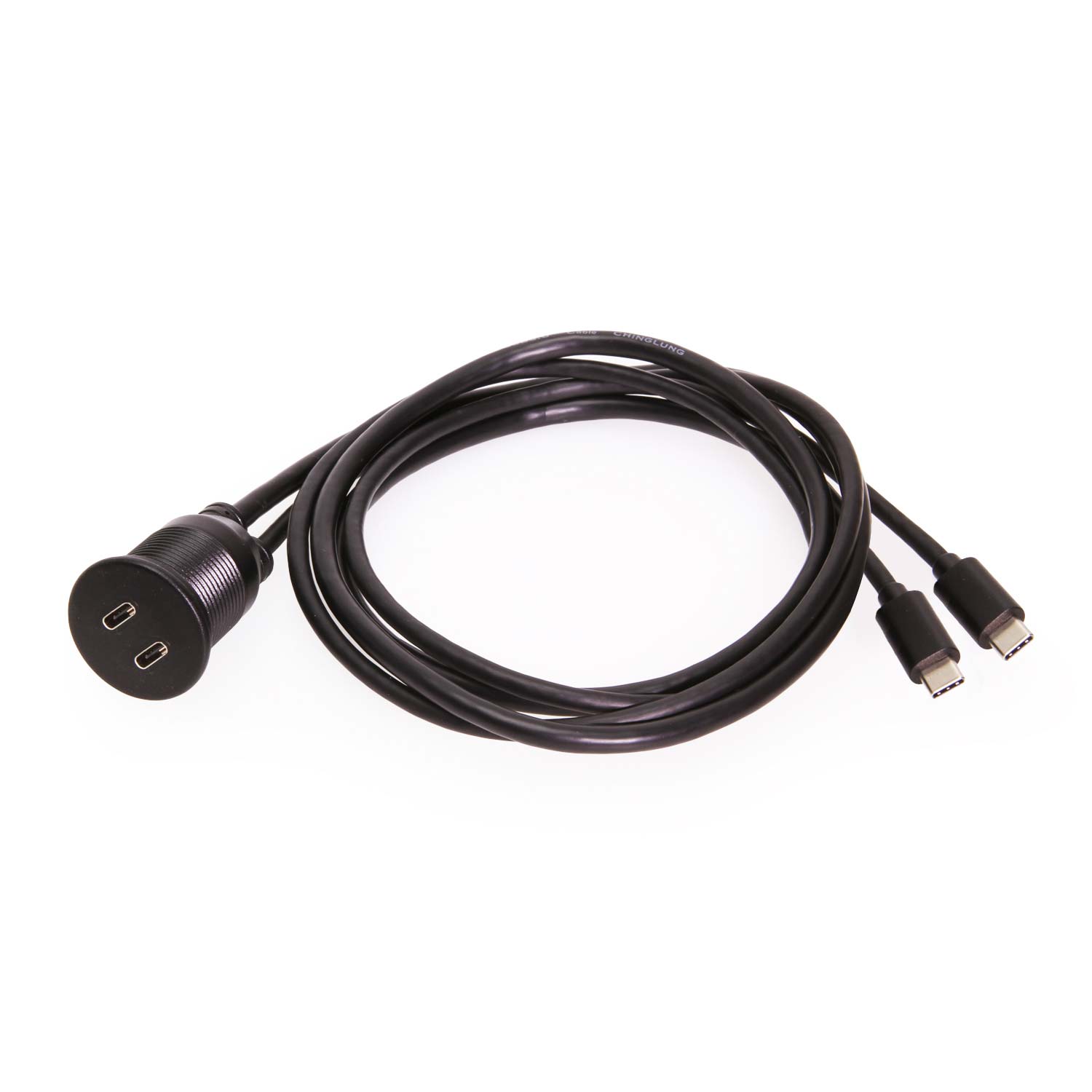
A dual port USB panel mount puts a Type-C port and a Type-A port behind one aperture, so the console is drilled once and sealed once. 100 W delivery on the Type-C side, 5 Gbps data on the Type-A side.
Last updated: 13 September 2026
Overview
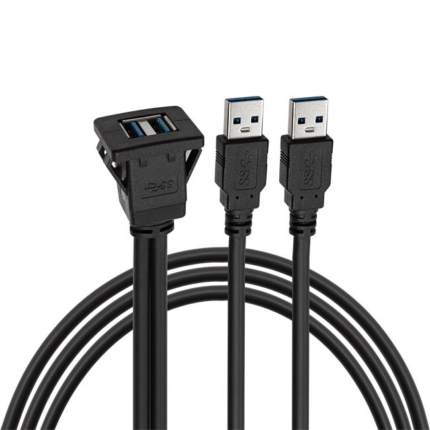
A dual port USB panel mount puts a Type-C port and a Type-A port behind one aperture. That matters on vehicle and vessel consoles, where panel space is scarce and a second hole means a second sealing joint to fail. Both ports share one flange, one gasket and one locknut, so the installer drills once and the console keeps its weather seal. On the inside, both ports leave as a single molded tail that goes to a charger module or to the equipment supply.
Putting high-power charging and 10 Gbps data in the same housing is convenient, and it brings two problems that a single-port part does not have: heat, and wiring.
Key Specifications
| Configuration | USB Type-C plus USB Type-A in one housing |
|---|---|
| Type-C port | USB 3.2, 10 Gbps, up to 100 W delivery (design target, pending supplier datasheet) |
| Type-A port | USB 3.0, 5 Gbps (design target, pending supplier datasheet) |
| Shielding | Braid plus foil screen, drain bonded to the shell |
| Conductor | Tinned copper (pending supplier confirmation) |
| Jacket | PVC or TPE depending on version (pending supplier confirmation) |
| Sealing | Panel gasket with threaded or clip-in fixing, IP67 (pending supplier test report) |
| Tail lengths | 0.5 / 1 / 2 m (pending supplier confirmation) |
| Options | Voltage display version and alternative bezel styles, subject to supplier range |
| Typical use | RV and campervan conversions, marine consoles, machine operator stations |
| Cut-out | One aperture for both ports – confirm against supplier drawing |
| Thermal note | Power delivery at the top of the range needs airflow behind the panel |
One aperture, two services: what you save and what you take on
| Two single-port apertures | One dual port housing | |
|---|---|---|
| Holes in the console | Two | One |
| Sealing joints | Two, each a leak path | One |
| Gasket and hardware | Two sets to buy and fit | One set |
| Panel space | Twice the footprint plus the land between | One footprint |
| Inside terminations | Two tails to dress and secure | One molded tail |
| Thermal | Each port has its own air | Both ports share a small volume of air |
| Failure mode | One port dies, the other keeps working | A housing fault takes out both |
The trade is real but it usually favors the dual housing on a console, because panel real estate and watertight joints are both scarcer than watts. On a machine operator station with room to spare, two separate ports are easier to replace.
100 W in a small housing: plan the heat and the wiring
Power delivery at the top of the range is a thermal question before it is an electrical one. Conversion losses in the charger module and resistance in the contacts both end up as heat inside a small sealed housing, and heat shortens the life of everything nearby.
| Plan for | Why it matters | What to do |
|---|---|---|
| Airflow behind the panel | A sealed console has nowhere for the heat to go | Leave a vent path, or derate the port |
| Charger module location | The module, not the port, makes most of the heat | Mount it away from the housing if the tail allows |
| Wire gauge on the supply | Voltage drop shows up as heat and as slow charging | Size the feed for the length, not for the connector |
| Fusing | A vehicle supply can deliver far more than the port can take | Fuse at the source, close to the tap |
| Simultaneous load | Two ports in use at once is the design case, not one | Size the supply for both ports loaded |
| Contact resistance | Rises with wear and with contamination | Specify the plating and keep the ports capped |
Power delivery is negotiated between the charger, the cable and the device, so a 100 W figure describes a system rather than a connector. A source that does not offer the profile will not deliver it regardless of what is fitted in the panel, and a 100 W port fed by an undersized supply will deliver whatever the supply can manage.
Shielding and the inside wiring
Both ports are braid and foil screened with the drain taken to the shell rather than left floating, which matters more here than on a slow charging port: 10 Gbps data and a high-current power path share the same housing, and the power path is the noisy neighbor. USB data rates are negotiated end to end, and a poorly bonded screen is a common cause of a link that drops to a lower rate instead of failing outright.
Getting the panel right
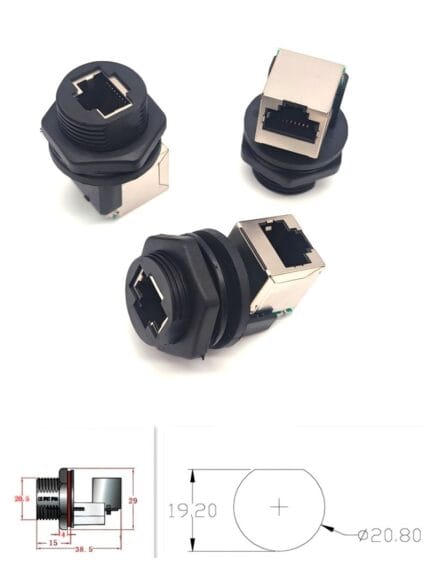
Cut-out diameter, panel thickness window and the fixing method are the three numbers to settle before the console is cut, and they are exactly the numbers competitor listings leave out. Comparable parts use either a threaded body with a locknut or a clip-in bezel. For any installation that vibrates, take the threaded version and torque the nut to the supplier figure by hand rather than with a driver. Seat the gasket flat on the panel face: a gasket twisted during assembly will leak even when the nut feels tight, and the leak usually only shows up at the next washdown.
Where this dual port USB panel mount gets installed
- Recreational vehicle and campervan conversions where panel space is limited
- Marine consoles and cabin panels
- Machine operator stations and control desks
- Construction and agricultural vehicle cab refits
- Service vehicle fit-outs that need charging and data at the same point
Options and what is not yet confirmed
Voltage display versions and different bezel styles are offered on comparable products, and we can supply those where the supplier range covers them. Data rate, power delivery, shielding construction, jacket material, tail lengths and the ingress rating for this range all come from published competitor data and are design targets until the supplier datasheet is on file, and each one carries a corresponding item on our confirmation list.
How to specify your build
- Cut-out and panel thickness off your console drawing.
- Fixing – threaded body with a locknut, or a clip-in bezel.
- Tail length and termination – what it plugs into inside the console.
- Power requirement – the profile you need to negotiate, and the supply behind it.
- Data requirement – 10 Gbps on the Type-C side, and whether both ports load at once.
- Cap and gasket for the environment the console lives in.
- Quantity, and whether this is a prototype or a production order.
Workmanship and testing
Assembly and inspection follow IPC/WHMA-A-620 Class 3 workmanship criteria under our ISO 9001 quality management system, and every unit passes 100% continuity and pinout testing before it is packed. Conductor range is 32 to 12 AWG. Where an ingress rating is specified we can quote seal checking on the production batch.
Custom builds and ordering
Small runs start at 5 pcs and leave in 3 working days. At production volume the minimum is 500 pcs and lead time is 14 working days after approval. New tooling is about 10 working days on top. OEM and ODM orders ship under your part number, with material certificates and first-article reports available.
Related dash and panel hardware
- Dual USB-A Twin Port Car Dashboard Flush Mount Extension Cable
- Dual-Port USB 3.0 Panel Flush-Mount Extension Cable (2x Type-A Female)
- USB 2.0 Single Port Car Dashboard Flush Mount Extension Cable
- Car Dashboard Flush Mount USB-A + 3.5 mm Audio Extension Cable with Bracket
- USB-C PD Charging Cable 240 W PD 3.1 EPR, Braided
- Waterproof USB-C Panel Pigtail, 10 Gbps with Dual Screw Lock
Full ranges: panel mount cable and automotive cable and wire harness.
Frequently Asked Questions
Can both ports be used at the same time?
Yes, and that should be the design case rather than the exception. Size the supply for both ports loaded and check the voltage drop over the length of the feed.
Does the Type-C port really deliver 100 W?
It can negotiate up to that figure if the source and the device both support the profile. It is a system figure, not a property of the receptacle, and the supply behind the panel decides the rest.
Threaded or clip-in fixing?
Threaded, on anything that vibrates. A clip-in bezel is quicker to fit and works loose over time; a locknut puts the load on the panel.
Is it sealed with nothing plugged in?
The rating for this class of part is quoted for the mated or capped condition. Fit the caps if the console is exposed to weather or washdown.
| Configuration | USB Type-C plus USB Type-A in one housing |
|---|---|
| Type-C port | USB 3.2, 10 Gbps, up to 100 W delivery class |
| Type-A port | USB 3.0, 5 Gbps class |
| Shielding | Braid plus foil screen, drain bonded to the shell |
| Conductor | Tinned copper |
| Jacket | PVC or TPE depending on version |
| Sealing | Panel gasket with threaded or clip-in fixing, IP67 class |
| Tail lengths | 0.5 / 1 / 2 m class |
| Options | Voltage display version and alternative bezel styles, subject to supplier range |
| Typical use | RV and campervan conversions, marine consoles, machine operator stations |
| Cut-out | One aperture for both ports – confirm against supplier drawing |
| Thermal note | Power delivery at the top of the range needs airflow behind the panel |
Related products