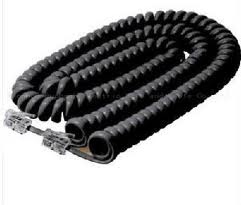
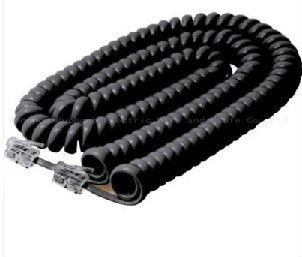
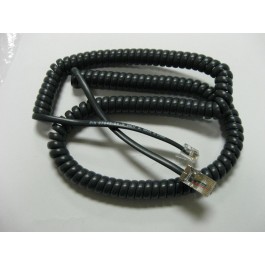
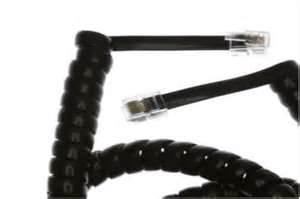
Coiled Telephone Handset Cable 4P4C / 6P6C
This coiled telephone handset cable is the curly cord between a telephone base and the handset, with overmolded 4P4C or 6P6C plugs and a 1:4 to 1:5 retractable coil. 26 AWG stranded tinned copper in a PVC jacket, straight-through or reversed pinout, for desk phones, POS and PBX.
Overview
A coiled telephone handset cable is the curly cord between the base and the handset, and it is still the part that wears out first on a desk phone. This one is four or six 26 AWG stranded tinned copper conductors in a PVC jacket, overmolded with a strain-relief boot at each plug and wound into a retractable coil with a 1:4 to 1:5 stretch ratio. Standard is 0.5 m relaxed to 3 m extended, in black, ivory or silver, wired straight-through by default with reverse or custom pin-outs on request.
Key Specifications
| Connector A | 4P4C or 6P6C plug, overmolded |
|---|---|
| Connector B | 4P4C or 6P6C plug, overmolded |
| Conductor | 26 AWG stranded tinned copper, 4 or 6 cores |
| Jacket | PVC, black, ivory or silver, 3 mm OD |
| Coil Stretch Ratio | 1:4 to 1:5 |
| Pin-out | Straight-through by default; reverse or custom on request |
| Length | 0.5 m coiled to 3 m extended; OEM on request |
| Build | Built and verified to your drawing and pinout |
4P4C or 6P6C on this coiled telephone handset cable
Both plugs are six-position modular shells; the difference is how many of those positions carry a contact. 4P4C has the middle four, 6P6C has all six, and a 4P4C plug will physically click into a 6P6C jack – which is convenient and also how the wrong cord ends up in service. Handset cords are usually 4P4C. Line cords and some data or system leads are 6P6C or 6P4C. If the equipment is a PBX key system or a POS terminal rather than a plain desk phone, count the contacts in the jack before you order rather than assuming.
| Plug | Positions populated | Where you meet it | Note |
|---|---|---|---|
| 4P4C | Middle 4 of 6 | Telephone handset cords | The usual handset cord |
| 6P4C | Middle 4 of 6 | Nurse call jacks, some system cords | Fits a 6-position jack |
| 6P6C | All 6 | Line cords, PBX and data leads | Physically accepts 4P4C |
What the stretch ratio decides
Two things: how far you can carry the handset, and how much cord is lying on the desk when it is not in use. A 1:4 coil is tidier and lives longer because it is worked less; a 1:5 coil gives reach for the same relaxed length. The failure that ends these cords is being stretched past their extended length repeatedly – the coil goes straight, takes a permanent set, and then hangs slack instead of retracting. If your users carry the handset across the desk all day, buy the longer extended length rather than asking a short coil to do a long job.
Straight-through or reversed: the pin-out question
Default is straight-through – pin 1 to pin 1, pin 2 to pin 2 and so on – which is what the overwhelming majority of desk phones want. Some PBX key systems and some POS terminals expect a reversed cord, and a reversed cord in a straight-through application usually shows up as a handset with no dial tone or with transmit and receive swapped, which is confusing because the cord is electrically perfect. If you are replacing a cord on equipment you know works, the safest move is to send us the old one and let us read it rather than reasoning about standards.
Where these cords live now
Not only on desks. A coiled handset cord is the standard lead on a POS terminal at a checkout, on a PBX key system at a reception desk, and on a surprising amount of industrial and test equipment that borrowed a modular jack because it was cheap and available. That is worth knowing when you are specifying a replacement, because the environment is harsher than an office: a checkout cord sees constant handling, cleaning fluid and occasionally a shopping trolley, and a 26 AWG conductor will not tolerate being pinched in a drawer slide indefinitely. Tell us where the cord lives and we will pick the jacket and the strain relief accordingly.
Why the coil stops retracting
PVC takes a set. Hold a coil extended for long enough – over a weekend, on a handset left off-hook – and the jacket remembers that shape and stops pulling back. Storing the handset properly is the free fix; specifying a compound with better recovery is the paid one. The other cause is simpler: the coil has been pulled straight one time too many and the conductors inside have work-hardened at the same point. There is no repair for either, but a coil that is correctly specified for the reach needed will last the life of the phone.
Typical applications for this coiled telephone handset cable
- Standard desk telephone curly cord between base and handset
- Replacement cord for a 4P4C or 6P6C telephone handset
- POS terminal handset cable on NCR and IBM RealPOS equipment
- PBX key system handset and line cords
- Custom coiled cords for industrial and office equipment with a modular jack
How to specify your build
- Plug type – 4P4C or 6P6C – at each end.
- Conductor count – four or six.
- Pin-out – straight-through, reversed or your diagram.
- Relaxed and extended length, and the ratio.
- Jacket color – black, ivory or silver.
- Quantity, and whether this is a sample or a production order.
Workmanship and testing
Workmanship on Coiled Telephone Handset Cable builds follows IPC/WHMA-A-620 Class 3, the line is run under ISO 9001, and the termination range is 32 to 12 AWG. continuity and pinout are verified on each Coiled assembly before packing, and seal checking is quoted whenever an ingress rating is on the drawing.
RoHS and REACH declarations are provided per project together with the agreed test reports; the documentation scope is listed under certifications and compliance. If your drawing specifies a UL style, we build to that drawing and supply the UL reference with the shipment instead of substituting an equivalent. Injection parameters for this part are developed against the jacket material using the approach documented under overmold materials and injection parameters. The wider context is covered under what instrument builds require. Any tooling we cut for this part stays yours, maintained in our own tool room under your part reference.
Custom builds and ordering
Quote Coiled Telephone Handset Cable builds from 1 to 50 pcs and they ship in 3 working days. At volume the minimum is 500 pcs with 14 working days after approval. Tooling not already held adds around 10 working days. Your part number and labeling go on Coiled shipments, and material certificates and first-article reports come with them on request.
Related coiled and data assemblies
- Coiled Retractable Cable for Instruments and Test Leads
- SJOW Coiled Power Cord 18-3 / 16-3
- Barcode Scanner Cable with Coiled Cord, DB9 to Scanner
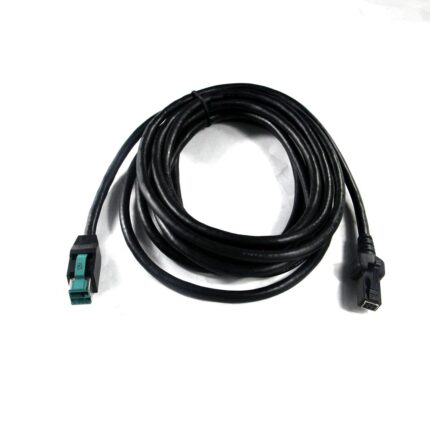
- NCR RealPOS 25 Powered USB Cable
- Cat5e UTP Short-Body Patch Cord for VoIP
- Custom Shielded Ethernet Data Cable
- UL1331 FEP Teflon Hook-Up Wire, 600 V / 150 °C
Full range: signal and data cable assemblies.
Frequently Asked Questions
Which plug do I need, 4P4C or 6P6C?
Count the contacts in the jack. Handset cords are usually 4P4C; line cords and some system leads are 6P6C. A 4P4C plug fits a 6-position jack, so look rather than assume.
Can I get a reversed pin-out?
Yes. Default is straight-through; reversed or custom pin-outs are built to your diagram.
Why has my old coil stopped retracting?
PVC takes a set when held extended. Staying inside the stated extended length and hanging the handset properly both extend the life considerably.
Do you make these for POS terminals?
Yes. POS and PBX handset cords are a common build – tell us the equipment and we will match the plug and pin-out.
| Connector A | 4P4C or 6P6C plug, overmolded |
|---|---|
| Connector B | 4P4C or 6P6C plug, overmolded |
| Conductor | 26 AWG stranded tinned copper |
| Jacket | PVC, black, ivory or silver, 3 mm OD |
| Coil Stretch Ratio | 1:4 to 1:5 |
| Length | 0.5 m coiled to 3 m extended; OEM on request |