Custom Shielded Ethernet Data Cable
A custom shielded Ethernet data cable built to the shield construction, connector, jacket and length your run needs — F/UTP or S/FTP, terminated to your earthing scheme rather than ours.
Overview
Most shielded Ethernet problems are not cable problems, they are termination problems. A custom shielded Ethernet data cable can leave the factory with a perfectly good braid and still behave like an unshielded one if that braid ends in a few centimeters of loose drain wire, or if it is grounded at one end while the equipment grounds it at the other. Shield construction, connector shell and termination method are one decision, not three. We build all three to what your drawing says, and we check the shield path on every unit before it is packed.
What we build
Four things on this assembly are genuinely configurable, and they are the four we ask about first.
| Choice | What it changes | What we see specified |
|---|---|---|
| Shield construction | How much noise stays out, and how stiff the cable becomes | F/UTP for general runs; S/FTP where drives or welders share the tray |
| Conductor and pair layout | Loss over length, flexibility and minimum bend radius | Stranded conductors for patch and moving runs, solid for fixed installation |
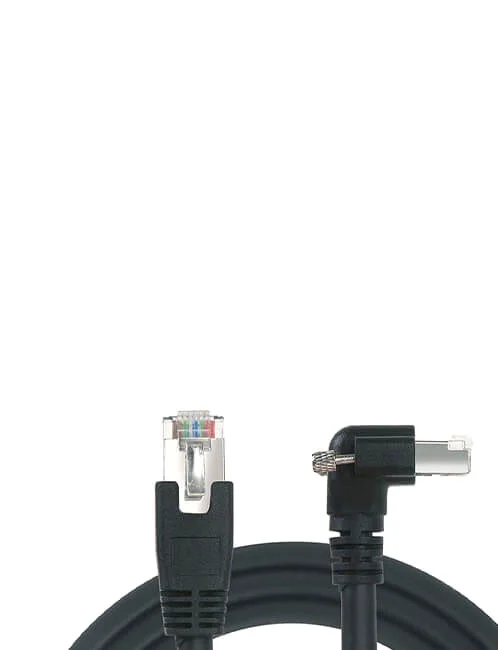
| Connector and shell | Whether the shield stays continuous through the joint | Metal-shell RJ45, M12 D- or X-code, ix Industrial, or stripped leads |
| Jacket compound | Oil, coolant, sunlight and flex life | PUR for drag chains and cutting fluid, PVC for cabinet runs, LSZH for public spaces |
Shield construction: what the letters mean
The F/UTP and S/FTP style of naming is the industry convention used in structured cabling specifications: the letter before the slash describes an overall screen around all four pairs, the letter after it describes screening on each pair individually. U is unscreened, F is a foil screen, S is a braided screen. This is an industry-standard naming convention and not a performance figure, and your assembly is built and verified to the values stated on your drawing.
| Construction | Structure | Where it gets used |
|---|---|---|
| U/UTP | No screen at all | Cabinet and office runs with no noise source nearby |
| F/UTP | Overall foil with a drain wire | General industrial Ethernet, PROFINET and EtherNet/IP drops |
| SF/UTP | Overall braid over an overall foil | Where the screen also has to survive flexing and carry fault current |
| S/FTP | Overall braid with foil on each pair | Cat6A and Cat7 links running next to motor drives and welders |
| F/FTP | Overall foil with foil on each pair | Fixed runs with a tight bend radius and a high pair count |
The construction classes and channel definitions are described in the ISO/IEC 11801 cabling standards. What matters for a build is simpler: the more screen you add, the stiffer the cable gets and the harder the strain relief has to work.
Where shielded builds go wrong
These are the five faults we are asked to correct most often. None of them is a defect in the cable itself.
1. The drain wire pigtail
Twisting the drain wire into a short lead and landing it on a pin undoes the screen at exactly the frequencies it is there for. Every millimeter of untwisted wire adds inductance in series with the path to ground. The termination that works clamps braid or foil to the connector shell through a full 360 degrees, so the screen becomes one continuous tube from plug to plug. If your drawing shows a pigtail we will build it, but we will raise it with you first.
2. A plastic connector in the middle of a shielded run
A standard plastic RJ45 plug interrupts the screen. Each half may be grounded, but the two halves are not connected to each other. Use a metal-shell plug on screened cable and mate it into a screened coupler or a screened panel feedthrough, or you have paid for a shield you do not actually have.
3. Grounding one end, both ends, or neither
There is no single right answer. Grounding both ends gives the screen the low-impedance path it needs at high frequency; grounding one end only avoids circulating current when the two devices sit at different earth potentials. What matters is that the drawing says which, and that every cable in the run is built the same way.
4. Using the screen as a conductor
The shield is not a signal return and it is not a power path. Where a run carries power as well as data, the power cores go inside the screen as their own conductors.
5. Fatigue where the cable flexes
Braid work-hardens. A screen clamped hard where the cable also bends will crack after enough cycles, and it fails intermittently long before it fails outright. The strain relief has to grip the jacket, not the screen, and the braid has to be terminated behind the flex point.
What we need from you
- Shield construction — U/UTP, F/UTP, SF/UTP, S/FTP or F/FTP, and whether individual pairs are screened.
- Connector at each end — RJ45 in plastic or metal shell, M12 D-code or X-code, ix Industrial, or stripped leads.
- Shield termination — 360-degree shell clamp, drain wire, or one end floating. This is the item people forget, and it is the one that changes the tooling.
- Construction and conductor — the category you need, stranded or solid, and the conductor size.
- Jacket — PVC, PUR, TPE or LSZH, and what it has to survive: cutting oil, coolant, sunlight, weld spatter, continuous flexing.
- Length and routing, including whether the run is fixed, in a carrier, or on a moving axis.
- Pinout — T568A, T568B, or your own. We wire to what you send.
- Quantity, and whether this is a prototype or a production release.
A drawing is ideal; a photograph of the existing cable and the device part number is usually enough for us to quote a build.
How the build runs
- Drawing and pinout review — we check the screen path end to end and flag anything that will not work as drawn.
- Material and tooling confirmation — shells, cable construction and mold tooling are booked against your part number.
- Prototype build — from 1 to 50 pcs, shipped in 3 working days.
- First article and approval — you fit it, test it, and come back with changes.
- Production — 14 working days from approval, on four assembly lines at our factory in Longgang, Shenzhen.
Tooling and lead time
We hold around 100 sets of mold tooling in house, so the common connector bodies and strain reliefs cost no tooling time at all, and a new overmold body adds about 10 working days. Prototypes start from 1 to 50 pcs and ship in 3 working days. Production orders start at MOQ 500 pcs and ship 14 working days after approval. Output of roughly one million pieces a year across four lines is what lets us hold those lead times on repeat orders. Factory audits and video line tours can be arranged.
Inspection and testing
Assembly and inspection follow IPC/WHMA-A-620 Class 3 workmanship criteria under our ISO 9001 quality management system, and every unit passes 100% continuity and pinout testing before it is packed. On screened builds we can also verify shield continuity from connector shell to connector shell, which is the test that catches every fault listed above. Conductor range is 32 to 12 AWG. Pull testing, seal testing and first-article reports are quoted per order. Category and frequency figures are the industry-standard values for that construction; your assembly is built and verified to the values stated on your drawing.
Typical applications for this custom shielded Ethernet data cable
- PROFINET, EtherNet/IP and EtherCAT drops inside a machine, where the data run shares a tray with motor power
- Machine vision and GigE camera links — see our Cat6A RJ45 screw-lock GigE Vision cable for the locking variant
- Cabinet-to-cabinet links through a sealed wall, using our IP67 RJ45 panel coupler
- M12 X-code to RJ45 runs on robot cells and AGVs — M12 X-code Cat6A to RJ45 cable
- Drag chain and continuous-flex runs — Cat6A PUR high-flex patch cord
- Outdoor and washdown enclosures where the port has to seal when mated — IP68 industrial data cable
Related shielded assemblies
- Cat6A shielded patch cord, S/FTP 26 AWG
- Cat6 S/FTP shielded RJ45 patch cord
- Cat6A M12 X-coded patch cord, 8-pin M12 to RJ45
- M12 D-code PROFINET industrial Ethernet cable
- IP67 RJ45 waterproof shielded patch cable
- Cat6A IP67 industrial pigtail with dust cap
- Rugged RJ45 IP68 military Ethernet cable
Full ranges: Ethernet cable and patch cords and signal and data cables.
Material declarations against RoHS and REACH are issued per project, alongside the dimensional and electrical reports agreed at quotation; see certifications, compliance and material declarations. Where your drawing names a UL style or another approval, the build follows your drawing and ships with the supporting document rather than a claim of our own. Overmold tooling for this part is designed and cut in our own tool room under overmold tooling cut in our own tool room, so the tool belongs to your program and a revision is a machining job rather than a new negotiation. More background: cable assemblies for test and measurement.
Frequently Asked Questions
Do I actually need a shielded build?
If the run passes close to a motor drive, a welder or a servo power cable, yes. If it is a short patch inside one cabinet with no noise source, unscreened is cheaper and easier to terminate well.
Can you ground the shield at one end only?
Yes. Mark it on the drawing. We terminate the screen at the end you nominate, insulate it at the other, and note it on the build sheet so repeat orders come out the same way.
Can you put M12 X-code on one end and RJ45 on the other?
Yes, and it is one of the more common builds. The screen is carried through the metal M12 shell and the metal RJ45 shell so both halves stay connected.
Will a shielded cable work in unshielded hardware?
It will pass traffic, but the screen does nothing until something connects it to ground. Many assemblies sent back as not shielded enough are plugged into plastic ports.
What is the minimum order?
For Custom Shielded Ethernet Data builds, prototypes run from 1 to 50 pcs with a 3 working day turnaround; volume orders begin at 500 pcs and ship 14 working days after approval. Tooling not already held adds around 10 working days.
| Shield construction | U/UTP, F/UTP, SF/UTP, S/FTP or F/FTP — to order |
|---|---|
| Cable construction | Cat5e, Cat6, Cat6A or Cat7 structure per your drawing |
| Connector ends | RJ45 plastic or metal shell, M12 D-code or X-code, ix Industrial, flying leads |
| Shield termination | 360-degree shell clamp, drain wire, or one end floating — per drawing |
| Jacket material | PVC standard; PUR for oil and flexing; TPE or LSZH on request |
| Conductor range | 32 to 12 AWG, stranded or solid |
| Length | OEM build to order |
| Workmanship | IPC/WHMA-A-620 Class 3 under ISO 9001 |
| Testing | 100% continuity and pinout; shield continuity check on request |
Related products
KUKA Robot Encoder Cable Compatible with 00-174-775
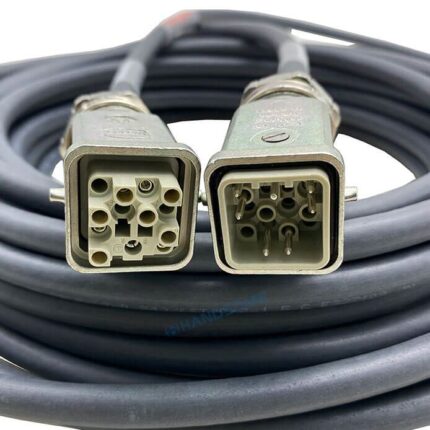
This kuka encoder 174775 cable is wired to the KUKA pin assignment for part 00-174-775, running encoder power and the data pair from the robot axis back to the controller. Six cores plus one pair under foil and braid, in a matte black PUR drag-chain jacket. A compatible replacement, not an OEM part.