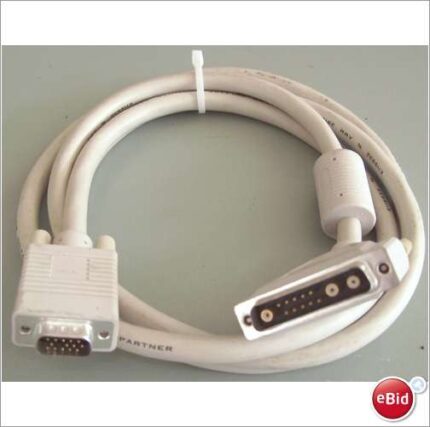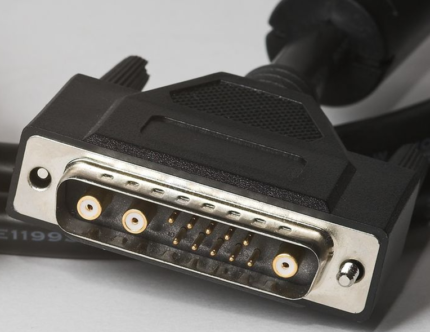
LFH60 to DB37 RS-449 / V.35 DCE Serial Cable
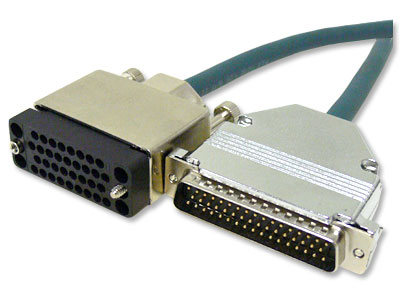
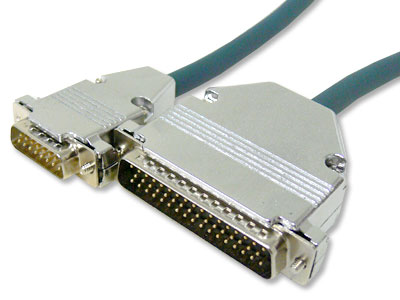
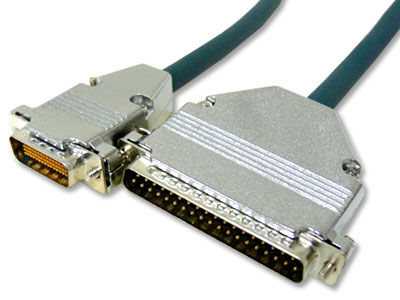
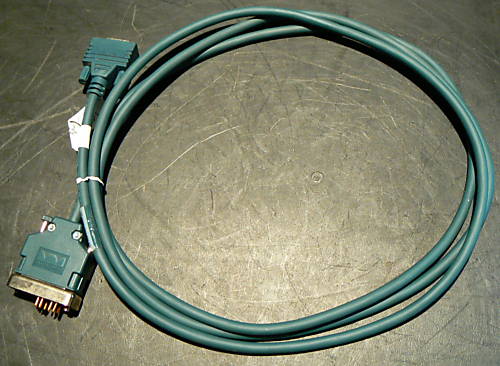
This lfh60 db37 cable breaks a 60-pin Low Force Helix concentrator port out to DB37 RS-449 or M/34 V.35, wired DCE as standard or DTE on request. Thirty 28 AWG twisted pairs under foil and braid, metal hoods with jackscrews, built to your pinout and length.
Overview
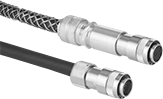
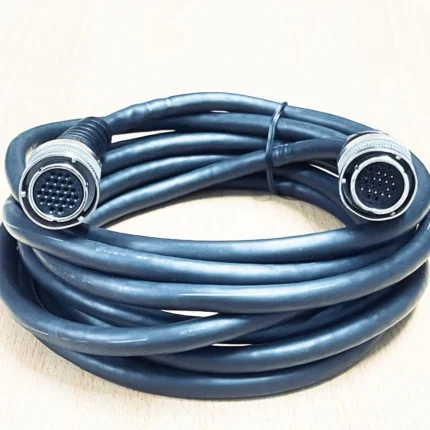
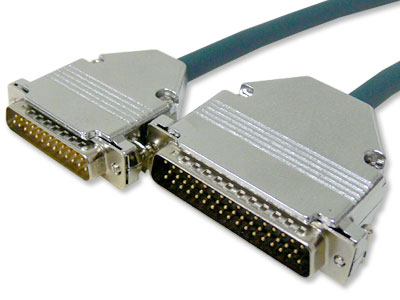
An lfh60 db37 cable is the serial breakout lead that gets an old concentrator card back on the network. The LFH60 – Low Force Helix – is the 60-pin half-pitch D-Sub shell used on Cisco, Sun and other serial concentrator WIC and HWIC cards; the DB37 side is the standard RS-449 connector, and the V.35 variant breaks the same signals out to the M/34 V.35 connector. Ours is thirty twisted pairs of 28 AWG stranded tinned copper under an overall foil plus braid shield with drain wire, in a PVC jacket, with metal hoods and jackscrews at the LFH60 end and thumbscrews at the far end.
Key Specifications
| Connector A | LFH60 male, metal hood with jackscrews |
|---|---|
| Connector B | DB37 male or female (RS-449) or M/34 male (V.35) |
| Pin-out | DCE per RS-449 / V.35 standard; DTE on request |
| Conductor | 28 AWG stranded tinned copper, 30 twisted pairs |
| Shielding | Overall foil + braid, drain wire |
| Jacket | PVC, black or beige, 8 mm to 10 mm OD |
| Length | 1 m to 10 m standard; OEM on request |
| Build | Pin-out verified to your drawing |
DCE or DTE on this lfh60 db37 cable
The default build is DCE, because that is what a concentrator card port expects to see on the other end of a leased-line connection. If you are patching two DCE ports together, or building a test fixture where the cable has to behave like a modem, ask for the DTE version and we will cross the appropriate pairs. Getting this wrong does not damage anything – the link simply never comes up, which is confusing because the cable looks perfect and tests continuous. Tell us what is at each end and we will confirm the wiring before cutting anything.
| Build | Use it when | Notes |
|---|---|---|
| DCE (default) | Concentrator card to a DTE device or a leased-line presentation | The standard RS-449 / V.35 breakout |
| DTE | Two DCE ports patched together, or a modem-simulating test fixture | Transmit and receive pairs crossed |
| Custom | Your own diagram, or an undocumented legacy panel | We verify pinout against your drawing 100% |
RS-449 or V.35: two breakouts, one shell
Both are serial interface standards from the same era, and both turn up on the same hardware. RS-449 defines the electrical and mechanical characteristics and uses a DB37 connector; V.35 defines the electrical interface for a 34-position connector and is the one you find on leased-line and data-circuit equipment. The signals overlap, which is why one LFH60 port can be broken out either way. What decides it is purely what is at the far end – look at the port, not at the old cable, because the old cable may have been part of an adapter stack that hid an intermediate connector.
| Far end | Connector | Where it is used | Confirm before ordering |
|---|---|---|---|
| RS-449 | DB37 male or female | Legacy leased-line and data circuit equipment | Gender of the port on the device |
| V.35 | M/34 male | Older serial concentrator cards and modems | That the port is V.35 and not a look-alike |
| Both | DB37 and M/34 | Test benches that see everything | Pin-out per port |
Thirty pairs: why the assembly is bigger than it looks
Sixty positions at half pitch means thirty pairs, and thirty pairs of 28 AWG is a substantial bundle – which is why the jacket is 8 mm to 10 mm OD and why the hood at the LFH60 end is not optional. The jackscrews matter too: they are what holds the connector into the card against the weight of that bundle, and a cable without them will slowly lever itself out of a vertical card. If the run is longer than a few meters, tell us – at 28 AWG the resistance per conductor becomes part of the link budget, and on a long run we may suggest a larger conductor or a shorter cable.
What to send us with the order
These are legacy links, documentation is often missing, and the fastest route is usually a photograph. Three things settle almost every order: the card or port at the LFH60 end, the connector at the far end, and whether the link ever worked with a cable you can send us.
| What to send | Why it matters | If you do not have it |
|---|---|---|
| Card or port model at the LFH60 end | Confirms the pin-out family | Photograph the port with something for scale |
| Far-end connector and gender | Decides DB37 or M/34, male or female | Photograph the device port |
| DCE or DTE | Decides whether pairs are crossed | Tell us what is at each end and we will work it out |
| Length | 28 AWG is thin; long runs need thought | Measure along the route, not the straight line |
Typical applications for this lfh60 db37 cable
- Cisco, Sun and other serial concentrator WIC / HWIC cards to RS-449
- V.35 leased-line connections on serial concentrator cards
- DCE patch cables for serial test fixtures
- Custom serial patch cables for broadcast and industrial control
- Keeping a legacy serial installation running through a migration
How to specify your build
- Far end – DB37 RS-449 or M/34 V.35, and the gender.
- DCE or DTE, or the equipment at each end.
- Pin-out – standard, or your diagram.
- Length, measured along the route.
- Hood style and jacket color.
- Quantity, and whether this is a sample or a production order.
Workmanship and testing
LFH60 builds are made to IPC/WHMA-A-620 Class 3 workmanship inside an ISO 9001 system, over a 32 to 12 AWG range. No LFH60 assembly is boxed before continuity and pinout are confirmed, and seal checking is quoted whenever an ingress rating is on the drawing.
RoHS and REACH declarations are provided per project together with the agreed test reports; the documentation scope is listed under certifications and compliance. If your drawing specifies a UL style, we build to that drawing and supply the UL reference with the shipment instead of substituting an equivalent. Injection parameters for this part are developed against the jacket material using the approach documented under overmolding and injection molding. More background: cable assemblies for test and measurement. Any tooling we cut for this part stays yours, maintained in our own tool room under your part reference.
Custom builds and ordering
For LFH60 builds, prototypes run from 1 to 50 pcs with a 3 working day turnaround; volume orders begin at 500 pcs and ship 14 working days after approval. Tooling not already held adds around 10 working days. LFH60 builds go out under your part number and labeling, and material certificates and first-article reports are available on request.
Related D-Sub and serial assemblies
- DB50 to DB25 DTE Serial Cable
- 2V2 / 3W3 / 5W5 Mixed-Contact D-Sub Cable
- SCSI Cable Assembly, HD68 to HD68
- DB9 to RJ45 Serial / Console Cable
- 13W3 to VGA (HD15) Mixed-Contact D-Sub Cable
- Custom Shielded Ethernet Data Cable
Full range: signal and data cable assemblies.
Frequently Asked Questions
Is the default wiring DCE or DTE?
DCE, per the RS-449 and V.35 conventions. The DTE version is available on request and crosses the transmit and receive pairs.
Will this fit my Cisco WIC card?
If the card has an LFH60 port, yes. Send the card model and we will confirm the pin-out family before building.
Can you build from a sample cable?
Yes, and on legacy hardware it is often the fastest route. We will read the sample, document the pinout and build to that.
How long can the run be?
1 m to 10 m as standard. Beyond that, tell us the length and we will confirm whether 28 AWG still suits the link.
| Connector A | LFH60 male, metal hood with jackscrews |
|---|---|
| Connector B | DB37 male or female (RS-449) or M/34 male (V.35) |
| Pin-out | DCE per RS-449 / V.35 standard; DTE on request |
| Conductor | 28 AWG stranded tinned copper |
| Jacket | PVC, black or beige, 8 mm to 10 mm OD |
| Length | 1 m to 10 m standard; OEM on request |