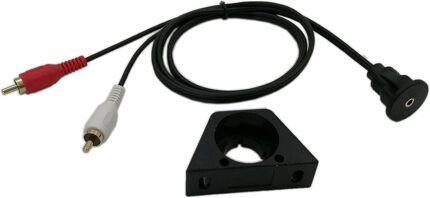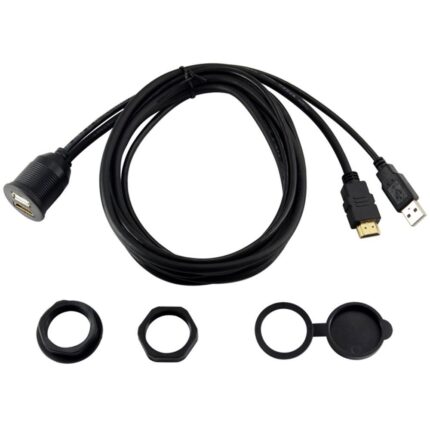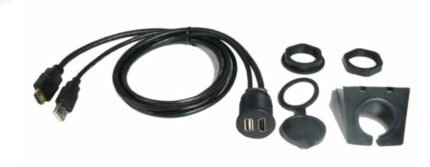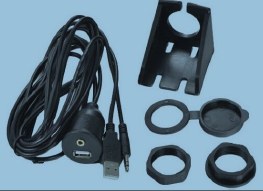
Control Cabinet Service Interface with RJ45 and USB-C Front Plate
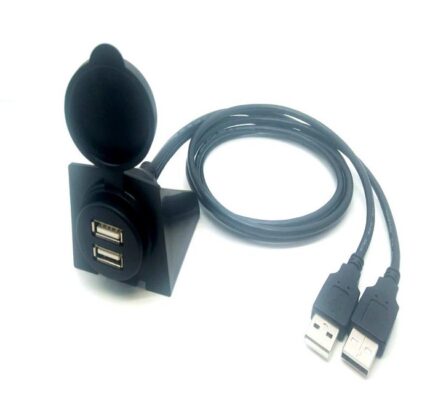
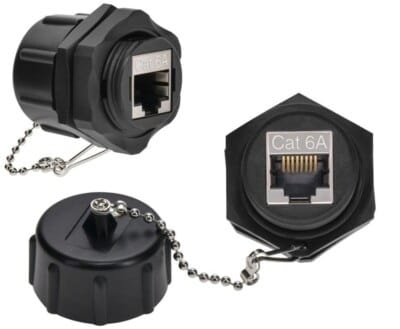
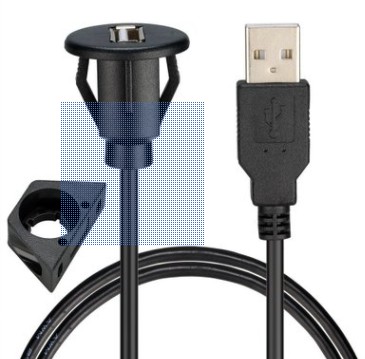
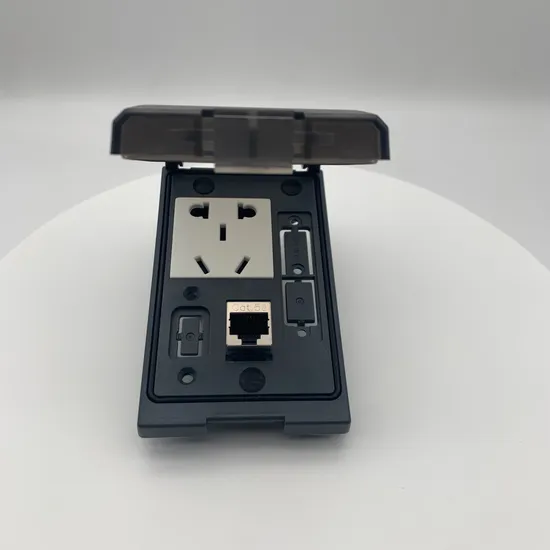
A control cabinet service interface that gives maintenance staff a labeled Cat6A RJ45 and USB 3.2 Type-C port on the cabinet door, so a live enclosure stays shut during commissioning and service. IP65 front face, IP20 rear, clip or screw fixing, hinged dust cover and label window options.
Last updated: 13 September 2026
Overview
A control cabinet service interface gives maintenance staff a defined, labeled place
to plug in a laptop without opening a live enclosure. On machine cabinets, battery energy storage
containers and inverter housings, that single detail removes the usual workaround of leaving a door
unsealed or a gland loose during commissioning, and it keeps the enclosure rating intact between service
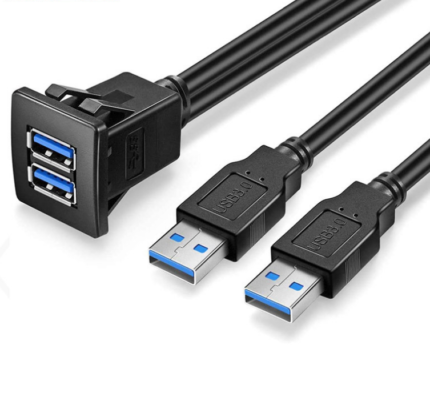
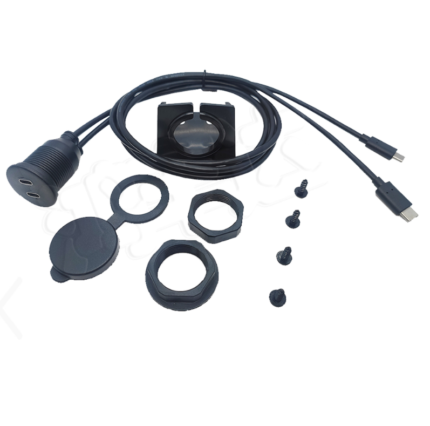
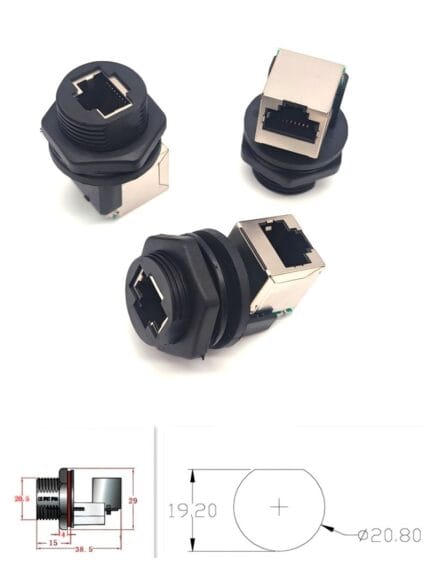
visits. This build puts a Cat6A RJ45 feedthrough and a USB 3.2 Type-C feedthrough on one gasketed front
plate, with the rear of the assembly left inside the cabinet.
Key Specifications
| Front interfaces | Cat6A RJ45 feedthrough plus USB 3.2 Type-C feedthrough |
|---|---|
| Port count | One-port or two-port plate |
| Ingress rating | IP65 front face / IP20 rear — design target, pending test |
| Fixing style | Tool-free clip fixing or screw fixing |
| Options | Hinged dust cover, label window |
| Panel cut-out | Design target — confirm against the drawing before cutting |
| Tails | Internal pigtail, terminated to your connector set or left blunt |
| Applications | Control cabinets, machines, energy storage cabinets, inverter enclosures |
What kills this assembly
A service port spends most of its life doing nothing and then gets used hard for ten minutes. That
duty cycle shapes the failure modes, and each one has an answer at the specification stage.
| Stress | What happens | Design answer |
|---|---|---|
| Door open and shut, several times a day | The internal tail flexes at the panel exit and work-hardens until it breaks | Enough slack for the full swing, dressed away from the hinge, with a bend relief at the body |
| Dust and swarf in the workshop | Contacts packed with debris; the port is dead the one day it is needed | Hinged dust cover, and a cap that is actually tethered |
| Washdown or weather on outdoor cabinets | Water tracks past the gasket into the cabinet | Even gasket compression on a flat land; confirm the rating by test before it goes on a customer drawing |
| Repeated service plugging | Receptacle wears, retention weakens, the plug falls out mid-update | Specify a mating cycle target; quote a retained receptacle where the plug must stay in |
| Careless plugging in the dark | Bent pins, cracked housing, a port that is dead next visit | Label window, and a cover that makes the port obvious |
Door hinge bending: the detail that decides service life
The port is usually on the door and the tail is fixed to the cabinet body, which makes the cable a
hinge with copper inside it. Three things keep that from becoming a fatigue failure.
- Leave enough slack for the full swing, measured with the door at its widest, plus a margin. A tail that is taut at full open will not last a year.
- Dress the tail away from the hinge side so it bends in one plane rather than twisting as the door closes.
- Support it at both ends. A cleat on the door skin and a tie on the cabinet frame stop the weight of the tail hanging off the receptacle.
Where the door is opened daily rather than yearly, tell us at the enquiry stage and we will quote a
high-flex jacket and a bend relief that starts at the body instead of down the cable.
Keeping the port clean between service visits
A service port that sits idle for months collects whatever the workshop makes. The hinged dust cover
is the cheap answer and it is worth specifying: it keeps dust, swarf and washdown water off the mating
faces, and it is obvious at a glance whether the port has been left open. Where the cabinet is hosed
down or sits outdoors, check the whole assembly rather than the front face alone — the plate gasket
decides whether the cabinet keeps its own rating, and a door skin with a stiffening rib behind the
mounting point will not seal no matter how good the gasket is.
Front IP65, rear IP20
The gasketed front face is rated to IP65 as a design target, while the rear of the assembly is IP20
and is meant to live inside the cabinet. Ingress ratings are defined in IEC 60529 as an industry-wide classification — the first digit covers
solid ingress, the second covers liquid — and a rating applies to the assembly as tested, not to the
component in isolation. Confirm the figure by test before it is
written onto a customer drawing; the rating your assembly is built and verified to is the one stated on
your drawing.
Mating cycle life
A service port does not get plugged in as often as a desk port, but it gets plugged in by someone who
is in a hurry, in poor light, often on a ladder. Two things are worth specifying. First, the mating cycle
target — how many insertions the receptacle has to survive, stated on the drawing so the right contact
is quoted. Second, retention: where a firmware update takes twenty minutes and the technician has to let
go of the plug, ask about a retained or screw-locking receptacle rather than relying on friction.
Mounting and panel preparation
Two fixing styles are offered: a tool-free clip fixing for thin sheet doors and a screw fixing for
thicker plate or for panels subject to vibration. Whichever is used, the preparation is the same and it
is where most sealing problems start.
- Cut the aperture from the finished panel drawing, not from a listing figure. Cut-outs are a design target until confirmed.
- Deburr both faces so the gasket sits on a flat land rather than on a raised edge.
- Check for ribs and stiffeners behind the mounting point before you cut.
- Tighten evenly in a cross pattern, so the gasket compresses uniformly.
- Fit the label before the cabinet is closed, while there is still room to work.
Typical builds for this control cabinet service interface
- A single RJ45 on a PLC cabinet door, wired to the service network
- An RJ45 plus Type-C pair on a battery rack service panel, next to our energy storage cabinet wiring harness
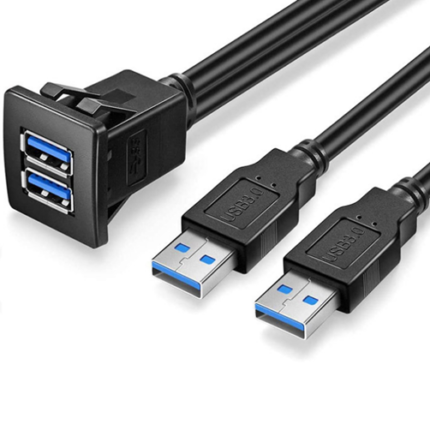
- A two-port plate on an inverter enclosure where commissioning and long-term monitoring are handled by different teams
- A sealed variant on outdoor plant, using an IP67 RJ45 panel coupler where the front face sees weather
- A keystone version for field-replaceable modules, with our IP67 keystone panel frame
Tails can be terminated to your connector set or left blunt for field termination; state which in the
enquiry so we quote the right assembly.
Workmanship and ordering
Workmanship follows IPC/WHMA-A-620 Class 3 and the line runs under ISO 9001. Conductors from 32 to 12 AWG are in range. Continuity and pinout are verified on 100% of units before packing; if you specify an ingress rating, seal checking on the batch can be quoted.
Related panel components
- IP67 RJ45 Panel Coupler, Cat6A Shielded Bulkhead Feedthrough
- IP67 Keystone Panel Frame for Field-Replaceable RJ45 Modules
- Cat6 RJ45 Panel-Mount Extension Cable with Thread-Locking
- Dual Port USB Panel Mount with USB-C 100 W and USB 3.0 A
- HDMI 8K Panel Coupler with Screw Lock for Cabinet Feedthrough
Full range: Panel Mount Cable.
Frequently Asked Questions
Is the IP65 front rating confirmed by test?
It is a design target pending test. Confirm it before the figure goes onto a customer drawing, and note that the cabinet keeps its own rating only if the gasket compresses evenly on a flat panel.
Can I mount it on a door that opens every day?
Yes, with the right preparation: enough slack for the full swing, the tail dressed away from the hinge, and a high-flex jacket if the duty is heavy.
Clip fixing or screw fixing?
Clip for thin sheet doors where speed matters. Screw for thick plate, or anywhere the cabinet vibrates.
Can the tails come terminated?
Yes — to your connector set, or left blunt for field termination. State which so we quote the right assembly.
What is the minimum order?
Minimum for a prototype run is 5 pcs, out the door in 3 working days. Volume production starts at 500 pcs and ships 14 working days after you approve the sample.
| Front interfaces | Cat6A RJ45 feedthrough plus USB 3.2 Type-C feedthrough |
|---|---|
| Port count | One-port or two-port plate |
| Ingress rating | IP65 front face / IP20 rear class |
| Fixing style | Tool-free clip fixing or screw fixing |
| Options | Hinged dust cover, label window |
| Panel cut-out | Design target – confirm against the drawing before cutting |
| Applications | Control cabinets, machines, energy storage cabinets, inverter enclosures |
| Tails | Internal pigtail, terminated to your connector set or left blunt |