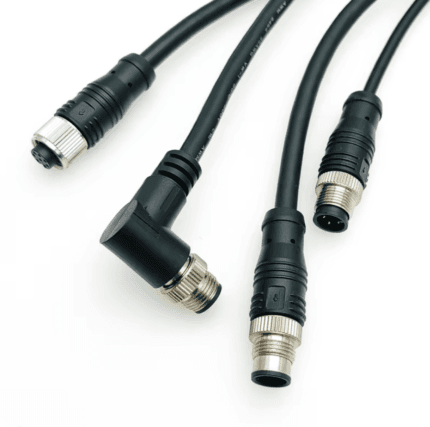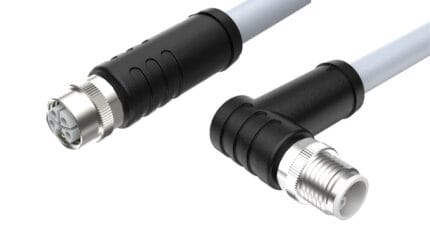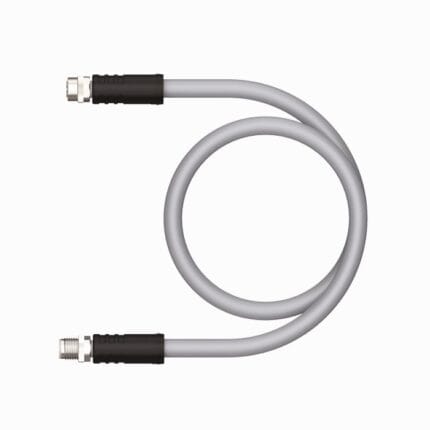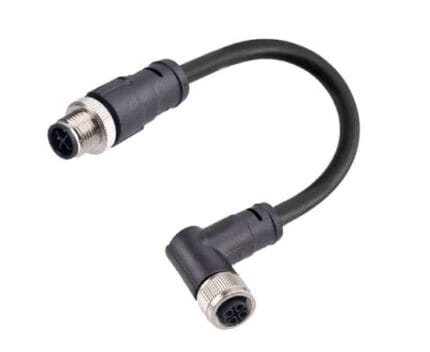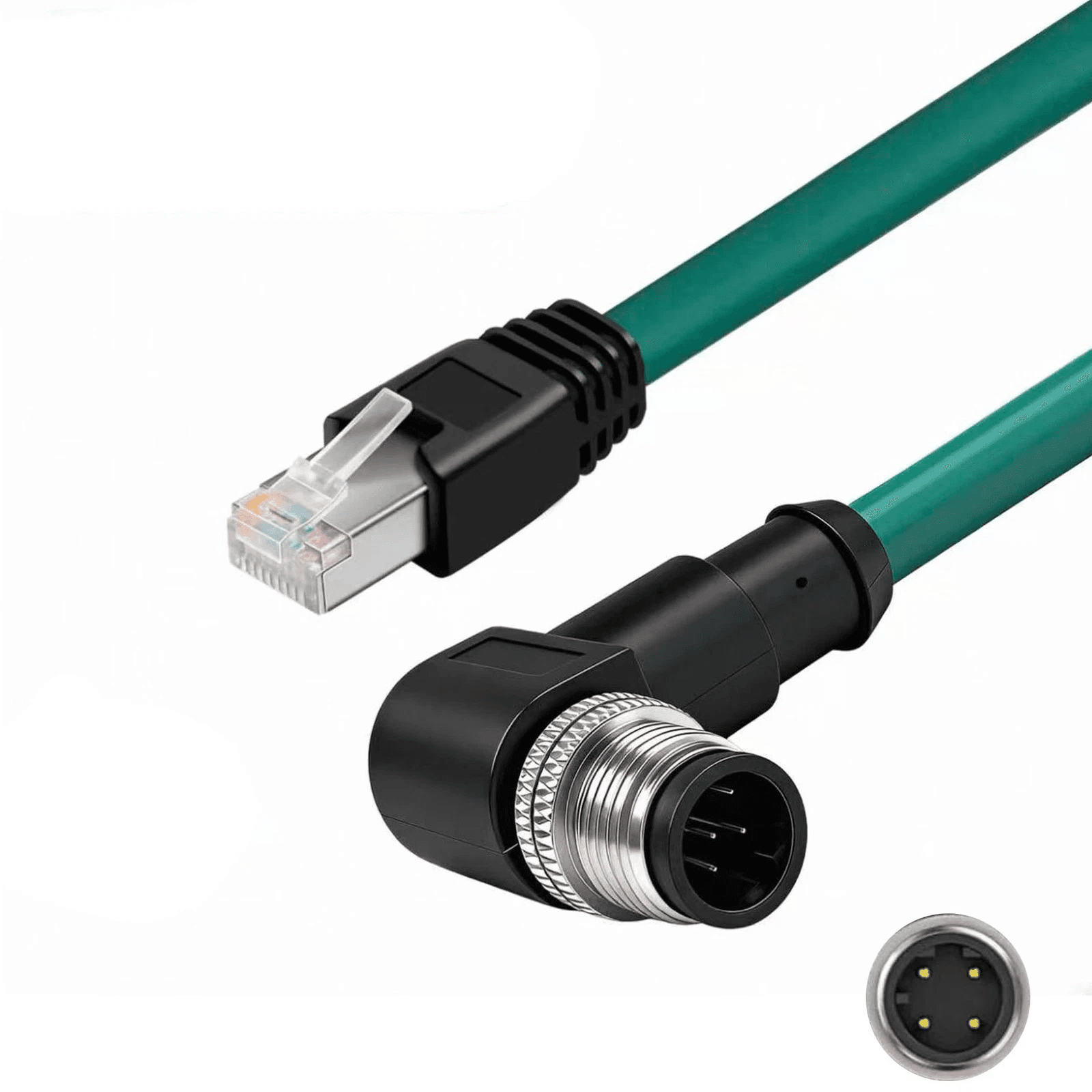
M12 D-Code 4-Pin PROFINET Industrial Ethernet Cable
This M12 PROFINET cable runs 100 Mbit/s industrial Ethernet from a D-coded IP67 device port to a shielded RJ45 in the cabinet. Cat5e SF/UTP, 24 AWG stranded, green PUR jacket, pin 1 TD+ through pin 4 RD-. Built to your length.
Overview
An M12 PROFINET cable carries 100 Mbit/s industrial Ethernet across two twisted pairs in a D-coded shell, which is the keying assigned to that duty by IEC 61076-2-101. D-coding is not a marketing tier. It is a mechanical guarantee that nobody walks up to a running line and plugs a fieldbus device into an Ethernet port, or worse, plugs Ethernet into a power socket. This build puts an IP67 D-coded plug on one end and a shielded RJ45 on the other, in the green PUR jacket the installation guidelines call for, made to the length your layout needs.
Key Specifications
| Connector A | M12 D-coded 4-pin male, shielded, IP67 |
|---|---|
| Connector B | RJ45 shielded male, industrial overmold |
| Coding | D per IEC 61076-2-101 |
| Protocol | PROFINET class industrial Ethernet, 100 Mbit/s Fast Ethernet |
| Cable | Cat5e SF/UTP class, 24 AWG stranded, 2 twisted pairs |
| Rated | 4 A / 60 V DC, 24 V typical for PROFINET supply |
| Jacket | PUR halogen-free, green, drag chain capable on request |
| Pin assignment | 1 TD+, 2 RD+, 3 TD-, 4 RD- |
| Length | OEM build to required length |
What D-coding actually defines
Two things, and both matter on-site. The first is electrical: the four contacts are laid out as two differential pairs with the geometry the Ethernet physical layer expects, which keeps impedance and crosstalk inside the budget. The second is the keyway itself, which physically refuses A-coded sensor plugs, B-coded PROFIBUS plugs, X-coded Cat6A plugs and every power coding in the family. PROFINET networks depend on that second property far more than most specifications admit.
| Code | Carries | Will it mate with D-coded |
|---|---|---|
| A | DC power and sensor signals | No, intentionally |
| B | PROFIBUS-DP fieldbus | No, intentionally |
| D | 100 Mbit/s Ethernet on two pairs | Yes, by definition |
| X | Up to 10 Gbit/s Ethernet on four pairs | No, intentionally |
| T and L | DC power at 63 V | No, intentionally |
D is the 100 Mbit/s coding, and it will not swap with A even though the shells look alike. The coding reference in the download center sets D alongside every other letter, with the pole counts and applications of each.
The green jacket is not decoration
Color coding within an industrial Ethernet installation stops field errors: green is conventionally used for PROFINET so that a technician tracing a cable at the back of a cabinet can identify the network without pulling every label. Beyond the color, PUR is chosen over PVC because machine-mounted Ethernet runs sit alongside cutting fluid and coolant mist, and because machine-mounted means moving. Where the run genuinely flexes, say so at the quote stage so it is built for continuous motion rather than for a fixed installation.
Pin assignment and where it goes wrong
Four contacts, two pairs, and the return pairs are not interchangeable with each other in a way you can discover only after commissioning. The D-coded assignment used on this build is pin 1 TD+, pin 2 RD+, pin 3 TD-, pin 4 RD-. If your devices use a different assignment, tell us and we will build to yours.
| Pin | Signal | Pair | Practical note |
|---|---|---|---|
| 1 | TD+ | Pair 1 | Transmit positive; wire color is confirmed per build |
| 2 | RD+ | Pair 2 | Receive positive; do not swap with pair 1 |
| 3 | TD- | Pair 1 | Transmit negative |
| 4 | RD- | Pair 2 | Receive negative |
Commissioning checks worth doing every time
Most Ethernet faults blamed on cables turn out to be configuration or grounding. Three checks separate the honest failures from the phantom ones: verify link speed and duplex at both ends, confirm that the shield is bonded the way your EMC plan specifies, and look at the error counters rather than relying on the fact that the link light is on. If the counters climb when a drive starts, the problem is noise on the route, not the termination.
Typical applications for this M12 PROFINET cable
- Device drops from a PROFINET controller to remote I/O blocks and valve islands
- Cabinet-to-machine runs where the machine end must stay sealed to IP67
- Drives and distributed field devices with a D-coded port on board
- Replacing fixed installation runs where the same path now flexes
- Sensor and actuator networks carrying real-time traffic at 100 Mbit/s
How to specify your build
- Ends – D-coded male to shielded RJ45, or D-coded both ends.
- Length, plus whether any part moves or flexes.
- Jacket – green PUR standard, other colors on request.
- Pin assignment, if your devices differ from the table above.
- Shield concept for the RJ45 end, matching your EMC plan.
- Quantity, prototype or production.
Workmanship and testing
M12 D-Code 4-Pin PROFINET builds are assembled and inspected to IPC/WHMA-A-620 Class 3 criteria, with ISO 9001 as the quality system over 32 to 12 AWG work. 100% continuity and pinout are checked on every M12 unit before packing, and seal checking is quoted whenever an ingress rating is on the drawing.
Every production run can ship with RoHS and REACH declarations and the electrical report agreed at quotation; see certifications and material declarations. UL styles and other named approvals are built to drawing: we source to the style you specify and document it, rather than asserting a listing we do not hold. For continuous motion the stranding, lay length and jacket are built to the flex method described under high-flex drag chain harness builds, with the cycle count defined in the test scope. The wider context is covered under what automation programs ask for. Tooling is quoted separately, cut in-house rather than brokered out, and owned by you.
Custom builds and ordering
M12 D-Code 4-Pin PROFINET prototype builds start from 1 to 50 pcs and are out in 3 working days. Production is quoted from 500 pcs at 14 working days after approval. Tooling not already held adds around 10 working days. Private-label M12 runs ship under your part number and labeling, and we provide material certificates and first-article reports when asked.
Related M8 and M12 assemblies
- M12 X-Coded Cat6A Cable to RJ45 for Machine Vision
- M12 B-Coded PROFIBUS Cable, 5-Pin Fieldbus Cordset
- M12 Push-Pull X-Code Cat6A Industrial Ethernet Cable
- M12 Y-Coded Hybrid Cable for Power and Fast Ethernet
- M8 D-Coded Ethernet Cable, 4-Pin 100 Mbit Cordset
- Cat5e UTP Patch Cord
Full ranges: circular M8 and M12 cable assemblies and Ethernet patch cords.
Frequently Asked Questions
<div class="
For a related configuration, see the M12 L-Code 16A Cable for IO-Link Power and AGV Drives.
hkw-faq”>
Can I plug a D-coded plug into an X-coded socket?
No, and that is deliberate. The keyway exists so that 100 Mbit/s and 10 Gbit/s networks cannot be cross-mated in the field.
Do I have to use the green jacket?
No, but it helps every technician who traces the cable later. Other colors are available on request.
Will this run at gigabit?
D-coding is specified for 100 Mbit/s on two pairs. For gigabit and above use X-coding with Cat6A construction.
Is it drag chain rated?
Tell us it needs to flex and we will build it for continuous motion. A standard build is aimed at fixed or occasionally moved installation.
How long can the run be?
Built to whatever length your layout needs, within the reach of the Ethernet physical layer. Very long runs are better handled with fiber.
| Connector A | M12 D-coded 4-pin male, shielded, IP67 |
|---|---|
| Connector B | RJ45 shielded male (industrial overmold) |
| Coding | D per IEC 61076-2-101 |
| Protocol | PROFINET Type C, 100 Mbps Fast Ethernet |
| Cable | Cat5e SF/UTP, 24 AWG stranded, 2-pair |
| Rated | 4 A / 60 V DC (24 V typical for PROFINET) |
| Jacket | PUR halogen-free, drag-chain rated, green (PROFINET color) |
| Length | OEM build to required length |
| Pin Assignment | 1 TD+, 2 RD+, 3 TD-, 4 RD |