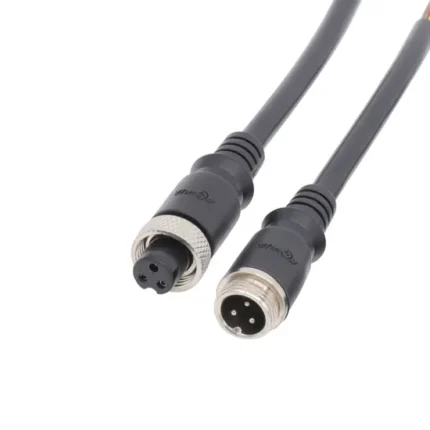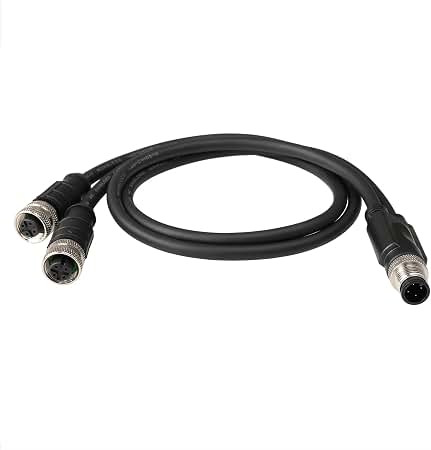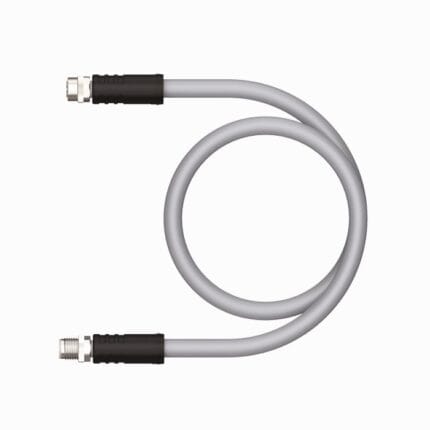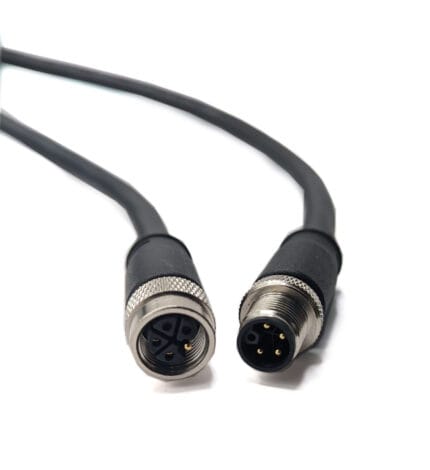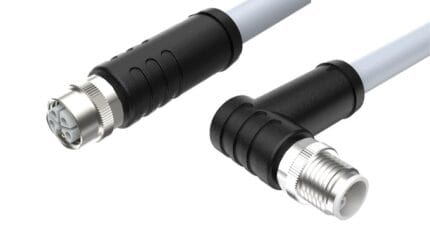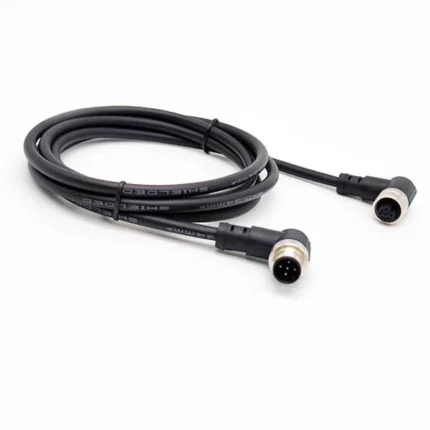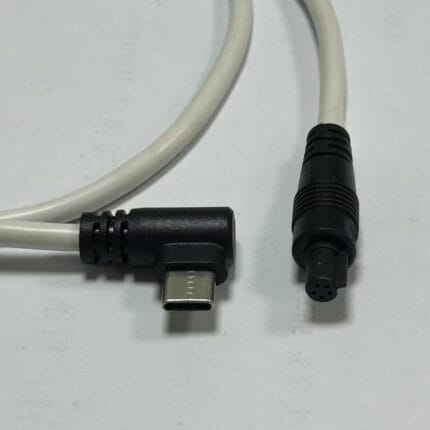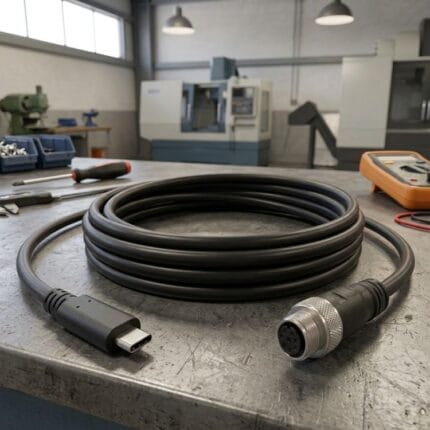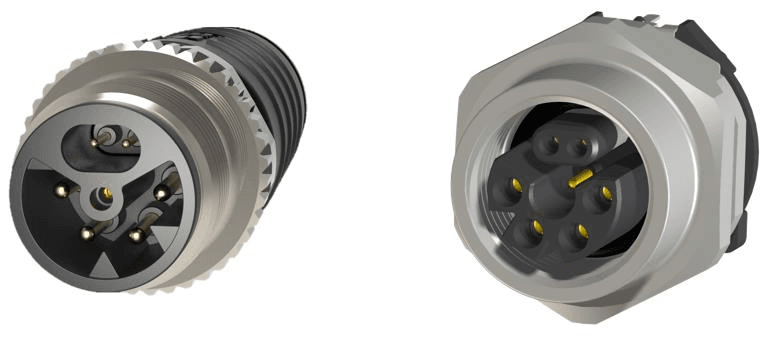
SPE M12 Hybrid Single-Pair Ethernet + Power Cable (IEC 63171-7)
An M12 hybrid SPE cable carries Single-Pair Ethernet and power in one connector built to IEC 63171-7: one shielded pair for 1000BASE-T1 and dedicated power contacts. It removes a connector, a cut-out and a routing path on compact automation nodes and robot joints.
Overview
An M12 hybrid SPE cable carries Ethernet over a single shielded pair together with dedicated power contacts, inside one M12 connector built to IEC 63171-7. Data and supply travel in one jacket through one panel cut-out, which is the whole point: compared with running a separate data cable and a separate supply cable, a hybrid assembly removes a connector, a gland, a cut-out and a routing path. That is why the interface is being taken up on compact automation nodes, robot joints and IIoT edge devices where space is the binding constraint.
Key Specifications
| Standard | IEC 63171-7 (published edition IEC 63171-7:2023) |
|---|---|
| Data | Single pair, 1000BASE-T1 / 100BASE-T1 / 10BASE-T1, up to 600 MHz |
| Power | 2 x 8 A at up to 63 V DC on dedicated power contacts |
| Cable | Single shielded data pair plus power conductors, PUR jacket |
| Length | OEM build to required length |
| Ways | Up to 7 ways including PE or FE (data/power) plus shield pin |
| Locking | M12 screw, P12 push-pull or C12 combined, per style |
| Sealing | IP65 or IP67 when mated – state the rating you need |
What Single-Pair Ethernet is, and what it is not
SPE carries full-duplex Ethernet over one balanced pair instead of two or four. The PHY does the work, so the cable gets thinner, lighter and easier to route. What SPE is not is a drop-in replacement for the structured cabling in your building: the PHY types are different, the reach depends on which one your device implements, and both ends have to speak the same one. It is a device-level and machine-level interface, which is where it pays.
| Question | Four-pair Ethernet (100BASE-TX / 1000BASE-T) | Single-Pair Ethernet |
|---|---|---|
| Pairs used | 2 or 4 pairs, 8 conductors | 1 shielded pair, 2 conductors |
| Cable diameter and weight | Larger, heavier, bigger bend radius | Thinner and lighter, routes through tight tracks |
| Where it is used | Building and campus structured cabling, machine backbones | Device drops, sensors, actuators, robot joints, edge nodes |
| Reach | Set by the 100 m channel model | Set by the PHY your device implements – state it on the order |
| Re-use of existing plant | Ubiquitous | Requires SPE on both ends; gateways are used to bridge |
The technology and its PHY family are summarised under Single-Pair Ethernet; the values your assembly is verified to are the ones on your drawing.
The coding on the M12 hybrid interface, and why keying matters
M12 connectors are mechanically similar and electrically different, and the coding is the only thing stopping a plug going into the wrong socket. The IEC 63171-7 mating faces are keyed so that an SPE hybrid plug will not enter a classic A-, D- or X-coded socket. That is a feature: it is what prevents 8 A of power landing on a sensor input.
| Coding | Typical duty | Pins | Will it mate with the hybrid face? |
|---|---|---|---|
| A-code | Sensors, actuators, DC power | 3 to 12 (data and signal) | No – different keying |
| D-code | 100 Mbit/s industrial Ethernet | 4 (two pairs) | No – different keying |
| X-code | 10 Gbit/s industrial Ethernet | 8 (four pairs) | No – different keying |
| SPE hybrid per IEC 63171-7 | Data plus power in one connector | Up to 7 ways including PE or FE plus a shield pin | This is the interface discussed here |
Single pair Ethernet brings its own mating faces, but it sits alongside the coded connectors on the same machine. The download center carries a two-page reference to the classic coding letters, A to Y, so the two can be planned together.
What one hybrid assembly actually removes
- One connector pair and one mating cycle on the assembly line.
- One panel cut-out and one cable gland, usually the expensive item on a sealed enclosure.
- One routing path through a cable track that is already full, plus its bend radius.
- One part number in the spare stock and one set of torque and sealing checks at service.
- Weight and drag on a moving joint, which on a robot wrist is paid for twice per cycle.
Data and power in one jacket: what to check
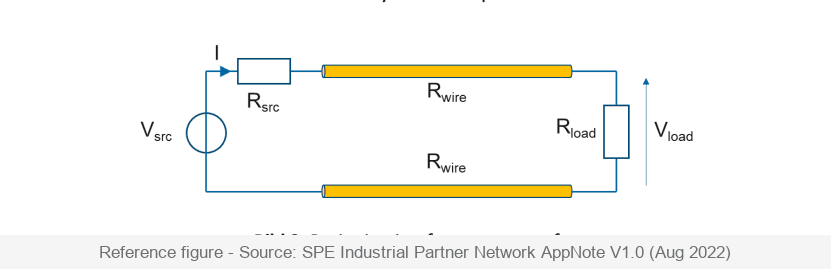
Mixing a communication pair and power conductors in one cable is routine, but three things decide whether it behaves. Separation: the data pair is screened, and that screen is why a switching supply on the adjacent contact does not show up as bit errors. A shield pin ties the cable screen to the connector shell for a full-circle termination, and if that pin is not connected at both ends you have bought an expensive unscreened cable. Voltage drop: state the current per contact and the run length and we size the conductors, because drop over a long run is usually the real limit. Heating: power conductors and a data pair share one thermal environment, so a bundle of hybrid runs in a closed track deserves the same derating thought as a bundle of power cables.
Locking style and sealing
| Style | How it locks | Where it suits | Note |
|---|---|---|---|
| M12 screw | Threaded coupling nut | Vibrating machine structure, permanent installation | The most common choice; needs hand access around the connector |
| P12 push-pull | Push to lock, pull the sleeve to release | High-density panels and frequent re-mating | Fast to connect where fingers cannot reach a thread |
| C12 combined | Push-pull with a threaded option | Mixed installations where some ports are hard to reach | Specify which behavior you want per end |
Sealing is IP65 or IP67 when mated, and the rating you need has to be stated on the order because it drives the gasket and the overmold. The jacket is PUR, chosen for oil and abrasion resistance; other compounds are available where the application calls for them.
Where an m12 hybrid spe cable pays for itself
- Robot joints and end-of-arm tooling, where one hybrid run replaces a data lead and a supply lead through the same cable track
- IIoT edge nodes, vision devices and remote I/O blocks that need backhaul and tens of watts over one connector
- Compact valve islands and actuator blocks, the same territory as our M12 hybrid SPE cable for actuators
- Retrofits where a second cable would mean a second hole in a sealed enclosure, alongside the M12 Y-coded hybrid cable
- Moving installations in drag chain, where our M12 drag chain cable covers continuous flex
What to send us to get a quote
- Which PHY the device implements, and the reach you need from it.
- Current per power contact and the supply voltage, for conductor sizing.
- Way count and pinout, including whether you need a PE or FE contact.
- Locking style per end, and the ingress rating you need when mated.
- Length, jacket compound and any drag chain or torsion duty.
SPE M12 Hybrid Single-Pair lots run from 1 to 50 pcs, out in 3 working days. Volume starts at MOQ 500 pcs shipping 14 working days after approval. Tooling not already held adds around 10 working days. Your part number and labeling go on SPE shipments, and material certificates and first-article reports are on offer.
Workmanship and testing
ISO 9001 covers the system and IPC/WHMA-A-620 Class 3 covers the work on SPE M12 Hybrid Single-Pair builds, across 32 to 12 AWG. continuity and pinout are tested on each SPE unit before it is packed, and seal checking is quoted whenever an ingress rating is on the drawing.
RoHS and REACH declarations are provided per project together with the agreed test reports; the documentation scope is listed under certifications and compliance. If your drawing specifies a UL style, we build to that drawing and supply the UL reference with the shipment instead of substituting an equivalent. Flex life is a construction decision made before tooling, following the conductor and jacket approach set out under continuous-flex construction and flex-life testing. More background: cable assemblies for industrial automation and robotics. Tooling for this build is cut in our own tool room and belongs to your program, so a repeat run years later starts from the same tool.
Frequently Asked Questions
Can SPE replace the Cat6A run to my camera?
Not directly. Single-Pair Ethernet needs an SPE PHY at both ends, so it is used where the device already implements it or where you are designing new hardware. Where you have existing four-pair equipment, a gateway or a media converter is the bridge.
How much power can the two contacts carry?
The values carried on this listing are 2 x 8 A at up to 63 V DC on dedicated power contacts. Treat them as the reference point and confirm against your device rating and the run length, because voltage drop over a long run is usually the real limit.
Will it plug into an A-coded or D-coded socket by mistake?
No. The IEC 63171-7 mating faces are keyed differently from the classic codings, so an SPE hybrid plug will not enter an A-, D- or X-coded receptacle. That is deliberate protection for the equipment on the other end.
Which locking style should I pick?
M12 screw for anything that vibrates or is installed once and left alone; P12 push-pull where ports are dense or are mated often; C12 where you want both behaviors available.
Related assemblies
| Standard | IEC 63171-7 (published edition IEC 63171-7:2023) |
|---|---|
| Data | Single pair, 1000BASE-T1 / 100BASE-T1 / 10BASE-T1, up to 600 MHz |
| Power | 2 x 8 A at up to 63 V DC on dedicated power contacts |
| Cable | Single shielded data pair plus power conductors, PUR jacket |
| Length | OEM build to required length |
| Ways | Up to 7 ways including PE or FE (data/power) plus shield pin |
| Locking | M12 screw, P12 push-pull or C12 combined, per style |
| Sealing | IP65 or IP67 when mated – state the rating you need |