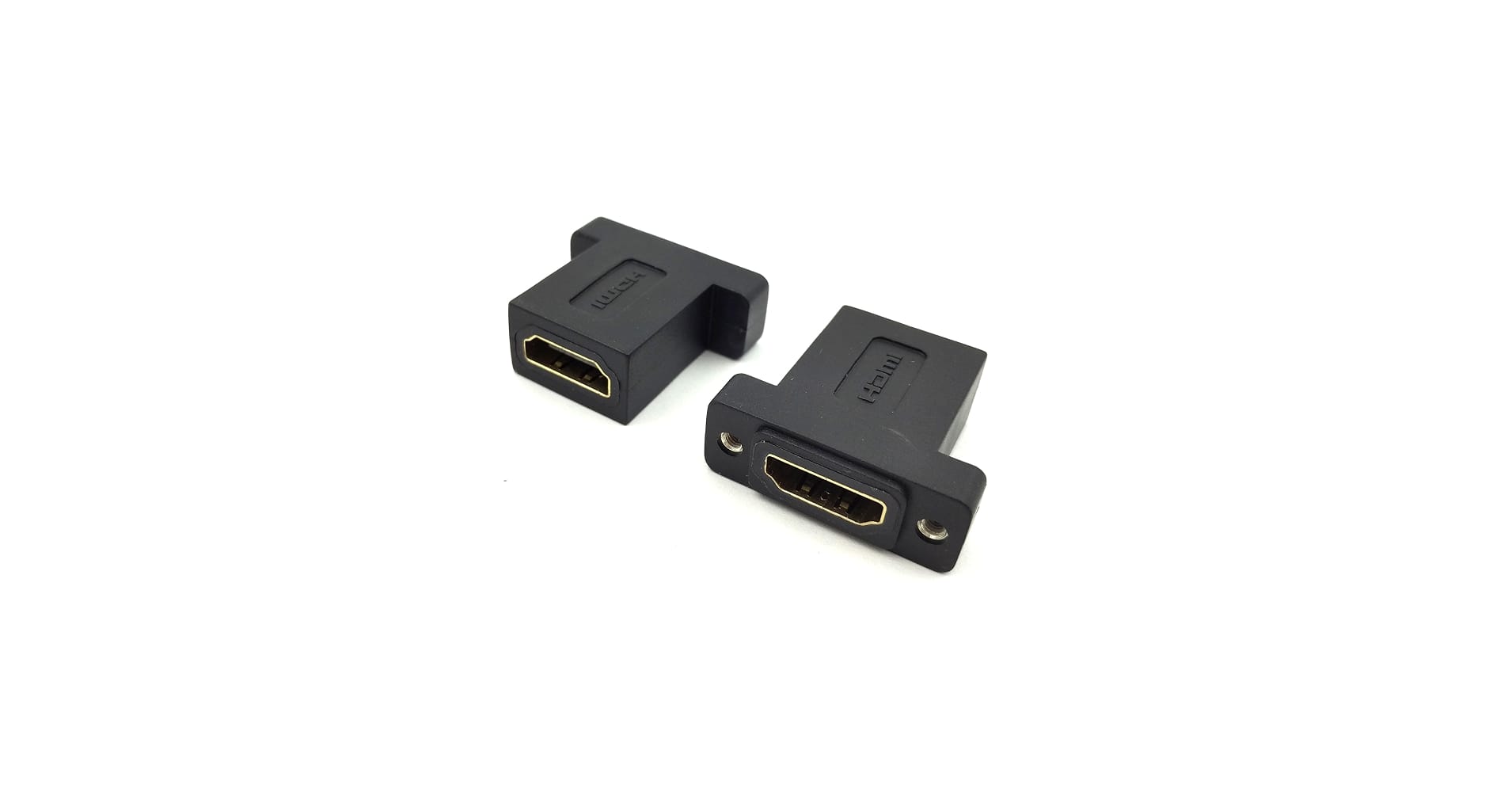
HDMI 8K Panel Coupler with Screw Lock for Cabinet Feedthrough
An HDMI 8K panel coupler carries a 48 Gbps signal through a rack panel or a cabinet wall, with the retention on the panel rather than on the connector shell. Two receptacles back to back, M3 fixings, passive feedthrough. Hole spacing confirmed before you drill.
Last updated: 13 September 2026
Overview
An HDMI 8K panel coupler carries a fixed-resolution signal through a rack panel, an equipment wall or the side of a flight case, and it keeps the cable retention on the panel rather than on the connector shell. Two HDMI receptacles sit back to back in a housing fixed from the front, so a source inside the rack and a display or a wall processor outside connect with standard leads. It is a passive feedthrough: it does not regenerate, equalize or convert anything, and it does not change what the link is capable of.
Key Specifications
| Product type | HDMI female to female panel feedthrough, passive |
|---|---|
| Bandwidth | 48 Gbps (design target, pending supplier datasheet) |
| Resolution support | 8K at 60 Hz and 4K at 240 Hz, subject to chroma and color depth (pending confirmation) |
| Hole spacing | 25 mm between fixing centers (design target, confirm before drilling) |
| Fixings | M3 screws or nuts, nickel plated (pending supplier confirmation) |
| Contact plating | Gold plated (pending supplier datasheet and plating thickness) |
| Shell | Overmolded or metal, version dependent |
| Signal handling | Passive feedthrough; no signal regeneration or conversion |
| Also available | Pigtail version with a captive lead in place of the rear receptacle |
| Compliance files | RoHS and REACH declarations pending supplier confirmation |
| Retention | Screw lock on the panel; the fixings carry the cable load |
| Typical use | Control rooms, OB vans, LED wall enclosures, imaging racks |
48 Gbps through a panel: what a passive join costs you
Higher HDMI rates run at 48 Gbps across four differential pairs. Every mating face is an impedance discontinuity and every discontinuity reflects some of the energy back at the source. A coupler adds two of them plus the loss of the internal path, and it does so on a link that may already be close to its length limit.
| What eats the margin | What it does | What to do about it |
|---|---|---|
| Two extra mating faces | Reflection and insertion loss at each face | Keep both leads as short as the install allows |
| Long passive leads | Loss accumulates with length | Move the source closer, or use an active solution |
| A distorted flange | Receptacles go out of alignment, plugs seat at an angle | Do not over-torque into a thin panel |
| An unshielded shell on a metal panel | The screen stops at the wall | Use a metal shell version and bond it to the panel |
| Cheap leads elsewhere in the chain | The channel is only as good as its worst part | Specify the leads, not just the coupler |
Screw lock: why the retention belongs on the panel
A standard HDMI plug is held in by the friction of the receptacle shell. On a static install that is fine. On a flight case that is trucked, an OB van that is rigged and struck, or a cart that is wheeled across a floor, friction is not enough: the plug rocks, the contacts wear and the link drops intermittently in a way that is very hard to diagnose.
| Retention | Held by | Good for | Not good for |
|---|---|---|---|
| Friction fit | The receptacle shell | Fixed installs behind a rack door | Anything that moves |
| Screw lock on the coupler | Two M3 fixings through the panel | Flight cases, OB vans, moving carts | Panels too thin to take a thread |
| Locking HDMI lead | A thumbscrew on the plug itself | Camera and monitor ends | Panels where the plug has to be swapped often |
| Latch-lock panel extension | A latch on the panel housing | Repeat rig and strike cycles | Where rear access is not available |
Putting the retention on the panel means the load path goes from the cable, through the plug, into the housing and out to the panel – not into the contacts. For a cabinet that is moved, that is the difference between a link that survives a season and one that does not. Our 8K HDMI Screw Lock Cable Assembly, HDMI 2.1 48Gbps, M3 Panel Screws takes the same approach at the lead end.
Hole spacing, fixings and mounting
Hole spacing is the dimension that catches people out: published data for comparable parts points to 25 mm between fixing centers, and that is a design target to confirm against the supplier drawing before the panel is drilled. M3 nickel-plated screws or nuts are used on comparable parts. Mount from the front wherever access allows, so the fixings can be re-torqued without dismantling the rack, and do not over-torque into a thin panel: a distorted flange pulls the receptacles out of alignment and the plugs then seat at an angle, which is a mechanical fault that presents as a signal fault.
Moving racks: bend, flex and strain
A coupler fixed to a panel is a hard point, and the lead leaving it is a lever. On a flight case or a mobile rack, dress the lead so the first 100 mm leaves the receptacle straight and supported, then take up the bend. Repeated flexing right at the plug is what kills these links, and it looks like a cable fault when it is really a dressing fault. Where the case is struck and rebuilt often, consider the pigtail version with a captive lead: one fewer mating face, and one fewer thing to go wrong at the back of the rack.
Where this HDMI 8K panel coupler gets installed
- Control room desks and equipment walls where every source lands on a panel
- Outside broadcast vehicles and flyaway racks used repeatedly
- LED wall and digital signage enclosures fed from a processor rack
- Flight cases for touring and event production
- Imaging and diagnostic equipment racks, where system-level approval stays with the equipment manufacturer
Before you order
- Hole spacing and fixing size – confirm against the drawing before drilling.
- Shell type – metal for shield continuity, overmolded where bonding is not possible.
- Panel thickness – and whether the fixings can be re-torqued later.
- Front or rear mounting, and the access behind the panel.
- Resolution and refresh combination you actually need, with chroma and color depth.
- Coupler or pigtail – how many mating faces the channel can afford.
- Quantity, and whether this is a prototype or a production order.
Bandwidth, resolution and refresh combinations, contact plating, fixing hardware and hole spacing for this range come from published competitor data rather than from a verified datasheet of ours, and we will confirm each one against the supplier document before we quote. Resolution and refresh rate are a pair, not two independent claims: what a link carries at 8K depends on chroma subsampling and color depth, and stating one without the other is how misleading listings get written.
Workmanship and testing
Builds here run under ISO 9001 to IPC/WHMA-A-620 Class 3 workmanship, across 32 to 12 AWG. Every assembly is tested for continuity and pinout before packing. Seal checking on the production batch can be quoted when the specification includes an ingress rating.
Custom builds and ordering
Prototype builds start from 5 pcs and ship in 3 working days; production orders start at MOQ 500 pcs and ship 14 working days after approval. New overmold tooling adds about 10 working days. OEM and ODM builds ship under your part number and labeling, with material certificates and first-article reports available on request.
Related video and panel hardware
- 8K HDMI Screw Lock Cable Assembly, HDMI 2.1 48Gbps, M3 Panel Screws
- Ultra High Speed HDMI Cable for 8K Video Walls
- HDMI Panel-Mount Extension Cable with Latch Lock
- Active Optical HDMI Cable for Boardrooms and Ceiling Projectors
- Car Dashboard Flush Mount USB + HDMI Extension Cable with Mounting Bracket
- DisplayPort Screw Lock Cable for Control Room and Kiosk Displays
Full ranges: panel mount cable and audio and video cable.
Frequently Asked Questions
Will it pass 8K at 60 Hz?
What a link carries at 8K depends on chroma subsampling and color depth as well as on refresh rate. Tell us the combination you need and we will confirm it against the supplier datasheet.
Does the coupler boost or equalize the signal?
No. It is passive. It adds a small amount of loss and two impedance discontinuities, so keep both leads short and treat the coupler as part of the channel.
Can I mount it from the rear?
Front mounting is preferred so the fixings can be re-torqued without dismantling the rack. Tell us if rear mounting is the only option and we will quote the hardware that suits it.
| Product type | HDMI female to female panel feedthrough, passive |
|---|---|
| Bandwidth | 48 Gbps class |
| Resolution support | 8K at 60 Hz and 4K at 240 Hz, subject to chroma and color depth class |
| Hole spacing | 25 mm between fixing centers class |
| Fixings | M3 screws or nuts, nickel plated class |
| Contact plating | Gold plated |
| Shell | Overmolded or metal, version dependent |
| Signal handling | Passive feedthrough; no signal regeneration or conversion |
| Also available | Pigtail version with a captive lead in place of the rear receptacle |
| Compliance files | RoHS and REACH |
| Retention | Screw lock on the panel; the fixings carry the cable load |
| Typical use | Control rooms, OB vans, LED wall enclosures, imaging racks |
Related products