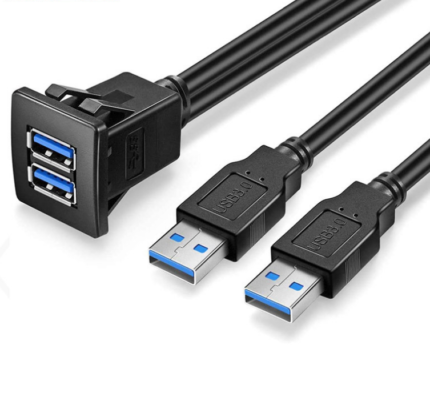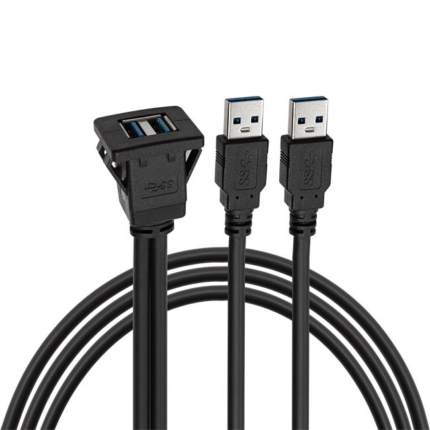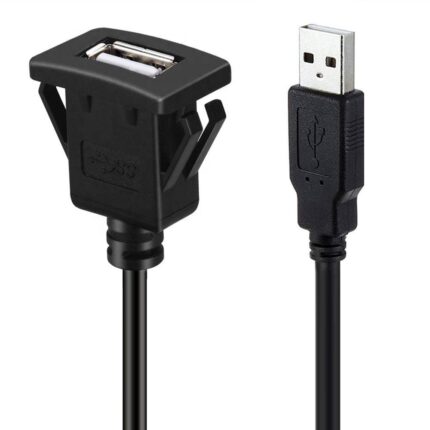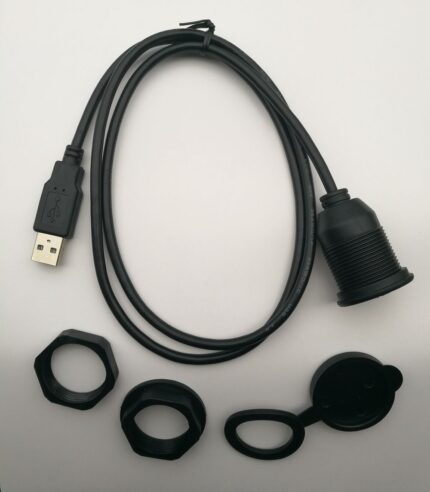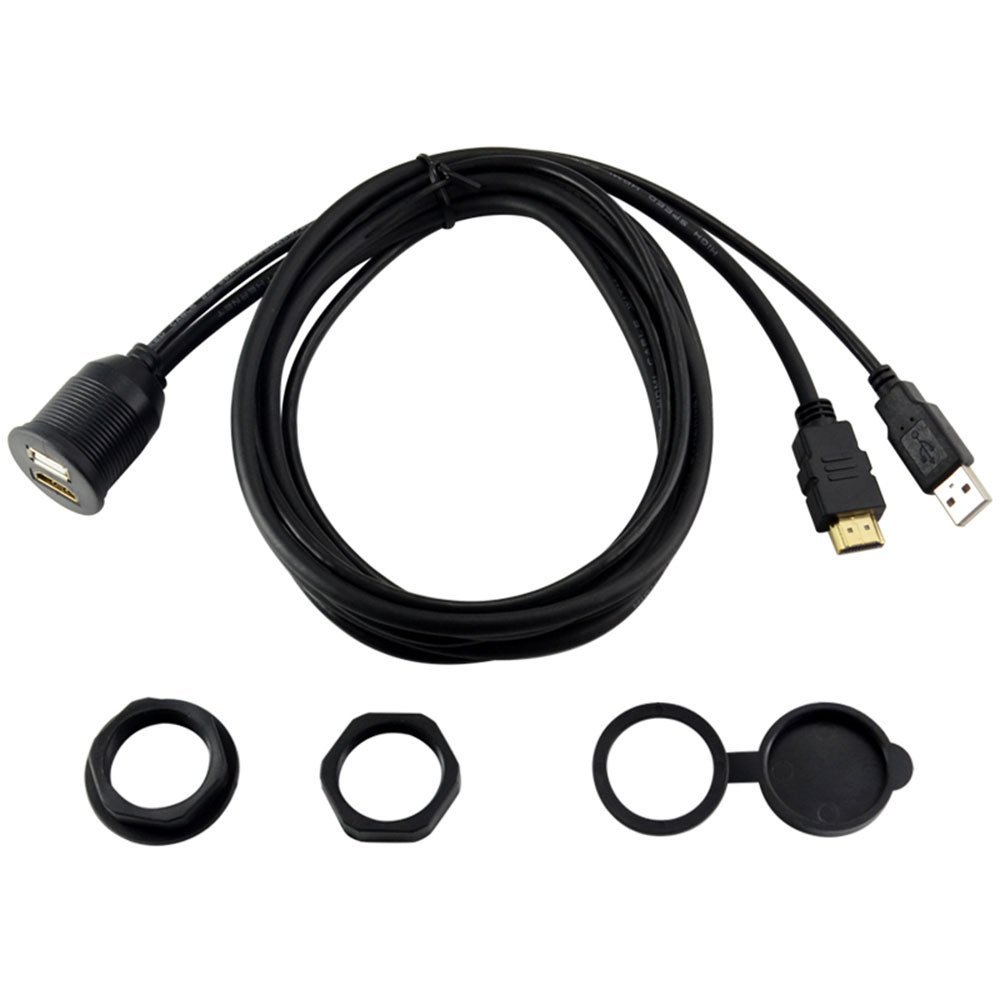
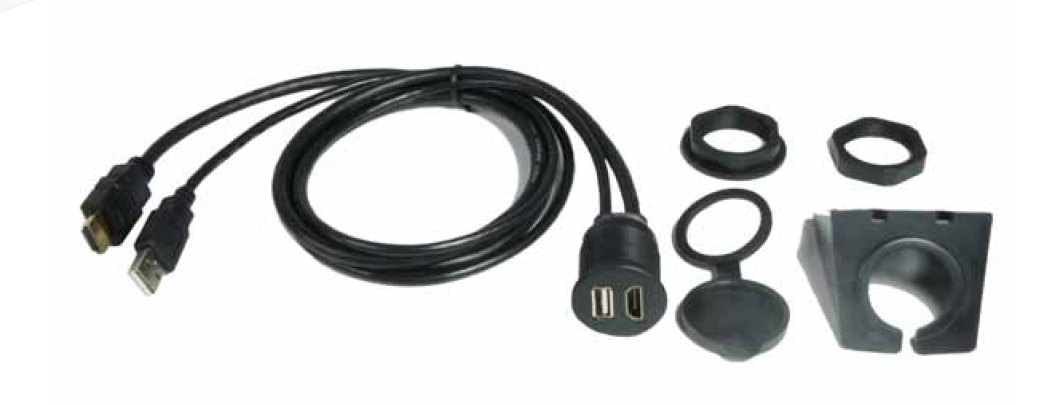
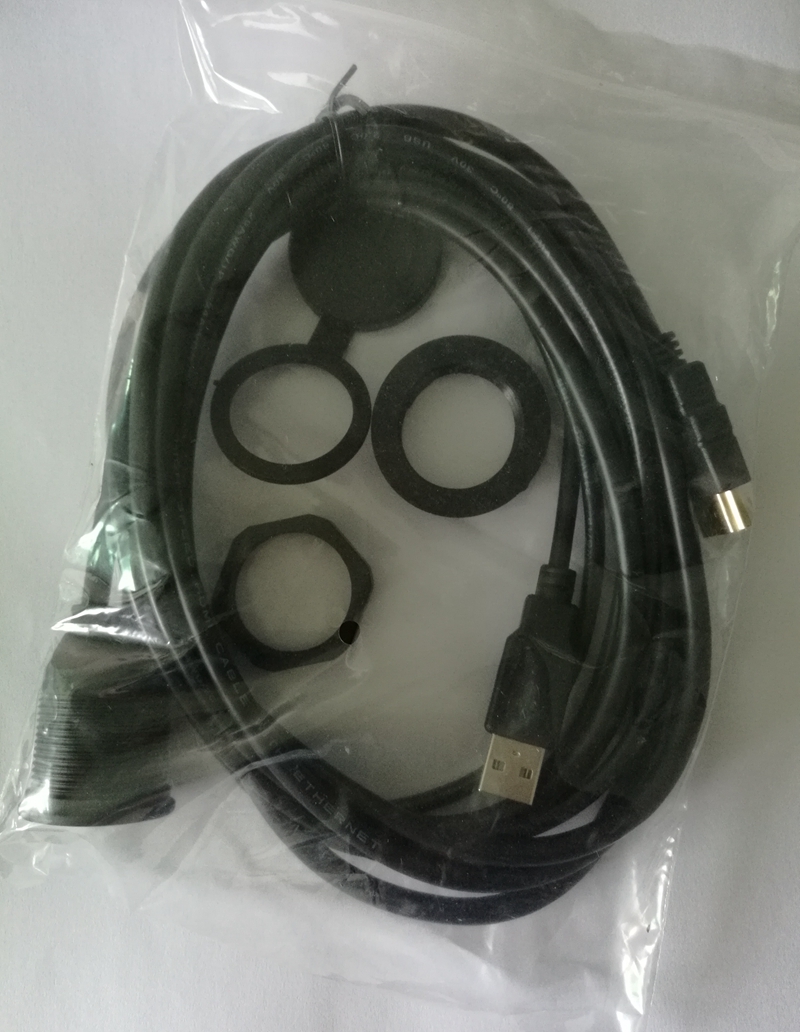
Car Dashboard Flush Mount USB + HDMI Extension Cable with Mounting Bracket
A car dashboard usb hdmi cable puts an HDMI socket and a USB-A socket on one flush bracket, so a media box or a phone feeds an in-car screen. HDMI OD 5.8 mm, USB 28/24 AWG, black PVC jacket, 1 m / 2 m / 3 m.
Overview
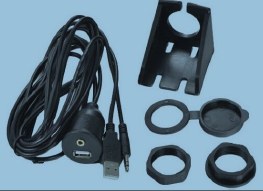
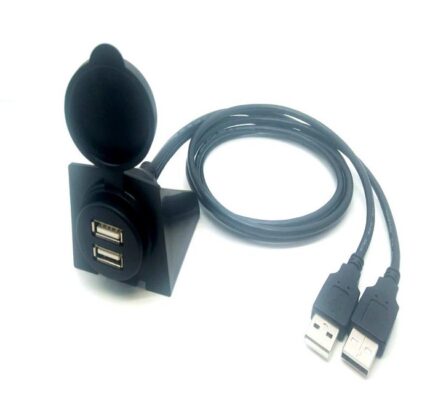
A car dashboard usb hdmi cable is the panel that turns a head unit or a rear screen into something you can actually plug into: an HDMI-A female and a USB-A female on one flush bracket, in a 28-30 mm round cut-out, with a waterproof lid over the face. The far end breaks out to an HDMI-A male and a USB-A male at the source. The HDMI leg is 24 AWG at 5.8 mm OD, the USB leg is 28 AWG data with 24 AWG power, the jacket is black PVC, and stock lengths are 1 m, 2 m and 3 m. On paper the HDMI leg is the easy part and the mechanics are the hard part: an HDMI connector body is large and stiff, and it is the thing that decides whether this panel will fit behind your trim.
Key Specifications
| Connector A | USB-A Male, HDMI-A Male |
|---|---|
| Connector B | USB-A Female, HDMI-A Female |
| Cable length | 1 m / 2 m / 3 m |
| USB specification | USB 2.0 480 Mbps; USB 3.0 5 Gbps with blue insert |
| HDMI specification | HDMI 1.4 1080p / 4K at 30 Hz; HDMI 2.0 4K at 60 Hz, 18 Gbps |
| Conductor | 28 AWG USB + 24 AWG HDMI |
| Outer diameter | USB OD 3.5 mm / USB OD 4.5 mm / HDMI OD 5.8 mm |
| Jacket material | Black PVC |
| Mounting | Flush mount bracket, 28-30 mm cut-out, screw and waterproof lid |
| Application | Car, marine and motorcycle dashboards; Set-Top Box and DVD head units |
What the HDMI version actually buys you
HDMI 1.4 covers 1080p and 4K at 30 Hz; HDMI 2.0 takes 4K to 60 Hz at a nominally 18 Gbps link rate. Neither is a promise about a particular cable length – the HDMI specification does not define a maximum cable length at all, it defines an electrical budget, and a passive cable either meets it at your length or it does not. What you see at the panel when the budget is exceeded is not a clean failure: it is a picture that sparkles, or drops to a lower resolution, or will not come up at all until something is wiggled.
| Symptom | What it usually means | First thing to try |
|---|---|---|
| Sparkles or white dots on the picture | The link budget is marginal at this length | Shorten the run, or lower the resolution to confirm the diagnosis |
| No picture at all | No handshake, or a dead conductor | Try the source direct to the screen with a known short lead |
| Picture drops to a lower resolution | The link negotiated down | Check the source output setting and the run length |
| Works cold, fails when hot | Thermal margin at the receiver, or a marginal connector | Check the connector seating at both ends first |
| Intermittent cut-outs over bumps | Mechanical, not electrical | Support the plug bodies; vibration is working them loose |
Bend radius: the failure that takes a season to appear
An HDMI lead at 5.8 mm OD is stiff, and behind a dashboard it will be asked to turn in a space that is too small. The damage does not happen at the middle of the bend, it happens where the cable leaves the rigid overmolded shell, because that is a rigid-to-flexible transition and that is where a conductor breaks one strand at a time. The rule is simple and it is routinely ignored: keep the cable straight for the first few centimeters out of the connector, and keep every turn generous. A fold that looks fine on the bench becomes an intermittent fault after a winter of vibration.
Depth and width: measure before you cut
An HDMI female body is deep, and it needs a straight run behind it before the cable can turn. Two plug bodies side by side on a combined bracket also make the assembly wide, which means the cut-out has to be right and the panel has to be stiff. Measure four things before you drill: the cut-out, the trim thickness, the available depth straight behind the panel, and the width the bracket needs. A bracket that fits the hole but not the depth is the most common reason a dash panel job gets reworked.
| Dimension | Why it decides the job | How to check |
|---|---|---|
| Cut-out, 28-30 mm round | Oversize leaves no land for the flange | Bracket drawing, plus a test piece in scrap trim |
| Trim thickness | Sets whether the clamp load lands properly | Measure at the mounting point, paint and substrate included |
| Depth behind the panel | An HDMI body plus its boot needs a straight run | Depth gauge, with the plug inserted |
| Bracket width | A combined HDMI and USB bracket is wide | Offer the bracket up before cutting anything |
| Bend radius at the exit | Where the conductors eventually break | Keep the first few centimeters straight |
Where a car dashboard usb hdmi cable earns its keep
- In-car Set-Top Box, DVD and media player installs feeding a headrest or roof screen
- Rear-seat entertainment retrofits where the screen input is buried behind trim
- Marine and RV panels with an HDMI source in a locker and a screen at the table
- Phone-to-screen mirroring where the phone also needs to charge on the same bracket
- Kiosk and exhibition panels with an HDMI service port, see the HDMI 8K Panel Coupler with Screw Lock
- Builds that want a locking HDMI connection instead, see the 8K HDMI Screw Lock Cable Assembly
- Head-unit installs where a latch-lock panel extension is a better fit, compare the HDMI Panel-Mount Extension with Latch Lock
- Cabinets and consoles that also need USB-C, see the Control Cabinet Service Interface
Failure modes on combined HDMI and USB panels
Mechanically, the bracket rocks: two bodies on one wide plate, plugged into repeatedly at an angle, will crack a thin trim panel at the screw holes within a season. Electrically, the classic is a marginal link at 3 m that works on the bench with a short lead and fails in the car, which gets blamed on the panel rather than on the length. And the lid: it is there for a reason. An HDMI socket in a vehicle collects dust and it will not seat properly once it is packed, so close it.
What we treat as a target rather than a claim
What is listed here for Car Dashboard Flush Mount builds is the industry-standard definition, not a measurement we took on a finished part. What your assembly is built and verified to is what your drawing states, confirmed against the supplier datasheet before a quote goes out.
How to specify your build
- HDMI version – HDMI 1.4 for 1080p and 4K at 30 Hz, HDMI 2.0 for 4K at 60 Hz.
- Length – 1 m, 2 m or 3 m; shorter is always easier on the link budget.
- USB version – USB 2.0 as standard, USB 3.0 with the blue insert on request.
- Depth behind the panel – the HDMI body plus the plug boot.
- Bracket width and the stiffness of the panel it is going into.
- Lid – fitted, tethered, or an open socket.
- Quantity and whether this is a prototype or a production order.
Workmanship and testing
For Car Dashboard Flush Mount builds the line runs to IPC/WHMA-A-620 Class 3 under ISO 9001, terminating 32 to 12 AWG. Every Car build gets a 100% continuity and pinout check before it is boxed, and seal checking is quoted whenever an ingress rating is on the drawing.
RoHS and REACH declarations are provided per project together with the agreed test reports; the documentation scope is listed under certifications and compliance. If your drawing specifies a UL style, we build to that drawing and supply the UL reference with the shipment instead of substituting an equivalent. Overmold tooling for this part is designed and cut in our own tool room under overmold tooling cut in our own tool room, so the tool belongs to your program and a revision is a machining job rather than a new negotiation. The wider context is covered under engineering support and design for manufacture review.
Custom builds and ordering
Car Dashboard Flush Mount prototype lots start from 1 to 50 pcs and ship in 3 working days. Production requires 500 pcs and runs 14 working days after sample approval. Tooling not already held adds around 10 working days. Your part number and labeling go on OEM and ODM Car shipments, and material certificates and first-article reports come with them on request.
Related video and panel hardware
- HDMI 8K Panel Coupler with Screw Lock
- 8K HDMI Screw Lock Cable Assembly
- HDMI Panel-Mount Extension with Latch Lock
- Control Cabinet Service Interface with RJ45 and USB-C
- Kiosk and Self-Service Terminal Harness
Full ranges: panel mount cable, signal and data cables and screw-lock molded cable.
Frequently Asked Questions
Will 3 m carry 4K at 60 Hz?
It depends on the whole link, not on the cable alone. HDMI defines an electrical budget rather than a maximum length, so a marginal 3 m run shows sparkles or drops resolution rather than failing outright.
Why does the picture cut out over bumps?
That is mechanical, not electrical. An HDMI plug body is heavy and it will lever itself loose if it is not supported. Tie it and leave a little slack.
Can I get a locking HDMI panel connection?
Yes. If the install vibrates, look at the screw-lock and latch-lock HDMI builds rather than a plain friction-fit panel socket.
Does the waterproof lid make it sealed?
It keeps dust and splash off the face of an unused socket. It is not a sealed bulkhead rating – if the panel is exposed to a hose, ask for a properly rated assembly.
| Connector A | USB-A Male, HDMI-A Male |
|---|---|
| Connector B | USB-A Female, HDMI-A Female |
| Cable length | 1 m / 2 m / 3 m |
| USB specification | USB 2.0 480 Mbps; USB 3.0 5 Gbps with blue insert |
| HDMI specification | HDMI 1.4 1080p / 4K at 30 Hz; HDMI 2.0 4K at 60 Hz, 18 Gbps |
| Outer diameter | USB OD 3.5 mm / USB OD 4.5 mm / HDMI OD 5.8 mm |
| Jacket material | Black PVC |
| Mounting | Flush mount bracket, 28-30 mm cut-out, screw and waterproof lid |
| Application | Car, marine and motorcycle dashboards; Set-Top Box and DVD head units |
| Conductor | 28 AWG USB + 24 AWG HDMI |