
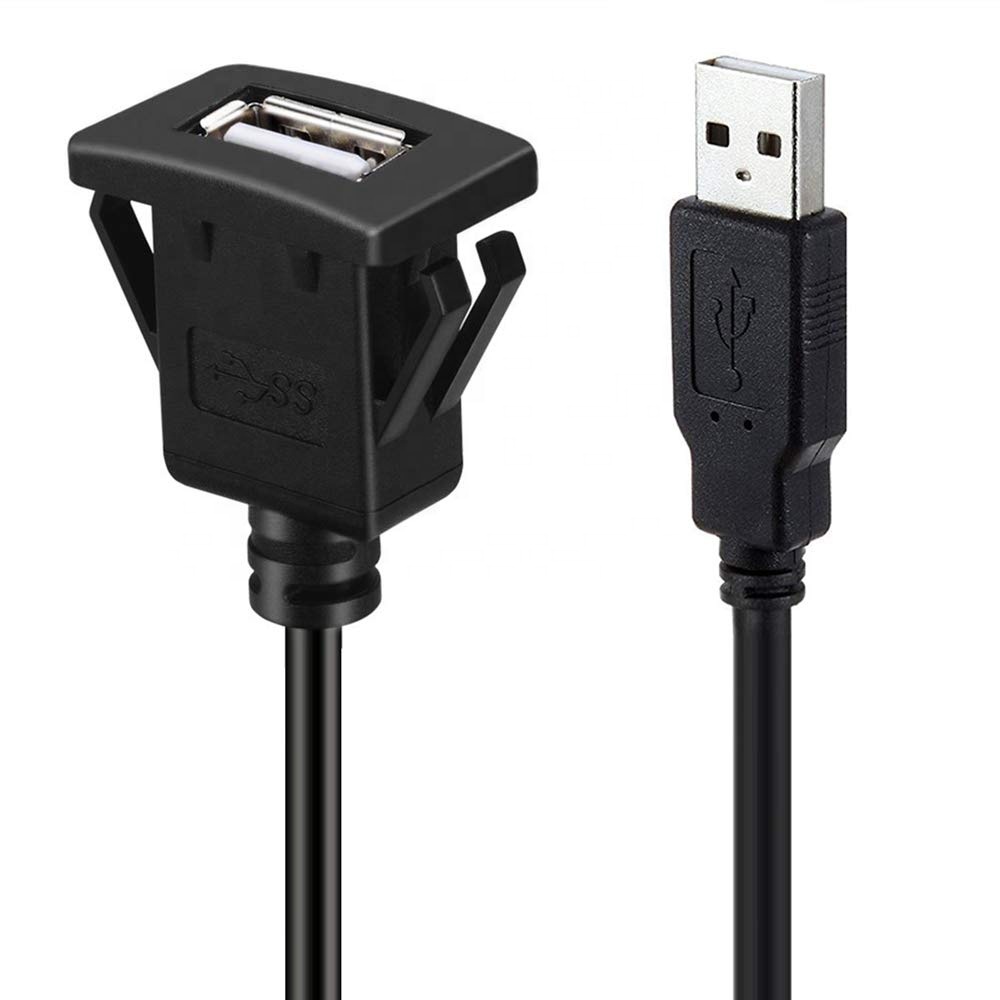
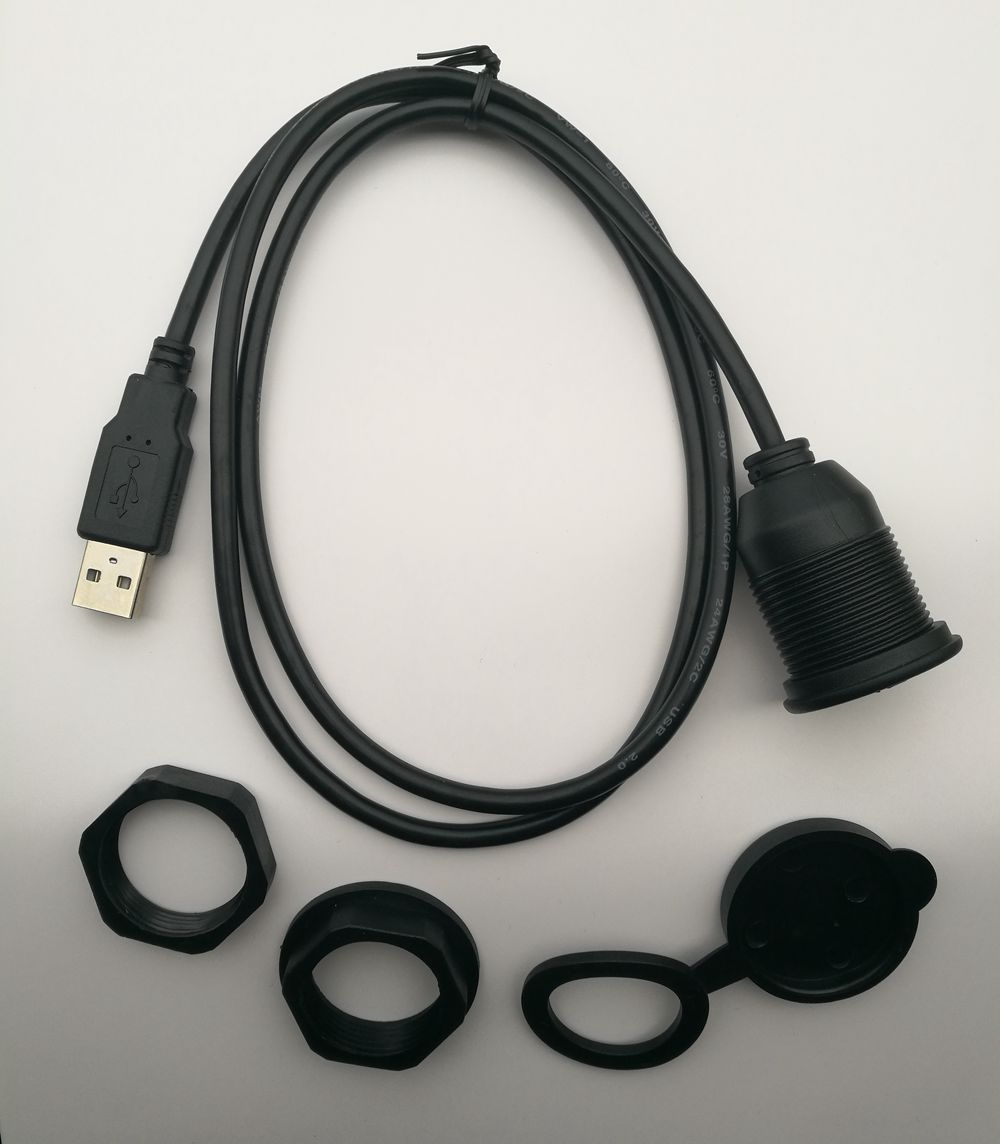
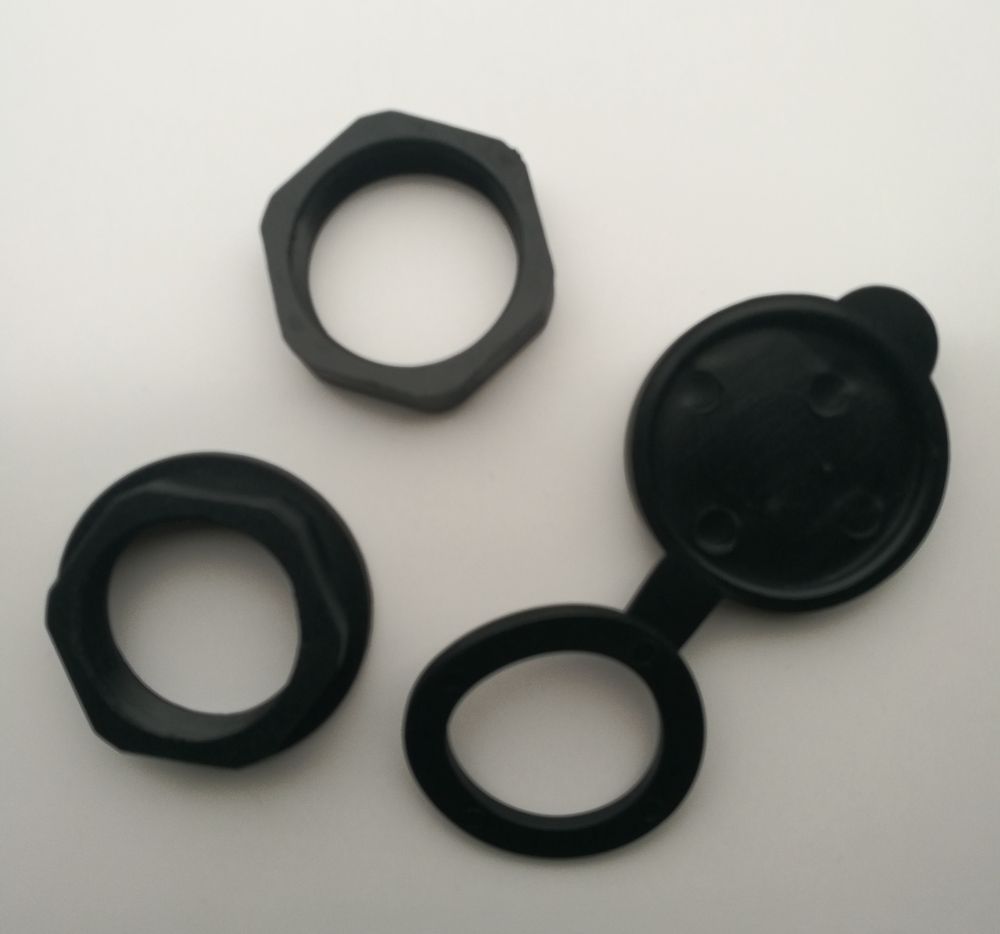
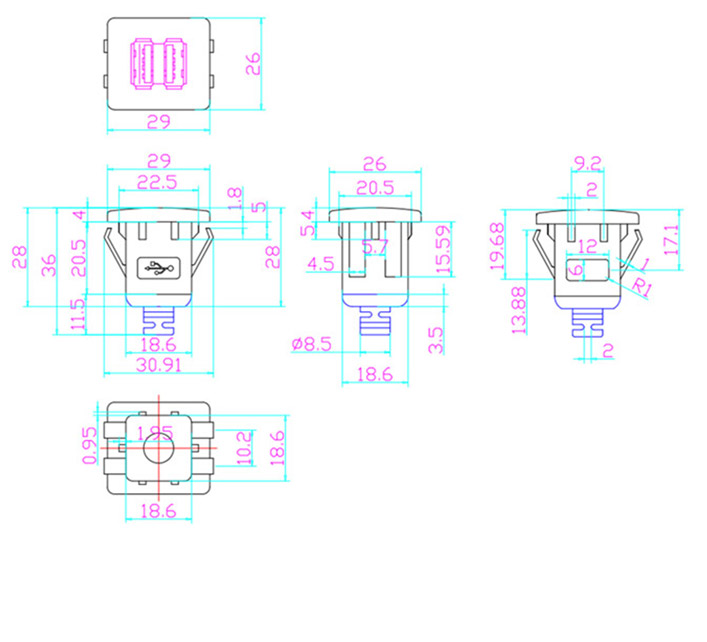
Single USB-A Female Car Dashboard Flush Mount Extension Cable with Waterproof Cover
A single usb a female cable on a flush panel bracket, with a flip cap over the socket so splash and dust stay out. 28 AWG data with 24 AWG power, black PVC jacket, 1 m / 2 m / 3 m. IP54 with the cap closed; cut-out 28-30 mm.
Overview
A single usb a female cable with a cap is the version you specify when the socket is going to live somewhere wet or dirty. The USB-A female sits in a 28-30 mm round cut-out on a flush bracket, and a flip cap closes over the face when nothing is plugged in, which takes it to IP54 splash resistance with the cap shut. Behind it, 28 AWG data conductors and a 24 AWG power pair in a black PVC jacket, in 1 m, 2 m and 3 m. The cap is the whole point of this part and it is also the part people lose, so it is worth deciding at order time whether you want it tethered. Note what IP54 is: splash resistant, not waterproof. It will survive a wet motorcycle and a kiosk under an awning. It will not survive a pressure wash or a deck fitting that sits under water.
Key Specifications
| Connector A | USB-A Male |
|---|---|
| Connector B | USB-A Female, panel mount, with waterproof cap |
| USB specification | USB 2.0, 480 Mbps |
| Conductor | 28 AWG data + 24 AWG power |
| Outer diameter | OD 3.5 mm / OD 4.5 mm |
| Jacket material | Black PVC |
| Cable length | 1 m / 2 m / 3 m |
| Mounting | Flush mount bracket, 28-30 mm cut-out, screw and flip cap |
| Ingress rating | IP54 splash resistant with the cap closed |
| Cut-out diameter | 28-30 mm round, 1.10 – 1.18 inch |
| Application | Car, marine and motorcycle dashboards; outdoor furniture and kiosks |
What IP54 does and does not cover
Under the IP code, ingress ratings are two numbers for two different things: the first is protection against solid objects, the second against water. A 5 on the solid scale means dust may get in but not in a quantity that interferes with operation; a 4 on the water scale means splashing water from any direction. Neither number covers immersion, neither covers a jet, and neither covers the state where the cap is open. This matters because a huge number of field complaints about a wet port turn out to be a port that was installed in a place it was never rated for, or a cap that has been missing since installation.
| Exposure | Covered by IP54? | What actually happens | What to specify instead |
|---|---|---|---|
| Rain splash on a motorcycle | Yes, with the cap closed | Fine as long as the cap is shut and the hinge is sound | This part |
| Kiosk under an awning, driven rain | Yes, with the cap closed | The cap takes it; the rear of the panel must stay dry | This part, plus a gasket on the flange |
| Deck wash-down with a hose | No | Water is driven at the joint under pressure | A sealed pigtail with a proper bulkhead rating |
| Temporary immersion | No | Water enters through the cap hinge and the flange | An IP67 or IP68 sealed assembly |
| Fine dust, unpaved road, workshop | Partly – dust-limited, not dust-tight | Grit packs into the socket and wears the contacts | Cap plus a regular clean-out regime |
The cap is a wearing part: design for that
A flip cap is a small plastic hinge that gets opened every day, in the sun, with cold hands. It is the first thing on this assembly to fail and it is also the cheapest thing to specify properly. Three decisions make the difference: whether the cap is tethered, which way the hinge faces, and what it is made of. A tether costs almost nothing and removes the single most common failure – the cap that goes missing in month one. A hinge that faces upward collects water and grit; one that faces down sheds both. And a cap in a UV-stable material survives a season on a motorcycle where a cheap one goes brittle and snaps.
Current budget: what one port has to deliver
The power pair inside this build is 24 AWG, which is a sensible default for a single socket, but the socket is only half the budget – the adapter on the other end is the other half. A phone that wants a fast charge will draw more than a legacy 5 V port expects, and a rear-seat tablet on a long run is a different proposition again. Decide what the port has to do before you choose the conductors, not after the install starts to get warm.
| What is plugged in | Typical draw | Conductor choice | Note |
|---|---|---|---|
| Phone, standard charge | Up to 1 A at 5 V | 24 AWG power pair | Stock build is fine |
| Phone, fast charge | 1.5 to 2 A at 5 V, or higher at 9 V | 24 AWG power pair, short run | Keep the run short; drop rises with length |
| Tablet or rear-seat screen | 2 A and above | Heavier power conductors on request | Tell us the length and the load |
| Two devices on one source | Split between ports | See the twin-port build | The source adapter has to cover the total |
Where a single usb a female cable earns its keep
- Motorcycle handlebar and fairing panels where the socket is ridden in the rain
- Marine consoles and boat dashboards, where a sealed option may be a better fit, see the Waterproof USB-C Panel Pigtail
- Outdoor furniture, kiosks and self-service terminals under cover, alongside our Kiosk and Self-Service Terminal Harness
- Truck, RV and van conversions where the socket faces the elements at a door opening
- Workshop and garage panels where grit is the enemy rather than water
- Cabinet and enclosure service ports, see the Control Cabinet Service Interface
- Installations that want a threaded metal body instead of a bracket, compare the Flush Mount USB-C Receptacle
Failure modes on capped panel sockets
In order of frequency: the cap goes missing and the port fills with dust; the bracket nut is done up tight enough to crack a thin trim panel; the cable leaves the shell with no service loop and the strain goes into the solder cups instead of the jacket; and the run is tied to something that moves, so the jacket chafes through to the braid or the conductors. None of these are cable defects. All of them are installation defects, and all of them are cheap to avoid if someone thinks about them before the trim goes back on.
What we treat as a target rather than a claim
Ratings shown here are the industry-standard description of what the Single USB-A Female Car interface family is defined to do, not test results from a part of ours. Your assembly is built and verified to the values on your drawing, which we check against the supplier datasheet before quoting.
How to specify your build
- Cap type – flip cap as standard; tethered if the cap is likely to go missing.
- Cut-out – 28-30 mm round, 1.10 to 1.18 inch; confirm before cutting.
- Length – 1 m, 2 m or 3 m, or your measured route length.
- Load – what the port has to charge, so we can size the power conductors.
- Hinge orientation – which way is down on the finished panel.
- Panel thickness and material at the mounting point.
- Quantity and whether this is a prototype or a production order.
Workmanship and testing
Single USB-A Female Car builds are made to IPC/WHMA-A-620 Class 3 workmanship inside an ISO 9001 system, over a 32 to 12 AWG range. Each Single unit passes a continuity and pinout check before it ships, and seal checking is quoted whenever an ingress rating is on the drawing.
Every production run can ship with RoHS and REACH declarations and the electrical report agreed at quotation; see certifications and material declarations. UL styles and other named approvals are built to drawing: we source to the style you specify and document it, rather than asserting a listing we do not hold. For the sealed version we follow the gasket path and overmold-to-jacket bond practices documented under waterproof sealing design and validation. Related reading: our engineering review process. Tooling is quoted separately, cut in-house rather than brokered out, and owned by you.
Custom builds and ordering
For Single USB-A Female Car builds, prototypes run from 1 to 50 pcs with a 3 working day turnaround; volume orders begin at 500 pcs and ship 14 working days after approval. Tooling not already held adds around 10 working days. OEM and ODM Single work ships under your part number and labeling, and material certificates and first-article reports come with them on request.
Related panel and USB hardware
- Flush Mount USB-C Receptacle, Threaded M21 Body
- Waterproof USB-C Panel Pigtail, 10 Gbps
- Dual Port USB Panel Mount with USB-C 100 W
- D-Type USB Panel Feedthrough with Reversible A Port
- Control Cabinet Service Interface with RJ45 and USB-C
- Micro USB Male to USB-A Female Car Dashboard Flush Mount Extension Cable
Full ranges: panel mount cable, signal and data cables and custom wire harnesses.
Frequently Asked Questions
Is IP54 the same as waterproof?
No. It is splash resistant from any direction with the cap closed. It does not cover a hose jet, a pressure wash or immersion. If the port sits in any of those, ask for a sealed pigtail instead.
Can the cap be tethered?
Yes, and it is worth doing. A missing cap is the single most common reason a capped port stops being protected, and a tether costs very little.
Will it fast-charge a phone?
The conductors will carry the current; whether fast charging happens depends on the source adapter and on how the device negotiates. Keep the run short and size the source for the load.
Which way should the hinge face?
Down, wherever the panel allows it. A hinge that opens upward collects water and grit and then drops them into the socket when it is opened.
| Connector A | USB-A Male |
|---|---|
| Connector B | USB-A Female, panel mount, with waterproof cap |
| Cable length | 1 m / 2 m / 3 m |
| USB specification | USB 2.0, 480 Mbps |
| Conductor | 28 AWG data + 24 AWG power |
| Outer diameter | OD 3.5 mm / OD 4.5 mm |
| Jacket material | Black PVC |
| Mounting | Flush mount bracket, 28-30 mm cut-out, screw and flip cap |
| Cut-out diameter | 28-30 mm round, 1.10 – 1.18 inch |
| Application | Car, marine and motorcycle dashboards; outdoor furniture and kiosks |
| Ingress rating | IP54 splash resistant with the cap closed |
Related products
SPE Bulkhead Panel Connector for 10BASE-T1L Field Devices
An SPE bulkhead panel connector brings 10BASE-T1L single pair Ethernet and Power over Data Line into a field device box through one sealed penetration. IEC 63171-6 mating face or M8 coupling, front or rear mounting. The cut-out is smaller and the termination is faster than a four-pair Ethernet entry.