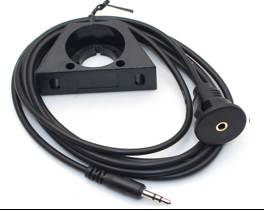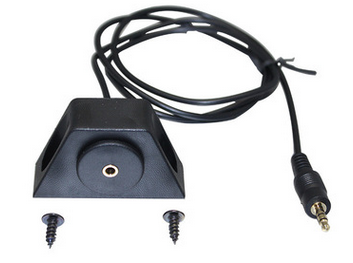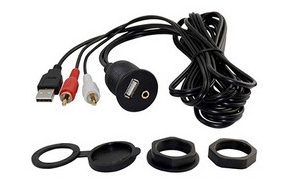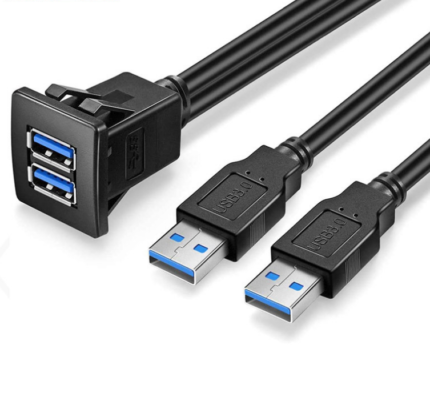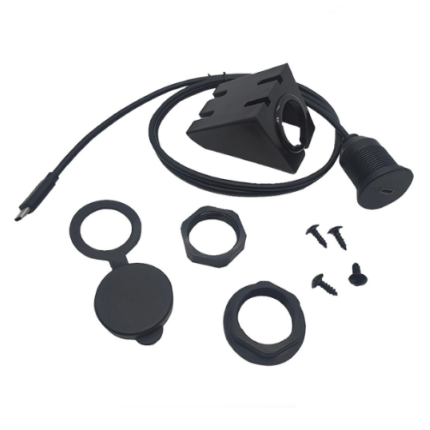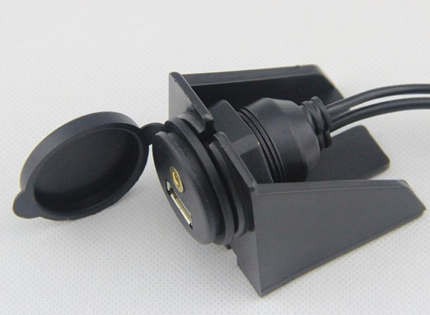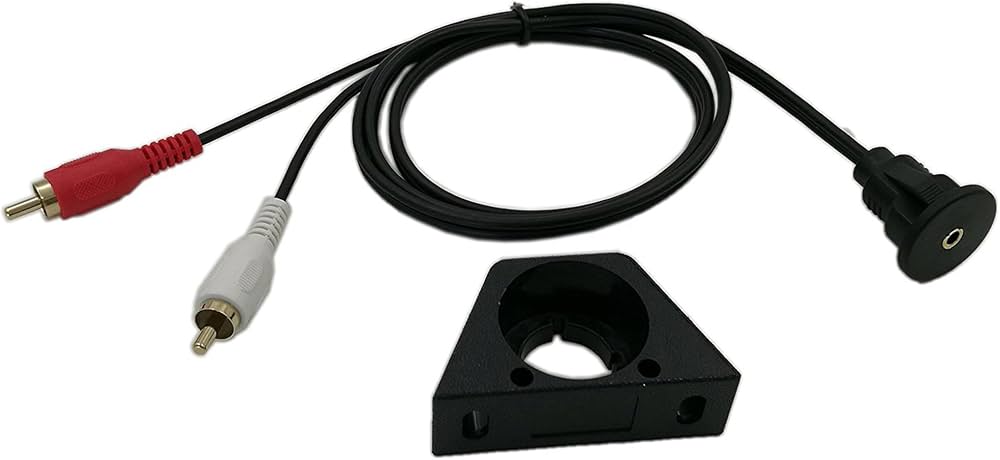
3.5 mm AUX Female to 2 RCA Male Car Dashboard Panel Mount Audio Cable
A 3 5mm aux 2 rca cable gives you a flush 3.5 mm socket on the dash and two RCA plugs at the head unit, so a phone with a headphone output feeds an amplifier input. 4C x 28 AWG, gold contacts, OD 3.5 mm, 1 m / 2 m / 3 m.
Overview
A 3 5mm aux 2 rca cable is the adapter lead that reconciles two worlds that never agreed on a connector: phones and players have a 3.5 mm stereo socket, amplifiers and head units have RCA inputs. This build puts the 3.5 mm female in a flush 28-30 mm panel bracket and takes two RCA male plugs back to the equipment. Four conductors of 28 AWG, gold-plated contacts, black PVC jacket at 3.5 mm OD, in 1 m, 2 m and 3 m. In a 4-conductor construction the spare conductor is normally tied to the sleeve at both ends to lower the return resistance; if you need a microphone channel instead, the panel socket has to be a 4-pole TRRS part and that has to be on the order.
Key Specifications
| Connector A | 3.5 mm Stereo Female, panel mount |
|---|---|
| Connector B | 2x RCA Male, audio left and right |
| Audio channels | Stereo left and right via 2 RCA |
| Conductor | 4C x 28 AWG |
| Outer diameter | OD 3.5 mm |
| Contact plating | Gold plated |
| Jacket material | Black PVC |
| Cable length | 1 m / 2 m / 3 m |
| Mounting | Flush mount bracket, 28-30 mm cut-out, screw and cap |
| Application | Car, marine and motorcycle AUX input; AV receiver and amplifier inputs |
The 3.5 mm pinout, contact by contact
Everything about this adapter follows from three contacts and one convention. On a 3-pole stereo plug the tip is the left channel, the ring is the right channel, and the sleeve is the common return for both. That shared return is why channel separation on a 3.5 mm connection is never as good as on two separate coaxial runs, and it is why a 4-conductor cable that doubles up the sleeve helps. On the RCA side each plug carries one channel: the center pin is the signal and the outer shell is the return, which is why RCA plugs should be inserted and removed one at a time with the amplifier turned down.
| Contact | Signal | Goes to | Fault if wrong |
|---|---|---|---|
| 3.5 mm tip | Left channel | RCA white or black, center pin | Channels swapped |
| 3.5 mm ring | Right channel | RCA red, center pin | Channels swapped |
| 3.5 mm sleeve | Common return | Both RCA outer shells | No sound, or a very thin sound |
| RCA center pin | Signal, one channel | Tip or ring, depending on channel | Nothing, or heavy hum |
| RCA outer shell | Return | Sleeve | Hum, or no return at all |
RCA plugs: the polarity convention nobody enforces
Red is right and white or black is left. That is the RCA connector convention and it is followed often enough to be useful, and breached often enough that you should check rather than trust it. On a stereo image a swapped pair is subtle; on a surround or a subwoofer feed it is not subtle at all. Mark the plugs at install time if there is any chance somebody else will be in the dash later.
Which end should be at the panel?
The adapter can be built either way round, and the decision is about who plugs in, not about signals. A 3.5 mm socket at the panel means anyone with a phone and a headphone output can connect, which is what you want in a car, a boat or a hotel room. RCA at the panel makes sense when the panel is feeding an amplifier and the source is fixed equipment with RCA outputs. There is a mechanical argument too: a 3.5 mm socket is compact and takes little depth, two RCA plug bodies side by side take considerably more.
| Panel end | Choose it when | Depth needed | Who can connect |
|---|---|---|---|
| 3.5 mm stereo socket | The source is a phone, player or laptop | Low – one barrel | Anyone with a headphone output |
| 2 RCA sockets | The panel feeds an amplifier and sources are fixed gear | Higher – two bodies | Anyone with an RCA lead |
| 3.5 mm plus USB | The panel has to charge as well as play | Higher – two bodies | Anyone, and the phone charges |
| Sealed pigtail | The panel is exposed to weather | Varies | Depends on the mating connector |
Where a 3 5mm aux 2 rca cable is the right adapter
- Car, marine and motorcycle AUX inputs where the phone has a headphone socket
- AV receiver and amplifier inputs behind a rack panel, alongside the 8-Pin DIN Panel-Mount Extension
- Head-unit retrofits that keep the original amplifier, see the Car Dashboard USB + 2 RCA Audio Extension
- Hotel, conference and furniture panels with a flush 3.5 mm socket
- Retrofits that need the socket only, without RCA, compare the 3.5 mm AUX Audio Female Panel Mount Extension
- Panels that also carry video, see the HDMI 8K Panel Coupler with Screw Lock
- Cart and equipment panels where a serviceable audio jack beats a hidden one, see the Medical Panel Feedthrough Set
Failure modes on AUX to RCA adapters
The connector-side failures are simple: a plug that is not pushed fully home gives you one channel and a lot of hum, and a worn 3.5 mm socket gives you a channel that comes and goes as the plug is rotated. The installation-side failure is the shared return – because both channels come back on one sleeve conductor, any resistance in that path couples left into right, and the symptom is muddy stereo rather than a hard fault. If channel separation matters, ask for dedicated returns per channel and check the panel socket is wired for it.
What we treat as a target rather than a claim
Ratings shown here are the industry-standard description of what the 3.5 mm AUX Female interface family is defined to do, not test results from a part of ours. Your assembly is built and verified to the values on your drawing, which we check against the supplier datasheet before quoting.
How to specify your build
- Which end is at the panel – 3.5 mm socket, or two RCA sockets.
- Poles – 3-pole stereo as standard, 4-pole TRRS if you need a microphone.
- Returns – common sleeve return, or a dedicated return per channel.
- Cut-out – 28-30 mm round; confirm against the bracket drawing.
- Length – 1 m, 2 m or 3 m, or your measured route length.
- Contact plating – gold as standard; say if the environment is damp.
- Quantity and whether this is a prototype or a production order.
Workmanship and testing
Build standard for 3.5 mm AUX Female builds is IPC/WHMA-A-620 Class 3 under ISO 9001, with terminations from 32 to 12 AWG. continuity and pinout are checked on every 3.5 unit before packing, and seal checking is quoted whenever an ingress rating is on the drawing.
Material declarations against RoHS and REACH are issued per project, alongside the dimensional and electrical reports agreed at quotation; see certifications, compliance and material declarations. Where your drawing names a UL style or another approval, the build follows your drawing and ships with the supporting document rather than a claim of our own. Where this build needs an overmold, the tool is designed, cut and maintained in our own shop under overmold tooling cut in our own tool room, and it is never used for another customer’s program. Related reading: our engineering review process.
Custom builds and ordering
On 3.5 mm AUX Female builds, prototype lots run from 1 to 50 pcs and leave in 3 working days. Production runs of 500 pcs and up ship 14 working days after approval. Tooling not already held adds around 10 working days. 3.5 OEM and ODM shipments carry your part number and labeling, and material certificates plus first-article reports are available.
Related audio and panel hardware
- 8-Pin DIN Male to Female Panel-Mount Extension
- 3.5 mm AUX Audio Female Panel Mount Extension
- Car Dashboard USB + 2 RCA Audio Extension
- HDMI 8K Panel Coupler with Screw Lock
- Medical Panel Feedthrough Set for Cart and Monitor Arms
Full ranges: panel mount cable, signal and data cables and custom wire harnesses.
Frequently Asked Questions
Which RCA plug is left and which is right?
Red is right, white or black is left by convention. It is worth checking with a known track rather than trusting it, because not every manufacturer follows it.
Can I have a microphone on the same socket?
Yes, but the panel socket has to be a 4-pole TRRS part rather than a 3-pole stereo socket. Specify it before we build.
Why does one channel hum when I touch the plug?
The plug is not fully home. Until the sleeve contact is made, the return is open and the input picks up mains hum instead of the signal.
Is a 4-conductor cable better than a 3-conductor one?
On this build the fourth conductor normally parallels the sleeve return, which lowers return resistance and improves separation slightly. It is a real but modest improvement.
| Connector A | 3.5 mm Stereo Female, panel mount |
|---|---|
| Connector B | 2x RCA Male, audio left and right |
| Cable length | 1 m / 2 m / 3 m |
| Audio channels | Stereo left and right via 2 RCA |
| Conductor | 4C x 28 AWG |
| Outer diameter | OD 3.5 mm |
| Contact plating | Gold plated |
| Jacket material | Black PVC |
| Mounting | Flush mount bracket, 28-30 mm cut-out, screw and cap |
| Application | Car, marine and motorcycle AUX input; AV receiver and amplifier inputs |