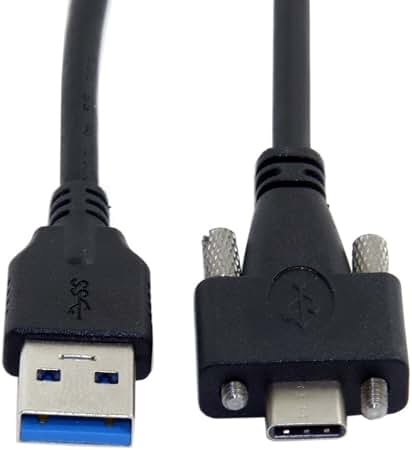
USB 3.1 Type-A Male to Type-C Female Screw-Lock Adapter Cable (5 Gbps, M2, Industrial Panel Mount)
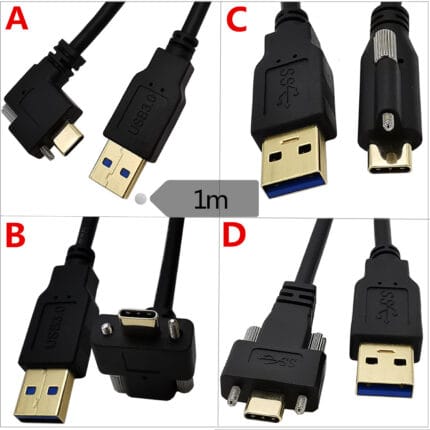
A screw lock adapter cable that gives a Type-A host a panel-mounted, vibration resistant USB-C port: two thumbscrews, thread and cutout to your panel.
Overview
A screw lock adapter cable of this type gives older equipment a modern, locked port. The Type-A end plugs into whatever host you already have; the Type-C receptacle is fixed to the panel with two thumbscrews, so a standard Type-C cable can be plugged into a port that does not walk out under vibration. It is the cheapest way to add a serviceable USB-C input to a machine that was built before USB-C existed.
Key Specifications
| Connector A (Host) | USB 3.1 Type-A Male |
|---|---|
| Connector B (Panel) | USB 3.1 Type-C Female Screw-Lock |
| Standard | USB 3.1 Gen1 |
| Data Rate | 5 Gbps |
| Lock | M2 x 2 Thumbscrews on Type-C side; M3 or 4-40 UNC to order |
| Contact | Gold-Plated |
| Panel Mount | Two-screw fixing, cutout to your drawing |
| Application | Industrial Control Panel, Machine Vision, Kiosk |
| Strain Relief | Molded PVC |
When you need this and when you do not
| Situation | This build | Why |
|---|---|---|
| Old host, new peripherals | Yes | Adds a locked Type-C port to a Type-A host |
| Port on a vibrating machine | Yes | The screws stop the plug walking out |
| Port plugged daily by operators | Yes | Wear lands on the replaceable receptacle |
| Both ends already Type-C | No | Use a Type-C screw-lock cable instead |
| Only need a longer lead | No | An extension is simpler and cheaper |
The point of the panel-mount end is serviceability: the part that wears is the part you can replace without opening the machine.
Thread, cutout and panel thickness
- Standard thread is M2 on the small Type-C body. Where the panel hardware is M3 or 4-40 UNC, we supply that instead.
- Screw pitch is measured center to center. Measure the panel, not the connector.
- Panel thickness sets screw length. A screw that bottoms out feels tight and clamps nothing.
- Cutout is quoted per body style; send the drawing and we confirm before tooling.
- Tapped holes or nuts: say which, because the hardware differs.
Thread sizes above are general hardware definitions. Your assembly is built and verified to the dimensions on your drawing.
Machine vision is where most of these end up, and it is a demanding application: the camera runs continuously, the frame moves, and a dropped frame is a bad part.
Why the original connection failed
- Vibration fretting on an unclamped plug, showing up as a device that disappears from the host.
- Adapter stacks. A Type-A to Type-C adapter on the end of an extension is two interfaces where there should be one, and both work loose.
- Cable weight levering a free-hanging adapter out of the host port.
- Snagging on a lead that runs across a walkway.
- Daily plugging at a service port wearing the host socket, which is soldered to the board.
Fitting and verifying the panel port
- Confirm the thread, the screw pitch and the cutout before ordering.
- Fix the Type-C receptacle to the panel first, then route the cable to the host.
- Plug the Type-A end into the host and let it enumerate.
- Connect the device and confirm the negotiated rate in the host, not just that it appeared.
- Tighten both thumbscrews by hand and re-check after the first week of service.
Typical Applications for This Screw Lock Adapter Cable
- Industrial control panels and PLCs needing a permanent USB-C port
- Machine vision PCs and camera systems with a screw-locked bulkhead
- Kiosks, self-service terminals and signage players
- Embedded systems and test fixtures with a ruggedized service port
- Retrofits where the host only has a USB Type-A port
How to specify your build
- Host end: USB 3.1 Type-A, or another interface if the host differs.
- Thread and screw pitch: M2, M3 or 4-40 UNC, plus the center distance.
- Panel thickness and cutout.
- Length from host to panel.
- Standard: USB 3.1 Gen1, or USB 2.0 where the link allows it.
- Marking with your part number for fleet builds.
- Quantity, and whether this is a prototype or a production order.
Workmanship and testing
Assembly and inspection follow IPC/WHMA-A-620 Class 3 workmanship criteria under our ISO 9001 quality management system, and every unit passes 100% continuity and pinout testing before it is packed. Conductor range is 32 to 12 AWG. Thread sizes are checked against the drawing on the production batch. Values quoted for the interface are the industry-standard ones; your assembly is built and verified to the values on your drawing.
Every production run can ship with RoHS and REACH declarations and the electrical report agreed at quotation; see certifications and material declarations. UL styles and other named approvals are built to drawing: we source to the style you specify and document it, rather than asserting a listing we do not hold. Production runs on the same lines described under the assembly lines behind this build, where cutting, termination, molding and 100 percent electrical verification sit under one roof. More background: our build-to-print process. Tooling is quoted separately, cut in-house rather than brokered out, and owned by you.
Custom builds and ordering
For USB 3.1 Type-A Male builds, prototypes run from 1 to 50 pcs with a 3 working day turnaround. Volume orders begin at 500 pcs and ship 14 working days after sample sign-off. Tooling not already held adds around 10 working days. OEM and ODM USB work ships under your part number and labeling, and material certificates with first-article reports are available.
Related screw-lock and vision assemblies
Panel and vision installations usually need one of these alongside:
- Right-Angle USB Type-C Male to Male Screw-Lock Cable
- Screw-Lock Type-C 3.1 Extension Cable, Male to Female
- Screw-Lock USB 3.0 Type-A Male to Female Socket Extension Cable
- USB Type-C Latch-Lock Extension Cable
- USB3 Vision Camera Cable with Locking Screws
- USB Type-C to M12 8-Pin Industrial Cable for Panel and Machine Vision
- Kiosk and Self-Service Terminal Harness
Full range: screw-lock molded cable assemblies.
Questions Before You Order
What thread are the screws?
M2 on the standard Type-C body. If your panel is drilled for M3 or 4-40 UNC, name it on the order.
Does it need a driver or power?
No. It is a passive adapter cable: plug it in and it works, subject to what the host supports.
Will it run at USB 3.1 speed?
The link runs at whatever the lower of the two devices supports. This build is made for USB 3.1 Gen1 hosts and devices.
Can I have it the other way round?
Yes. A Type-C plug to a Type-A receptacle is built the same way if that is what the installation needs.
What is the minimum order?
For USB 3.1 Type-A Male builds, prototypes run from 1 to 50 pcs with a 3 working day turnaround. Volume orders begin at 500 pcs and ship 14 working days after sample approval.
| Connector A (Host) | USB 3.1 Type-A Male |
|---|---|
| Connector B (Panel) | USB 3.1 Type-C Female Screw-Lock |
| Standard | USB 3.1 Gen1 |
| Data Rate | 5 Gbps |
| Lock | M2 x 2 Thumbscrews on Type-C side; M3 or 4-40 UNC to order |
| Contact | Gold-Plated |
| Application | Industrial Control Panel, Machine Vision, Kiosk |
| Panel Mount | Two-screw fixing, cutout to your drawing |
| Strain Relief | Molded PVC |