usb 2.0 a to mini b Latch-lock Cable for Automotive Front Camera / GPS / Industrial Vision (480 Mbps, M2)
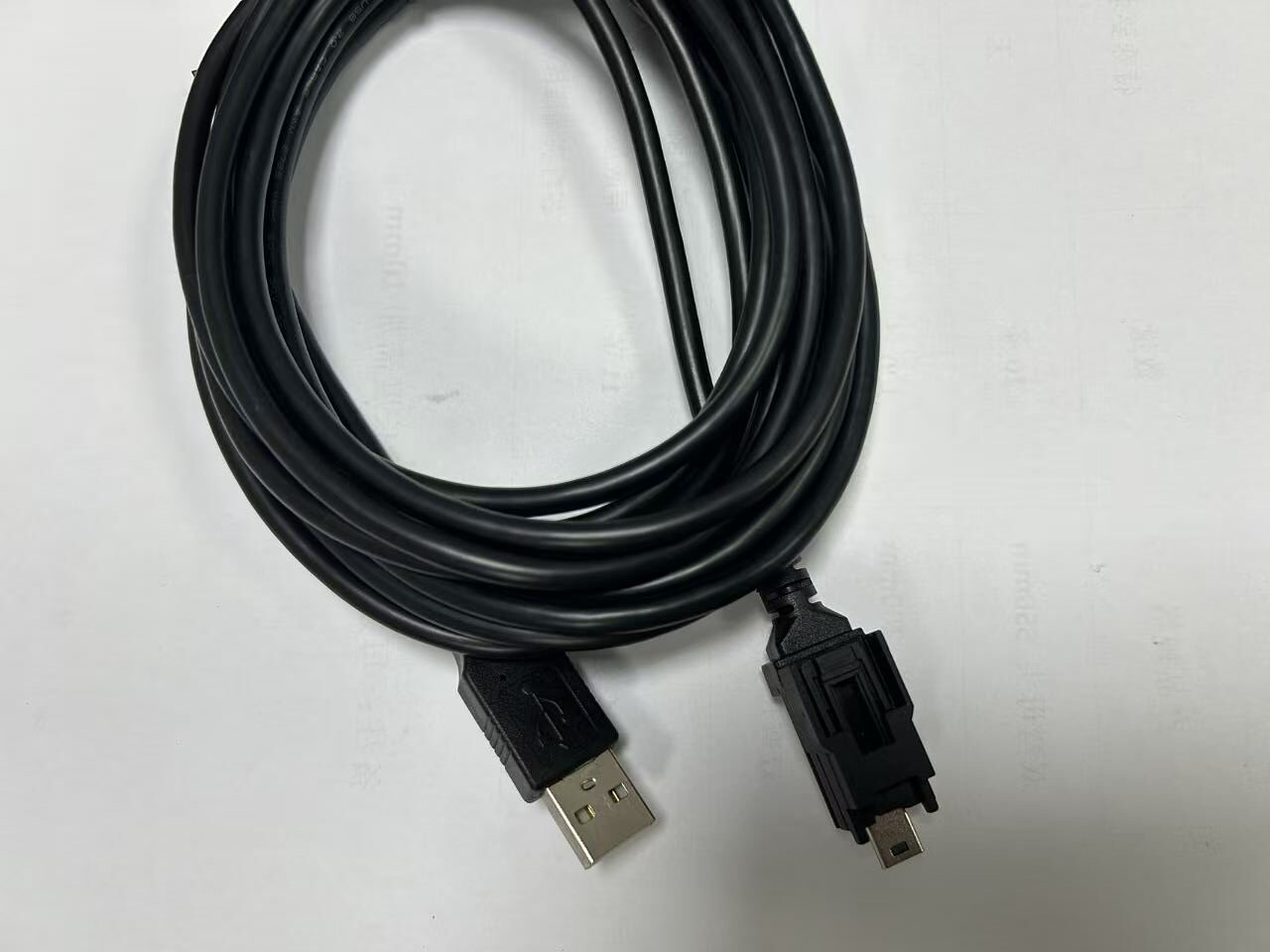
A usb mini b automotive cable with an M2 thumbscrew on the Mini-B end, so the plug cannot walk out of the device under engine vibration. 28 AWG stranded, UL2725 PVC jacket, gold-plated contacts, 1.5 m. For dash cams, GPS and machine vision.
Overview
A usb mini b automotive cable exists because the ordinary Mini-B plug is a friction-fit part in a place where friction is not enough. The Mini-B end on this build carries a single M2 thumbscrew that threads into the matching receptacle on the device, so the connector is held by a screw rather than by the spring tension of a shield tab. Behind that is a 28 AWG stranded conductor in a UL2725 PVC jacket at 4.5 mm OD, with gold-plated contacts, which is the combination you want when the run sits behind a dashboard or inside a machine-vision housing and nobody is going to look at it again for five years. It is still a USB 2.0 High Speed part at 480 Mbps as defined by the USB Implementers Forum, backward compatible with USB 1.1, and 1.5 m is the stock length.
Key Specifications
| Connector A | USB 2.0 Type-A Male |
|---|---|
| Connector B | USB Mini-B 5-Pin Male with M2 thread lock |
| Standard | USB 2.0 High Speed, 480 Mbps |
| Conductor | 28 AWG stranded |
| Contact | Gold-plated |
| Cable OD | 4.5 mm |
| Jacket | UL2725 PVC |
| Thread | M2 x 4.0 x 36 mm thumbscrew |
| Length | 1.5 m / 5 ft |
| Operating temperature | -20 C to +80 C |
Why the standard cordset fails in a vehicle
A Mini-B receptacle holds a plug with two small dimples in the shield. That is enough for a camera on a desk and it is not enough for anything bolted to a vehicle. Engine idle, road input and the thermal cycling of the cabin all feed a low-amplitude relative motion into the joint, and the connector frets: the contact surfaces rub by a few microns, the plating wears, the contact resistance goes up, and the device starts dropping out or browning out. Nothing looks broken. That is what makes it expensive – the fault is intermittent and it never reproduces on the bench.
| Failure mode | What you see | Root cause | What fixes it |
|---|---|---|---|
| Fretting at the contacts | Device drops out over a bump, comes back on its own | Micron-scale motion between contact surfaces | Screw the connector down so the motion stops |
| Plug walking out | Found unplugged after a long run | Friction-fit retention decaying with vibration | M2 thumbscrew into the device receptacle |
| Intermittent 5 V | Camera reboots at idle | Contact resistance rising at the worn interface | Gold-plated contacts and a locked joint |
| Conductor break at the shell | Works when wiggled, dead when released | Strain landing on the solder cups instead of the jacket | Strain relief at the shell, plus a service loop |
| Chafed jacket | Short to body after a season | Cable tied to a moving part with no slack | Tie to fixed structure, keep clear of the steering column |
What the M2 thumbscrew actually locks to
The screw on this build is M2 x 4.0 x 36 mm and it needs a threaded receptacle on the device to bite into. That is the one thing to check before ordering: plenty of cameras and GPS units have the two threaded lugs either side of the Mini-B port, plenty do not, and a thumbscrew with nothing to thread into is dead weight. Tighten by hand. Snug is enough to stop relative motion; more than that strips an M2 thread in a plastic housing, which is a worse failure than the one you were fixing.
28 AWG over 1.5 m: the voltage drop question
Data at 480 Mbps is not the constraint here, power is. A worked example, using the nominal resistance of 28 AWG stranded copper and counting the return path, gives roughly two thirds of an ohm for the round trip on a 1.5 m lead. At 500 mA that is around a third of a volt lost, which most 5 V devices tolerate. At 1 A you are losing well over half a volt, and a device at the far end of a longer custom length may fall below its undervoltage threshold even though the supply is healthy. This is a calculation from the nominal conductor resistance, not a measured figure from your build – if the load matters, tell us the current and the length and we will size the power conductors accordingly.
| Load | Approximate round-trip drop | What it means |
|---|---|---|
| 100 mA, small GPS logger | Well under 0.1 V | No concern at any sensible length |
| 500 mA, typical dash-cam | Around 0.3 V | Fine at 1.5 m; check the source adapter first |
| 1 A, tablet or phone charging | Around 0.6 V and climbing with length | Specify heavier power conductors on longer runs |
| 2 A and above | Not a job for 28 AWG | Ask for a build with a separate, heavier power pair |
Where a usb mini b automotive cable earns its keep
- Dash cams, front and reverse cameras, and GPS navigators with a threaded Mini-B receptacle
- Industrial machine-vision cameras on vibrating mounts, where a dropout costs a rejected part
- Ruggedised handhelds, barcode terminals and test instruments used in vehicles
- Lab and kiosk gear that gets moved on a cart and plugged in repeatedly
- Any install where the device end is inaccessible once the trim is back on
- Builds that also need a right-angle device plug, see our Car USB-C Data Cable with Right Angle Plug
- Installations where the camera end is sealed and the host end is not, compare the Circular USB-C Screw Cable with Metal M12 Style Shell
- Machine builds that route the same run through a cabinet wall, see the Control Cabinet Service Interface
Routing and the bend radius nobody checks
A 4.5 mm cable looks like it will go anywhere, and that is exactly why it gets folded. The minimum bend radius has to be respected at the point where the cable leaves the overmolded shell, because that is a rigid-to-flexible transition and it is where stranded conductors break one strand at a time. Leave the cable straight for the first few centimeters out of the connector, keep the radius generous at every turn, and do not tie the run to anything that moves relative to the device.
What we treat as a target rather than a claim
Ratings shown here are the industry-standard description of what the usb 2.0 a interface family is defined to do, not test results from a part of ours. Your assembly is built and verified to the values on your drawing, which we check against the supplier datasheet before quoting.
How to specify your build
- Confirm the device receptacle – an M2 thumbscrew needs threaded lugs on the device.
- Length – 1.5 m stock, or the measured route length.
- Load current – so we can size the power conductors if 28 AWG is not enough.
- Connector orientation – straight or right-angle at the Mini-B end.
- Jacket – UL2725 PVC as standard; PUR where oil or coolant is present.
- Environmental exposure – in-cabin, under-hood, or outdoor at the device end.
- Quantity and whether this is a prototype or a production order.
Workmanship and testing
usb 2.0 a builds are made to IPC/WHMA-A-620 Class 3 workmanship inside an ISO 9001 system, over a 32 to 12 AWG range. No usb assembly is boxed before continuity and pinout are confirmed, and seal checking is quoted whenever an ingress rating is on the drawing.
Material declarations against RoHS and REACH are issued per project, alongside the dimensional and electrical reports agreed at quotation; see certifications, compliance and material declarations. Where your drawing names a UL style or another approval, the build follows your drawing and ships with the supporting document rather than a claim of our own. Where this build needs an overmold, the tool is designed, cut and maintained in our own shop under overmold tooling cut in our own tool room, and it is never used for another customer’s program. More background: engineering support and design for manufacture review.
Custom builds and ordering
For usb 2.0 a builds, prototypes run from 1 to 50 pcs with a 3 working day turnaround; volume orders begin at 500 pcs and ship 14 working days after approval. Tooling not already held adds around 10 working days. usb builds go out under your part number and labeling, and material certificates and first-article reports are on offer.
Related locking and automotive hardware
- Car USB-C Data Cable with Right Angle Plug
- Circular USB-C Screw Cable with Metal M12 Style Shell
- Aramid Reinforced USB-C Cable
- CoaXPress Machine Vision Cable Assembly
- Control Cabinet Service Interface with RJ45 and USB-C
Full ranges: panel mount cable, signal and data cables and screw-lock molded cable.
Frequently Asked Questions
Will the thumbscrew fit my camera?
Only if the device has the threaded lugs either side of its Mini-B receptacle. Check the device before you order – the screw needs something to thread into.
How tight should the thumbscrew be?
Hand tight and no more. The screw only has to stop relative motion at the interface; an M2 thread in a plastic housing strips easily.
Is 480 Mbps enough for a machine-vision camera?
For compressed or lower-resolution streams, yes. For high frame rates at full resolution, look at the CoaXPress and GigE builds instead – USB 2.0 is the wrong bus for that bandwidth.
Can I get a longer run?
Yes, custom lengths are quoted. Tell us the load current at the same time, because drop across 28 AWG is the thing that limits length, not the data rate.
| Connector A | USB 2.0 Type-A Male |
|---|---|
| Connector B | USB Mini-B 5-Pin Male with M2 thread lock |
| Standard | USB 2.0 High Speed, 480 Mbps |
| Conductor | 28 AWG stranded |
| Contact | Gold-plated |
| Cable OD | 4.5 mm |
| Jacket | UL2725 PVC |
| Thread | M2 x 4.0 x 36 mm thumbscrew |
| Length | 1.5 m / 5 ft |
| Operating temperature | -20 C to +80 C |
Related products
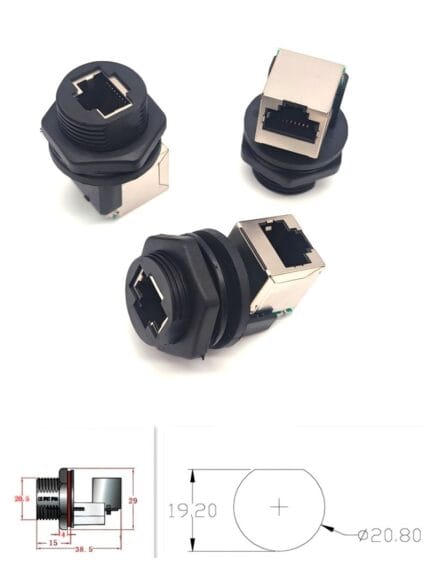
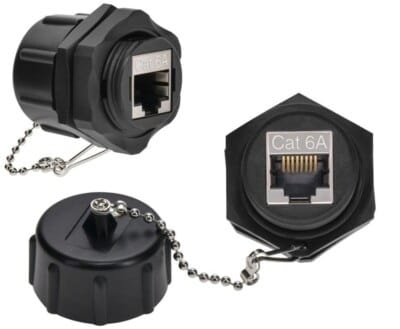
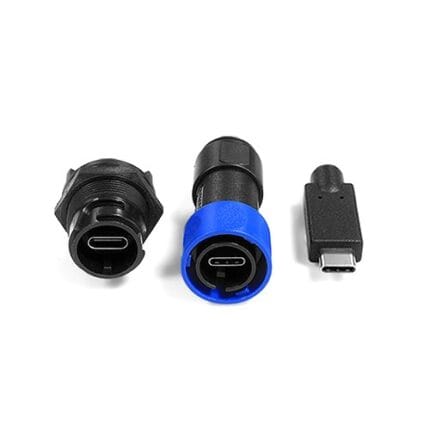
SPE Bulkhead Panel Connector for 10BASE-T1L Field Devices
An SPE bulkhead panel connector brings 10BASE-T1L single pair Ethernet and Power over Data Line into a field device box through one sealed penetration. IEC 63171-6 mating face or M8 coupling, front or rear mounting. The cut-out is smaller and the termination is faster than a four-pair Ethernet entry.