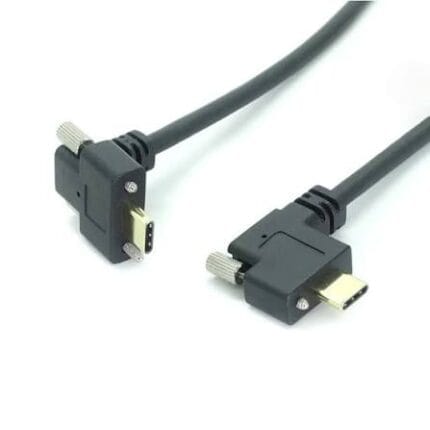
screw lock Type C 3.1 extension cable male to female anti-vibration and prevent accidental disconnection
A screw lock type c extension cable that stays mated when the machine shakes: USB 3.1 male to female, dual thumbscrews on the panel end, built to your panel and length.
Overview
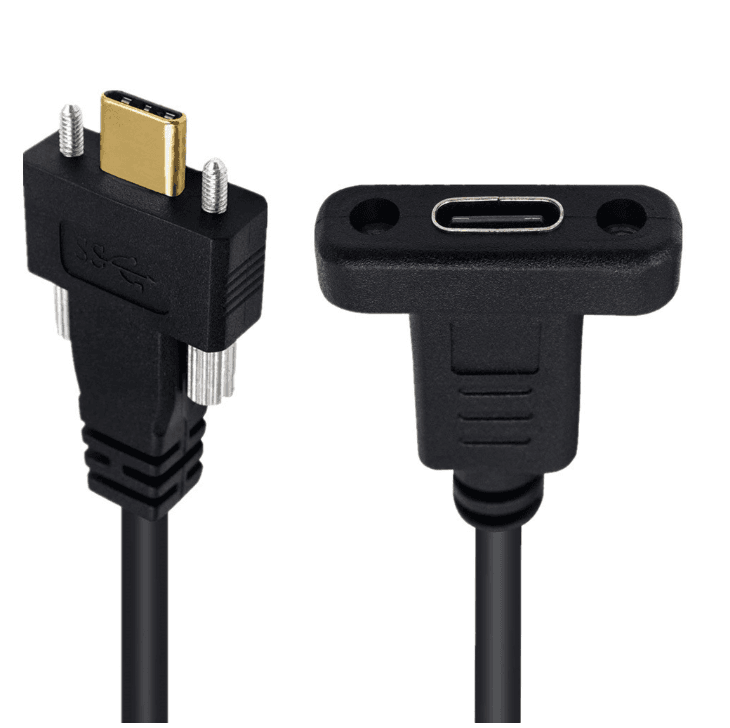
A screw lock type c extension cable exists because a standard USB-C plug has no retaining feature at all: it is held in by contact friction, and contact friction is exactly what vibration defeats. On a machine frame, a vehicle or a door-mounted panel, the plug walks out a fraction of a millimeter per cycle until the link drops. This build puts a thumbscrew pair on the panel end so the joint is clamped, not just pushed together, while the device end stays a normal reversible Type-C plug.
Key Specifications
| Connector A | USB Type-C Male |
|---|---|
| Connector B | USB Type-C Female Panel-Mount with Dual Thumbscrews |
| Lock | Dual thumbscrews on the panel-mount end |
| Thread | M2 standard; 4-40 UNC or M3 to your panel specification |
| Standard | USB 3.1, backward compatible with USB 2.0 |
| Orientation | Straight on both ends |
| Strain Relief | Molded PVC |
| Jacket | Black PVC |
| Application | Vibration-prone industrial equipment, control panel, kiosk |
What actually holds a USB-C plug in place
The retention on a standard USB-C receptacle comes from the side latches inside the shell, and it is specified for hand insertion and removal, not for a machine that runs all shift. Vibration does not pull the plug straight out; it frets the contacts, the link re-negotiates, and the host drops the device. Three fixes get used, and they are not equivalent:
| Retention method | How it works | Where it is enough |
|---|---|---|
| Standard friction | Shell latches only | Desk equipment that never moves |
| Latch-lock shell | Spring latch on the plug | Portable kit that gets moved occasionally |
| Thumbscrew pair | Screws into the panel or receptacle | Anything on a frame, vehicle or moving axis |
| Threaded coupling | Metal collar on a circular shell | Washdown and outdoor enclosures |
Thread and panel cutout
The screws are the part that catches people out. On USB Type-A and Type-B locking shells the usual thread is 4-40 UNC, which is the size most industrial panel hardware already expects. On a small Type-C panel body there is not enough metal for that, so standard builds on this platform use M2. We supply the thread you name on the drawing: M2, M3 or 4-40 UNC, with the screw pitch and panel cutout to your panel specification rather than to a guess.
- Screw pitch has to match the holes already in your panel. Measure center to center, not edge to edge.
- Panel thickness sets the screw length. A screw that bottoms out is worse than no screw, because it feels tight and clamps nothing.
- Cutout size is quoted per body style; send the panel drawing and we will confirm before tooling.
Thread sizes above are general hardware definitions, not a claim about our own product. Your assembly is built and verified to the dimensions on your drawing.
Why the original cable failed
- Vibration fretting on the contacts, which shows up as intermittent enumeration rather than a clean failure.
- Cable weight on the plug. A long run hanging off a horizontal port levers the connector until the latches give up.
- Snagging. One pull on a cable routed past a walkway is enough to break a shell that has no clamp.
- Thermal cycling in an enclosed panel works the joint loose over a season.
- Right-angle strain. Where depth is tight and the cable is bent hard at the exit, the molded relief is doing work it was not shaped for.
The connector itself is the USB-C shell, which is why a locked build still mates with ordinary cables: the screws add retention, they do not change the interface.
Fitting and verifying a locked run
- Confirm the screw thread and pitch against the panel before you order, not after.
- Seat the plug fully, then tighten both screws evenly by hand. Power tools strip M2 threads.
- Support the cable within 150 mm of the connector so the weight is not on the shell.
- Enumerate the device, then run a sustained transfer rather than trusting the connect sound.
- Re-check the screws after the first week of service on a vibrating machine.
Typical Applications for This Screw Lock Type C Extension Cable
- Machine vision cameras on frames and gantries that run continuously
- Control cabinets where a Type-C service port has to survive daily plugging
- Kiosks and self-service terminals with a panel-mounted user port
- Test fixtures and burn-in rigs re-racked several times a shift
- Vehicle and rail installations where the harness sees constant vibration
How to specify your build
- Thread and pitch: M2, M3 or 4-40 UNC, and the screw center distance.
- Panel thickness and cutout from your drawing.
- Ends: which end is the panel receptacle and which is the free plug.
- Length, and the routing between panel and host.
- Standard: USB 3.1, or USB 2.0 only where the link does not need the bandwidth.
- Jacket: standard PVC, or PUR where the run sees oil.
- Quantity, and whether this is a prototype or a production order.
Workmanship and testing
Assembly and inspection follow IPC/WHMA-A-620 Class 3 workmanship criteria under our ISO 9001 quality management system, and every unit passes 100% continuity and pinout testing before it is packed. Conductor range is 32 to 12 AWG. Where a thread size is specified it is verified against the drawing with go and no-go gauges on the production batch. The thread forms named above are general hardware definitions; the values your assembly is built and verified to are the ones on your drawing.
RoHS and REACH declarations are provided per project together with the agreed test reports; the documentation scope is listed under certifications and compliance. If your drawing specifies a UL style, we build to that drawing and supply the UL reference with the shipment instead of substituting an equivalent. The strain relief and molded body are produced on tooling we cut ourselves see overmold tooling cut in our own tool room so the tool is quoted separately, owned by you, and available for repeat runs years later. The wider context is covered under our build-to-print process.
Custom builds and ordering
screw lock Type C prototypes start from 1 to 50 pcs and ship in 3 working days. Series supply starts at 500 pcs and takes 14 working days after approval. Tooling not already held adds around 10 working days. screw builds ship under your part number and labeling for OEM and ODM orders, and material certificates with first-article reports are available.
Related screw-lock assemblies
If the panel end needs to be a different interface, or the cable has to leave the connector at an angle, these sit in the same family:
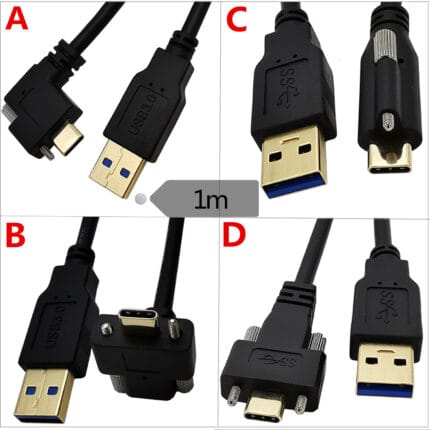
- USB 3.1 Type-A Male to Type-C Female Screw-Lock Adapter Cable
- Right-Angle USB Type-C Male to Male Screw-Lock Cable
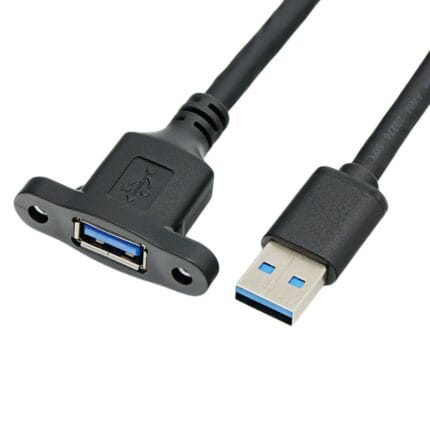
- Screw-Lock USB 3.0 Type-A Male to Female Socket Extension Cable
- USB-C Screw Locking Cable
- USB Type-C Latch-Lock Extension Cable
- USB3 Vision Camera Cable with Locking Screws
- Waterproof USB-C Panel Pigtail
Full range: screw-lock molded cable assemblies.
Questions Before You Order
What thread do the screws use?
Standard builds on this body use M2. If your panel is drilled for M3 or 4-40 UNC, say so on the order and we supply that instead.
Can I get an angled exit?
Yes. Where the run has to leave the connector parallel to the panel, see our right-angle Type-C screw-lock build.
Does a locked cable still work with normal USB-C devices?
Yes. The screws only add retention; the interface and the pinout are unchanged.
How tight should the screws be?
Hand tight plus a quarter turn. M2 threads strip easily, and a stripped screw clamps nothing.
What is the minimum order?
screw lock Type C prototypes start from 1 to 50 pcs and ship in 3 working days. Series supply starts at 500 pcs and takes 14 working days after approval.
| Connector A | USB Type-C Male |
|---|---|
| Connector B | USB Type-C Female Panel-Mount with Dual Thumbscrews |
| Lock | Dual thumbscrews on the panel-mount end |
| Orientation | Straight on both ends |
| Strain Relief | Molded PVC |
| Jacket | Black PVC |
| Application | Vibration-prone industrial equipment, control panel, kiosk |
| Thread | M2 standard; 4-40 UNC or M3 to your panel specification |
| Standard | USB 3.1, backward compatible with USB 2.0 |