USB4 Screw Lock Cable, 80Gbps Dual-Screw USB-C, PD 3.1 EPR 240W
Why a Screw Lock on USB-C
USB-C was designed as a consumer connector, and its friction fit is adequate for a laptop on a desk. It is not adequate for a broadcast camera on a jib, a vision box bolted into a rack that gets trucked to site, or an XR rig worn by a moving operator. At 80 Gb/s the link margin is also far tighter than it was at 5 Gb/s, so a plug that has worked slightly loose does not just fall out — it first degrades into intermittent link training failures that are expensive to diagnose. A pair of screws on the plug shell removes the variable.
Retention Design
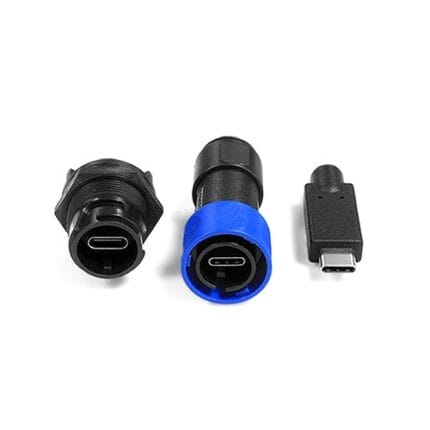
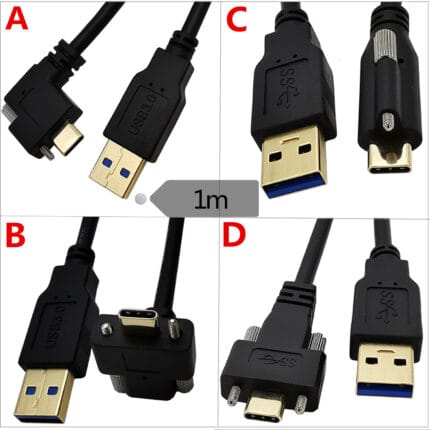
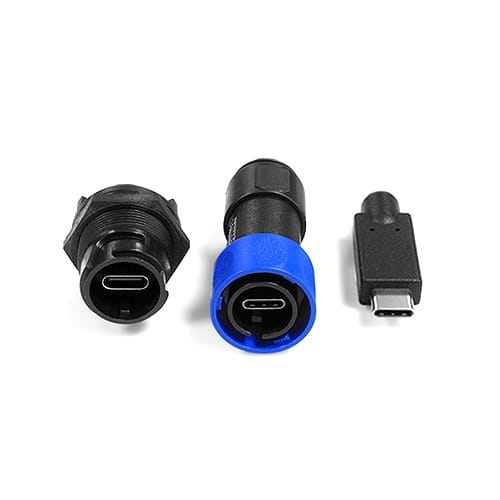
- Two knurled thumb screws, one on each side of the plug shell, engaging threaded posts on the device jack.
- Screws are captive in the overmold so they cannot be lost during a build or a service call.
- Finger-tight installation; no driver required, which matters when the port is behind a panel.
- Screw pitch matched to the common dual-screw USB-C receptacle footprint used on industrial and broadcast equipment.
High-Speed Construction
At this data rate the cable is the component that decides whether the link trains. The construction uses coaxially built high-speed pairs with individual shielding and a continuous 360-degree shield around the whole bundle, terminated into the plug shell on both ends rather than pigtailed. The jacket is TPE, chosen for a thin wall and a small bend radius without the stiffness that a heavier jacket would introduce.
Power Delivery
The assembly is built for USB Power Delivery 3.1 Extended Power Range, up to 240 W at 48 V and 5 A. That allows a single cable to run a camera, a monitor and a dock, and removes the separate DC barrel supply from the bill of materials. As with any EPR assembly, the power contract depends on the source, the sink and the cable all supporting the same profile.
Where It Is Used
- 8K and 16K production cameras feeding a recorder or a switcher.
- Machine vision and inspection stations with a high-bandwidth link to a host frame grabber.
- XR and simulation rigs where the tether is subject to constant movement.
- Docks and expansion enclosures in broadcast and industrial enclosures.
Compatibility and Caution
The plug is a standard USB-C connector and will mate with any USB-C receptacle that presents the matching threaded posts; it will also plug into an unthreaded consumer port, in which case it behaves as a normal USB-C cable without retention. Backward compatibility with earlier-generation USB-C hosts and devices is expected, but the achievable data rate and power profile are set by the lowest common denominator in the chain, so we recommend a sample evaluation on the actual host hardware before volume release.
Ordering Notes
Stock lengths are 0.5 m, 1 m and 2 m, with 0.3 m available for rack-internal runs. Longer runs at 80 Gb/s are only practical with an active or optical assembly, so we qualify the link end to end with the customer rather than quoting a passive length that will not hold the rate.
Related Cable Ranges
Panel Mount Cable • Signal and Data Cables • Circular M8 M12 Cable
| Category | Screw-Lock Molded Cable |
|---|---|
| Interface | USB4, USB-C plug both ends |
| Data rate | Up to 80 Gb/s (USB4 Gen 4 x 2) |
| Power delivery | USB PD 3.1 EPR, up to 240 W (48 V / 5 A) |
| Retention | Dual knurled thumb screws, captive |
| Shielding | Coaxial high-speed pairs, 360-degree overall shield |
| Jacket material | TPE |
| Display support | DisplayPort Alt Mode, high-resolution output |
| Lengths | 0.3 / 0.5 / 1 / 2 m |
| Application | Broadcast, machine vision, XR, docking |