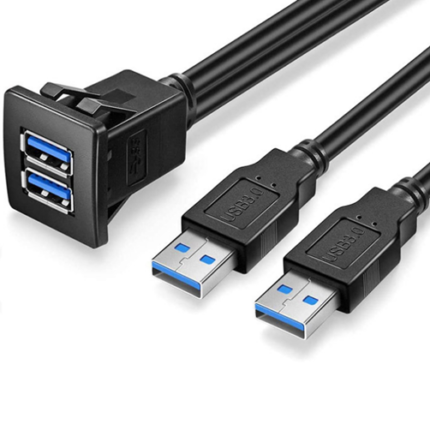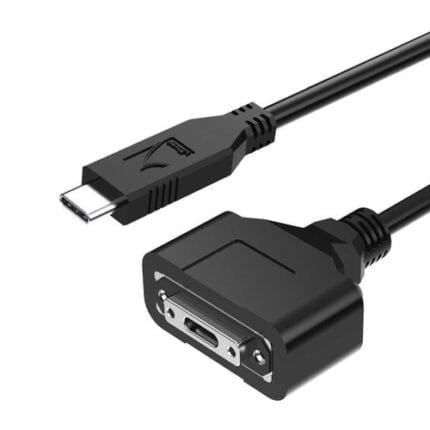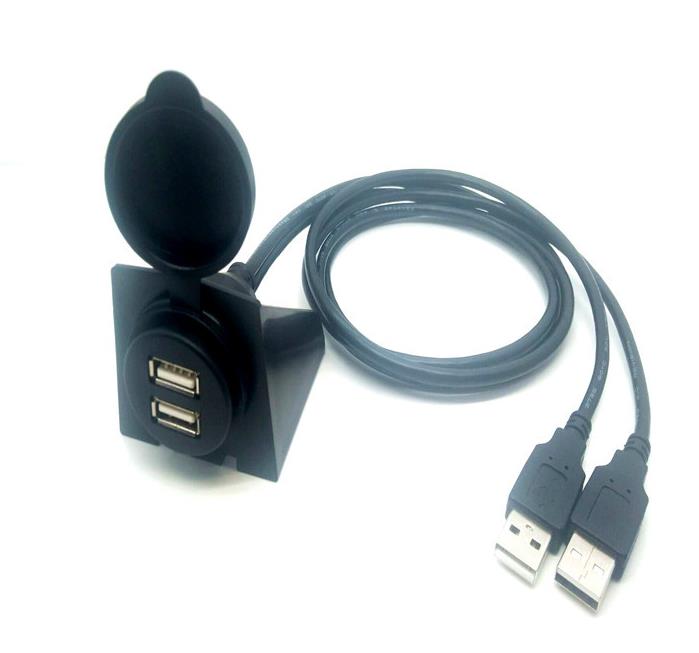
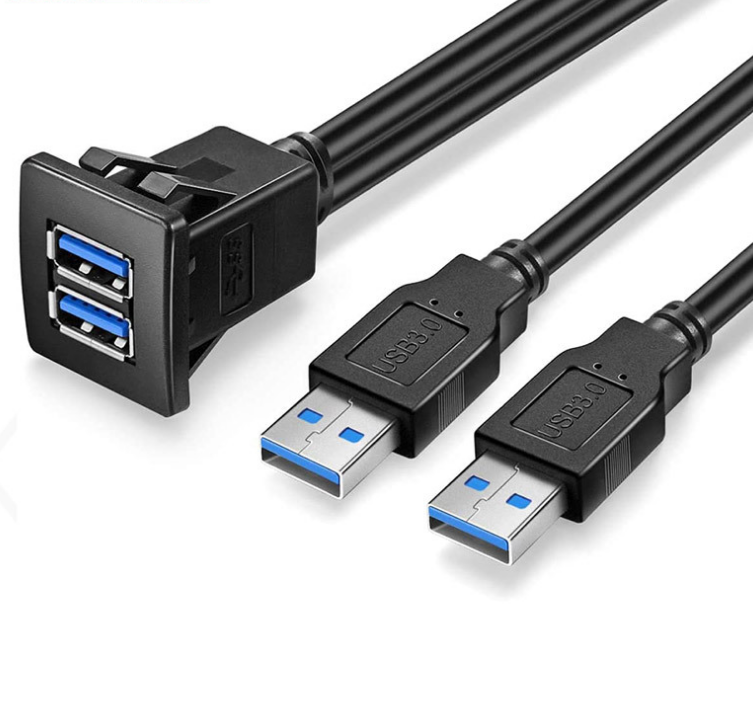
Dual USB-A Twin Port Car Dashboard Flush Mount Extension Cable
A dual usb twin port cable puts two USB-A sockets in one flush panel bracket, so a driver and a passenger can charge at the same time. 28 AWG data with 24 AWG power per leg, OD 4.5 mm, black PVC jacket, 1 m / 2 m / 3 m.
Overview
A dual usb twin port cable is two USB-A sockets on one bracket, in one 28-30 mm round cut-out, each leg carrying its own 28 AWG data pair and 24 AWG power pair back to two separate USB-A male plugs at the source. The point is not redundancy, it is that a two-socket panel needs one hole instead of two, and a passenger and a driver can charge at once without a splitter dangling out of the dash. Both legs are individually wired, which matters: a Y-splitter that feeds two sockets from one source conductor is a different, cheaper, and worse part. This is the USB-A version; the USB-C twin-port build is the one to look at if the devices being charged are modern phones.
Key Specifications
| Connector A | 2x USB-A Male |
|---|---|
| Connector B | 2x USB-A Female, panel mount |
| USB specification | USB 2.0 480 Mbps; USB 3.0 5 Gbps with blue insert |
| Function | Data and charging extension |
| Conductor | 28 AWG data + 24 AWG power per leg |
| Outer diameter | OD 4.5 mm |
| Jacket material | Black PVC |
| Cable length | 1 m / 2 m / 3 m |
| Mounting | Twin-port flush mount bracket, 28-30 mm cut-out, screw and cap |
| Application | Car, marine and motorcycle dashboards; truck and RV sleeper cabs |
Which twin-port build do you need?
Twin-port panels come in three flavours and the differences are not cosmetic. Two USB-A sockets, two USB-C sockets, or one of each. The right answer depends on the device fleet, not on the vehicle.
| Build | Sockets | Best for | Watch out for |
|---|---|---|---|
| Twin USB-A | 2 x USB-A female | Fleet vehicles with legacy device cables | Modern phones may need a USB-C adapter or cable |
| Twin USB-C | 2 x USB-C female | Newer phones and tablets, PD charging | PD negotiation and e-marker behavior on the source side |
| Mixed A and C | 1 x USB-A, 1 x USB-C | Mixed fleets, passenger plus driver | Two different current budgets on one bracket |
| Single port | 1 socket | One device, or a data port | Not enough when two people travel together |
| Splitter off one source | 2 sockets, 1 source conductor | Never, on a vehicle build | Shared conductor means both devices sag under load |
Build the current budget before you order
This is where twin-port installs go wrong. Two sockets implies two loads, and the source has to cover both – no cable can offer more than the USB specification allows a legacy port to deliver. A twin-port panel fed from a single 1 A head unit port will not charge two phones at full rate, and the symptom – both devices charging slowly and one of them disconnecting when the other starts – gets blamed on the cable. Each leg here has its own 24 AWG power pair back to its own plug, so the cable is not the bottleneck; the source is. Size the source for the total draw and, where the run is long, tell us the load so we can step up the power conductors.
| Scenario | Total draw | What the source needs | Conductor note |
|---|---|---|---|
| Two phones, standard charge | Around 2 A total | A 2 A or better dual-port adapter | 24 AWG power per leg is fine at 1 m to 2 m |
| Two phones, fast charge | 3 A and above | A PD or QC source rated for both ports | Keep the run short; drop rises with length |
| Phone plus tablet | 2.5 A and above | A high-output source, ideally with per-port limiting | Consider heavier conductors on the tablet leg |
| Rear-seat screen plus a phone | 3 A and above on a long run | A dedicated fused feed, not a head unit port | Specify the length and the load and we will size it |
Mechanics: one hole, twice the load
A twin-port bracket is wider and it takes more abuse, because the moment arm when someone plugs into the outer socket is longer. Two things follow. The cut-out edge has to be clean and the panel has to be stiff enough to take a clamp load at both ends of the bracket – on flexible trim, add a backing plate. And the cable management behind the panel matters more, because there are now two leaves emerging from roughly the same place and they will rub against each other if they are not dressed apart.
Where a dual usb twin port cable earns its keep
- Truck and RV sleeper cabs where two devices charge overnight
- Family cars and shuttles where a passenger port is expected, alongside the Dual Port USB Panel Mount
- Marine and motorcycle panels where a second port saves a second hole in the trim
- Rear-seat entertainment installs feeding a screen and a phone
- Fleet vehicles where the driver runs a phone and a handheld terminal
- Cabinet and console builds that need two service ports, see the Control Cabinet Service Interface
- Mixed fleets that want one A and one C port, compare the Dual-Port USB 3.0 Panel Flush-Mount Extension
- Installs moving to USB-C only, see the Dual USB-C Twin Port Flush Extension
Failure modes on twin-port panels
The predictable one is under-specifying the source, described above. The physical one is the bracket rocking: with a wider body and a longer moment arm, a cut-out that is marginally oversize lets the whole assembly pivot, and after a season the flange cracks where the screws pass through. The third is heat – two fast-charging devices on a long run, in a dash that is already hot, is a genuinely demanding environment for a connector, and a socket that feels warm to the touch is telling you the contact resistance is no longer what it was.
What we treat as a target rather than a claim
The figures quoted for Dual USB-A Twin Port builds are the industry-standard definitions of the interface family, not a claim about a part we have tested. The figures your assembly is actually built and verified to come from your drawing, and we check them against the supplier datasheet before quoting.
How to specify your build
- Socket types – two USB-A, two USB-C, or one of each.
- USB version – USB 2.0 as standard, USB 3.0 with the blue insert on request.
- Cut-out – 28-30 mm round; check the bracket width against your panel.
- Length – 1 m, 2 m or 3 m, or your measured route length.
- Load per port, and what the source adapter actually delivers.
- Panel stiffness – whether you need a backing plate.
- Quantity and whether this is a prototype or a production order.
Workmanship and testing
Terminations on Dual USB-A Twin Port builds run from 32 to 12 AWG, and the work is held to IPC/WHMA-A-620 Class 3 inside an ISO 9001 system. continuity and pinout are checked on every Dual unit before packing, and seal checking is quoted whenever an ingress rating is on the drawing.
Material declarations against RoHS and REACH are issued per project, alongside the dimensional and electrical reports agreed at quotation; see certifications, compliance and material declarations. Where your drawing names a UL style or another approval, the build follows your drawing and ships with the supporting document rather than a claim of our own. Production runs on the same lines described under our assembly lines in Longgang, where cutting, termination, molding and 100 percent electrical verification sit under one roof. Related reading: engineering support and design for manufacture review. Tooling for this build is cut in our own tool room and belongs to your program, so a repeat run years later starts from the same tool.
Custom builds and ordering
Dual USB-A Twin Port prototypes start from 1 to 50 pcs and ship in 3 working days. Series supply starts at 500 pcs and takes 14 working days after sample sign-off. Tooling not already held adds around 10 working days. Dual builds ship under your part number and labeling for OEM and ODM orders, and we provide material certificates and first-article reports when asked.
Related panel and USB hardware
- Dual Port USB Panel Mount with USB-C 100 W
- Dual-Port USB 3.0 Panel Flush-Mount Extension
- Control Cabinet Service Interface with RJ45 and USB-C
- Aramid Reinforced USB-C Cable
- Kiosk and Self-Service Terminal Harness
Full ranges: panel mount cable, signal and data cables and custom wire harnesses.
Frequently Asked Questions
Can both ports fast-charge at once?
Only if the source can supply both. Each leg has its own conductors back to its own plug, so the cable is not the limit – the adapter is. Size the source for the combined draw.
Is this just a splitter inside the bracket?
No. Each socket has its own data and power conductors back to a separate plug at the source. A splitter sharing one conductor is a different and inferior part.
Do I need a backing plate?
On thin or flexible trim, yes. A twin-port body is wider, so the moment arm when plugging into the outer socket is longer and the clamp load needs something stiff behind it.
Should I take USB-A or USB-C sockets?
Depends on the devices. If the fleet is still on USB-A cables, two A sockets. If it has moved to USB-C, take the twin USB-C build or a mixed A and C bracket.
| Connector A | 2x USB-A Male |
|---|---|
| Connector B | 2x USB-A Female, panel mount |
| Cable length | 1 m / 2 m / 3 m |
| USB specification | USB 2.0 480 Mbps; USB 3.0 5 Gbps with blue insert |
| Function | Data and charging extension |
| Conductor | 28 AWG data + 24 AWG power per leg |
| Outer diameter | OD 4.5 mm |
| Jacket material | Black PVC |
| Mounting | Twin-port flush mount bracket, 28-30 mm cut-out, screw and cap |
| Application | Car, marine and motorcycle dashboards; truck and RV sleeper cabs |