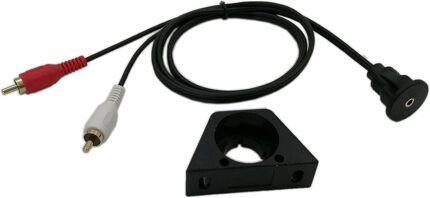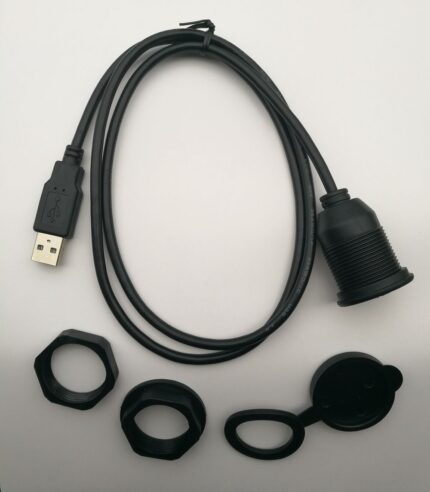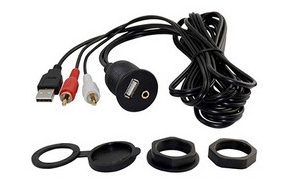
Car Dashboard Flush Mount USB-A + 2 RCA Audio Extension Cable with Bracket
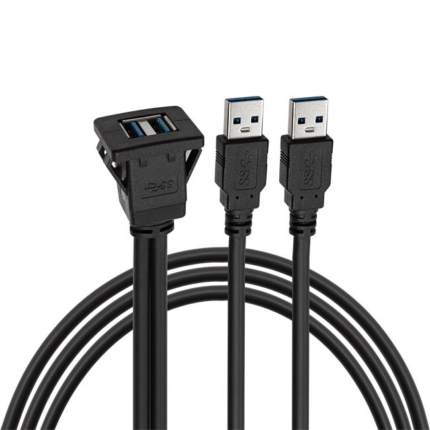
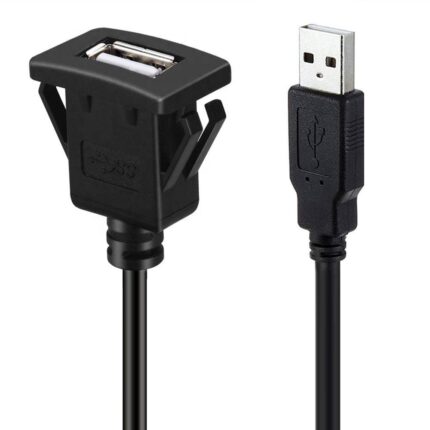
A 2rca audio cable bundled with a USB-A panel socket, so one bracket gives you a charger and a stereo RCA input on the dash. 28 AWG data with 24 AWG power, black PVC jacket, 1 m / 2 m / 3 m. For head-unit retrofits.
Overview
A 2rca audio cable paired with a USB socket on one bracket is the standard answer for a head-unit retrofit. The panel carries a USB-A female for charging and a pair of RCA plugs that land on the head unit audio input; the far end breaks out into a USB-A male and a 3.5 mm stereo male. One cut-out, two functions, and the installer only has to pull one assembly through the dash. Conductors are 28 AWG for data with a 24 AWG power pair, the jacket is black PVC, and 1 m, 2 m and 3 m are the stock lengths. RCA is unbalanced and it is not a digital interface, so the way this run is routed matters more than the cable specification – more on that below.
Key Specifications
| Connector A | USB-A Male, 3.5 mm Stereo Male |
|---|---|
| Connector B | USB-A Female panel mount, 2x RCA Male audio L/R |
| USB specification | USB 2.0, 480 Mbps |
| Audio channels | Stereo left and right via 2 RCA |
| Conductor | 28 AWG data + 24 AWG power |
| Outer diameter | USB OD 3.5 mm / USB OD 4.5 mm |
| Jacket material | Black PVC |
| Cable length | 1 m / 2 m / 3 m |
| Mounting | Flush mount bracket, 28-30 mm cut-out, screw and cap |
| Application | Car, motorcycle and marine dashboards; AV head-unit retrofits |
RCA or 3.5 mm: which input are you actually feeding?
Both carry two channels of unbalanced line-level audio. RCA is the connector you find on an amplifier or a head unit input; 3.5 mm TRS is the connector you find on a phone or a player, and the RCA connector convention is the one most panels are marked to. The choice is dictated by what is at each end, not by quality – a short run of either will sound the same. Where the two differ mechanically is retention and size: an RCA plug pulls out easily and takes panel depth, a 3.5 mm plug is compact and also pulls out easily, and neither is a locking connector. If the run is inside a dash, tape or tie the plugs so vibration cannot work them loose.
| 2 RCA | 3.5 mm TRS | |
|---|---|---|
| Found on | Amplifiers, head units, AV receivers | Phones, players, PCs, small devices |
| Channels | Two, one plug per channel | Two, one plug for both |
| Polarity marking | Red for right, white or black for left | Tip left, ring right, sleeve ground |
| Retention | Friction, pulls free easily | Friction, pulls free easily |
| Panel depth needed | More – two plug bodies side by side | Less – a single barrel |
| Best use here | Landing on a head unit or amp input | Coming from a phone or a player |
Keeping the USB side out of the audio
Combining a charging port and an unbalanced audio input in one bracket is convenient and it is also how you get alternator whine. The failure mode is a shared return: the USB power current and the audio return end up in the same conductor, the voltage drop across that conductor is then in series with the audio signal, and you hear the charger. Two things prevent it. Keep the audio return and the USB power return separate all the way back to the head unit, and route the audio pair away from the USB power conductors rather than bundled tight alongside them for three meters.
| Symptom | Cause | Check first | Fix |
|---|---|---|---|
| Whine that rises with engine speed | Alternator ripple on a shared return | Unplug the USB device – if the noise stops, it is the charger path | Separate returns; charge from a different supply |
| Buzz only while charging | Switch-mode charger noise | Try another charger | Isolate the charger supply, or filter it at the source |
| Crosstalk between channels | Return resistance shared between L and R | Swap the RCA plugs left for right – if the fault follows, it is the source | Dedicated return per channel on request |
| One channel dead | Plug not seated, or a broken conductor | Wiggle test at both ends | Continuity check; if open, it is a replacement |
| Hum with no engine running | Earth difference between source and head unit | Run the source on battery | Ground loop isolator on the audio path |
Head-unit retrofits: what to measure before you order
Dash work is unforgiving because everything is hidden and access is the expensive part. Before you cut, measure four things: the panel cut-out, the thickness of the trim at that point, the depth available behind it for the plug bodies and the bracket, and the route length from the dash to the head unit cavity following the actual path rather than a straight line. Add slack for a service loop. A cable that is 200 mm too short means pulling the dash apart again, and one that is a meter too long means a coil of surplus that will chafe behind the trim.
Where a 2rca audio cable belongs in the build
- Head-unit retrofits in cars, vans and trucks where the input is RCA and the phone is 3.5 mm
- Motorcycle and marine panels that need both a charger and an audio input in one hole
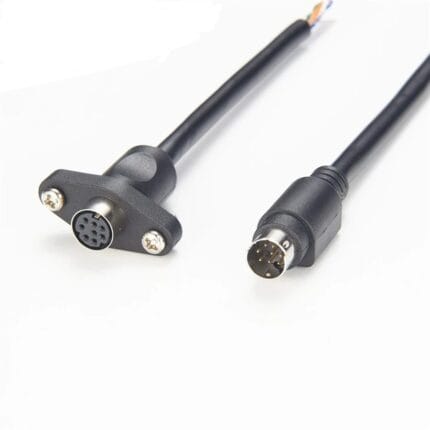
- AV receiver and amplifier hookups behind a rack panel, see the 8-Pin DIN Panel-Mount Extension
- Camper and RV conversions adding a dash multimedia panel
- Retrofits where a 3.5 mm socket is wanted instead of RCA, compare the 3.5 mm AUX Audio Female Panel Mount Extension
- Builds that also need a panel video feed, see the HDMI 8K Panel Coupler with Screw Lock
- Kiosk and cabinet panels that carry audio, see the Control Cabinet Service Interface
Failure modes on combined AV panels
Two recur. The first is a bracket mounted on trim that flexes, with a plug body pressing on it from behind – over a season the flex cracks the trim around the cut-out. The second is RCA plugs left unsupported at the head unit, where vibration slowly works them out of their sockets and the customer reports sound that cuts out on a particular bump. Support the plugs, keep the trim stiff, and leave enough slack that nothing is under tension.
What we treat as a target rather than a claim
Treat the numbers on this page as the industry-standard definitions for Car Dashboard Flush Mount builds rather than measured data from our line. The values your build is made and verified to are the ones on your drawing, checked against the supplier datasheet before we quote.
How to specify your build
- Audio connector at the panel – 2 RCA, or a 3.5 mm socket if the source demands it.
- Source end – 3.5 mm stereo male and USB-A male as standard; say if you need RCA there.
- Cut-out – 28-30 mm round; confirm against the bracket drawing.
- Length – 1 m, 2 m or 3 m, or your measured route length.
- Return arrangement – shared or dedicated returns per channel.
- Depth behind the panel – two RCA plug bodies need room.
- Quantity and whether this is a prototype or a production order.
Workmanship and testing
Workmanship on Car Dashboard Flush Mount builds follows IPC/WHMA-A-620 Class 3, the line is run under ISO 9001, and the termination range is 32 to 12 AWG. No Car assembly is boxed before continuity and pinout are confirmed, and seal checking is quoted whenever an ingress rating is on the drawing.
Every production run can ship with RoHS and REACH declarations and the electrical report agreed at quotation; see certifications and material declarations. UL styles and other named approvals are built to drawing: we source to the style you specify and document it, rather than asserting a listing we do not hold. Overmold tooling for this part is designed and cut in our own tool room under in-house mold making and overmold tooling, so the tool belongs to your program and a revision is a machining job rather than a new negotiation. Related reading: engineering support and design for manufacture review.
Custom builds and ordering
Quote Car Dashboard Flush Mount builds from 1 to 50 pcs and they ship in 3 working days. At volume the minimum is 500 pcs with 14 working days after approval. Tooling not already held adds around 10 working days. OEM and ODM Car runs go out under your part number and labeling and material certificates plus first-article reports are available.
Related audio and panel hardware
- 8-Pin DIN Male to Female Panel-Mount Extension
- 3.5 mm AUX Audio Female Panel Mount Extension
- HDMI 8K Panel Coupler with Screw Lock
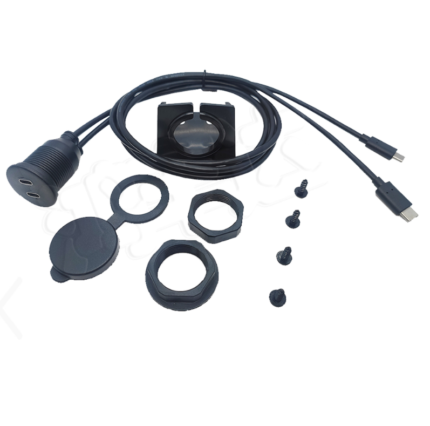
- Control Cabinet Service Interface with RJ45 and USB-C
- Medical Panel Feedthrough Set for Cart and Monitor Arms
Full ranges: panel mount cable, signal and data cables and custom wire harnesses.
Frequently Asked Questions
Can I get RCA at the panel and RCA at the source?
Yes. The stock build is RCA at the panel with a 3.5 mm plug at the device end, but the assembly is built to your drawing, so any combination of ends can be quoted.
Why do I get whine when a phone is charging?
Because the charger current and the audio return are sharing a path, or the charger is noisy. Try another charger first; if it persists, the returns need separating.
Is RCA better than 3.5 mm?
No. Both are unbalanced line-level connections and a short run of either sounds the same. Choose by what is at each end.
How do I stop the plugs working loose?
Support them. Tape or tie the RCA plugs at the head unit and leave a little slack so vibration cannot lever them out of the sockets.
| Connector A | USB-A Male, 3.5 mm Stereo Male |
|---|---|
| Connector B | USB-A Female panel mount, 2x RCA Male audio L/R |
| Cable length | 1 m / 2 m / 3 m |
| USB specification | USB 2.0, 480 Mbps |
| Audio channels | Stereo left and right via 2 RCA |
| Conductor | 28 AWG data + 24 AWG power |
| Outer diameter | USB OD 3.5 mm / USB OD 4.5 mm |
| Jacket material | Black PVC |
| Mounting | Flush mount bracket, 28-30 mm cut-out, screw and cap |
| Application | Car, motorcycle and marine dashboards; AV head-unit retrofits |