FPV Drone Video Cable, Right-Angle Mini-USB to 3-Pin Leads
An FPV drone cable picks up video and power at a camera’s mini-USB port and brings them out on two 3-pin leads, so the camera wires to a VTX or flight controller without soldering on the camera board.
Overview
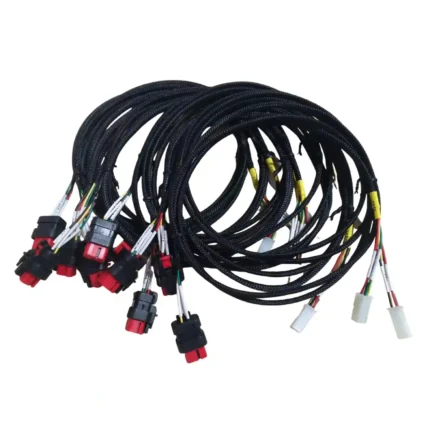
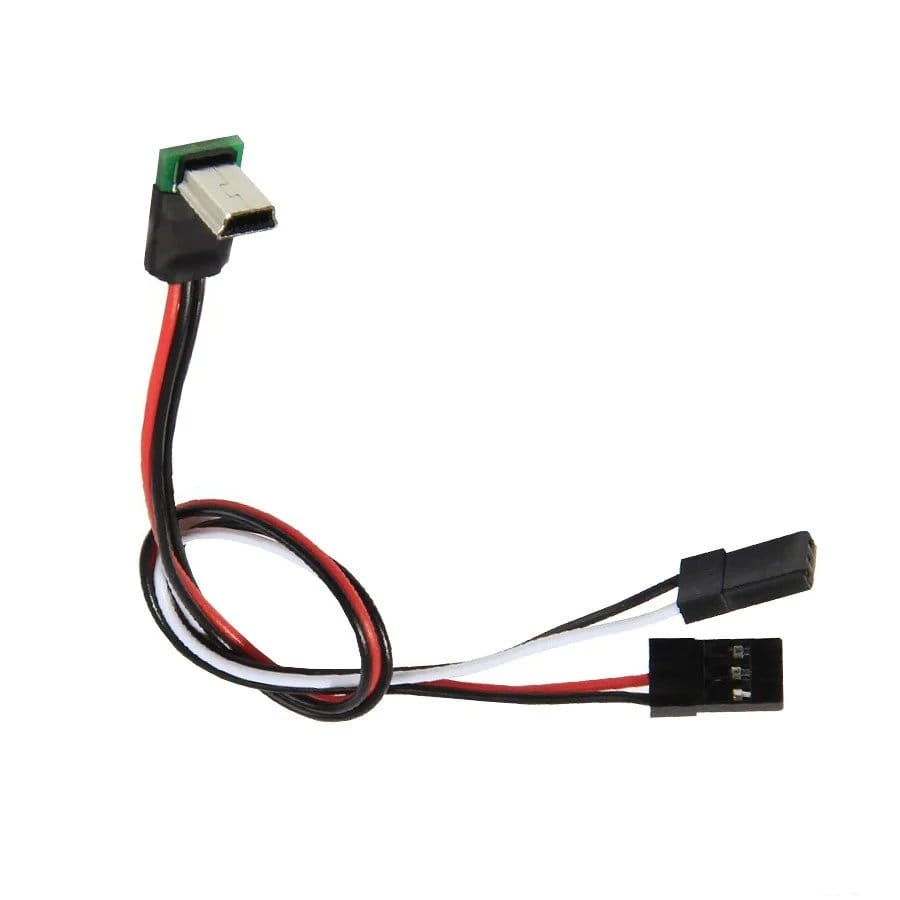
An FPV drone cable has one job: get video and power off the camera cleanly. The photographed assembly starts with a right-angle mini-USB plug, splits into two 3-pin leads, and carries three cores — power, ground and the video signal — built to the pinout on your drawing.
Why cameras hide video and power behind the USB port
Many FPV cameras expose more than data on their USB connector: on several families the video signal is available on one of the USB pins, which lets a single port carry power in and video out. A molded breakout cable turns that into something a builder can use without opening the camera case or soldering to a pad the size of a pinhead.
Right-angle mini-USB plug
The plug in the photo exits at 90° from a molded body. On a frame that matters: a straight plug either fouls the lens mount or levers against the port every time the harness moves. The right-angle exit keeps the plug flat against the camera shell and points the cable along the direction it already needs to run. The overmold at the exit is where most USB cables die; see our overmolding capability for how that transition is built here.
Two 3-pin leads: power, ground and video
The camera end is one plug; the equipment end is two 3-pin servo-style connectors (2.54 mm pitch, one male, one female) so the same assembly lands on either a VTX or a flight controller without adapters. Three cores do the work — power, ground and video/signal — and the mapping of which core lands on which pin follows the drawing, not a guess. Every finished piece is checked for continuity and pinout.
Where the cable runs on the frame
The lead typically runs from the camera at the front of the airframe back to the VTX or FC stack, so length is specified, not standard: too long adds weight and a loop that rattles against the frame, too short tensions the plug. Fine-strand conductors keep the run flexible across the vibrations a lightweight UAV wire harness survives, and the jacket is chosen to match the tape-and-tie method used on the build. For the shielding and drain rules that keep ESC noise out of the video feed, see our drone cable supplier guide to weight, vibration and EMI.
Build options
- Pinout mapped to your camera and VTX documentation
- Length cut to spec, from compact stacked builds to long-range frames
- Connector family on the 3-pin ends per drawing
- Jacket color and marking for build documentation
Quality checks
Continuity and pinout are checked on 100% of pieces — on a video lead the failure mode is not dramatic, it is a channel that shows noise or no image and costs a day of troubleshooting. The pinout check is done against the released drawing, so a swapped core is caught at the bench, not on the airframe. Limits and sampling are agreed in writing before production release.
FPV drone cable vs a stock USB cable
A generic mini-USB cable fails this job twice over: the pinout is not the camera’s video breakout, and the molded strain relief is built for bench use, not for an airframe. This assembly is built to the drawing for both — pinout and strain relief — which is what separates it from the parts bin. Background reading on the connector family: USB hardware.
How to order
Send the drawing or a marked-up sample: pinout, gauge, length, connector family on the 3-pin ends. The assembly is quoted and built through the standard custom wire harness flow, with prototypes and production released from the same document.
| Build Type | Build to drawing or build to sample |
|---|---|
| Application | FPV camera video and power breakout to VTX or flight controller |
| Connector A | Mini-USB male, right-angle, molded |
| Connector B | Two 3-pin servo-style connectors, 2.54 mm pitch, male and female |
| Conductors | 3 cores: power, ground, video/signal |
| Wire Gauge | Fine-strand, sized per the drawing |
| Length | Cut to spec per order |
| Testing | 100% continuity and pinout check |