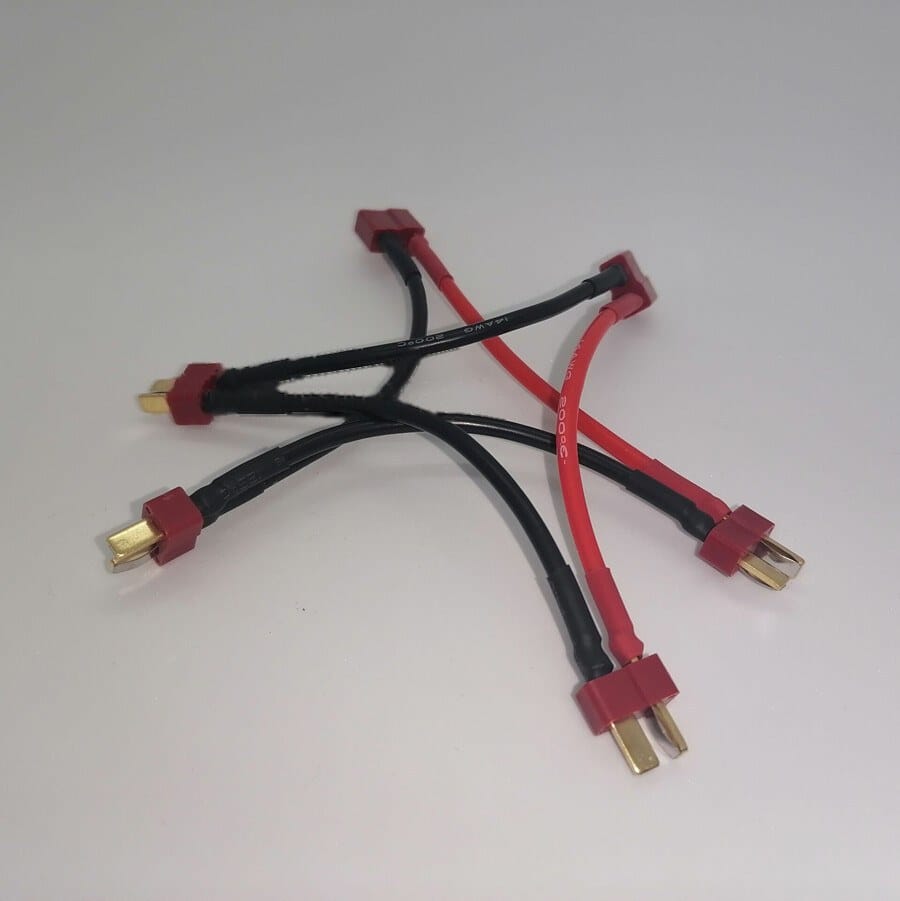
Drone Battery Power Harness, 12 AWG Silicone with T-Plug Connectors
A drone battery power harness is the high-current lead that links a flight battery to the ESC or power distribution board, built so voltage drop and heat stay under control at burst current.
Overview
A drone battery harness is one of those parts that looks like a simple cable until it is the reason a pack sags under load. This version is built around what the photographed leads show: 12 AWG silicone-jacketed wire printed with a 200 °C rating, terminated in red T-plug (Deans style) connectors, cut and assembled to your drawing.
Where the harness sits in the power path
The run starts at the pack’s discharge leads and ends at the ESC input or the power distribution board. The same lead style covers three jobs: the main power run, the charge lead that reaches a balancing charger, and the parallel link that ties two packs together. Each job stresses the harness differently, which is why conductor size and connector choice are specified rather than assumed.
T-plug (Deans style) connectors, mated both ways
The leads in the photo use the red T-plug family in both polarities, so a single drawing can cover the pack side and the equipment side of the run. The family is widely used on existing air and ground builds; if your fleet has standardized on a different connector, the harness is built to that drawing instead. What does not change is the rule that one airframe uses one connector family, because mixed families are the usual cause of reversed or mis-mated packs.
12 AWG silicone wire, rated 200 °C
The wire on the photographed leads is printed 12 AWG with a 200 °C temperature rating, which is exactly what you want next to ESCs and battery terminations: silicone stays flexible in cold weather and does not shrink back when a solder joint is made nearby. The fine stranding keeps DC resistance low on short runs. Other gauges are cut to order when the drawing calls for them — see silicone wire harnesses for the insulation family. The mass, vibration and EMI disciplines that decide the rest of the loom are set out in our drone cable supplier checklist.
Keeping voltage drop and heat down
On a battery lead, the loss is I²R in the copper and contact resistance at each termination. Short runs of 12 AWG keep the copper loss small, and crimped-and-soldered terminations keep the contact contribution predictable. The practical check is simple: measure pack voltage at the ESC input under burst load. If the sag is larger than the drawing allows, the harness is the first place to look — before blaming the pack.
Build options and marking
- Single red/black pair or multiple leads per assembly
- Polarity and connector gender assigned by the drawing, keyed to the pack
- Cut to length per order, no standard stock length to work around
- Print or heat-shrink labels per node list for fleet maintenance
- Packaging in pairs or kits so the pack side and the charger side ship together
Quality checks before shipment
Every piece gets a 100% continuity and polarity check — on a power lead, reversed polarity is not a warranty claim, it is a fire. Crimp pull tests are run on the terminations used for your order. The limits and sampling plan are agreed in writing before production release, the same discipline applied across our lightweight UAV wire harness work.
Drone battery harness options: single leads, paired leads, charge leads
Most orders fall into three shapes. A single paired lead is the main pack-to-ESC run. A charge lead reaches from the pack’s connector to the charger, often with the opposite gender. Parallel links tie packs together and need the same gauge as the main run, because they carry the same current. Tell us which shape the drawing describes and the assembly is built around it, the same way our battery communication harnesses orders are structured.
What to Put on the Drawing for a Drone Battery Harness
A drone battery harness is released against a drawing, not a catalog description. Put the connector family and keying on each end, the pinout or polarity map, the finished length measured between the mating reference planes, the cable construction you want, and the acceptance tests you expect. If the battery power harness has to clear a panel cutout or a bracket, give that envelope too. Anything left open is agreed in writing before tooling or a production slot is committed.
Where a value is not fixed by your drawing we do not invent one. Contact rating, jacket material, sealing class and test limits are recorded as confirm per build, and the released drawing is what the first article is checked against. Send a marked-up sample if a drawing is not available; we confirm the pinout back to you in writing before any Drone Battery Harness is built.
How to Request a Quote for a Drone Battery Harness
Send a drawing or BOM, a physical sample, or a written requirement. We log the interface, the application conditions, the environment and the target quantity together, then return an acknowledgement with a list of anything still missing. Pricing is confirm per RFQ and is quoted against the released specification, not against a generic drone battery harness description.
If the design is not final, say so: we quote the prototype route and hold the production tooling decision until the first article is approved. Drawings are handled under a mutual NDA before they are received. The same document then carries the build from sample through repeat orders, which keeps the battery power harness consistent across batches.
Routing and Bend Relief for This Battery Power Harness Assembly
Plan the route before you fix the length. A drone battery harness that has to turn immediately behind the connector needs clearance for the first bend, and the molded exit is not a hinge. Leave enough slack for service removal, keep the lead away from sharp edges and moving parts, and secure it with clips that grip the jacket rather than crushing it. On UAV battery feeds and power distribution boards, the run usually sees more handling than the specification suggests.
If the assembly passes through a bulkhead or a gland, confirm the opening clears the largest cross-section of the finished connector, coupling included, rather than the cable alone. A battery power harness cannot be taken apart after molding, so the route has to accept the finished part. Where space is tight, an angled exit or a shorter body is chosen at quotation, not discovered at installation.
Strain Relief at the Battery Power Harness Exit
The transition from a rigid connector to a flexible cable is where most field failures start. On this build the overmold bonds to the jacket so a pull lands on the molded body instead of on the crimp. Keep the first bend outside that transition, avoid tying the lead tightly against the shell, and do not use the cable as a handle when unplugging. Exposure to airframe vibration and repeated battery swaps makes a stiff exit worse, because the jacket does not relieve the lever on its own.
Where the design needs a different exit angle, a longer boot or an additional clamp, that is a tooling question and is settled before production. We mold the exit rather than bending a finished plug, and the geometry is kept under your part reference so a repeat order matches the drone battery harness you approved.
Prototype, Tooling and Production Quantities
Prototype lots run from 1 to 50 pieces and are built from the same drawing as production, so a sample that works is reproducible. Production starts at 500 pieces per part number. If the battery power harness needs a new overmold, the tool is designed and cut in our own tool room; more than 3,000 tooling sets have been built since 2012, and the tool cut for your program belongs to your program.
The first article is submitted before the production run, and changes to connector, cable, pinout or mold geometry are confirmed in writing before they are implemented. Keeping prototypes and production on one document is what stops a revision from quietly changing a Drone Battery Harness between the sample and the order.
How to order
Send a drawing or a sample: connector family and gender, gauge, length, polarity and marking. Quotations follow the standard custom flow on the custom wire harness page, and prototypes and production are built to the same released document. Reference background on the connector family and wire types is widely published; silicone rubber is one neutral starting point for the insulation family.
Every production run can ship with RoHS and REACH declarations and the electrical report agreed at quotation; see certifications and material declarations. UL styles and other named approvals are built to drawing: we source to the style you specify and document it, rather than asserting a listing we do not hold. Where this build needs an overmold, the tool is designed, cut and maintained in our own shop under overmold tooling cut in our own tool room, and it is never used for another customer’s program. More background: prototypes and first article inspection.
| Build Type | Build to drawing or build to sample |
|---|---|
| Application | Flight battery to ESC or PDB power runs, charge leads, parallel packs |
| Connector | T-plug style (Deans type), male and female |
| Conductor | 12 AWG high-strand copper |
| Insulation | Silicone, 200 °C rating (printed on the cable) |
| Configuration | Single red/black pair or multiple leads; polarity per drawing |
| Length | Cut to spec per order |
| Marking | Print or heat-shrink labels per node list |
| Testing | 100% continuity and polarity check; crimp pull test |