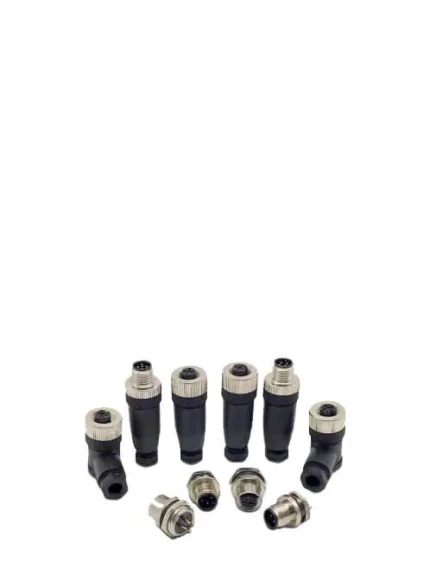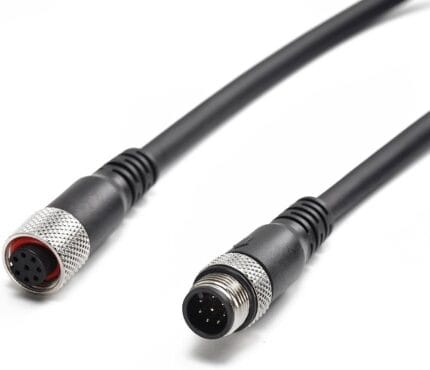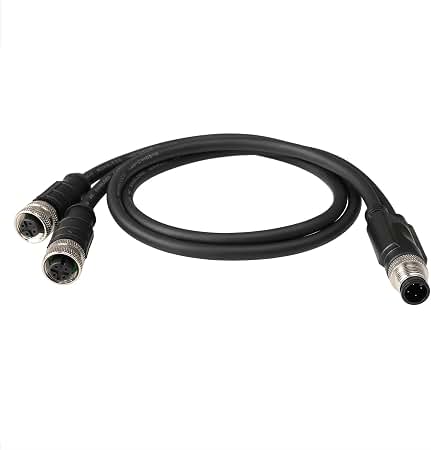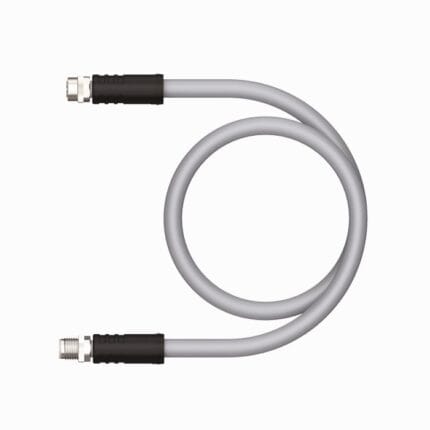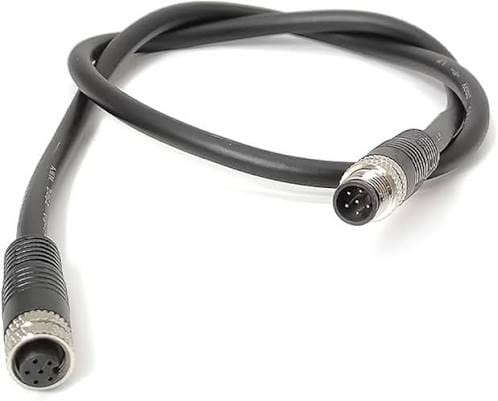
M8 6-Pin A-Coded Sensor Cable, Straight Male to Female
An M8 6 pin A coded sensor cable for devices that need two signals plus power and have no room for a 12 mm shell. Straight male to female, PUR or PVC, built to the length and pinout your machine specifies.
Overview
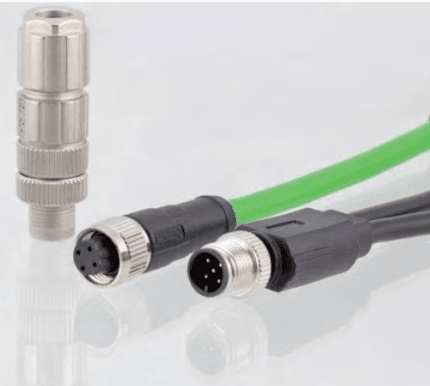
Six contacts is the awkward middle of sensor wiring: more than the 3-pin and 4-pin standards most machines run on, still small enough to disappear into a bracket. An M8 6 pin A coded sensor cable is what you reach for when a device needs two signals plus power and there is no room for an M12 shell. This build is a straight male-to-female extension, made in the jacket and length your machine specifies.
Key Specifications
| Coding | M8 A-coded, 6-position |
|---|---|
| Configuration | Straight male to female |
| Jacket | PUR or PVC |
| Cable | Multi-core shielded sensor cable |
| Conductor | 32 to 12 AWG, per build |
| Shielding | Braided shield carried to the coupling nut, or unshielded |
| Overmold | Standard M8 body from in-house tooling; new body adds about 10 working days |
| Length | OEM build to order |
| Mating | Standard M8 A-coded 6-position sensor interfaces |
M8 or M12: which shell size do you need?
Both families are defined in the IEC 61076 series — M8 in IEC 61076-2-104 and M12 in IEC 61076-2-101 — and they share the same coding idea. They do not share the same space. The decision is nearly always mechanical before it is electrical: if the sensor head or the bracket pocket cannot take a 12 mm shell, M8 wins regardless of what you would prefer to stock. The coding concept itself is shared across the whole M12 connector family, which is why the same A, B and D codes turn up in both sizes.
| Shell | Body size | Common pin counts | Typical use | Choose it when |
|---|---|---|---|---|
| M8 | 8 mm thread, about 10 mm body | 3, 4, 6, 8 (A-coded); 4 (D-coded) | Tight pockets, small sensors, in-fixture wiring | The sensor head or bracket has no room for a 12 mm shell |
| M12 | 12 mm thread, about 15 mm body | 3 to 12 (A-coded), 4 (D), 5 (B), power codes | General machine wiring, fieldbus, Ethernet, power | You need more contacts, a power code, or a fieldbus standard |
The trade runs both ways. An M8 body is easier to route and lighter on a moving head, but it gives you less contact area and a smaller cable gland, so it is not the right choice for a power feed or a long drag-chain run. Where the application is power rather than signal, our M12 L-code power cable is the honest answer, and where the run flexes continuously, an M12 drag chain cable will outlast either. The values a build is made and verified to are the ones on your drawing.
M8 A-coded 6-position pinout
The conductor colors below follow the convention most M8 makers work to. They are a starting point, not a guarantee: sensor vendors do deviate, and a cable wired to a generic chart is the most common cause of a device that powers up and does nothing. We wire to the pinout you send and test against it.
| Pin | Conductor color | Typical assignment |
|---|---|---|
| 1 | Brown | Supply positive on most sensor builds |
| 2 | White | Signal or second supply, per your device |
| 3 | Blue | Supply common, 0 V |
| 4 | Black | Switching signal or IO-Link C/Q |
| 5 | Gray | Second signal channel |
| 6 | Pink | Third signal channel or spare |
A-coding is the one most sensor builders meet first, and the one most often assumed to be the only one. It is not. The coding reference in the download center works through A to Y with pole counts, typical duties and the cross-mating traps, in two pages.
Straight or right-angle, and which way the cable exits
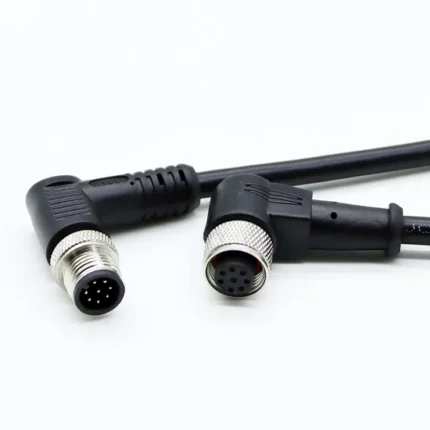
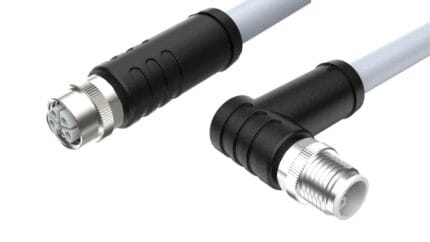
On a straight body the cable leaves along the axis, which is fine until the sensor sits against a wall. A right-angle body solves the clearance problem and creates another one: which way does the exit point. On our builds the exit can be clocked to the run so the cable leaves in the direction it has to go rather than into the machine frame. Our M8 6-pin A-coded right-angle sensor cable is the same platform with the body turned.
Jacket, shielding and conductors
- PVC — the default. General purpose, good flex life, lowest cost.
- PUR — for cutting oil, coolant and abrasion. Costs more and lasts longer in the same place.
- Shielded or unshielded — the shield is carried through to the coupling nut where the signal needs it, and left off where it would only add stiffness.
- Conductor range — 32 to 12 AWG, sized to the current and the run rather than to habit.
Typical applications for this M8 6 pin A coded sensor cable
- Compact sensor and actuator extensions where a 4-pin body runs out of contacts
- Dual-channel proximity and photoelectric sensors
- Small valve blocks and manifolds with combined power and feedback
- Fixture, gauge and test-rig wiring, next to our M8 3-pin A-coded sensor and actuator cable
- Machine retrofits standardizing on M8, including M8 4-pin IP65 power builds
How to specify your build
- Pin count and coding — 6-position A-coded here; 3, 4 or 8 on the same platform.
- The pinout, or the sensor part number so we can derive it.
- Ends — male to female straight, right-angle, or mixed.
- Cable exit direction on a right-angle body.
- Jacket — PVC or PUR, and what it will be exposed to.
- Shielded or unshielded.
- Length, and whether the run is fixed or moving.
- Quantity, and whether this is a prototype or a production order.
Workmanship and testing
IPC/WHMA-A-620 Class 3 is the workmanship bar for M8 6-Pin A-Coded Sensor builds, and ISO 9001 is the system behind the line, from 32 to 12 AWG. Every M8 build gets a 100% continuity and pinout check before it is boxed, and seal checking is quoted whenever an ingress rating is on the drawing.
Material declarations against RoHS and REACH are issued per project, alongside the dimensional and electrical reports agreed at quotation; see certifications, compliance and material declarations. Where your drawing names a UL style or another approval, the build follows your drawing and ships with the supporting document rather than a claim of our own. Overmold tooling for this part is designed and cut in our own tool room under overmold tooling cut in our own tool room, so the tool belongs to your program and a revision is a machining job rather than a new negotiation. Related reading: cable assemblies for industrial automation and robotics.
Custom builds and ordering
Five pieces is the prototype minimum for M8 6-Pin A-Coded Sensor builds, shipping in 3 working days. The production minimum is 500 pcs, delivered 14 working days after approval. Tooling not already held adds around 10 working days. M8 orders ship under your part number and labeling material certificates with first-article reports are available.
Related M8 and M12 assemblies
- M8 and M12 5-pin right-angle PUR sensor cable
- M8 D-coded 4-pin Ethernet cable for tight spaces
- M12 3-pin A-coded sensor and actuator extension
- M12 IO-Link cable, master to device drop
- M12 12-pin cable for encoders and valve blocks
- M8 leak detection pigtail for CDU and manifold sensing
Full range: circular M8 and M12 cable assemblies.
Frequently Asked Questions
Will an M8 6-pin cable mate with a 5-pin sensor?
No. The coding and the pin count both have to match, and the keyway stops a mismatch from mating. If you are unsure, send a photo of the connector face and the code and pin count can usually be read off it.
Do you wire to standard colors or to my pinout?
To your pinout. The standard colors are the default where nothing is specified, but a drawing or a sensor part number overrides them every time, and every unit is tested against the table we built it from.
Can I get a right-angle body on one end only?
Yes. Straight or right-angle on either end, and on a right-angle body the cable exit can be clocked to the direction the run needs.
Is PUR worth the extra cost?
Where the cable sees cutting oil, coolant or abrasion, yes. In a dry cabinet on a fixed run, PVC is the sensible choice and there is no reason to pay for more.
What is the minimum order?
Five pieces is the prototype minimum for M8 6-Pin A-Coded Sensor builds, shipping in 3 working days. The production minimum is 500 pcs, delivered 14 working days after sample sign-off.
| Coding | M8 A-coded, 6-position |
|---|---|
| Configuration | Straight male to female |
| Jacket | PUR or PVC |
| Cable | Multi-core shielded sensor cable |
| Length | OEM build to order |
| Mating | Standard M8 A-coded 6-position sensor interfaces |
| Conductor | 32 to 12 AWG, per build |
| Shielding | Braided shield carried to the coupling nut, or unshielded |
| Overmold | Standard M8 body from in-house tooling; new body adds about 10 working days |