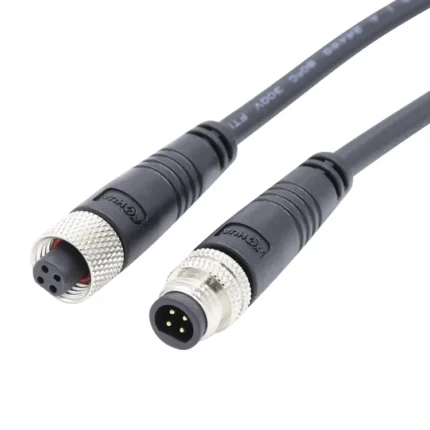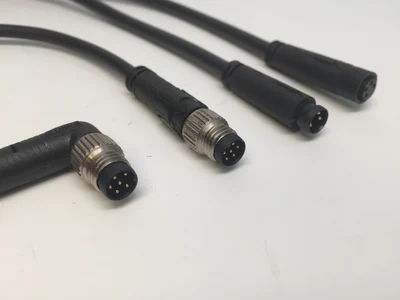
M8 6-Pin A-Coded Right-Angle Sensor Cable
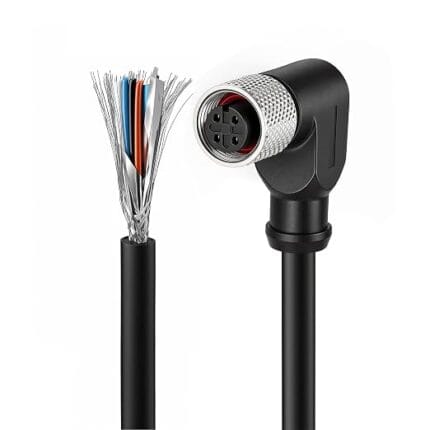
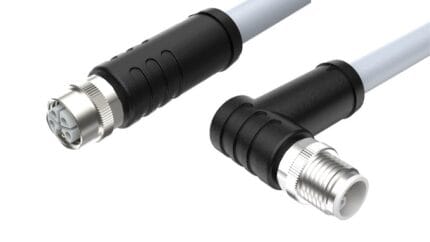
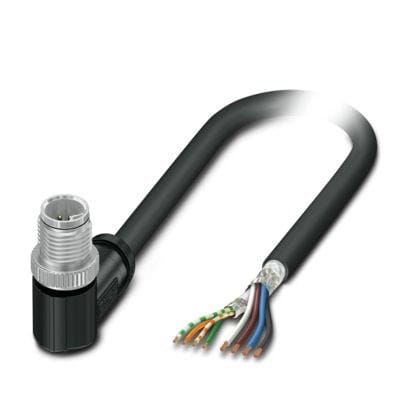
An m8 sensor cable in 6-pin A-coded form with a right-angle body, IP67, 30 V and 1.5 A per pin, 6 x 26 AWG in PUR or PVC. For compact six-signal sensor chains and robotic tooling where a straight connector will not fit.
Overview
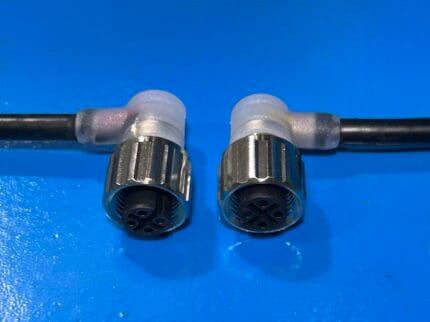
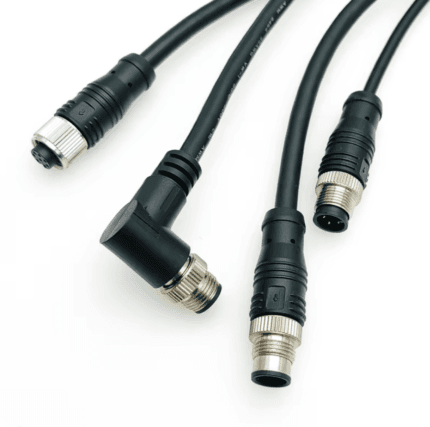
An m8 sensor cable in the 6-pin A-coded format is what you reach for when a sensor needs more than the usual three or four conductors and there is no room for an M12 body. This one is a right-angle male-to-female extension built to the M8 family of IEC 61076-2-104, rated IP67 in the mated condition, 30 V and 1.5 A per pin, with six 26 AWG conductors in a PUR or PVC jacket. The right-angle exit is not a convenience detail: on a tooling plate, on the back of a compact photoelectric sensor, or anywhere the cable has to run along a surface rather than away from it, a straight body will not fit and a right-angle one is the only option that keeps the bend radius sane.
Key Specifications
| Connector | M8 6-Pin A-Coded Male/Female, right-angle |
|---|---|
| Standard | IEC 61076-2-104 |
| IP rating | IP67 |
| Rated voltage | 30 V AC/DC |
| Rated current | 1.5 A per pin |
| Conductor | 6 x 26 AWG |
| Jacket | PUR / PVC |
| Operating temperature | -25 to +85 C |
| Mating cycles | More than 100 |
| Contact | Gold-plated brass |
| Orientation | Right-angle |
Confirm the coding before you order
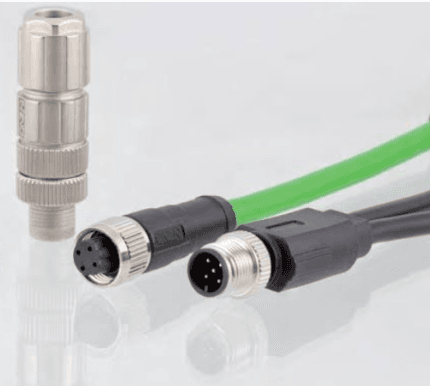
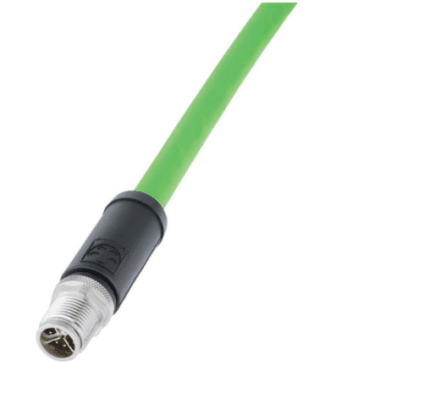
M8 and M12 connectors are mechanically keyed so that incompatible systems cannot be mated, and that keying is the single most expensive thing to get wrong on a sensor install, because the parts look nearly identical on a shelf. A-coding is the sensor and signal standard and it is what this cable carries. D-coding is Ethernet, B-coding is fieldbus, and none of them will mate with an A-coded receptacle. The M12 connector family is described in IEC 61076-2-101 and the M8 family in IEC 61076-2-104; the coding letter is defined there and it is worth checking the receptacle on the device rather than assuming.
| Coding | Used for | Mates with this cable? | Typical pins |
|---|---|---|---|
| A-coded | Sensors, actuators, signals, DC power | Yes – this build | 3, 4, 5, 6, 8, 12 |
| B-coded | PROFIBUS and some fieldbus | No – different keyway | 5 |
| C-coded | AC sensor and actuator supplies | No – different keyway | 3, 4, 5, 6 |
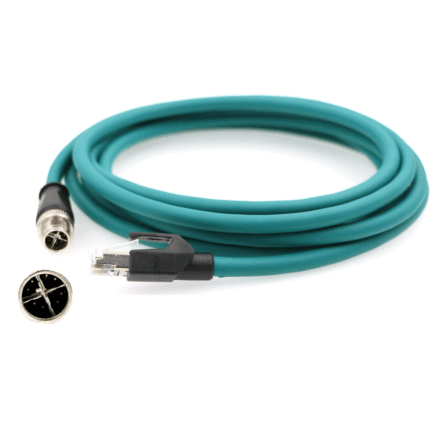
| D-coded | Industrial Ethernet up to 100 Mbit/s | No – different keyway | 4 |
| X-coded | Cat6A industrial Ethernet | No – different keyway | 8 |
Coding is only half the check on an M8 build; the other half is the position count. Our M12 and M8 coding reference lists every code letter from A to Y with the pole counts each one normally appears in, so you can confirm both before the order goes in. Two pages, free, and there is no form to fill in.
Six pins: what each one is usually assigned to
There is no single universal pinout for a 6-pin A-coded M8 – manufacturers assign them, and the datasheet for the device is the authority. What is consistent is the shape of the assignment: power on the first pins, signals after, and the remaining conductors either spare or used for a second channel. That matters because it is why you cannot swap a 6-pin lead between two sensor brands and assume it will work.
| Pin (typical) | Common assignment | Why it is typically there |
|---|---|---|
| 1 | Supply positive | Powers the sensor electronics |
| 2 | Second supply or second signal | Dual-channel sensors, or a second switched output |
| 3 | Supply negative | The return for the supply |
| 4 | Signal output | The switched or analogue output |
| 5 | Second signal or a configuration line | Complementary output, or teach-in |
| 6 | Shield or spare | Drain connection, or unused |
Treat that table as the shape of the convention, not as a wiring instruction. Send us the device datasheet or the pinout you work to and the assembly is built and verified to it.
Right-angle or straight: pick by the space, not by habit
A right-angle body solves a clearance problem and creates a routing one. It lets the cable run flat along a surface, which is what you want on a tooling plate or against a machine frame, and it saves the 40 or 50 mm of straight depth that a straight connector plus its bend radius needs. What it costs is that the exit direction is fixed, so the cable has to be routed the way the connector points, and there is no rotating it later. On a crowded panel, order the orientation after you have decided the route.
| Right-angle | Straight | |
|---|---|---|
| Depth needed | Low – the cable turns at the connector | Higher – body plus bend radius |
| Routing | Fixed exit direction, decide the route first | Flexible, rotates in the gland space |
| Best on | Tooling plates, compact sensors, tight frames | Open runs, conduit, cable trays |
| Strain at the exit | Higher if the cable is pulled sideways | Lower – the load is axial |
Where an m8 sensor cable earns its keep
- Compact photoelectric and proximity sensors with six conductors in a tight housing
- Robotic tooling plates and end-effectors where a straight body will not clear
- Dual-channel sensors, or sensors with a teach-in line as well as an output
- Machine vision panels and I/O blocks, alongside our M12 IO-Link Cable
- Field installs that need a 3-pin or 4-pin instead, see the M8 3-Pin A-Coded Sensor / Actuator Cable
- Power-only M8 runs, compare the M8 4-Pin A-Coded IP65 Waterproof Power Cable
- Installs where the straight version fits, see the M8 6-Pin A-Coded Sensor Cable, Straight
- Panels that need a bulkhead feedthrough rather than an extension, see the M12 Bulkhead Panel Connector
Failure modes on M8 sensor runs
The coupling nut is the first one: hand tight and no more, because the usual failure is an over-tightened nut that has deformed the seal and drawn water in rather than keeping it out. The second is the exit strain – a right-angle connector takes a sideways pull badly, and on a moving tooling plate the cable has to be clamped close to the connector so the load never reaches the contacts. The third is coding: an A-coded plug forced into a D-coded receptacle will damage both, and it happens more often than anyone admits.
What we treat as a target rather than a claim
Ratings shown here are the industry-standard description of what the M8 6-Pin A-Coded Right-Angle interface family is defined to do, not test results from a part of ours. Your assembly is built and verified to the values on your drawing, which we check against the supplier datasheet before quoting.
How to specify your build
- Coding and pin count – 6-pin A-coded as standard; confirm against the device.
- Orientation – right-angle as standard, or straight.
- Length – state the route length; custom lengths are quoted.
- Jacket – PVC as standard; PUR where oil, coolant or UV is present.
- Ends – male to female as standard; flying leads on request.
- Pinout – send the device datasheet or the pinout you work to.
- Quantity and whether this is a prototype or a production order.
Workmanship and testing
Build standard for M8 6-Pin A-Coded Right-Angle builds is IPC/WHMA-A-620 Class 3 under ISO 9001, with terminations from 32 to 12 AWG. continuity and pinout are checked on every M8 unit before packing, and seal checking is quoted whenever an ingress rating is on the drawing.
Every production run can ship with RoHS and REACH declarations and the electrical report agreed at quotation; see certifications and material declarations. UL styles and other named approvals are built to drawing: we source to the style you specify and document it, rather than asserting a listing we do not hold. The 90-degree exit is formed in the tool itself; the exit options and their clearances are set out under right-angle exit tooling options. The wider context is covered under what automation programs ask for. Tooling is quoted separately, cut in-house rather than brokered out, and owned by you.
Custom builds and ordering
On M8 6-Pin A-Coded Right-Angle builds, prototype lots run from 1 to 50 pcs and leave in 3 working days; production runs of 500 pcs and up ship 14 working days after approval. Tooling not already held adds around 10 working days. M8 OEM and ODM shipments carry your part number and labeling, and we provide material certificates and first-article reports when asked.
Related M8 and M12 hardware
- M8 3-Pin A-Coded Circular Connector Sensor Cable
- M8 4-Pin A-Coded IP65 Waterproof Power Cable
- M8 6-Pin A-Coded Sensor Cable, Straight
- M8 5-Pin to USB Type-C Adapter Cable
- M12 Bulkhead Panel Connector with Pigtail
Full ranges: circular M8 M12 cable, signal and data cables and custom wire harnesses.
Frequently Asked Questions
Can I use this in place of a 4-pin M8 lead?
No. The pin count is part of the connector – a 6-pin plug will not enter a 4-pin receptacle. Take the 4-pin build instead.
Is A-coded the same as D-coded?
No, and they are deliberately keyed so they cannot be mated. A-coded is sensors and signals; D-coded is industrial Ethernet. Forcing them damages both parts.
How tight should the coupling nut be?
Hand tight. The nut only has to compress the seal and stop the connector backing off; over-tightening deforms the seal and that is how water gets in.
PUR or PVC jacket?
PVC for a dry, indoor machine. PUR where there is oil, coolant, UV or washdown, because it holds up where PVC hardens and cracks.
| Connector | M8 6-Pin A-Coded Male/Female, right-angle |
|---|---|
| Standard | IEC 61076-2-104 |
| IP rating | IP67 |
| Rated voltage | 30 V AC/DC |
| Rated current | 1.5 A per pin |
| Conductor | 6 x 26 AWG |
| Jacket | PUR / PVC |
| Operating temperature | -25 to +85 C |
| Mating cycles | More than 100 |
| Contact | Gold-plated brass |
| Orientation | Right-angle |