D-Type USB Panel Feedthrough with Reversible A/B Core
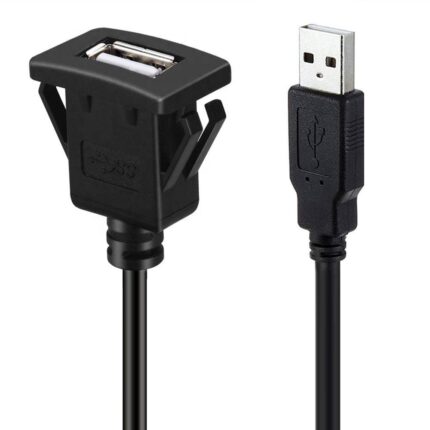
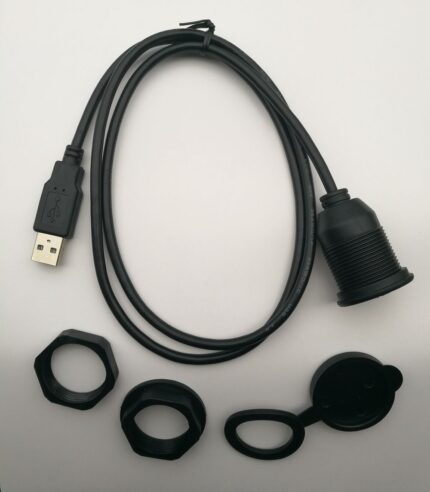
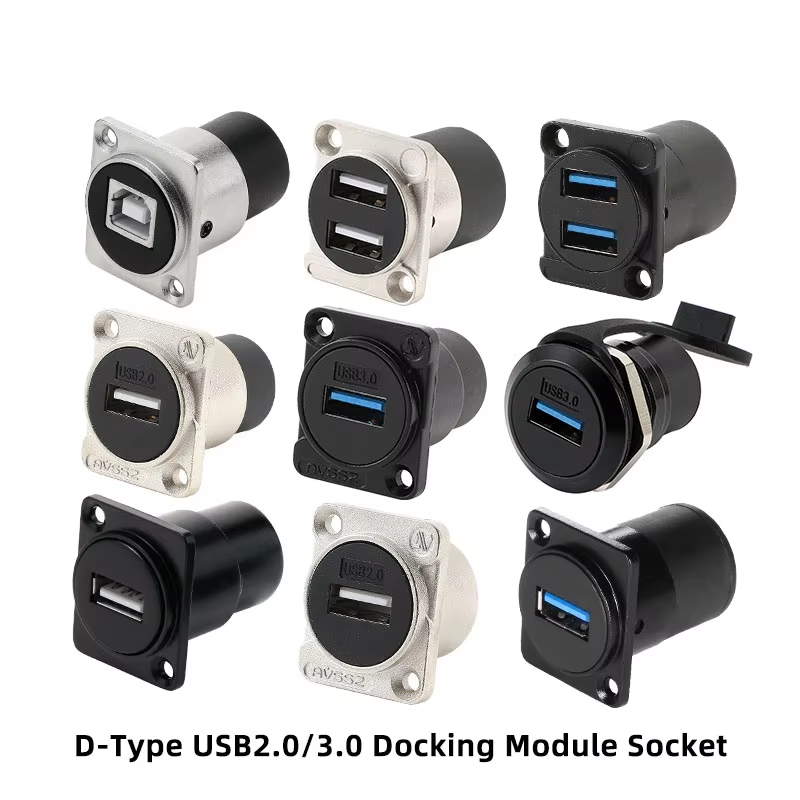
A D-type USB panel feedthrough with a reversible core: flip the insert and the same hardware presents a Type-A face or a Type-B face to the front of the panel. One part number covers both orientations, which halves the spares you have to hold.
Last updated: 13 September 2026
Overview
A D-type USB panel feedthrough moves the USB port off the equipment chassis and onto the panel, so a media server, recorder or controller inside a rack can be patched from the front without opening the enclosure. It sits in the D-shape flange cut-out used across broadcast racks, studio patch bays, AV carts and meeting-room tables, which means one panel layout can carry USB next to XLR, HDMI and other D-shape openings without a second tooling setup.
The part that earns its keep is the reversible core. It rotates, so either the Type-A face or the Type-B face can be presented to the front of the panel with the same hardware.
Key Specifications
| Interface | USB 3.2 Gen 1 Type-A / Type-B feedthrough with reversible insert |
|---|---|
| Panel cut-out | D-shape flange cut-out – design target, confirm before cutting |
| Panel thickness | Design target – confirm against supplier drawing before cutting |
| Shell finish | Nickel or black |
| Contact material | Brass contacts with gold flash over the mating area |
| Grounding | Removable ground spring for bonding to coated or bare panels |
| Operating temperature | -25 C to +85 C – supplier datasheet confirmation pending |
| Mounting | Screw fixing through the D-shape flange |
| Orientation | Type-A face or Type-B face presented to the front of the panel |
| Internal termination | Left to the installer; tail length set by cabinet depth |
| Typical use | Broadcast racks, studio patch bays, AV carts, industrial consoles |
Why a reversible core halves your spares
On a cart build or a rack build, the orientation question is usually answered after the panel is cut. The internal tail is already dressed to a media server on the left, and the question of whether the front of the panel needs an A socket for a camera or a B socket for a printer arrives on the day of the install. With a fixed feedthrough that is a second part number, a second stock line, and often a second courier charge.
| Fixed-orientation feedthrough | Reversible-core feedthrough | |
|---|---|---|
| Part numbers held | One per orientation per finish | One per finish |
| Orientation decided | Before ordering | On the bench, after the panel is cut |
| Rework on a change of plan | Swap the part, re-dress the tail | Rotate the insert |
| Risk on site | Wrong part turns up, install stops | Any unit fits either way |
| Cost of a late change | New part plus a site visit | A screwdriver |
D-shape cut-out: the panel detail that has to be right
The D-shape family is a de facto standard rather than a single published dimension, and that is exactly why it needs checking. The values below are the ones commonly quoted in the trade for this cut-out family. They are typical values, not a standard, and the only safe way to use them is to cut a test piece in the same material and the same thickness first.
| Dimension | Commonly quoted value | What it controls | How to verify |
|---|---|---|---|
| Across the flats | Around 24 mm for the D-series / XLR-style family | Whether the housing drops in at all | Supplier drawing, then a test cut |
| Screw centers | Commonly in the 19 mm class on D-shape flanges | Whether the fixings line up with the panel holes | Pilot drill, do not assume |
| Panel thickness | Varies by version; no released figure for ours | How much of the thread and the shell is engaged | Supplier drawing before ordering |
| Corner radius | Set by the punch or the router bit | Whether the flange seats flat instead of bridging a corner | Check the first piece under a light |
Grounding on painted and anodized panels
The removable ground spring bonds the shell to the panel, and on bare or conductive metal that is straightforward. On painted, powder-coated or anodized panels the spring has to bite through the finish, and it often will not. Either mask a small area around the screw holes before the panel is finished, or specify a conductive gasket for coated panels. A feedthrough with a floating shield is a noise problem and an ESD problem at the same time.
Finish is nickel or black, and matching the rest of the panel hardware is usually the deciding factor on a visible front face rather than anything electrical.
What the interface is and is not
The insert carries a USB 3.2 Gen 1 class interface at 5 Gbit/s signaling, presented as Type-A or Type-B depending on the orientation. It is a passive feedthrough: it does not convert, regenerate or isolate, and it adds nothing to the link budget. Keep the internal lead as short as the rack allows, because the channel is the two leads plus this join. USB cable length limits are set by the specification for the generation in use, not by the panel hardware.
Ordering notes
Supplied as a bare feedthrough for screw fixing to the panel. Finish, orientation and the ground spring option are selected per order. Internal termination is left to the installer, so the tail length is set by the cabinet depth rather than by a fixed cable assembly. If you need a sealed front face in a washdown area, ask for the gasket and cap combination instead of the open flange – a standard D-shape feedthrough is not a sealed part.
Where a D-type USB panel feedthrough earns its keep
- Broadcast racks and studio patch bays patched from the front every day
- AV carts and flyaway kits where the internal tail is dressed before the face is decided
- Industrial consoles and machine HMI panels with a service port
- Meeting-room and lectern panels carrying USB next to audio and video openings
- Rack builds standardized on one cut-out across the whole panel, alongside our HDMI 8K Panel Coupler with Screw Lock for Cabinet Feedthrough
- Equipment enclosures where the port is on the box and the device is on the board
What we still have to confirm
Cut-out geometry, maximum panel thickness, flange screw pitch and the operating temperature range for our part are all design targets taken from competitor published data, not released dimensions. We will confirm each one against the supplier drawing before we quote, and we would rather send the drawing than a number we cannot hold.
Workmanship and testing
Each assembly is built and inspected to IPC/WHMA-A-620 Class 3 criteria within an ISO 9001 quality system, covering 32 to 12 AWG. Continuity and pinout are tested on every unit before packing. Where the specification calls for an ingress rating, seal checking on the batch can be quoted.
Custom builds and ordering
The prototype minimum is 5 pcs, out in 3 working days. Production starts at 500 pcs and ships 14 working days from approval. Tooling for a body we do not stock adds about 10 working days. Your part number, your label, your packaging – with material certificates and first-article reports on request.
Related panel hardware
- Dual Port USB Panel Mount with USB-C 100 W and USB 3.0 A
- Dual-Port USB 3.0 Panel Flush-Mount Extension Cable (2x Type-A Female)
- Medical Panel Feedthrough Set for Cart and Monitor Enclosures
- 3.5 mm AUX Audio Female Panel Mount Extension Cable with Bracket
- 8-Pin DIN Male to Female Panel-Mount Extension Cable
- IP67 RJ45 Panel Coupler, Cat6A Shielded Bulkhead Feedthrough
Full ranges: panel mount cable, audio and video cable and signal and data cables.
Frequently Asked Questions
Can I flip the orientation after the panel is cut?
Yes. That is the point of the reversible core: the insert rotates so either the Type-A face or the Type-B face presents to the front. The panel does not change.
Is the D-shape cut-out a standard size?
It is a widely used family rather than one published standard. Values around 24 mm across the flats are commonly quoted, but confirm against the supplier drawing and cut a test piece first.
Will the ground spring work on a powder-coated panel?
Not reliably. The spring has to bite through the coating. Mask the mounting area before finishing, or specify a conductive gasket for coated panels.
Is it sealed?
The standard open flange version is not. For a washdown or outdoor front face, ask for the gasket and cap combination, or take one of our IP67 sealed panel parts instead.
| Interface | USB 3.2 Gen 1 Type-A / Type-B feedthrough with reversible insert |
|---|---|
| Panel cut-out | D-shape flange cut-out |
| Panel thickness | Design target – confirm against supplier drawing before cutting |
| Shell finish | Nickel or black |
| Contact material | Brass contacts with gold flash over the mating area |
| Grounding | Removable ground spring for bonding to coated or bare panels |
| Operating temperature | -25 C to +85 C class |
| Mounting | Screw fixing through the D-shape flange |
| Orientation | Type-A face or Type-B face presented to the front of the panel |
| Internal termination | Left to the installer; tail length set by cabinet depth |
| Typical use | Broadcast racks, studio patch bays, AV carts, industrial consoles |