M12 Rail Ethernet Cable for Rolling Stock and Bus Networks
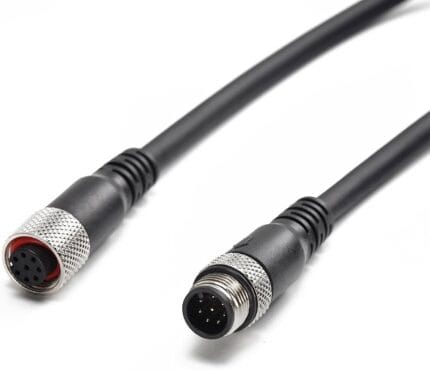
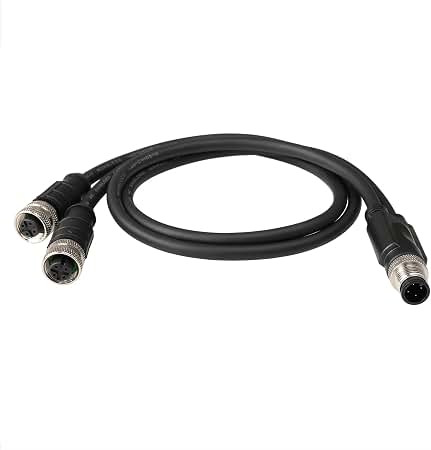
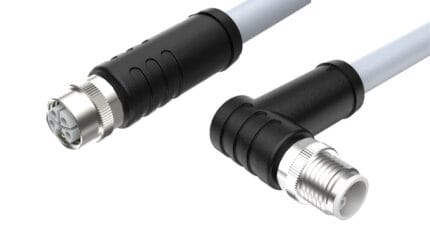
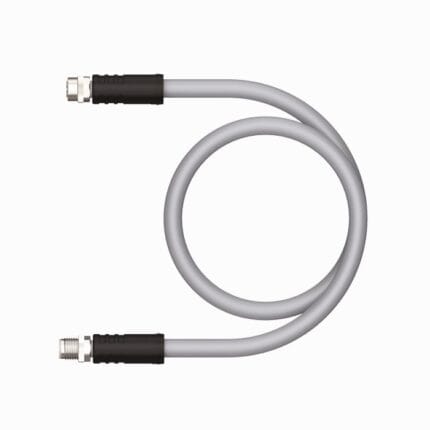
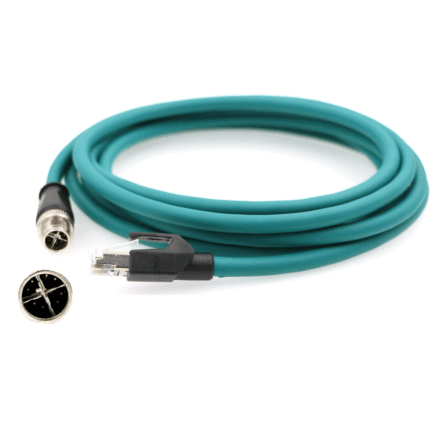
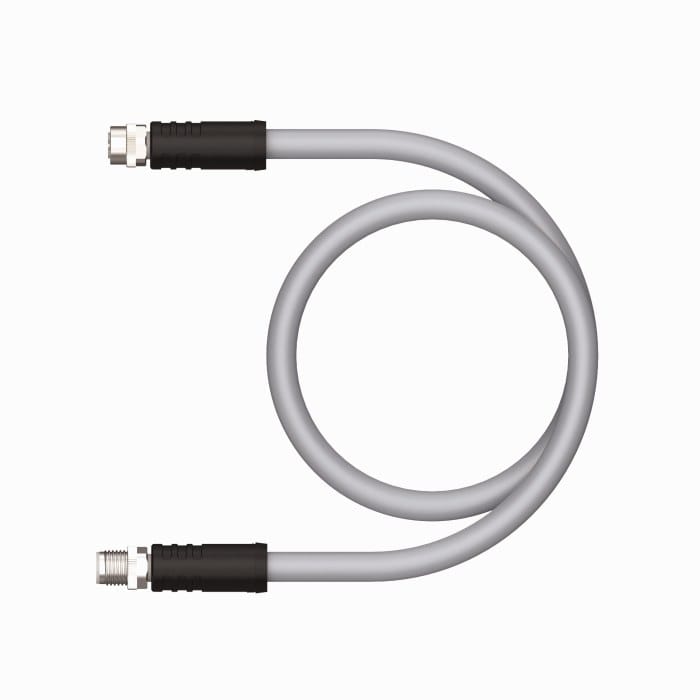
An M12 rail Ethernet cable carries the consist and backbone network on rolling stock and coaches: CCTV, passenger information and infotainment. X-coded 8-position face, halogen-free crosslinked jacket, low smoke.
Overview
Vehicle networks are the reason this product exists as a separate part number from a factory Ethernet cordset. A M12 rail Ethernet cable is built for train and tram consist and backbone networks, onboard CCTV, passenger information screens and the infotainment servers now fitted to coaches and long-distance buses. Electrically it is the same eight-position X-coded interface used in factories. Everything that differs is in the jacket and the documentation, because a cable that is acceptable inside a machine cabinet is not automatically acceptable inside a passenger saloon.
Key Specifications
| Connector series | M12, X-coded, 8 positions, 4 pairs |
|---|---|
| Conductor construction | 4 x 2 x 0.25 mm2 class (pending supplier datasheet) |
| Jacket material | Halogen-free, electron-beam crosslinked compound (pending material declaration) |
| Fire performance | EN 45545-2 hazard levels quoted in competitor data, pending test report |
| Vibration and shock | IEC 61373 category quoted in competitor data, pending test report |
| Temperature range | -40 to +90 C class (pending supplier datasheet) |
| Transmission class | Cat6A / Cat7 class claimed in competitor data, pending channel test |
| Standard lengths | 1 / 2 / 5 / 10 m, other lengths on request |
| Typical uses | Rail Ethernet backbone, onboard CCTV, passenger information, coach networks |
| Compliance files | Material declaration and fire test reports outstanding |
Why vehicle cable is a different product
The governing requirement in a rail vehicle is what happens in a fire. A halogenated jacket releases dense, corrosive smoke, and in a tunnel or a sealed saloon the smoke and the acidity matter more than the flame spread. Competitor rail ranges use electron-beam crosslinked halogen-free compounds. Fire, smoke and toxicity performance to EN 45545-2 is quoted in competitor data at hazard levels HL1 to HL3. We are not stating a hazard level for our part until the material has its own test report.
What the onboard environment asks of the assembly
EN 50155 is the industry reference for electronic equipment used on rolling stock: operating temperature class, vibration and shock all get a clause. It applies to equipment rather than to a cable assembly on its own, but the clause list is the right way to read a vehicle specification.
| Stress | What it does to the assembly | What we need from you |
|---|---|---|
| Thermal cycling | Expands and relaxes the joint and the crimp | Mounting location: saloon, underframe or roof |
| Random vibration | Works a poorly supported connector loose | Which bogie or equipment frame the run is fixed to |
| Condensation and humidity | Wicks along a badly sealed jacket | Whether the run is interior or exterior |
| Cleaning agents | Attacks the jacket plasticizer | The agent in use on the fleet |
| Service life | Decades, not production seasons | Whether this is new build or refurbishment |
X-coded 8-position layout for the consist network
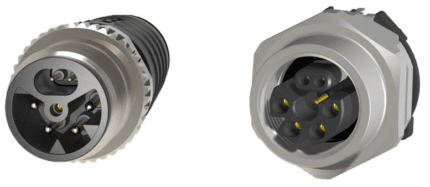
Four pairs, each kept separate to the mating face, which is what lets the interface carry the transmission class the backbone needs.
| Pin | Pair | Function | Screen note |
|---|---|---|---|
| 1 | Pair 1 | BI_DA+ | Pair foil plus overall braid |
| 2 | Pair 1 | BI_DA- | Pair foil plus overall braid |
| 3 | Pair 2 | BI_DB+ | Pair foil plus overall braid |
| 4 | Pair 2 | BI_DB- | Pair foil plus overall braid |
| 5 | Pair 3 | BI_DC+ | Pair foil plus overall braid |
| 6 | Pair 3 | BI_DC- | Pair foil plus overall braid |
| 7 | Pair 4 | BI_DD+ | Pair foil plus overall braid |
| 8 | Pair 4 | BI_DD- | Pair foil plus overall braid |
On rolling stock the same 12 mm thread can carry an X-coded data run or an A-coded signal drop, which is precisely the confusion the keyway exists to prevent. Our download center has a two-page coding reference covering the whole alphabet.
Coding family, mapped onto a vehicle
A vehicle carries more codings than most factories do, and the keyway is the only thing keeping them apart.
| Code | Contacts | Carries | Where on the vehicle |
|---|---|---|---|
| X | 8 | Backbone and video traffic | Consist network, CCTV recorders |
| D | 4 | 100 Mbit/s device drops | Door cameras, passenger counters |
| A | 3 to 12 | Discrete signals | Doors, brakes, HVAC, lighting |
| L | 4+FE | 24 V DC distribution | Saloon and equipment power |
| T | 2 to 4 | DC power | Fan and damper drives |
| K | 4+PE | Three-phase AC | Compressor and HVAC motors |
| S | 2+PE / 3+PE | Single-phase AC | Galley and socket circuits |
| M | 5 to 6 | Servo power with brake | Door actuators on some fleets |
| B | 4 to 5 | PROFIBUS-DP | Legacy onboard bus segments |
| C | 3 to 6 | AC power | Older AC auxiliary circuits |
| P | 4 | EtherCAT P | Rare on vehicles |
| Y | 8 (4+4) | Power plus data | Modular equipment racks |
Vibration and temperature
A vehicle cable lives in a different mechanical world from a factory drop. It sees continuous random vibration from the bogies and the traction package, thermal cycling between a heated saloon and an underframe at winter ambient. Shock and vibration qualification to IEC 61373 and a range from -40 to +90 C are quoted for comparable products; both need supplier test evidence before they go on a datasheet, and both should be checked against where the run actually sits.
Where the runs go
- Ethernet consist network and backbone links between vehicles
- Onboard CCTV camera drops and video recorders
- Passenger information displays and infotainment servers on coaches and buses
Onboard CCTV is the application that most often drives the bandwidth: a saloon full of closed-circuit television cameras writing to a recorder is a sustained load, not a burst.
Specifying a length
These assemblies are normally ordered at fixed lengths of 1, 2, 5 and 10 meters rather than cut on site, because the transmission performance of a four-pair cable is set by the termination as much as by the cable. X-coding keeps the four pairs separated to the mating face, which is what makes the higher transmission class possible over this interface; a poorly terminated field plug will not hold it.
Documentation status
Fire and smoke classifications, the vibration category, the temperature range and the Cat7 capability quoted for comparable products are leads from public competitor data, not verified values for our assemblies. Ask for the material declaration and the test reports early.
Typical applications for this M12 rail Ethernet cable
- Consist and backbone Ethernet links between vehicles
- Onboard CCTV drops and video recorder links
- Passenger information displays and public address data
- Coach and long-distance bus infotainment servers
How to specify your build
- Where the run sits – saloon, underframe, roof or cabinet.
- Fire and smoke requirement for the vehicle class.
- Transmission class you have to hold.
- Length, and whether it is cut on site or pre-terminated.
- Vibration category and the mounting method.
- Quantity and whether it is new build or refurbishment.
Workmanship and testing
ISO 9001 covers the system and IPC/WHMA-A-620 Class 3 covers the work on M12 Rail Ethernet builds, across 32 to 12 AWG. Every M12 build gets a 100% continuity and pinout check before it is boxed, and seal checking is quoted whenever an ingress rating is on the drawing.
RoHS and REACH declarations are provided per project together with the agreed test reports; the documentation scope is listed under certifications and compliance. If your drawing specifies a UL style, we build to that drawing and supply the UL reference with the shipment instead of substituting an equivalent. Production runs on the same lines described under the assembly lines behind this build, where cutting, termination, molding and 100 percent electrical verification sit under one roof. More background: cable assemblies for industrial automation and robotics. Any tooling we cut for this part stays yours, maintained in our own tool room under your part reference.
Custom builds and ordering
Prototypes are quoted from 1 to 50 pcs and ship within 3 working days. Volume production starts at 500 pcs with a 14 working day lead time after approval, and about 10 working days more when a new tool is needed. Private labeling carries your part number, and material certificates with first-article reports are available on request.
Related rail and M12 assemblies
- M12 Rail Signal Cable for Door Control and Brake Sensors
- Railway Rolling Stock Harness Built to EN 45545-2 Cable Specifications
- Cat6A Railway Patch Cord for Rolling Stock, RJ45 or M12 Ends
- M12 Push-Pull X-Code Cat6A Industrial Ethernet Cable
- M12 X-Coded Cat6A Cable to RJ45 for Machine Vision
- M12 CAN Bus Cable, 5-Pin Shielded Pair for CANopen and DeviceNet
Full range: circular M8 and M12 cable assemblies.
Frequently Asked Questions
Is this the same as a factory X-coded cable?
The interface is the same eight-position X-coded face. What differs is the jacket compound and the documentation, because a passenger saloon has fire, smoke and toxicity requirements a machine cabinet does not.
Can you state an EN 45545-2 hazard level?
Not yet. Fire, smoke and toxicity performance to EN 45545-2 is quoted in competitor data at HL1 to HL3; we will not state a hazard level until the material has its own test report.
Why fixed lengths rather than cut on site?
Transmission performance is set by the termination as much as by the cable. A poorly terminated field plug will not hold the transmission class the interface is capable of.
| Connector series | M12, X-coded, 8 positions, 4 pairs |
|---|---|
| Conductor construction | 4 x 2 x 0.25 mm2 class |
| Jacket material | Halogen-free, electron-beam crosslinked compound |
| Fire performance | EN 45545-2 hazard levels |
| Vibration and shock | IEC 61373 category |
| Temperature range | -40 to +90 C class |
| Transmission class | Cat6A / Cat7 class |
| Standard lengths | 1 / 2 / 5 / 10 m, other lengths on request |
| Typical uses | Rail Ethernet backbone, onboard CCTV, passenger information, coach networks |
| Compliance files | Material declaration and fire test reports outstanding |