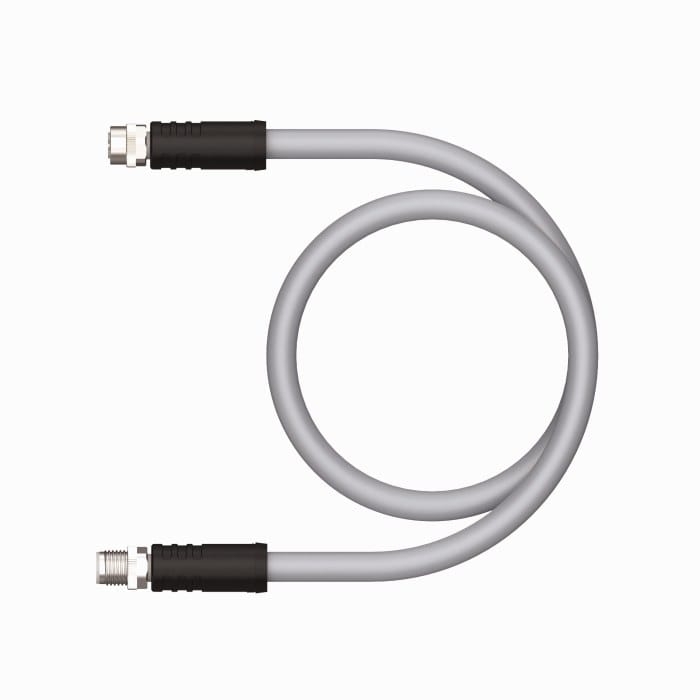
M12 Rail Signal Cable for Door Control and Brake Sensors
An M12 rail signal cable carries the discrete and low speed signals that make a vehicle work – door feedback, obstruction edges, brake wear, HVAC probes. A-coded or D-coded, halogen-free jacket, built to your pinout and length.
Overview
Not every connector on a vehicle carries Ethernet. The majority carry the ordinary signals that make a bus or a train car work: door open and closed feedback, door obstruction edges, brake wear and brake pressure sensors, HVAC temperature probes, saloon and step lighting, and the passenger counting beams over the doorways. This M12 rail signal cable covers that layer, in A-coded four, five and eight position versions and in D-coded four position versions where the run is Fast Ethernet rather than discrete IO.
Key Specifications
| Connector series | M12, A-coded 4 / 5 / 8 positions, or D-coded 4 positions |
|---|---|
| Jacket type | Halogen-free compound of the SABIX and RADOX type |
| Fire performance | EN 45545-2 quoted in competitor data, pending test report |
| Vibration category | IEC 61373 cat 1 class B quoted in competitor data, pending test report |
| Temperature range | -40 to +120 C class (pending supplier datasheet) |
| Ingress rating | IP67 class (pending supplier test report) |
| Fluid resistance | Oil and fuel resistant, pending material declaration |
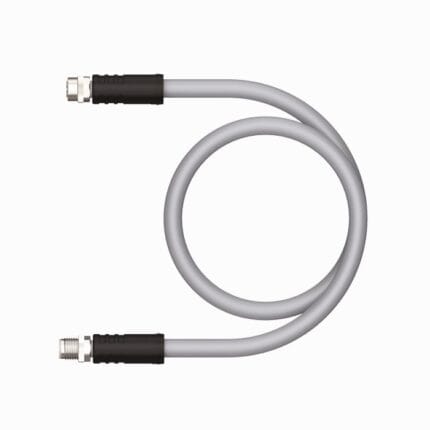
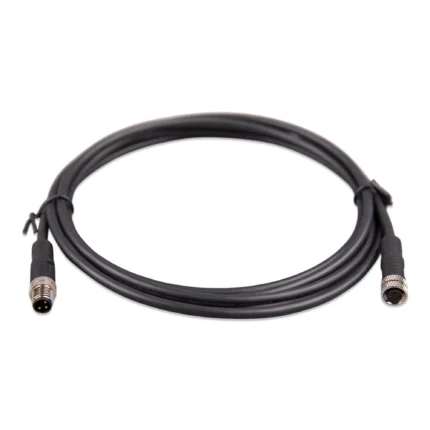
| Standard lengths | 1.5 / 2 / 5 / 10 m, other lengths on request |
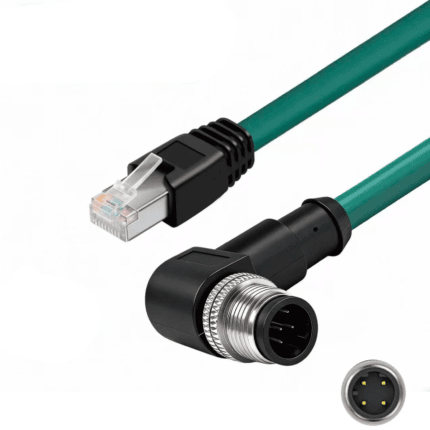
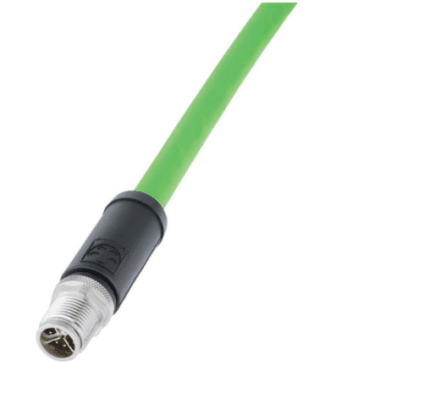
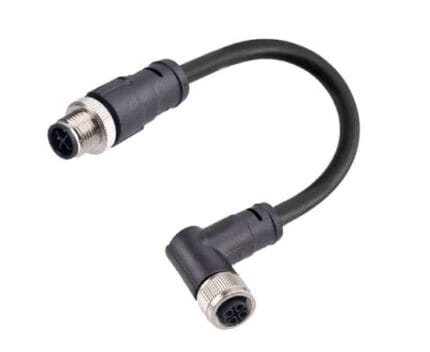
| Versions | Straight / right-angle cordsets, panel feedthrough receptacles |
| Typical uses | Door control, brake sensing, HVAC probes, lighting, passenger counting |
Safety-relevant signals, not data
Door control is the clearest example of why this layer deserves its own cable. A door controller reads an obstruction edge, a closed limit switch and an emergency release, and it has to be right every time, because the failure mode is a door closing on a passenger or opening while the vehicle is moving. Brake wear and brake pressure sensors are in the same category. That does not change the connector, but it changes how seriously the pinout, the strain relief and the jacket are specified.
Rail signal pinout reference
These are the wire colors most device makers follow for A-coded faces, with the D-coded assignment alongside for Ethernet device drops.
| Pin | Color | A-code 4-pin | A-code 5-pin | D-code 4-pin |
|---|---|---|---|---|
| 1 | Brown | +V (24 V DC) | +V (24 V DC) | TD+ |
| 2 | White | Signal 2 | Signal 2 | RD+ |
| 3 | Blue | 0 V | 0 V | TD- |
| 4 | Black | Signal 1 | Signal 1 (C/Q) | RD- |
| 5 | Gray | – | Functional earth or spare | – |
We wire to the pinout you send. On signal cables the pin assignment is where most rework originates, so a drawing of both ends is worth more than a part number.
A-coded or D-coded on the same vehicle
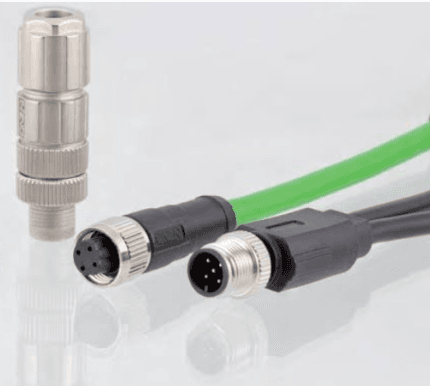
The choice is decided by what the device is, not by preference. A door controller doing discrete IO and analog inputs takes an A-coded connector; a door-mounted camera or an Ethernet passenger counter takes D-coded, because D-coding keeps the two data pairs separated through the mating face and preserves the 100 ohm channel. Mixing them on one vehicle is normal and is not a problem as long as the two codings are never interchangeable at the point of use, which the keyways guarantee. On rolling stock that matters more than it does in a factory, because the interval between maintenance visits is measured in years and the person making the change may not be the person who designed the harness.
Coding family, as a vehicle engineer would read it
The same 12 mm shell turns up all over a vehicle, which is why the keyway is the only thing standing between a sensor lead and a mains outlet.
| Code | Contacts | Job on the vehicle | Voltage class |
|---|---|---|---|
| A | 3 to 12 | Discrete IO, sensors, actuators | 30-250 V |
| D | 4 | Fast Ethernet device drops | 60 V |
| X | 8 | Backbone and video traffic | 60 V DC |
| B | 4 to 5 | Legacy PROFIBUS segments | 60 V |
| C | 3 to 6 | AC auxiliary circuits | 250 V AC |
| K | 4+PE | Three-phase motors and compressors | 630 V AC |
| S | 2+PE / 3+PE | Single-phase HVAC supplies | 630 V AC |
| L | 4+FE | 24 V DC distribution and IO-Link | 63 V DC |
| T | 2 to 4 | DC drives and fan supplies | 63 V DC |
| M | 5 to 6 | Traction and servo power | 630 V AC |
| P | 4 | EtherCAT P combined drops | 60 V |
| Y | 8 (4+4) | Power plus data on modular units | 50 V |
The voltage column is the published value for the coding as an interface. Your assembly is manufactured and accepted to the nominal values on your drawing.
Running A-coded and D-coded outlets on the same vehicle works, as long as the keyways keep them apart. The whole family, A to Y, is mapped with pole counts and typical duties in the coding reference in our download center.
Why the jacket chemistry matters here
Vehicle interiors are enclosed spaces, so the fire, smoke and toxicity behavior of the jacket is a specification item rather than a nice-to-have. The halogen-free compounds used in these ranges, of the SABIX and RADOX type, do not release halogen acid gases when they burn, and they keep their flexibility across the temperature extremes a vehicle sees. Oil and fuel resistance and fire performance to EN 45545-2 are quoted in competitor literature and need supplier test evidence before we state them as our own.
Where it is installed
- Door control units, obstruction edges and door status feedback
- Brake wear, brake pressure and axle temperature sensors
- Saloon HVAC probes, damper actuators and lighting feeds
Ordering notes
These assemblies are normally supplied at fixed lengths of 1.5, 2, 5 and 10 meters with halogen-free overmolding, in straight or right-angle versions depending on the depth behind the panel. Where a run passes through a bulkhead, a panel feedthrough receptacle is usually a better answer than a grommet, because it keeps the ingress rating of the enclosure intact.
What still needs confirming
Temperature range, ingress rating, fire classification, oil and fuel resistance and the vibration category quoted for this range come from public competitor data rather than a verified datasheet for our part. A -40 to +120 C range and an IP67 rating are quoted for comparable assemblies; both are plausible for this jacket type and both need a test report before they belong on a specification.
Typical applications for this M12 rail signal cable
- Door control loops, obstruction edges and emergency release feedback
- Brake wear and brake pressure sensing on bogies and axle boxes
- Saloon HVAC probes, damper actuators and step lighting feeds
- Passenger counting beams over the doorways
How to specify your build
- Coding and pin count – A-coded 4, 5 or 8, or D-coded 4.
- Pinout of both ends, or the device part numbers.
- Length and the routing – through a bulkhead or not.
- Fire and smoke requirement for the vehicle class.
- Fluid exposure – oil, fuel, cleaning agents.
- Quantity and whether it is a retrofit or new build.
Workmanship and testing
Build standard for M12 Rail Signal builds is IPC/WHMA-A-620 Class 3 under ISO 9001, with terminations from 32 to 12 AWG. continuity and pinout are checked on every M12 unit before packing, and seal checking is quoted whenever an ingress rating is on the drawing.
Material declarations against RoHS and REACH are issued per project, alongside the dimensional and electrical reports agreed at quotation; see certifications, compliance and material declarations. Where your drawing names a UL style or another approval, the build follows your drawing and ships with the supporting document rather than a claim of our own. Overmold tooling for this part is designed and cut in our own tool room under the overmold tooling we build in-house, so the tool belongs to your program and a revision is a machining job rather than a new negotiation. More background: cable assemblies for industrial automation and robotics.
Custom builds and ordering
On M12 Rail Signal builds, prototype lots run from 1 to 50 pcs and leave in 3 working days; production runs of 500 pcs and up ship 14 working days after approval. Tooling not already held adds around 10 working days. M12 OEM and ODM shipments carry your part number and labeling, and material certificates and first-article reports can be supplied.
Related M12 and M8 assemblies
- M12 Rail Ethernet Cable for Rolling Stock and Bus Networks
- Railway Rolling Stock Harness Built to EN 45545-2 Cable Specifications
- M12 CAN Bus Cable, 5-Pin Shielded Pair for CANopen and DeviceNet
- M12 A-Coded PVC/PUR Straight or Right-Angle Extension Cable
- M12 Bulkhead Panel Connector with Pigtail, A, D and X Coding
- M12 12-Pin Bulkhead Cable with Flying Leads
Full range: circular M8 and M12 cable assemblies.
Frequently Asked Questions
A-coded or D-coded for a door-mounted device?
Discrete IO and analog inputs take A-coded. A camera or an Ethernet passenger counter takes D-coded, because it keeps the two data pairs separated through the mating face.
Do you build the panel feedthrough?
Yes. A bulkhead receptacle keeps the enclosure rating intact and is usually better than a grommet on a vehicle.
Can you meet EN 45545-2?
Fire, smoke and toxicity performance to EN 45545-2 is quoted in competitor data at hazard levels HL1 to HL3. We are not stating a hazard level for our part until the material has its own test report.
| Connector series | M12, A-coded 4 / 5 / 8 positions, or D-coded 4 positions |
|---|---|
| Jacket type | Halogen-free compound of the SABIX and RADOX type |
| Fire performance | EN 45545-2 |
| Vibration category | IEC 61373 cat 1 class B |
| Temperature range | -40 to +120 C class |
| Ingress rating | IP67 class |
| Fluid resistance | Oil and fuel resistant |
| Standard lengths | 1.5 / 2 / 5 / 10 m, other lengths on request |
| Versions | Straight / right-angle cordsets, panel feedthrough receptacles |
| Typical uses | Door control, brake sensing, HVAC probes, lighting, passenger counting |