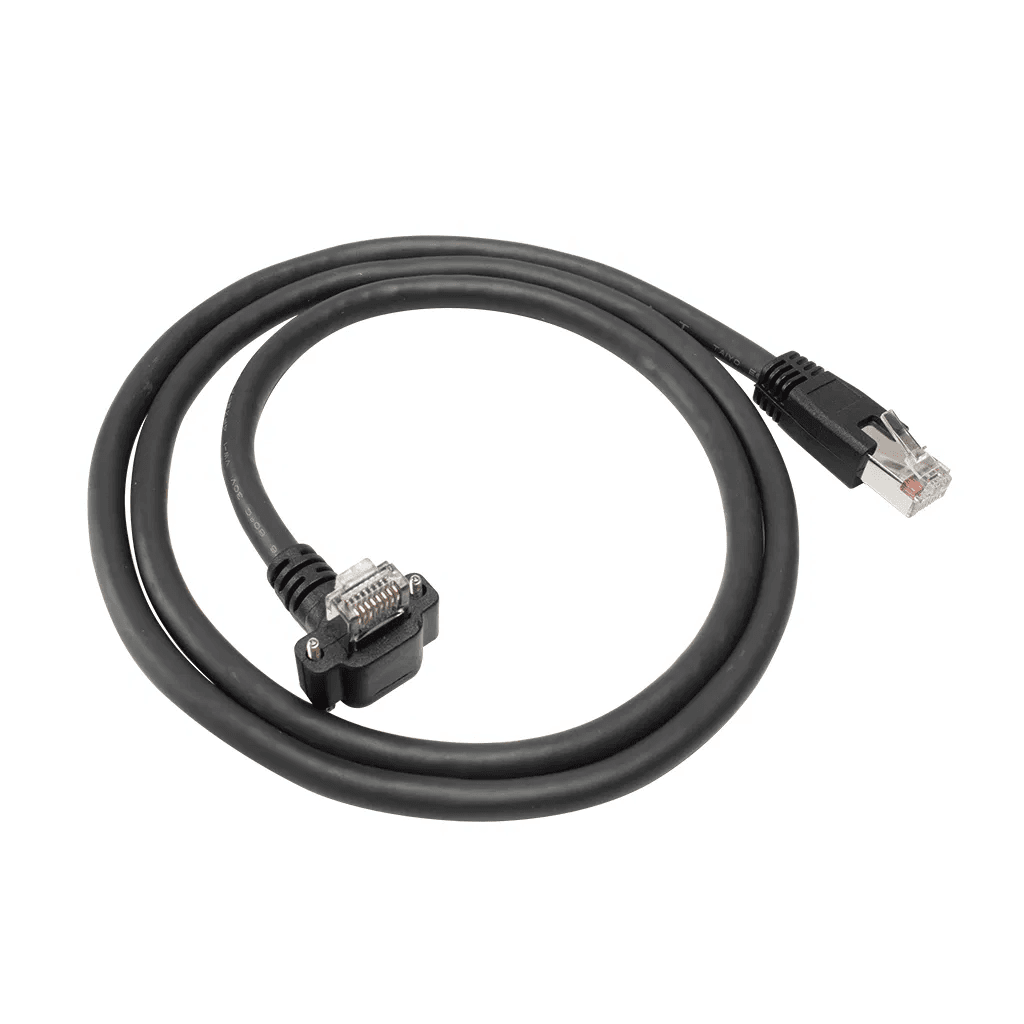
Right-Angle RJ45 Screw-Lock Cable (90 Degree Thumbscrew Plug, Cat6A S/FTP)
A right angle RJ45 screw lock cable uses the same thumbscrew locking plug as our straight version, but the plug body turns 90 degrees so the cable leaves sideways instead of straight back. It is the answer when a camera, control box or switch sits against a wall or inside a shallow enclosure.
Overview
A right angle RJ45 screw lock cable is the same thumbscrew locking plug as our straight screw-lock version, with the plug body turned 90 degrees so the cable leaves the connector sideways instead of straight back. The point is clearance: when a camera sits against a wall, when a control box lives in a shallow enclosure, or when a switch is mounted on the back of a press, a straight plug plus the bend radius of a Category 6A jacket simply does not fit. Turning the exit sideways also takes the sideways pull off the receptacle that a straight plug hanging under its own weight puts there.
Key Specifications
| Connector A | RJ45 8P8C male, 90 degree, twin thumbscrew lock, 4-40 UNC |
|---|---|
| Connector B | RJ45 8P8C male straight shielded; 90 degree on both ends optional |
| Exit Direction | Up, down, left or right – specified per build |
| Category | ISO/IEC 11801 Class EA / TIA-568.2-D Category 6A |
| Data Rate | 10GBASE-T to 500 MHz, IEEE 802.3an |
| Conductor | 26 AWG stranded bare copper, S/FTP |
| Jacket | High-flex PVC or PUR |
| Length | OEM build to required length |
How much depth does the right-angle plug actually save?
The depth a straight plug needs is not the plug body alone. It is the body, plus the strain relief boot, plus the bend radius the jacket needs before it can turn. A right-angle plug removes almost all of that and replaces it with the width of the plug body, which is the dimension that runs parallel to the panel. On a wall-mounted camera or a shallow wall box that difference is usually the whole job.
| Depth behind the panel | Straight plug | Right-angle plug |
|---|---|---|
| Plug body and boot | Projects straight back from the port face | Runs sideways, parallel to the panel |
| Jacket bend radius | Needed before the cable can turn at all | Cable already leaves at 90 degrees, so no extra turn is needed |
| Cable dress | Hangs away from the wall, loading the port sideways | Runs flat along the wall or frame member |
| Space needed | Body plus boot plus bend radius | Roughly the plug body width plus jacket thickness |
| Confirm on | Stated per your drawing | Stated per your drawing |
Measure the clearance before you order, not after
Right-angle plugs are returned for one reason more often than any other: the exit was specified without measuring what is next to the port. Five minutes with a rule and a torch avoids it.
- Measure the depth from the port face to the nearest obstruction – the wall, the frame member, the machine guard. That is the number a straight plug has to beat.
- Note which way the cable has to run once it is out: up, down, left or right. The overmold is dedicated to one direction, so this has to be right at the order stage.
- Check that the thumbscrews are reachable with a finger or a driver once the cable is dressed. On a right-angle body the screws sit closer to the panel than on a straight one.
- Check the neighboring ports. A right-angle body is wider across the panel than a straight plug, and adjacent ports may not accept two of them side by side.
- If the equipment moves, check the clearance through the whole travel.
Thumbscrew or long screw: which locking hardware do you want?
| Locking style | How it is tightened | Where it suits | Watch out for |
|---|---|---|---|
| Thumbscrew, 4-40 UNC | By hand, no tool | Cameras and control boxes that are re-plugged during commissioning or service | Hand torque only; on a vibrating axis add a check at service intervals |
| Long screw, 4-40 UNC | With a driver | Fixed installations where the plug is fitted once and not touched again | Needs tool access in front of the panel |
| Captive screws in the molded shell | Either way | Any build where a lost screw would stop the line | The screws are retained, so they cannot be dropped inside the enclosure |
Our screws are captive in the molded shell so they cannot be lost during installation, and the thread is 4-40 UNC because that is what the mating receptacles on industrial cameras and vision equipment use. If your hardware carries a different thread, say so on the drawing and we build to it.
Where a right-angle plug is the wrong answer
- Tight side-by-side ports: the body is wider across the panel than a straight plug, so adjacent ports can block each other.
- Runs pulled through conduit after termination: the right-angle body will not go through the same hole the cable does.
- Runs that get re-dressed often: the exit direction is fixed by the overmold.
- Ports facing into open space: a straight plug with a proper boot is cheaper.
Construction: what holds Class EA performance through the turn
The 90 degree body is overmolded around the loaded connector rather than clipped on, so the thumbscrew bosses and the strain relief are part of the same molding. Inside, the four foil-wrapped pairs and the overall braid are dressed to the exit side with the pair lay maintained as far as the contacts, which is what keeps Class EA performance to 500 MHz. Conductors are 26 AWG stranded bare copper, and the jacket is high-flex PVC or PUR. The metal shell bonds to the braid so the screen continues through the plug.
Typical applications for this right angle RJ45 screw lock cable
- Cameras and sensors mounted close to a wall, a frame member or a machine guard, where straight-back clearance is a few centimeters
- Shallow wall boxes, pole boxes and flush-mounted enclosures
- Robot arm joints and rotary axes where the cable has to run along the arm rather than away from it – for continuous motion see our hybrid robot torsion cable
- Rack and cabinet runs where the port faces a door or a side panel, next to the RJ45 screw lock patch cable for the device-to-device section
- GigE Vision links in tight housings, alongside the Cat6A GigE Vision screw-lock cable
Ordering and lead time
Right-Angle RJ45 Screw-Lock prototype builds start from 1 to 50 pcs and are out in 3 working days; production is quoted from 500 pcs at 14 working days after sample approval. Your part number and labeling go on OEM and ODM Right-Angle shipments, and material certificates plus first-article reports are available. We hold 100 sets of mold tooling in house, so a standard body needs no tooling time and a new one adds about 10 working days.
Workmanship and testing
Assembly and inspection follow IPC/WHMA-A-620 Class 3 workmanship criteria under our ISO 9001 quality management system, and every unit passes 100% continuity and pinout testing before it is packed. Conductor range is 32 to 12 AWG. The eight-position interface itself is the standard registered jack wiring, which is why the plug mates with ordinary equipment; Ratings quoted here are the industry-standard definitions from IEC, ISO/IEC and TIA documents; the values your assembly is built and verified to are the ones stated on your drawing.
Every production run can ship with RoHS and REACH declarations and the electrical report agreed at quotation; see certifications and material declarations. UL styles and other named approvals are built to drawing: we source to the style you specify and document it, rather than asserting a listing we do not hold. Exit direction is a tooling decision, not a field bend see right-angle cable assembly forms and tooling for the forms we mold and when each one makes sense. The wider context is covered under build-to-print cable assemblies. Tooling is quoted separately, cut in-house rather than brokered out, and owned by you.
Frequently Asked Questions
Can I get both ends at 90 degrees?
Yes. The 90 degree body can be built on one end or both. Remember that each end has its own exit direction, so specify both and check them against how the cable has to be dressed.
Can I change the exit direction later?
Not on the same cable. The overmold is dedicated to one direction, so a change of direction means a new build. This is the single most common reason a right-angle order has to be redone, which is why we ask for it explicitly at quoting.
Will a right-angle plug fit two ports side by side?
Often not. The body is wider across the panel than a straight plug. If your equipment has two ports close together, measure the port pitch and check it against the body width on the drawing before ordering two right-angle plugs.
Is the thumbscrew enough on a vibrating machine?
It is far better than a plastic latch, because the screws take the load off the latch entirely. On a permanently vibrating axis, specify the screw-locked version, dress the cable so it does not hang off the plug, and add a re-check at your service interval.
Related assemblies
| Connector A | RJ45 8P8C male, 90 degree, twin thumbscrew lock, 4-40 UNC |
|---|---|
| Connector B | RJ45 8P8C male straight shielded; 90 degree on both ends optional |
| Exit Direction | Up, down, left or right – specified per build |
| Category | ISO/IEC 11801 Class EA / TIA-568.2-D Category 6A |
| Data Rate | 10GBASE-T to 500 MHz, IEEE 802.3an |
| Conductor | 26 AWG stranded bare copper, S/FTP |
| Jacket | High-flex PVC or PUR |
| Length | OEM build to required length |