USB 2.0 Type-B Male to Female Screw-Lock Panel-Mount Extension Cable (480 Mbps, M3, 30V, PVC)
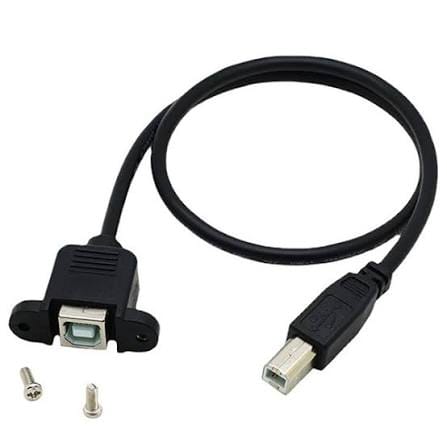
A usb type b screw lock cable carries a 480 Mbps link to a panel-mounted Type-B receptacle held by two M3 thumbscrews. 26+28 AWG copper, foil plus braid shield, 30 V / 2 A.
Overview
A usb type b screw lock cable keeps the square USB Type-B port that industrial and instrument equipment still ships with, and fixes the one thing it was never good at: staying plugged in. The male end goes into the host or the device; the female end is a panel-mount receptacle with two M3 thumbscrews and captive nuts, so the port becomes part of the enclosure instead of a socket floating on the end of a lead. Printers, scanners, lab instruments, CNC panels and banking terminals get moved, cleaned and bumped, and every one of those events is a chance for a friction-held plug to walk out. The conductor is 26 + 28 AWG bare copper with aluminum foil plus braid shielding, which is what keeps a 480 Mbps link clean next to motors and drives.
Key Specifications
| Connector A | USB 2.0 Type-B male |
|---|---|
| Connector B | USB 2.0 Type-B female, panel-mount with screw lock |
| Standard | USB 2.0 High Speed |
| Data Rate | 480 Mbps |
| Conductor | 26 + 28 AWG bare copper, multi-strand |
| Shielding | Aluminum foil + braid |
| Cable OD | 4.5 mm |
| Jacket | Eco-friendly PVC, black, halogen-free |
| Rated | 30 V / 2 A |
| Lock | M3 thumbscrews, approx. 30 mm pitch |
Why the Type-B port is still here
Type-B was designed as a hub-and-peripheral connector and it has three properties that industrial designers still value: the shell is large enough to be robust, the shape makes it impossible to plug in backwards, and the mating face is big enough to carry real retention hardware. That is why it outlived its consumer life and is still on instruments, controllers and print engines that will be in service for another decade.
- Mechanical robustness. The shell takes the abuse, not the contact insert.
- Keyed geometry. No orientation errors and no ambiguity about which end goes where.
- Room for hardware. The standard face accepts a screw-locked version without redesigning the product.
The trade-off is size. Where the panel has no room for a Type-B face and two screws, a locking Type-C or a circular connector is the alternative, and we build both. The other thing to check before you commit is what is on the far end: a Type-B plug at the host and a Type-B receptacle at the panel is the usual arrangement, but a device with a Type-B socket and no panel can use the same screw-lock receptacle bolted to a bracket.
Panel cut-out: the one dimension you cannot recover
A screw-lock receptacle is only as good as the panel preparation. Once a hole is punched in a finished door or a molded enclosure, the repair options are a step plate or a new door, so the sequence matters: obtain the receptacle drawing, confirm the aperture and the screw pitch, then cut. The table below lists what to confirm, not what to assume.
| Dimension | Why it bites | How to confirm |
|---|---|---|
| Aperture shape and size | A rectangular bore cannot be enlarged cleanly after the fact | Off the receptacle drawing we supply with the quotation |
| Screw pitch | M3 hardware is often quoted around a 30 mm pitch, but it varies by shell | Measure the sample, or take the drawing value |
| Panel thickness | Sets whether the screws are long enough and whether the nuts seat | Measure at the mounting point, including any paint or gasket |
| Mounting direction | Front or rear mounting changes which side the nuts land on | Decide before the panel is finished |
| Surface finish | Paint and anodizing insulate the shell from the panel | Mask a contact area, or specify a conductive gasket |
On the last point: a shielded receptacle bolted to a painted panel is an unshielded receptacle. If the shield is meant to continue into the enclosure, the mounting face has to make metal-to-metal contact.
Torque, and why tighter is not better
Thumbscrews are meant to be snug, not torqued. Two failure modes come from over-tightening: the receptacle flange distorts and the contact insert shifts, or the thread in a soft panel strips and the port is then loose no matter what you do. The purpose of the screws is to stop relative movement between the plug and the receptacle, and a snug fit achieves that. If a joint is working loose at a snug torque, the problem is vibration amplitude or unsupported cable mass, not insufficient tightness.
- Tighten by hand to a firm stop; a driver is not needed and usually does harm.
- Support the cable within a short distance of the panel so its weight does not hang on the joint.
- Re-check the screws at the first service interval, and after that only if the environment warrants it.
Where a usb type b screw lock cable is the right answer
- Printers, scanners and multifunction devices in shared or industrial spaces
- POS terminals and retail kiosks that get cleaned and moved daily
- Lab and medical instruments where a dropped link means a lost run
- CNC machine panels and industrial control cabinets next to drives
- Banking and ticketing equipment with a service port on the outside of the enclosure
- Panel feedthroughs that also need sealing, where our IP67 RJ45 Screw-Lock Bulkhead Cable family shows the approach for other interfaces
Workmanship and testing
USB 2.0 Type-B Male builds are assembled and inspected to IPC/WHMA-A-620 Class 3 criteria, with ISO 9001 as the quality system over 32 to 12 AWG work. continuity and pinout are checked on every USB unit before packing, and seal checking is quoted whenever an ingress rating is on the drawing.
RoHS and REACH declarations are provided per project together with the agreed test reports; the documentation scope is listed under certifications and compliance. If your drawing specifies a UL style, we build to that drawing and supply the UL reference with the shipment instead of substituting an equivalent. Where this build needs an overmold, the tool is designed, cut and maintained in our own shop under overmold tooling cut in our own tool room, and it is never used for another customer’s program. More background: build-to-print cable assemblies.
Custom builds and ordering
USB 2.0 Type-B Male prototype builds start from 1 to 50 pcs and are out in 3 working days; production is quoted from 500 pcs at 14 working days after approval. Tooling not already held adds around 10 working days. Private-label USB runs ship under your part number and labeling, and material certificates and first-article reports are available on request.
What is listed here for USB 2.0 Type-B Male builds is the industry-standard definition, not a measurement we took on a finished part. What your assembly is built and verified to is what your drawing states, confirmed against the supplier datasheet before a quote goes out.
Related screw-lock and panel-mount builds
- Screw-Lock USB 3.0 Type-A Extension Cable
- D-Sub Screw Lock Cable, DB9 DB15 DB25
- Screw Lock Console Cable, DB9 to RJ45
- IP67 D-Sub Screw Cable, Sealed Cordset
- VGA Screw Lock Cable, HD15 for Industrial Monitors
- GX16 Aviation Plug Cable, Threaded Circular
- Right-Angle USB 3.0 Type-A Screw-Lock Cable
Full ranges: screw-lock molded cable and signal and data cables.
Frequently Asked Questions
Does it need a special panel tool?
No. The aperture is a plain rectangular bore plus two screw holes, cut to the receptacle drawing we supply. A step plate can recover an oversized hole if one is already cut.
Is the receptacle sealed?
This build is not. For a wet or dusty location add a gasket behind the flange, or specify a sealed version at the inquiry stage.
Will it work with USB 1.1 devices?
Yes. USB 2.0 High Speed is backward compatible with USB 1.1 and 1.0, and the cable does not change what the host negotiates.
Can I get it with a right-angle plug on the host end?
Yes, and it is often worth it behind a rack-mounted device. Tell us the exit direction you need in the installed position.
| Connector A | USB 2.0 Type-B male |
|---|---|
| Connector B | USB 2.0 Type-B female, panel-mount with screw lock |
| Standard | USB 2.0 High Speed |
| Data Rate | 480 Mbps |
| Conductor | 26 + 28 AWG bare copper, multi-strand |
| Shielding | Aluminum foil + braid |
| Cable OD | 4.5 mm |
| Jacket | Eco-friendly PVC, black, halogen-free |
| Rated | 30 V / 2 A |
| Lock | M3 thumbscrews, approx. 30 mm pitch |