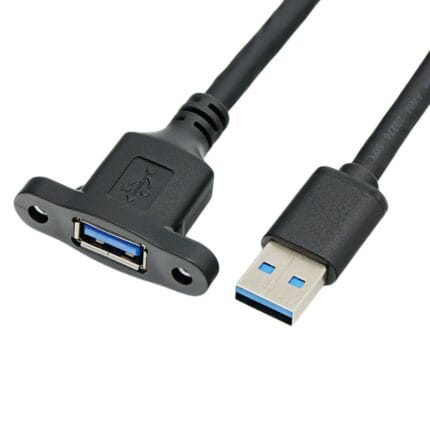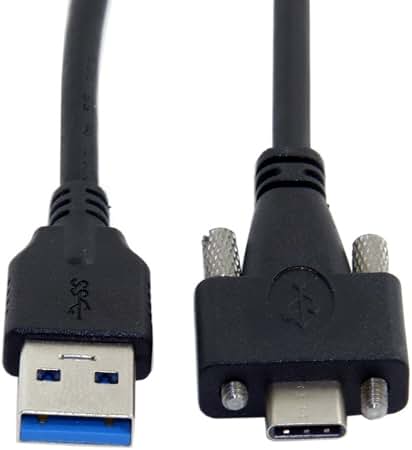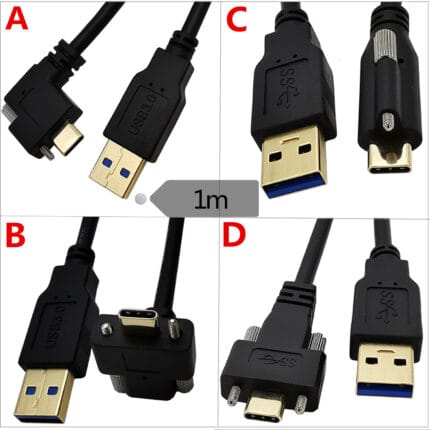
VGA Screw Lock Cable, HD15 for Industrial Monitors and CNC Panels
Last updated: 7 September 2026
Analog fails differently from digital
A digital link either arrives or it does not. VGA is three analogue color channels plus sync, and every meter of VGA screw lock cable rounds off the edges, adds capacitance and picks up noise. The symptom is never a clean failure: it is a soft picture, ghosting on vertical edges, color that will not converge, or a monitor that only locks when somebody holds the plug. That is why the construction of a vga screw lock cable matters far more than it does for a digital lead, and why the moulded lead that came with a 1990s monitor is not the right part for a machine.
Why a fat low-capacitance core matters past a few meters
Each of the red, green and blue channels rides on its own coax-style core with its own return. The capacitance per unit length of that core, working against the source impedance, behaves as a low-pass filter: the longer the run and the higher the capacitance, the more the high frequencies are rolled off – and the high frequencies are exactly what puts a crisp edge on text and on the fine detail in an image. Building the three channels on properly sized coax cores with a thicker dielectric keeps that roll-off low enough that a run to an operator station across a machine still shows a readable picture. Thin signal wire in a cheap lead degrades well before that distance.
Why the screws survive a machine tool
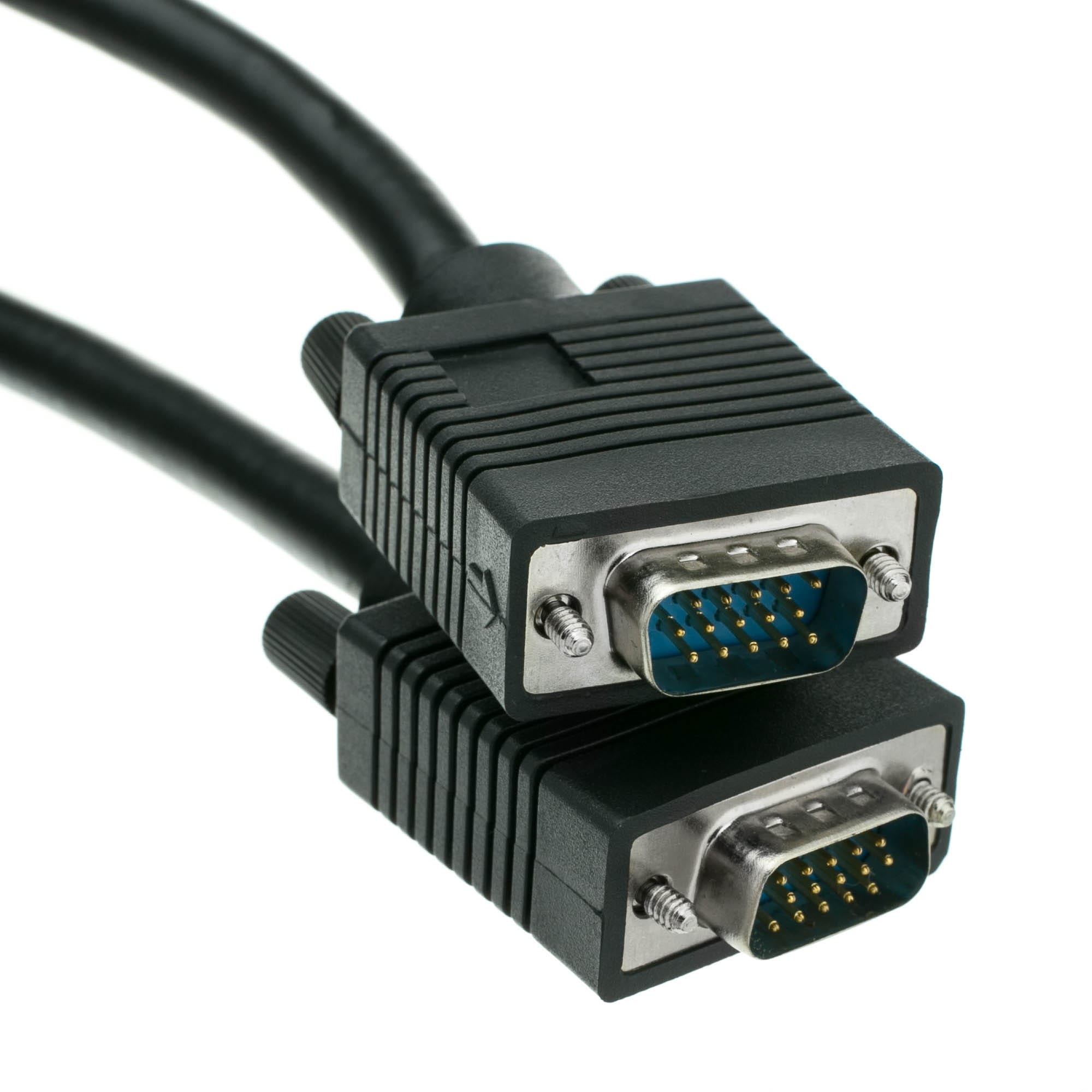
An HD15 plug without retention depends on the grip of its contacts and the weight of the cable hanging behind it. Put that on a machining center, a press or a cabinet with a fan tray and the vibration does the rest: the plug frets in the socket, the picture flickers, and eventually a pin loses contact. The two jackscrews on a retained HD15 clamp the shell to the panel threads so the connector and the socket move as one piece.
Where these are still being fitted
- Industrial panel PCs and operator stations on older production lines
- CNC controllers from the 1990s and early 2000s that will never be upgraded
- KVM trays and rack consoles in server and control rooms
- Inspection, measurement and test stations with legacy capture hardware
- Older laboratory and medical displays still in daily service
What to tell us
- The run length, and whether it passes near variable-speed drives or contactors
- Male-to-male extension, or a male plug to a panel-mount feed-through
- Straight or right-angle at either end
- Whether the machine is grounded the way the display expects
- Any ferrite suppression or jacket color requirement
You May Also Need
Related Cable Ranges
Panel Mount Cable • Signal and Data Cables • Circular M8 M12 Cable
Frequently Asked Questions
What is VGA Screw Lock Cable used for?
Industrial monitors, CNC panels, KVM trays, inspection stations.
Which connectors does VGA Screw Lock Cable use?
One end is HD15 / DE-15 male with retained jackscrews and the other end is HD15 male, female, or a panel-mount feed-through.
What jacket material does VGA Screw Lock Cable use?
The jacket is PVC as standard, PUR on request.
| Connector A | HD15 / DE-15 male with retained jackscrews |
|---|---|
| Connector B | HD15 male, female, or a panel-mount feed-through |
| Interface | VGA, 15-pin D-sub per the original IBM / VESA analogue pinout |
| Retention | Two jackscrews clamping to the mating panel threads |
| Signal cores | Three coax-style color channels plus sync conductors |
| Shielding | Overall braid plus individual channel screening – confirm per build |
| Jacket | PVC as standard, PUR on request |
| Shell orientation | Straight or right-angle moulded hood |
| Application | Industrial monitors, CNC panels, KVM trays, inspection stations |
Related products
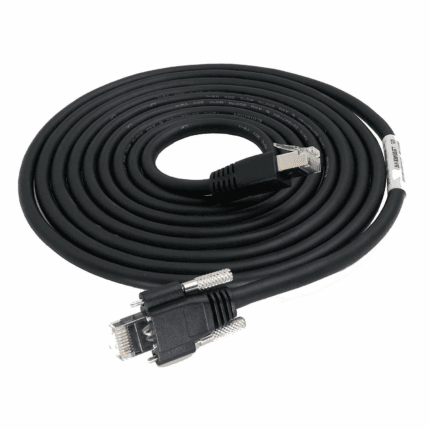
Cat6A RJ45 Screw-Lock GigE Vision Cable (S/FTP, High-Flex PUR, Drag Chain)
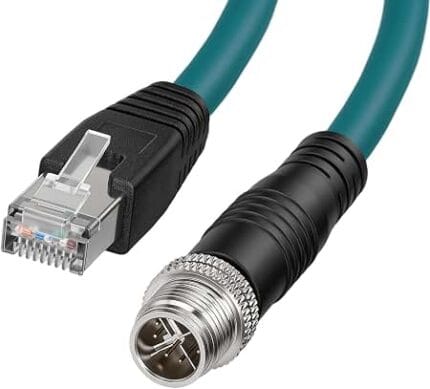
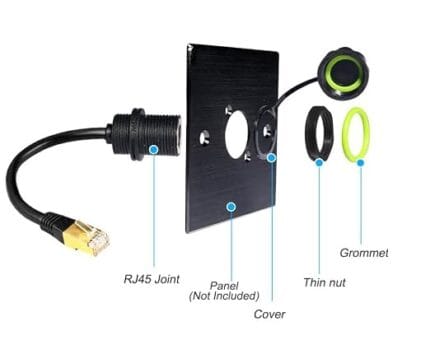
IP67 RJ45 Screw-Lock Bulkhead Cable (Threaded Coupling, Panel Mount, Dust Cap)
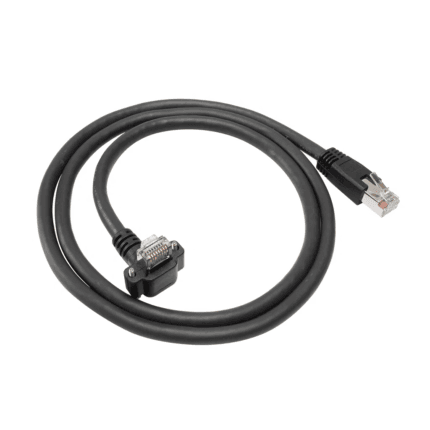
Right-Angle RJ45 Screw-Lock Cable (90 Degree Thumbscrew Plug, Cat6A S/FTP)