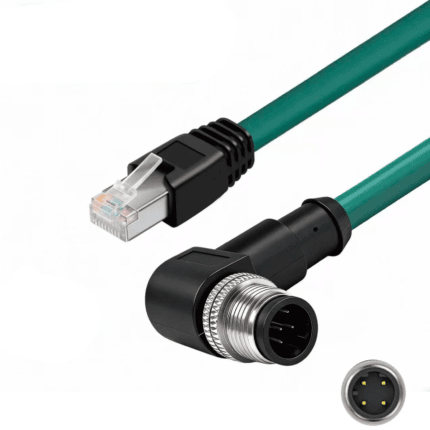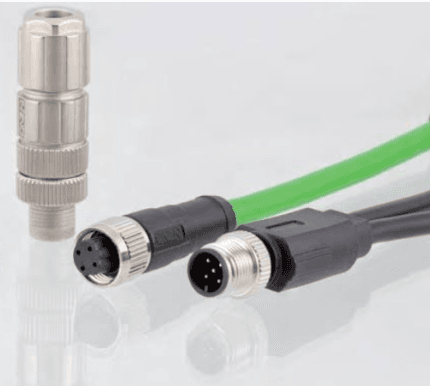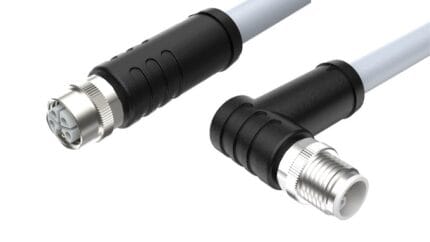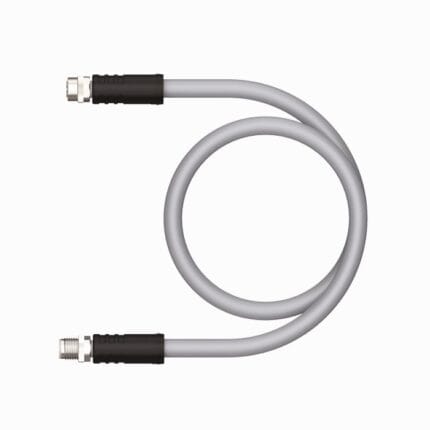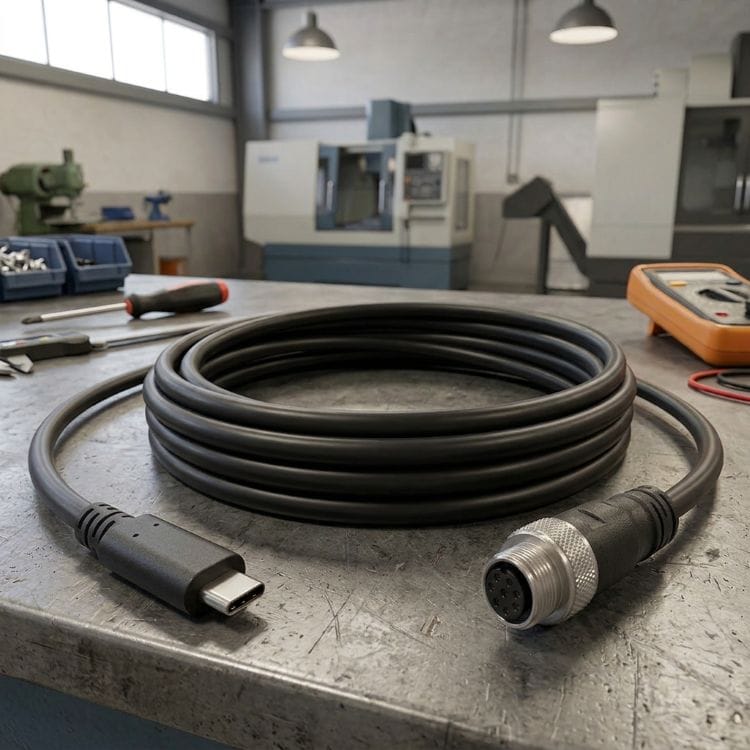
USB Type-C to M12 8-Pin Industrial Cable for Panel / Machine Vision
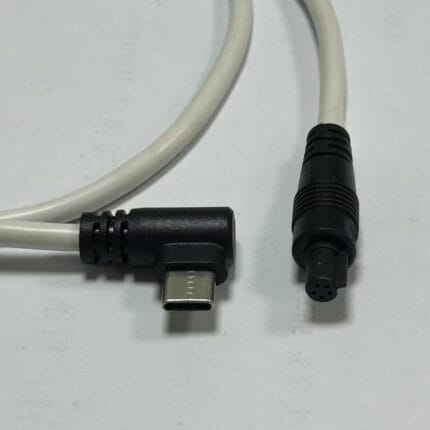
This USB type c m12 cable carries Type-C from a controller or service laptop to a sealed IP67 eight-position A-coded field connector. 8 x 26 AWG, TPU or oil-resistant PUR jacket. Built to your pinout; specify the band against the USB side.
Overview
A USB Type-C M12 cable solves the boundary problem on modern equipment: the computing hardware speaks USB, and the field side needs a sealed circular connector that survives coolant, swarf and daily handling. One assembly puts Type-C on one end and an eight-position A-coded M12 with an IP67 mated joint on the other, so the panel stays sealed and the machine can still be serviced. It is a panel, HMI and machine vision part far more often than it is a sensor part, and it should be specified that way.
Key Specifications
| Connector A | USB Type-C male |
|---|---|
| Connector B | M12 8-pin A-coded male |
| Standards referenced | USB 2.0 / USB 3.0 Type-C, IEC 61076-2-101 for the M12 end |
| Ingress rating | IP67 on the M12 end when mated |
| Rated voltage | 5 V DC on the USB side, up to 30 V DC on the M12 side |
| Conductor | 8 x 26 AWG stranded |
| Jacket | TPU or PUR, oil resistant options |
| Operating temperature | -25 to +85 °C |
| Mating cycles | >100 |
Which end limits the performance
The Type-C end decides the ceiling. USB 2.0 uses one differential pair and is tolerant; anything faster needs additional pairs plus screening that actually works at those frequencies, and the length budget shrinks steeply with each step up. If neither the computing hardware nor the distance has margin, ask us to quote an active build with a repeater or to move the link onto industrial Ethernet, which is what the long runs usually deserve.
| Link | What it wants from the cable | Practical length thinking |
|---|---|---|
| USB 2.0 class | One clean differential pair, tolerant of skew | Service drop lengths are normally fine |
| USB 3.0 class | Extra pairs plus effective screening | Keep it short, treat it as an internal link |
| Power only | Conductors sized for current, not for pairs | Current, not distance, sets the limit |
| Camera and vision links | Bandwidth plus a sealed field end | Consider a dedicated vision assembly instead |
Vision panels and the bandwidth question
Machine vision is where this assembly gets asked for the most and where it is most often the wrong answer. A camera producing real image data over USB wants bandwidth that a multi-meter assembly will not hold, and the failure mode is intermittent: frames drop when the machine is running, which is expensive to diagnose. Where the drop carries image data, ask for the sealed connectivity designed for it, such as a X-coded Cat6A assembly from our range, or a dedicated machine vision cable. Use this build for control, configuration, low rate data and service.
The M12 end has to be specified too
It is tempting to treat the circular side as the easy half. Eight positions give four usable pairs, but which of them carries power, which carries data, and whether a return is shared all depend on the device. Send the pinout. Note also the voltage difference: the USB side is 5 V while the field side may see up to 30 V, so the two ends are not interchangeable and the assembly has a direction.
The USB end is defined by its specification; the M12 end is defined by the keyway you choose. Our download center has a two-page M12 coding reference covering A through Y, with the pole counts and typical duties of each.
Environment: what the jacket has to do
A TPU or oil resistant PUR jacket is the default here because this assembly usually leaves the cabinet. Choose against where it actually goes: cutting oil and coolant mist, outdoor UV, or repeated handling by technicians during diagnosis. If it stays inside an enclosure, PVC is cheaper and easier to work with, and we will quote it that way without argument.
Typical applications for this usb type c m12 cable
- Panel PCs and embedded controllers needing a sealed field side connection
- Service and configuration ports brought out to the machine enclosure
- Low rate instrument data from a field mounted analyzer to a local host
- Washer safe trolleys and carts where diagnostics happen away from the cabinet
- Touchscreen and HMI cabinets with a circular bulkhead on the outside
How to specify your build
- Host interface – USB 2.0 or USB 3.0, and the data rate actually used.
- M12 pinout, or the device part number so we can confirm it.
- Length, kept as short as the installation allows.
- Jacket chosen against oil, coolant, UV or handling.
- Current drawn from the USB side, if it is more than trivial.
- Quantity, prototype or production.
Workmanship and testing
USB Type-C builds are made to IPC/WHMA-A-620 Class 3 workmanship inside an ISO 9001 system, over a 32 to 12 AWG range. No USB assembly is boxed before 100% continuity and pinout are confirmed, and seal checking is quoted whenever an ingress rating is on the drawing.
Material declarations against RoHS and REACH are issued per project, alongside the dimensional and electrical reports agreed at quotation; see certifications, compliance and material declarations. Where your drawing names a UL style or another approval, the build follows your drawing and ships with the supporting document rather than a claim of our own. Where this build needs an overmold, the tool is designed, cut and maintained in our own shop under the overmold tooling we build in-house, and it is never used for another customer’s program. The wider context is covered under cable assemblies for industrial automation and robotics.
Custom builds and ordering
For USB Type-C builds, prototypes run from 1 to 50 pcs with a 3 working day turnaround. Volume orders begin at 500 pcs and ship 14 working days after approval. Tooling not already held adds around 10 working days. USB builds go out under your part number and labeling, and material certificates and first-article reports come with them on request.
Related M8 and M12 assemblies
- M8 5-Pin to USB Type-C Adapter Cable
- M12 X-Coded Cat6A Cable to RJ45 for Machine Vision
- CoaXPress Machine Vision Cable Assembly
- Cat6a Fiber Hybrid Cable for Machine to Cabinet Links
- M12 12 Pin Cable, High Density Cordset
- Cleanroom Robot Cable Harness
- 7/8″ 3-Pin Industrial Power Cable, 13 A / 300 V, IP67
Full ranges: circular M8 and M12 cable assemblies and signal and data cables.
Frequently Asked Questions
Can this carry USB 3.0 speeds?
It can be built for it, but keep the length short and tell us at the quote stage. Longer runs at higher rates usually need either an active solution or a different interface.
Is the M12 end waterproof?
IP67 in the mated state. The Type-C end is not, so it belongs inside the enclosure or at a service point.
Which pin carries power?
That depends on your device. Send us the pinout or the part number and we will build to it.
Is it suitable for GigE or high speed cameras?
Generally not for the image data itself. Use a Cat6A X-coded assembly for that and keep this one for control and service.
Does the cable have a direction?
Yes. USB is 5 V and the field side may see up to 30 V, so the two ends are not interchangeable.
| Connector A | USB Type-C Male |
|---|---|
| Connector B | M12 8-Pin A-Coded Male |
| Standards | USB 2.0 / USB 3.0 Type-C, IEC 61076-2-101 (M12) |
| IP Rating | IP67 (M12 mated) |
| Rated Voltage | 5 V DC (USB) / 30 V DC (M12) |
| Conductor | 8 x 26 AWG |
| Jacket | TPU / PUR (oil-resistant) |
| Operating Temperature | -25 to +85 °C |
| Mating Cycles | >100 |